

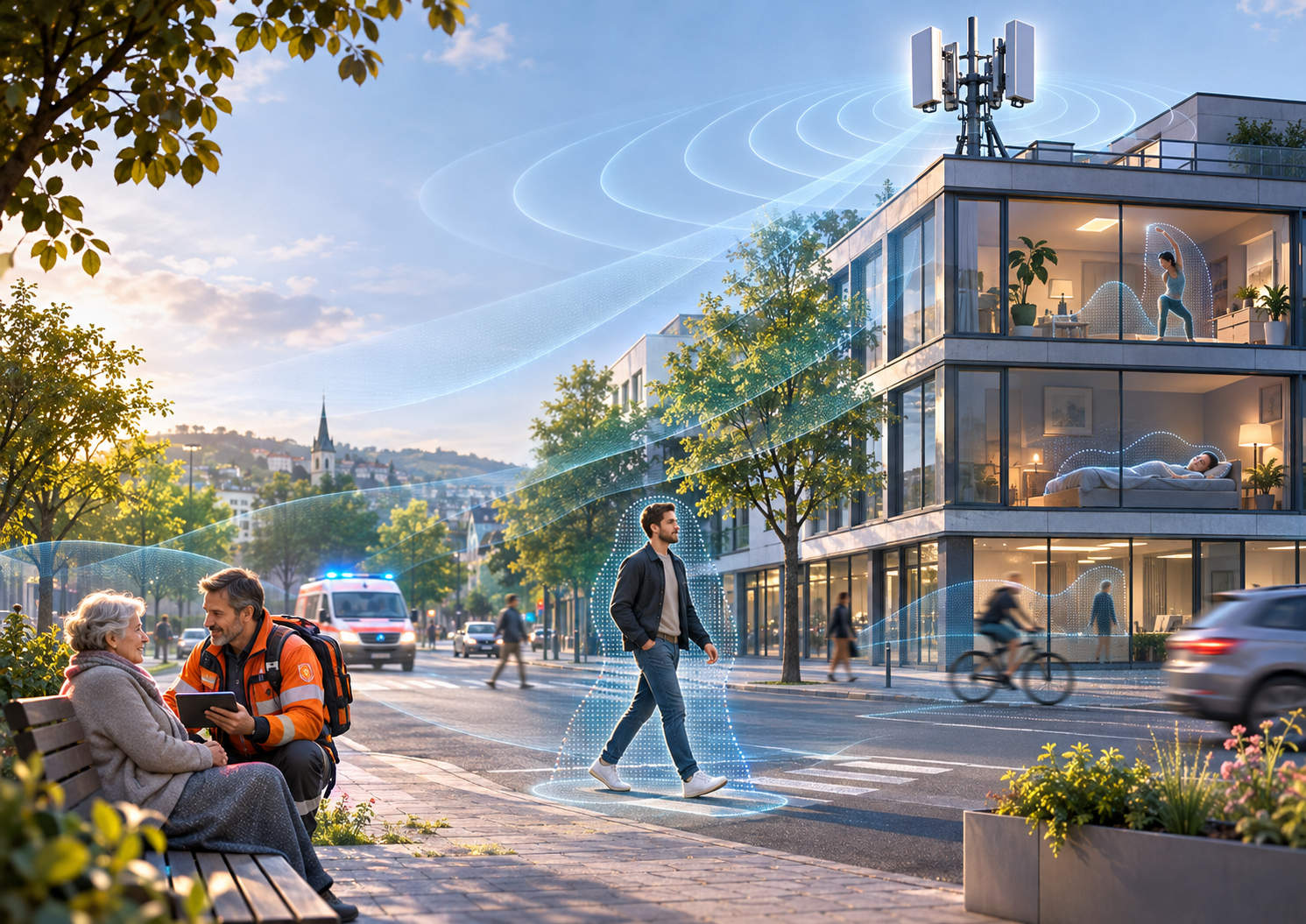
Mobile networks are set to transmit data in the future, but with 6G Sensing they could also detect movements, people, and objects in their surroundings. Under certain conditions, this can even be done without a smartphone. The technology could locate buried individuals, identify accidents, or measure breathing movements. At the same time, it poses an uncomfortable question: Who is allowed to scan us if we might not even notice it?
Your phone is at home. Can the mobile network still detect you?
Imagine you go for a walk and deliberately leave your smartphone at home.
No location sharing, no app, no GPS. You simply want some peace and quiet.
Until now, this at least meant that your smartphone could not provide location data via the mobile network because it wasn’t there with you.
However, with a technology being developed for the next generation of mobile networks, something fundamental could change.
A radio network equipped accordingly could detect under certain conditions that a person is moving in an area without them having to carry a smartphone or any other electronic device.
This whole concept is called 6G Sensing.
And before anyone thinks of science fiction or secret surveillance technology: Behind this lies a real field of research, where universities, network equipment manufacturers, and international standardization bodies are working.
The crucial question is no longer just what data a mobile network can transmit.
It is also about what the network could learn about its surroundings from radio waves.
How does 6G Sensing work at all?
To understand the technology, we first need to look at what happens with radio waves.
A mobile phone mast emits electromagnetic waves. These spread out, hit buildings, vehicles, trees, or people, and are partially reflected, attenuated, or altered in their propagation.
This already happens today.
Normally, a mobile network is mainly interested in ensuring that the transmitted data arrives reliably at the receiver.
With so-called Integrated Sensing and Communication, short ISAC, these radio waves should additionally be used as sensors.
The basic principle resembles radar.
If a reflection changes, a system developed for this purpose can draw conclusions about the movement, position, or speed of an object under suitable conditions.
A person walking through a room alters radio propagation differently than a standing cabinet.
Even a vehicle leaves other measurable changes than a pedestrian.
With appropriate signal processing, such differences can be evaluated.
In doing so, a camera image is not necessarily generated. A radio sensor first measures signals from which a computer can derive information.
Depending on the equipment and procedures, movements, distances, or certain movement patterns could be recognized.
However, it is important: Not every ordinary mobile phone mast automatically becomes a radar for this. Suitable hardware, software, frequency bands, and measurement methods are required.
Even the ability to detect people does not automatically mean that the system knows their identity.
Detecting people without them owning a smartphone
Here, the technology becomes particularly interesting – and problematic from a data protection perspective.
Until now, many people associate location tracking via mobile networks mainly with their smartphone.
The device logs into the network. The network operator can derive certain location information from this.
With 6G Sensing, fundamentally another form of capture would also be possible.
A person could simply be detected because their body influences radio waves.
This works in principle regardless of whether they own a smartphone, have it switched on, or are even a customer of the respective mobile network provider.
It is then initially about detecting an object or a person in the monitored area.
Whether this results in a permanently trackable movement profile depends on the technical capabilities, the infrastructure used, and the processing of the data.
And exactly there lies a problem.
Because while I can still deactivate certain functions or switch off my smartphone, I initially have no comparable control over radio waves from foreign infrastructure.
Can 6G Sensing also see through walls?
This question will concern many people.
Radio waves can penetrate certain materials. We know this, for example, from Wi-Fi, which also works in the neighboring room.
Under suitable conditions, radio sensors can therefore detect movements even if an obstacle is located between the sensor and the person.
However, this depends strongly on the frequency band used and the material.
A thin interior wall behaves differently than a massive reinforced concrete wall. Metallic shielding can significantly affect radio waves.
This does not mean that a future mobile phone mast can automatically monitor every room of a building.
Nevertheless, the basic possibility of detection behind certain obstacles is real.
And with this, we must also ask how privacy within apartments or other protected rooms should be ensured.
Measuring breathing rate and heartbeat – without physical contact?
What initially sounds incredible has already been demonstrated in scientific experiments.
When breathing, the rib cage moves slightly. Even the heartbeat causes tiny bodily movements.
Correspondingly sensitive radio systems can attempt to measure these changes via reflected signals.
A research paper published in June 2025 examined a combined radio and sensor system capable of capturing breathing rates and heart rates of subjects in a controlled office environment.
The researchers used specially developed radio signals and compared the results with conventional measurement methods.
This is a remarkable development.
However, such laboratory results should not be equated with a medical function available on a widespread scale.
Distance, obstacles, multiple people, and distracting movements can significantly complicate measurements.
Nevertheless, this experiment demonstrates the potential inherent in combining radio technology and sensing.
And thus we arrive at the truly positive aspects.
When Technology Can Save Lives
Finding Buried People After an Earthquake
After a severe earthquake, every minute counts.
Rescue teams must determine whether people are still trapped beneath collapsed buildings.
It is often difficult to detect signs of life. Injured individuals may be unconscious, unable to speak, or no longer able to attract attention.
Radio sensing could assist in detecting even the slightest movements—or possibly even breathing—under suitable conditions.
The buried person would not need to possess a mobile phone.
Such procedures could help rescue forces examine areas more precisely and obtain clues about survivors.
However, it has not yet been proven that future 6G networks can reliably detect people through thick rubble fields.
Conditions following a building collapse are significantly more complex than those in a research room.
Nevertheless, searching for and rescuing humans is explicitly listed among the application areas investigated for ISAC.
Detecting Falls and Other Accidents
Imagine an elderly person living alone in their apartment.
They fall and are subsequently unable to get up.
Today, certain smartwatches or home emergency alert systems can help. However, the affected individual must wear a suitable device or be able to trigger an emergency call.
Future radio sensing might potentially detect that a person has suddenly moved unusually and then remains motionless for an extended period without requiring any wearable device.
If the system is configured accordingly, this could trigger an alarm.
This would only be sensible if the detection works reliably, the affected person has consented to such monitoring, and someone actually responds to the alarm.
After all, a false alarm is merely annoying; a missed serious accident can be life-threatening.
Increased Safety for Hazardous Solo Work
This could also become interesting in my profession eventually.
I work as a truck driver in roundwood transport.
About five years ago, I fell from a loading crane while at work and landed on my back against the frozen forest floor. Three spinous processes of my spine were fractured.
My mobile phone was left in the cab.
Despite my injuries, I had to move myself back into the truck to seek help.
A conventional GPS system might have only indicated where my truck was located.
In contrast, a future sensor infrastructure suitably adapted could potentially detect that a person has fallen and subsequently ceased moving.
However, significant technical questions arise specifically in forested areas.
Dense trees, difficult terrain, and lack of radio infrastructure can impair detection.
Therefore, this is not a substitute for emergency calling technology, which is already available today.
I explain the options currently available to professional drivers in detail in my separate contribution on GPS tracking and accident assistance.
Increased Safety in Road Traffic and Industry
Beyond medical emergencies, 6G sensing is also being researched.
A conceivable application area is the detection of vehicles and other road users.
Systems equipped accordingly could provide additional information about their surroundings in the future.
Such data might be interesting for intelligent traffic control, automated vehicles, or securing hard-to-see areas.
Radio methods could also help detect people or moving machinery in industrial facilities.
However, one must distinguish between detecting movement and a safety-critical application.
If a facility is to stop automatically upon detecting a person, the system must meet particularly high reliability requirements.
A research demonstrator alone is insufficient for this purpose.
The Other Side: When Environmental Detection Becomes Surveillance
So far, we have mainly discussed potential benefits.
Yet the same technology that could help a rescue service locate a person can, in principle, also be used to observe individuals.
And thus we arrive at an issue that, in my opinion, deserves at least as much attention as the technical possibilities.
Assume a suitably equipped system can determine whether people are present in a room and how they move.
Then it could also be interesting for someone who wants to know when an apartment is empty.
Or for an employer who wishes to learn as precisely as possible how employees move during their working hours.
Applications for monitoring public spaces are also conceivable.
A system does not even need to know a person’s name to collect problematic information.
Even a recognizable movement pattern can enable sensitive inferences.
If a person is later linked with other data, an initially anonymous observation could under certain circumstances result in a personal movement profile.
Whether such applications actually emerge and would be legally permissible is another question.
But we should discuss this before such systems become part of everyday life.
What does this mean for our privacy?
Especially problematic would be collection methods about which the affected people know nothing at all.
In classical video surveillance, it is at least often recognizable that cameras are installed.
A radio sensor, however, does not have to look like a camera.
Its measurement function could be part of a communication system whose actual purpose appears entirely harmless to outsiders.
How can someone recognize whether such a system is currently communicating or additionally recording its surroundings?
Who decides which information is processed?
Are companies allowed to store movement patterns?
And how could a person prevent being recorded without their consent?
These questions are by no means purely theoretical.
In March 2026, the European standardization organization ETSI published a report that explicitly addresses the security and data protection issues of such systems.
It deals among other things with unauthorized recording, the processing of sensitive measurement data, and the question of how people can be informed about possible recording.
This becomes particularly difficult with people who do not own any device at all through which one could inform them or obtain their consent.
This shows that even the experts working on this technology see the protection of privacy as a major challenge.
What data could emerge?
Not every ISAC application requires the same information.
For traffic control, it might suffice to detect the approximate position and speed of a vehicle.
A system for fall detection would have to evaluate changes in human movement instead.
In the case of measuring breathing or heart rate, one would already be in the area of potentially very sensitive health information.
Therefore, it is not only decisive whether a system can technically capture such data.
We must also clarify for what purpose they may be used, who gets access, and how long they are stored.
A sensible approach would be to process only the information that is actually necessary for the respective purpose.
For example, a rescue system does not necessarily have to permanently archive all movements of a person.
For alerting purposes, it might suffice to detect a dangerous situation and subsequently transmit only the necessary information.
However, such restrictions must be enforced technically and legally.
Can one protect oneself against 6G sensing?
This is a difficult question.
With classical smartphone location tracking, there are at least certain possibilities to limit one’s own data transmission.
With passive recording via radio reflections, this does not necessarily work.
Because the human body influences radio waves regardless of whether we want that or not.
Turning off a smartphone does not prevent this physical interaction.
However, one must not draw the conclusion from this that in the future every person can be tracked at any time and everywhere.
For that, corresponding sensors, suitable radio conditions, and powerful evaluation procedures would be necessary.
The range and accuracy of such systems are also limited.
Therefore, the decisive protection option could lie less with individual users than with binding rules for operators and manufacturers.
We need clear provisions on when such recording is allowed, how it must be made recognizable, and which uses of the data must be excluded.
And what does the European Union have to do with this?
On January 21, 2026, the European Commission submitted a proposal for so-called Digital Networks Act.
With this, the legal framework for digital communication networks within the EU is to be modernized.
The goal is among other things to facilitate investments and the expansion of modern communication infrastructure.
The proposal is, however, not yet binding law.
And it is also not a special permit for monitoring people using 6G sensing.
Nevertheless, European network policy is relevant for the further development of such technologies.
Because with the expansion of modern communication networks, the technical foundations are also created on which future applications can build.
The actual data protection and fundamental rights questions must be clarified separately.
I will deal with the Digital Networks Act itself in a separate contribution.
How far is the technology today really?
As of November 2026, 6G sensing is still in research and standardization.
There are scientific demonstrations in which movements and even certain vital signs could be recorded using radio technology.
International standardization bodies are also working on the technical foundations.
The organization 3GPP examines corresponding functions among other things within the framework of Release 20.
ETSI has already published several reports on possible applications, system architectures, as well as security and data protection requirements.
Only on November 5, 2026 did another ETSI report appear on the integration of computing power into future ISAC systems.
This shows how actively work is being done in this area.
But it does not mean that current mobile networks can already monitor people without smartphones across the board.
Between a successful laboratory experiment and a reliable, economically viable mobile service lie significant technical challenges.
It is also far from decided which functions future 6G networks will actually support.
Therefore, we should neither pretend that the technology is already in use everywhere nor underestimate its potential impact on society.
My Conclusion: A Technology with Two Very Different Sides
I find the development of 6G Sensing quite fascinating.
A technology that could help locate people after an earthquake, detect medical emergencies, or make dangerous workplaces safer deserves to be further researched.
Especially when I think back to my own accident in the forest, I see a possible benefit.
At the same time, I do not want to live in a society where companies or authorities can determine where I am and what I am doing without sufficient legal boundaries.
And even less do I want such monitoring to happen secretly.
Therefore, we should not wait until the technology is installed everywhere before thinking about data protection.
These questions must be clarified during development.
Because the same radio waves that one day might detect an unconscious person could potentially also be used for unnoticed observation of other people.
The question is therefore not only what 6G Sensing can technically achieve, but above all, who should decide when this technology is deployed.
Sources and Further Information
- ETSI: Use Cases for 6G Sensing (April 14, 2025)
- ETSI: ISAC System Architecture (February 26, 2026)
- ETSI: Security, Data Protection, and Sustainability (March 2, 2026)
- ETSI: Computing Power for Future 6G Services (November 5, 2026)
- 3GPP TR 38.765 – Study on Integrated Sensing and Communication
- Scientific Study on Contactless Detection of Breathing and Heart Rate (2025)
- European Commission: Proposal for the Digital Networks Act (2026)
As of: November 7, 2026
Christian Rumpf – ChristiansBlog.eu
