

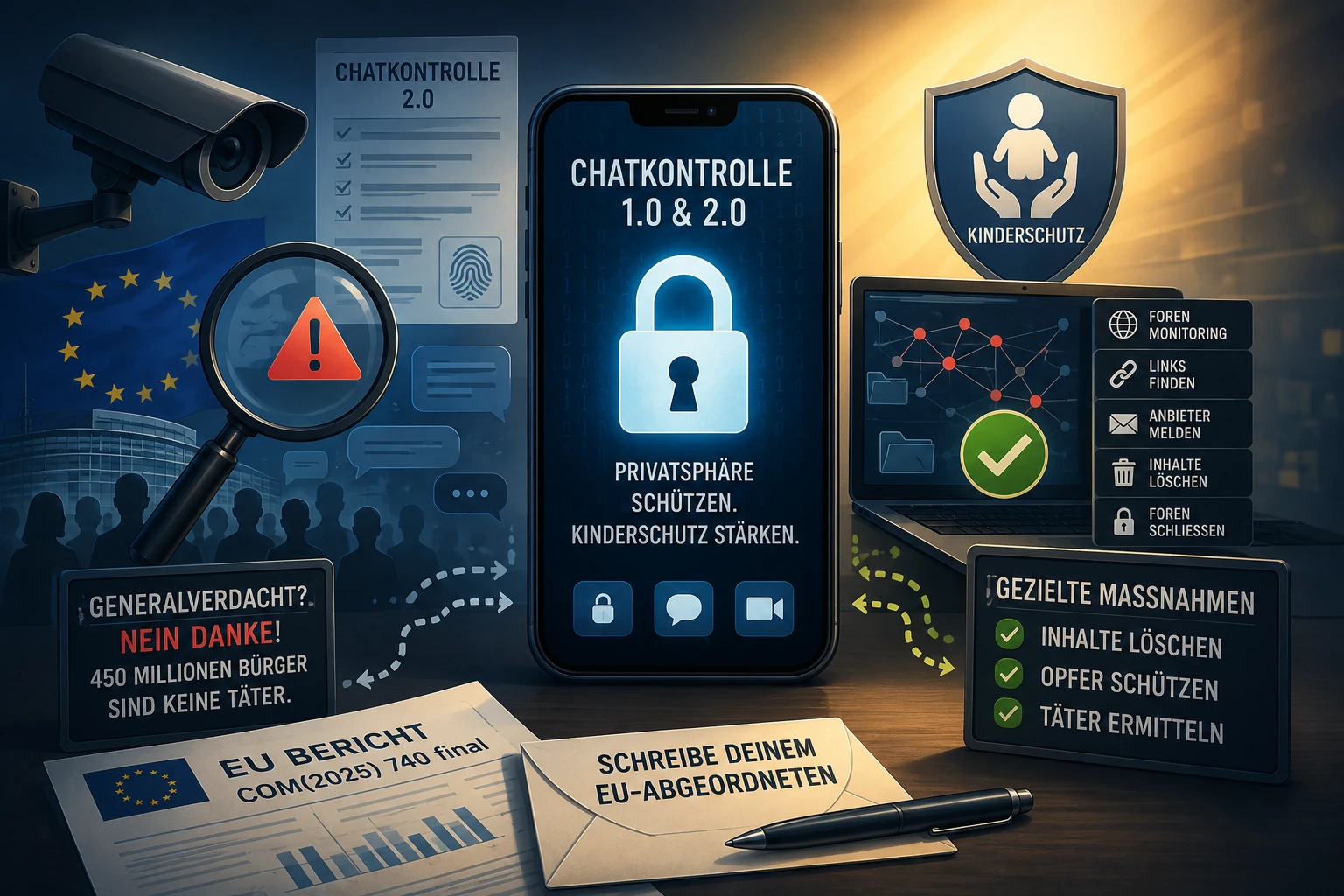
Terms briefly explainedChat control 1.0 refers to the current EU exception regulation, which allows providers to voluntarily scan certain content.
Chat control 2.0 refers to the long-discussed legislative proposals that would introduce mandatory measures under certain conditions.
The terms 1.0 and 2.0 are not official names of the EU, but have become established in media and public debates.
Those following the discussion around the so-called “Chat control” quickly get the impression that the European Union wants to read all private messages of its citizens tomorrow morning. On the other hand, the opposite side claims that it’s merely about fighting child abuse and only criminals have something to fear.
As often is the case, the truth lies somewhere between the extremes. The problem: The debate is now being conducted so emotionally that many people no longer know what is actually being discussed.
Therefore, it is worth separating the various regulations from each other clearly.
Chat control 1.0 already exists
Many people believe that Chat control is still a legislative proposal. In fact, the so-called Chat control 1.0 has already existed for several years.
More precisely, it refers to an exception regulation at the EU level, which allows providers of communication services to voluntarily check unencrypted content as well as content they technically have access to, in order to detect known child sexual abuse material (CSAM) and grooming attempts.
The affected services include, among others, webmail providers, cloud services, social networks, and messengers that technically have access to the content of their users or had access in the past. This includes platforms such as Google, Microsoft, Facebook, or Instagram, which have been using various systems to detect known abuse content for years.
It is important to note the word “voluntary”.
The regulation currently does not obligate any provider to search private messages. It merely creates the legal basis for companies to do so without violating certain data protection regulations.
Exactly this regulation has been extended several times in recent years. The latest extension is currently causing renewed discussions, although it has changed little in terms of technical possibilities.
So, if someone believes that the EU has just decided to monitor all messengers, they are mistaken. Conversely, if someone claims that the regulation has no impact on privacy, they are oversimplifying.
Because voluntary does not automatically mean that nothing happens.
Why Chat control 1.0 received relatively little attention
The reason is simple.
Most major platforms already control content in some form.
When storing photos on Facebook, Instagram, Google, or Microsoft, users should not assume that these data lie completely unnoticed on a hard drive. Many services automatically check content for malware, spam, or already known abuse material.
What was new was less the technical possibility than the legal basis for it.
For users of classic end-to-end encrypted messengers like Signal or Threema, the practical impact has remained relatively low so far. Exactly for this reason, the actual controversy quickly moved to the next level of the discussion.
Chat control 2.0 goes much further
When today “Chat control” is mentioned, it usually refers to the so-called Chat control 2.0.
And here begins the actual dispute.
Unlike the existing regulation, the draft does not provide for voluntary control anymore. Instead, providers should be able to be obliged under certain conditions to search the content of their users.
The problem here is not the goal.
Few people would seriously dispute that child abuse must be fought.
The decisive question is rather:
How can one search encrypted communication without weakening the encryption?
So far, there is no technically undisputed answer to this.
The encryption problem
End-to-end encryption means, in simple terms, that only the sender and recipient can read a message.
Neither the service provider nor a third party can decrypt the content.
Exactly for this reason, this technology is used by banks, companies, journalists, lawyers, doctors, and now also millions of private individuals.
Whoever now wants to control encrypted messages faces a logical problem:
You can only check a message if it is readable.
And precisely here arose the idea of so-called client-side scanning.
In this case, a message would be examined already on the user’s device before it is encrypted and sent.
Technically speaking, the encryption is not directly broken. Critics, however, point out that the result is similar: A software on the device checks the content before it even leaves the private area.
The discussion reminds a bit of the statement:
“We don’t open your letter. We just look briefly inside before sealing the envelope.”"
Depending on whom you ask, this is a significant difference or merely wordplay.
The real concern of many data protection advocates
Interestingly, the criticism of many experts does not primarily target the fight against abuse content.
The concern rather concerns the infrastructure that would need to be created for this.
Because once a system exists that can automatically check messages, the question inevitably arises:
What else could it be used for in the future?
Today it is about abuse content.
Maybe tomorrow about copyright violations.
The day after tomorrow about other content.
Even if such an expansion was never planned, the technical possibility remains.
Data protection advocates often refer to a so-called dammbruch or the misuse of existing surveillance structures.
Why the discussion is so emotionally charged
The answer is uncomfortably simple.
On one side stands the protection of children.
On the other side stand data protection, privacy, and secure encryption.
Both are legitimate interests.
Those who argue against chat monitoring do not necessarily want to protect abuse.
Those who support chat monitoring do not automatically want to establish a surveillance society.
The real problem is that both sides are often portrayed as if there were only black or white.
This is one of the most difficult technical and societal questions of our time.
The real problem: No one knows exactly how effective the measures are
Supporters of chat monitoring argue that law enforcement agencies need more possibilities to combat abuse representations and grooming on the internet.
The question of how effective the current measures actually are, however, is surprisingly difficult to answer.
Even the European Commission points out in its current Implementation Report on Chat Monitoring 1.0 that the data situation is incomplete. Member states provide different data, some states report only partially, others not at all. As a result, many numbers are only partially comparable.
In addition, high reporting numbers do not automatically mean that as many perpetrators are identified or victims rescued. There are often significant differences between an automated report, a real investigation, and a later conviction.
The actual debate should therefore not only focus on how many contents can be found. Equally important is the question of which measures have been proven to help identify perpetrators, protect victims, and permanently remove abuse content from the internet.
The actual question is often not even posed
In public debate, there is often the impression that there are only two possibilities:
- Monitor private communication.
- Do nothing against child abuse.
Exactly at this point, many critics of chat monitoring start their argument.
Because the question is not only whether the proposed measures technically work or are compatible with fundamental rights.
The question is also:
Are there more effective measures that interfere less deeply with the privacy of uninvolved people?
This discussion often goes unnoticed in public perception.
It is not about downplaying child abuse or preventing investigations. Rather, it is about whether widespread monitoring of private communication is actually the most effective way.
Is it enough to find perpetrators?
When talking about combating abuse representations, people often talk about perpetrators.
That is understandable. After all, offenders should be identified and brought to trial.
But for the victims, the problem does not end with an arrest.
As long as images and videos continue to circulate on the internet, the incident remains permanently present for many affected individuals.
That is why child protection organizations have been asking for years another question:
How can we get the images and videos permanently out of the internet?
This question often plays a surprisingly small role in the debate about chat monitoring.
The often forgotten question: What happens to the images?
In public debate, a central question is usually posed:
How do we find the perpetrators?
This question is important. It, however, falls short.
Because for the victims, the abuse does not end with an arrest or a conviction. For many affected individuals, the abuse actually lasts as long as the recordings continue to circulate, are downloaded, and are spread on the internet.
Each individual image and each individual video documents a real crime. Every repeated sharing means that the consequences of this crime continue to live on.
Therefore, a second question should be asked at least as frequently:
How can we get the images and videos permanently out of the internet?
There is more than just surveillance or doing nothing
In public discussion, there is often the impression that there are only two possibilities:
- Monitor the communication of all users.
- Do nothing against child abuse.
But there are numerous approaches between these two extremes.
Already several years ago, journalists and IT experts showed that one can also directly act against the infrastructure of the spread.
Instead of monitoring the communication of millions of law-abiding citizens, they developed tools that observed relevant platforms and forums where known abuse material was spread.
This did not involve reading private chats or searching messages. Instead, publicly accessible content, links, and known spread paths were analyzed. The found links were documented, platform operators were informed, and deletions were initiated.
The result was remarkable: Within a few months, large amounts of content disappeared from the internet. Some platforms lost their user base, others completely ceased operations.
Of course, this does not solve the problem entirely. But it shows that there are also other ways to combat the spread of abuse material without having to monitor the private communication of the entire population.
TipDemocracy does not end on election day.
If you have an opinion on chat control, share it with your European Parliament representative. Sincere and respectful letters are among the ways citizens can influence political decisions.
Use the search function linked under the article in the European Parliament, find one or more German Members of the European Parliament, and ask about their position on chat control. The more citizens ask, the harder it becomes to make such decisions without public debate.
Why deletion can often have more impact than surveillance
Those who engage with the topic quickly realize that a significant part of the scene does not produce content themselves but rather spreads existing content repeatedly.
Exactly here the strategy of consistent deletion comes into play.
If the infrastructure is disrupted, download options disappear, links become unusable, and platforms lose their actual purpose.
In other words:
A perpetrator who is arrested is removed from the traffic.
An image that is deleted may prevent thousands of further accesses to the suffering of a victim.
Both are important.
However, public debate often focuses almost exclusively on the question of perpetrator investigation and significantly less on the removal of already known content.
The actual problem is often not the technology
Proponents of chat control often argue that law enforcement authorities lack the necessary tools.
Yet law enforcement has pointed out other problems for years:
- Staff shortages
- Delays in analyzing seized data storage devices
- lengthy international legal assistance procedures
- lack of capacity for the removal of known content
- insufficient personnel for specialized investigation units
Even the best surveillance technology helps only limitedly if the resulting clues cannot be analyzed in a timely manner.
The actual political question
The discussion should therefore not only be about:
How far can we control private communication?
But also:
Why do we not invest more in the removal of already known abuse content?
Between “monitor everything” and “do nothing at all” there is a wide spectrum of possible measures:
- consistent removal of known abuse content
- better international cooperation
- targeted investigations in perpetrator forums
- faster procedures against platform providers and hosts
- more personnel for law enforcement agencies
- specialized units for the identification and removal of illegal content
Many of these measures directly target where the material is actually spread.
What does this mean for users today?
Those who follow the current debate may easily get the impression that private communication in Europe is already extensively monitored. However, the reality is not yet that far.
The so-called Chat Control 1.0 allows providers to take voluntary measures to detect abuse representations and grooming. There is currently no general obligation to monitor private communication.
The actual political and technical debate revolves around the proposals for Chat Control 2.0. Here, for years, there has been debate about how far state interference in private communication is allowed and whether the proposed measures are actually suitable for achieving the desired goals.
For users, this means above all one thing:
The debate is not yet over.
At the same time, it is worth looking more closely when social networks or headlines claim that the EU wants to either “read all chats” or “only focus on child protection.” The actual proposals are significantly more complex, and their potential effects go far beyond these simplified representations.
That is why a factual discussion is more important than outrage or trivialization.
TipDemocracy does not end on election day.
If you have an opinion on chat control, share it with your European Parliament representative. Sincere and respectful letters are among the ways citizens can influence political decisions.
Use the search function linked under the article in the European Parliament, find one or more German Members of the European Parliament, and ask about their position on chat control. The more citizens ask, the harder it becomes to make such decisions without public debate.
Conclusion
The debate around chat control is often conducted as if one has to choose between child protection and privacy.
Those who only rely on short videos or headlines often overlook the legal background. That is why it is worth looking at the development of EU regulations on chat control so far.
→ Further article: Chat Control 2.0 – What has been decided so far and what has not
In reality, it’s about something else.
The question is not whether child abuse should be fought. There is widespread agreement on this.
The actual question is rather which means a democratic rule of law may use to achieve this goal.
At the same time, it should not be forgotten that the fight against child abuse does not start with surveillance. It also starts where known abuse content is consistently removed, distribution channels are disrupted, and the infrastructure of perpetrators is disturbed.
In other words:
If we develop a tool that theoretically can control every digital letter before it is sent, we should carefully consider whether this is actually the only or best solution.
The challenge is not only about finding something. The challenge is about finding the right things without generating millions of false suspicion indicators.
Because sometimes it is more sensible to close the marketplace of offenders than to open all letters of the population.
Want to take action yourself?
The discussion about chat control is often conducted as if citizens had to simply accept the decision. In reality, the European Parliament decides on the future of such initiatives – and members of parliament can be contacted.
If you want to express your opinion on chat control, you can write to your designated European Parliament member and request a statement.
If you need support in formulating your message, you can, for example, use ChatGPT or other AI systems.
Use the following prompt:
I want to write a factual and polite email to my European Parliament member.
The email should critically address the proposals for Chat Control 2.0, without sounding polemical or unsound.
Consider the following points:
- References to the European Commission’s report COM(2025) 740 final on the implementation of the current regulation.
- Point out that the Commission itself highlights limitations and gaps in the data situation, and therefore the actual effectiveness of the measures can only be assessed to a limited extent.
- Mention that the fight against child abuse is naturally supported and there is no doubt about this.
- References to research by journalists and IT experts who have achieved verifiable successes through targeted identification, reporting, and removal of abuse content and its distribution channels.
- Raise the question of why more investment is not being made in the removal of known abuse content, the dismantling of distribution platforms, and the staffing of investigative authorities.
- Point out that the removal of content can help victims and also provide investigative approaches against perpetrators and distributors.
- Express the concern that the proposed measures could affect millions of innocent citizens, although alternative approaches exist.
- Politely ask the member for their position on this topic.
- Also ask them to consider whether measures for targeted removal of abuse content and combating the distribution infrastructure would not be more effective and proportionate than controlling private communication.
The email should be factual, respectful, argumentatively strong, and about 500 to 800 words long.
Finding your European Parliament member
Do you want to express your opinion on chat control directly to the European Parliament?
On the official website of the European Parliament, you can find all German members of the European Parliament, including contact details:
👉 https://www.europarl.europa.eu/meps/de/search/advanced?countryCode=DE
Alternatively, you can use the search function of the European Parliament to specifically search for members, parties, or countries:
👉 https://www.europarl.europa.eu/meps/de/home
Many members publish their official email address as well as their websites and social media channels alongside their official contact details.
