

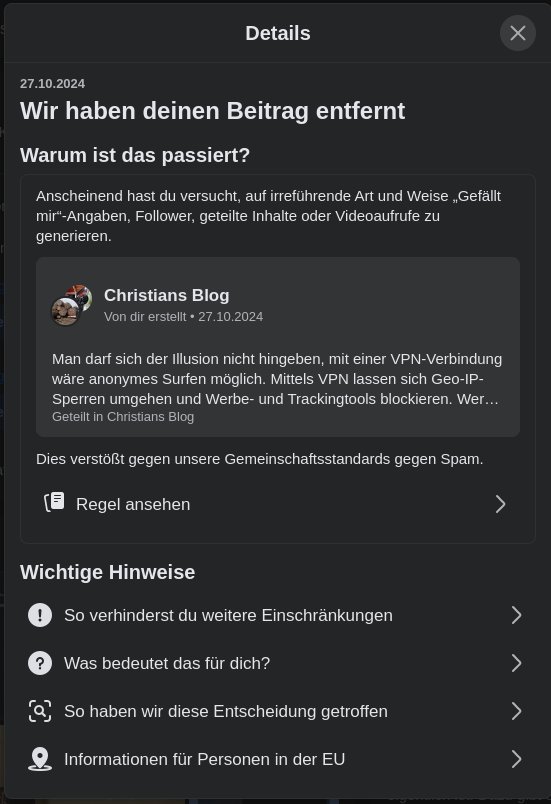
In recent times, it is increasingly common for my posts on my Facebook page to be deleted by Meta.
Officially, it is then stated that I have tried to generate “Like”-indications or interactions in a misleading way. What exactly this means remains – as often – rather vaguely formulated.
For me as a blogger, this is naturally a problem. Because originally, Facebook was exactly for that purpose: sharing content, building reach, and engaging with people.
Reach at any cost?
What has, however, changed significantly in recent years: The control over which content is visible and which is not is no longer in the hands of the user.
Algorithms decide, moderation systems intervene – and in case of doubt, a post simply disappears.
Especially when publishing content that critically addresses large platforms or data protection, the probability seems higher that posts are restricted or deleted.
Whether this is really intentional or simply a overly cautious system, let’s leave that aside. The result remains the same: The own reach is artificially limited.
Alternatives must come
For this reason, I have decided to spread my content more widely and no longer rely exclusively on Facebook.
Besides Mastodon , I now also use other channels to spread my posts.
Among other things, I have set up a channel on Telegram. (Update: However, this is no longer being used, since I no longer use Telegram)
Yes, I am aware: From a data protection perspective, neither WhatsApp nor Telegram are really ideal.
But one must also remain realistic.
Between Ideal and Reality
Of course, I could consistently use data protection-friendly solutions, for example, completely switching to Matrix and running my own channel there.
Technically, that would even be the cleanest solution.
Those who are interested can find a simple step-by-step guide here: Matrix account creation – Simple guide for beginners
The problem: The reach is limited there (yet).
Many users still move on the known platforms. And it is precisely there that broad communication takes place.
If you want to reach people – especially with topics like data protection or digital alternatives – you can hardly avoid being at least partially present on these platforms today.
Completely stepping back? No option
One could now say: “Then just delete all accounts and completely withdraw.”
But let’s be honest: That is not a realistic solution for most people.
One would have to completely isolate oneself, give up on almost all digital communication tools, and limit contact with many people.
Few people want that – and it is also not necessary.
The narrow line
We are currently moving on a narrow line between:
- Comfort
- Reach
- Data protection
The big tech companies have a clear interest in collecting and using as much data as possible. And moderation or restrictions on content can certainly play a role in this.
I have repeatedly tried to publish posts on exactly these topics – and they were deleted again.
My conclusion
I have decided for myself: I am becoming more independent.
Facebook is no longer my central platform. If posts disappear there – that’s just how it is.
My content still exists:
- on my blog
- in the Fediverse via Mastodon
A small note at the end
The Telegram channel still exists, but I no longer use the service for data protection reasons. In addition, the unsolicited inviting to other groups and the constant crypto spamning on the platform get on my nerves. Therefore, I continue to use Matrix and for family and friends also Signal. WhatsApp is no longer an option.
In the long term, I personally see more open systems like Matrix ahead – but it will probably take some time before these really gain widespread acceptance.