

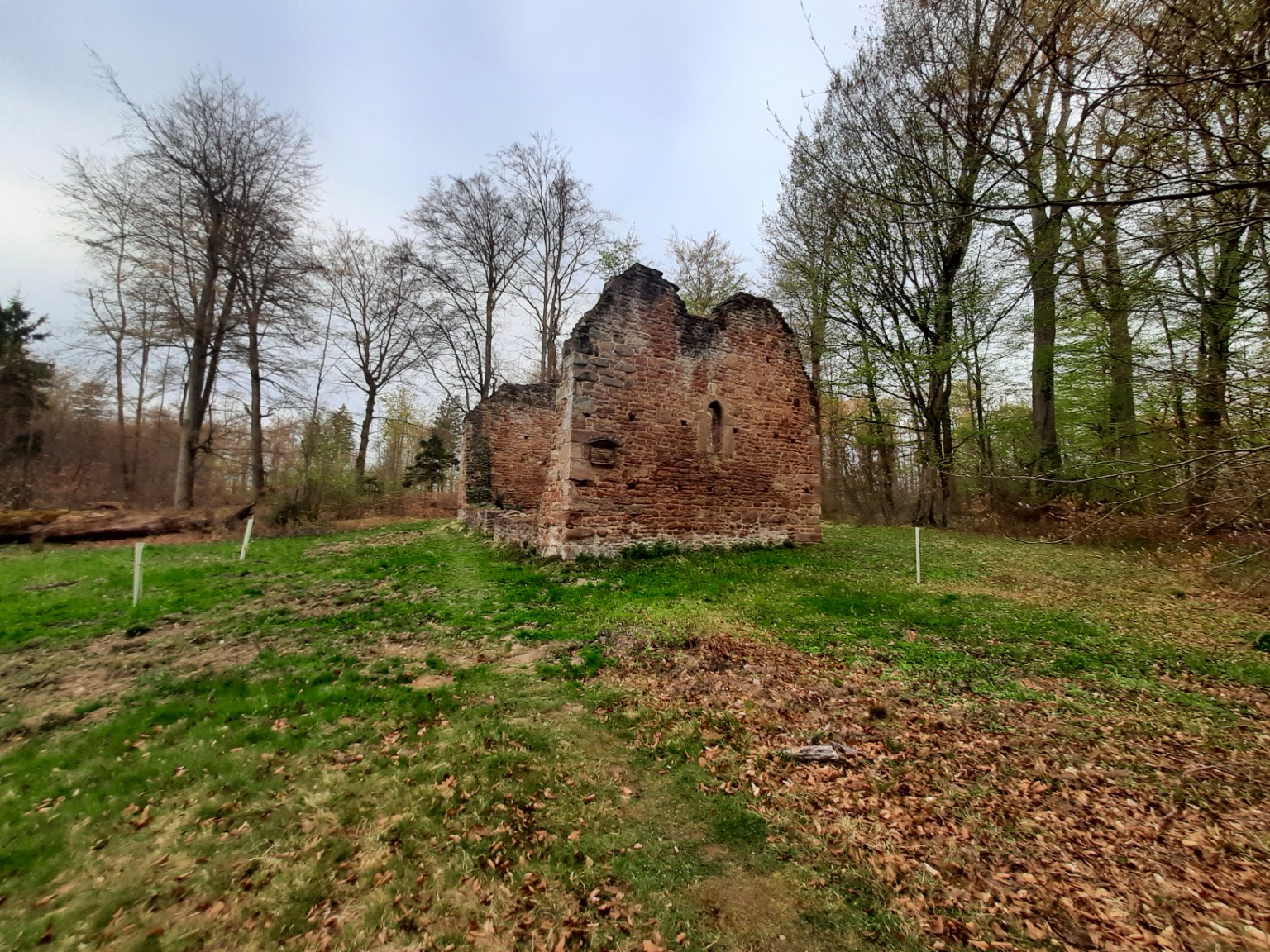
When you’re a woodcutter traveling through the forest, you sometimes come across places that tell more than you might initially think.
So today:
The Leisenberger Church Ruin.
I love such places with history. So buckle up – it’s going to be interesting.
In the middle of the forest – and yet full of history
In the middle of the forest, unassuming and almost forgotten, it still stands:
The Church Ruin of Leisenberg.
What today looks like an idyllic Lost Place was in fact a fascinating window into a time when a whole village existed here – with fields, people, daily life and faith.
And then… it was simply gone.
Historical context
The few documented facts can be remarkably well placed:
- 1105: Founding of the monastery (probably Calden/Callenburg) by Count Dietrich III.
- 1309: Documentary mention of the church or donation
- Middle Ages: Leisenberg as an active village with agriculture
- ca. 1460–1470: Abandonment of the village („wüst gefallen“)
This places Leisenberg exactly in the typical time period of many so-called Wüstungen.
NoteA Wüstung is an abandoned settlement – a widespread phenomenon in the late Middle Ages.
Why does an entire village disappear?
The short answer:
Because the Middle Ages were anything but stable.
The long answer:
Plagues
After the plague from 1347, entire populations collapsed. Many villages had simply not enough people left.
Uncertainty & Conflicts
Regional feuds, economic pressure and political upheavals made small settlements unattractive or dangerous.
Agricultural Change
Poor soil or inefficient farming led people to migrate to better regions.
Concentration
Survivors moved to larger, better protected places.
Result:
The village dies slowly – not spectacularly, but through migration and decay.
The Church – the last thing that remains
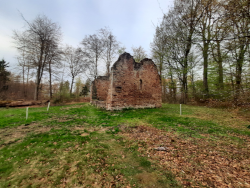
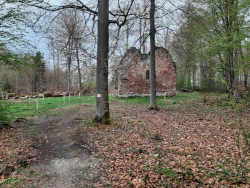
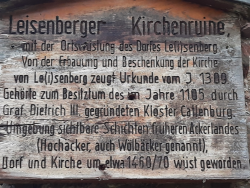
Why does the church remain standing?
Simple:
- Houses → Wood + Clay → disappear quickly
- Church → Stone construction → survives centuries
Construction and Architecture
The Leisenberger Church shows typical features of a small village church:
- Rough stone masonry with brick elements
- small window openings → little light, but stable
- probably one nave without a tower
Style
The window shape suggests a transition:
- Romanesque (rounded arch, massive)
→ early Gothic (slimmer, taller)
Probably 12th–13th century core building, later added to.
The High Fields – frozen agriculture
The real highlight often lies not in the ruin itself, but in the ground around it.
The wavy structures in the terrain suggest so-called:
High Fields (Wölbäcker)
What is that?
- medieval field strips
- formed over years of plowing
- typical wave-like pattern in the soil
Why do we still see this today?
After the village was abandoned, the area was no longer farmed.
Nature has reclaimed the land – and the forest has preserved the structures.
No modern agriculture = nothing is levelled.
Was there also a graveyard here?
Very likely, yes.
Typically, the graveyard was located directly around the church.
Today, no visible graves remain – but the structure of such villages clearly indicates this.
From village to forest – a change of perspective
What today looks like untouched nature was once full of life:
- Children played here
- People worked, married and were buried here
- Fields were farmed
Today, there is a mixed forest of beech, oak and Douglas fir.
The peace is not the original state – but the result of over 600 years of reclamation by nature.
More than just a Lost Place
The Leisenberger Church Ruin is far more than just an abandoned site.
- Part of a completely vanished village
- Testimony of medieval religious culture
- rarely well-preserved traces of historical agriculture
- example of the transformation of landscapes over centuries
And perhaps the most intriguing thing:
There was no dramatic downfall. No major event.
Only the slow disappearance of people – and the even slower return of the forest.
