

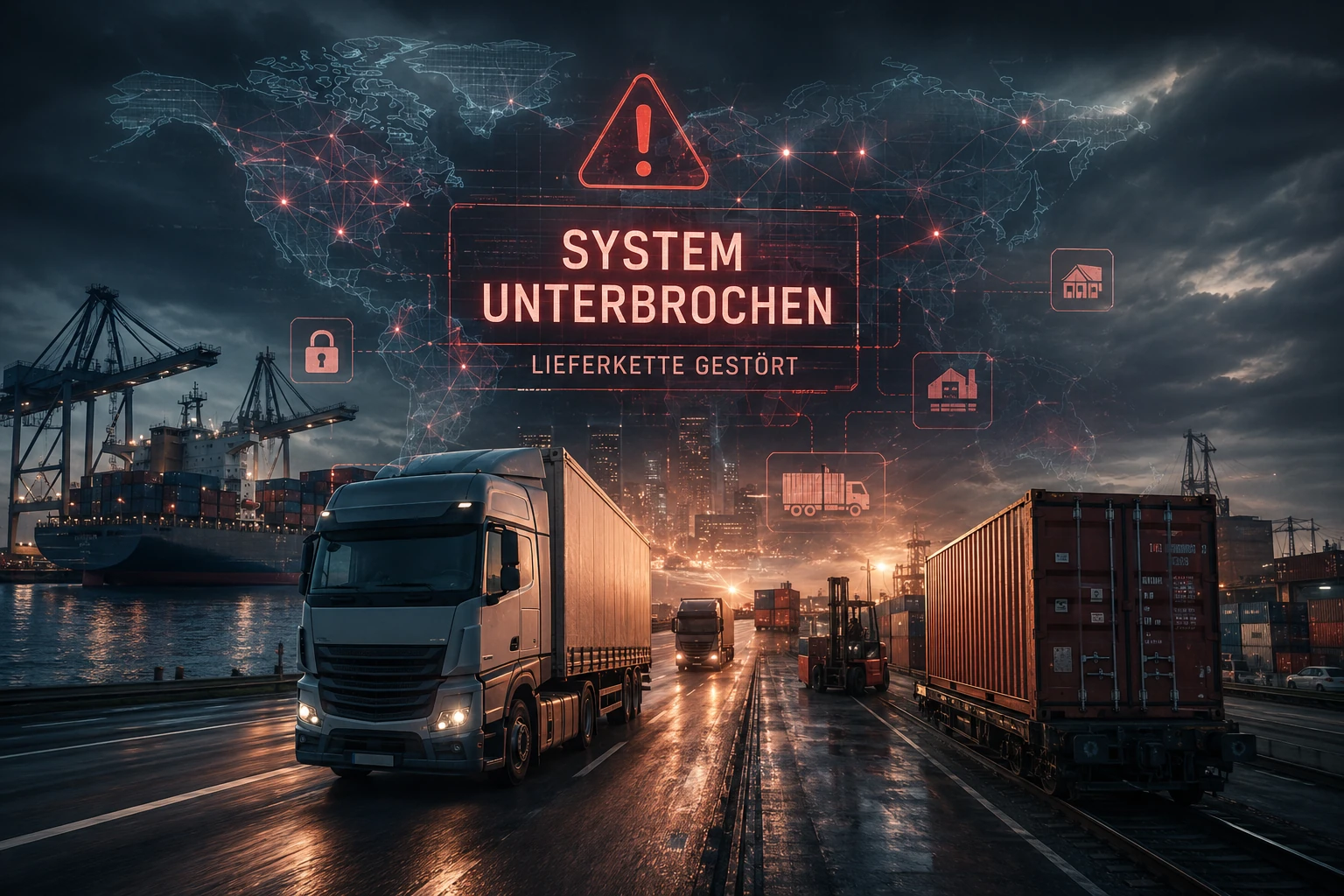
What would happen if someone attacked our supply chains?
A thought experiment about our vulnerable supply chain – and why full shelves are far from as self-evident as many believe.
Part 1: The Illusion of Self-Evidence
“What do trucks have to do with my cheese?”
Some memories stay with you.
Not because they are particularly spectacular. But because they suddenly show you how self-evident things have become.
It was somewhere in the early 2000s. Winter. One of those weather situations where even people who usually like snow eventually get fed up. Roads were barely passable in some areas, traffic was tense, and in many places trucks could no longer drive at all. Anyone who was on the road at that time – especially in freight transport – probably remembers it well.
For many people, this meant above all one thing: traffic chaos.
For the logistics industry, it meant much more.
Goods came to a standstill. Tours were postponed. Warehouses no longer operated as planned. Supply chains came to a halt.
And it was precisely from this time that a situation has remained in my mind to this day.
We were shopping, because I couldn’t and wasn’t allowed to work due to the weather and a state order.
In front of a refrigerated display, a customer was loudly arguing with a salesperson. More precisely: she was making the employee-in-charge accusations, because her favorite cheese was unavailable.
The salesperson explained calmly that due to the weather conditions, there were problems with deliveries. Many trucks probably couldn’t drive at all, which is why certain goods simply hadn’t arrived yet.
The customer’s response came immediately – and honestly speaking, it seemed so self-evident that it almost sounded absurd:
“What do trucks have to do with my cheese?”
I remember well how this sentence irritated and angered me at that moment.
Not out of arrogance. Not because the question was “dumb,” even though it was for me at that moment.
But rather because it made visible something that many people probably never consciously think about:
How do goods actually get to where we buy them?
So that the salesperson wouldn’t get even more pressed, I got involved at that time.
Not particularly diplomatically, if I’m being honest.
The situation affected me more than it probably should have. Maybe because I knew how much work goes into exactly those things that many people now take for granted.
In essence, I said at that time:
“How do you actually think the goods get here in the store? The supermarket doesn’t have a cellar where everything suddenly appears. Do you really seriously think we drive our trucks through the countryside for dumb nuts? If your cheese isn’t here, just take another one today.”
Looking back, that was certainly exaggerated.
Maybe also a bit of frustration.
But the customer’s sentence stayed with me. Not because of the cheese. But because of what stood behind it.
Because probably there is an idea that many people share, without consciously expressing it: goods are simply there.
You go shopping, reach for the shelf, and expect everything to be available. Milk, bread, cheese, medications, spare parts – as if they somehow appear at their place on their own.
But the story of a product begins long before someone takes it from a shelf.
Somewhere, someone processes raw materials. Somewhere, a dispatcher plans tours at night because a vehicle has broken down. While most people sleep, warehouses are filled, vehicles are loaded, and cold chains are monitored. Drivers are on the road, workshops keep the fleets running, at ramps goods are loaded, sorted, and improvised.
It is a huge machine that usually remains invisible.
As long as it works.
Because most people experience only the end of a long chain. They see the shelf – not the way there.
And that is perhaps one of the biggest illusions of our time: that supply is self-evident.
The invisible machine behind our daily lives
We live in a society where supply usually functions silently.
In the morning, fresh bread lies in the displays, in the refrigerated display, milk stands, the pharmacy receives medications, and somewhere a truck is already being unloaded, long before most people have had their first coffee. Workshops receive spare parts, hardware stores fill their warehouses, and packages often land so self-evidently at the doorstep that one hardly questions how they got there at all.
Why would they?
What works every day fades from consciousness.
Few people think about the paths a product has already taken before it finally ends up in the shopping cart. A piece of cheese in the refrigerated display is not simply “there.” Before that, there is processing, packaging, storage, and transport. Cold chains must be maintained, goods are picked, vehicles are loaded, and tours are coordinated. Products change warehouses, pass through transshipment centers, are redistributed, and eventually end up where people effortlessly reach for them.
Between all these people work countless others – often when others are sleeping.
Drivers are on the road, warehouses operate around the clock, dispatchers plan around, because somewhere a delay has occurred. Mechanics ensure that vehicles run, production facilities keep processes running, and in distribution centers, goods are sorted, loaded, and improvised.
Yet behind all these people, something else is working:
A system.
Modern logistics has little in common with the image of a clipboard, a radio device, and a few phone calls. Routes are planned digitally, inventory is monitored in real time, and time windows are automatically assigned to ramps. Scanners, telematics systems, warehouse management, and digital platforms coordinate much of what was once clearly simpler — but also slower — to organize.
Exactly this precision makes supply chains so powerful.
And perhaps simultaneously, so vulnerable.
Because it is precisely there that a question begins, which initially seems uncomfortable: What happens if this invisible system stumbles?
The idea came from a podcast about IT security
Some time ago, I listened to a podcast about IT security. Nothing unusual really. Topics like malware, data leaks, or hacker attacks have become almost part of the digital everyday. Yet one term stuck with me:
Supply chain attacks.
Or, as they are often called in IT: Supply-Chain-Attacks.
At first, it sounds awkward and surprisingly technical. Almost like something that only affects large corporations or IT departments. In reality, however, it is a thought that is surprisingly simple.
Instead of attacking the company directly, something that the company trusts is targeted.
Not the actual target is at the center, but the way to get there.
In practice, this can mean that the company itself is not attacked, but a supplier, a software library, a service provider, or an entity whose programs are used by thousands of companies.
The idea behind it is almost disturbingly logical:
Why attack a fortress head-on, when you can enter through the supplier’s entrance?
This principle becomes particularly insidious where trust becomes a weakness.
People install updates because they are supposed to create security. Companies update software because that is considered a protective measure. No one assumes they are deliberately bringing a problem into their house.
And yet, in the past, there have been cases where exactly that happened: Malware did not enter the system through an obviously suspicious file, but through paths that actually enjoy trust.
The problem does not come in as a thief through the window.
It rings the doorbell.
With an ID.
And is let in.
The longer I thought about it, the more a different question pressed itself upon me:
If this principle works in the digital world — why shouldn’t it also work in the real world?
Because in the end, our supply chains also rely on trust.
On the fact that suppliers deliver.
That data is accurate.
That time windows are met.
That somewhere in the night, a driver departs so that in the morning, a shelf is filled.
And suddenly, the question no longer seemed so theoretical:
What would actually happen if someone attacked these supply chains?
Of course, one could say at this point:
“Well, that concerns IT. But what does that have to do with logistics?”
Exactly this question would not let me go.
Because the longer I thought about it, the more obvious a parallel became, which initially seems almost trivial — and that is precisely why it is interesting.
Our real economy also relies on supply chains.
Only not with software packages, but with things that hold our daily lives together: food, medicines, fuel, spare parts, electronics, or raw materials. Things that usually only receive attention when they suddenly disappear.
Here, too, a lot works through trust.
A supermarket trusts that goods are delivered at night. Workshops rely on spare parts so that vehicles do not stand still for days. Factories plan production processes often down to the minute because deliveries are supposed to arrive on time. Hospitals need medicines, materials, and consumables — often exactly when they are needed and not only days later.
And somewhere in between sit people who ensure that all of this works.
Dispatchers plan routes when something goes wrong. Drivers stand at ramps at night. Warehouses coordinate thousands of movements. Systems calculate time windows, inventory, and arrival times.
Most of this remains invisible.
Until something no longer functions.
Perhaps it is exactly at this point that the question suddenly no longer seems theoretical:
What would happen if someone deliberately exploited these dependencies?
Not spectacularly.
Not with explosions or images like from an action movie.
Perhaps no one would even notice at first that something is wrong.
No destroyed harbors. No blown-up roads. No obvious sabotage.
Only small disruptions.
A time window that suddenly disappears.
Inventory that does not match.
Routes that are planned incorrectly.
Data on which people rely — and which suddenly is no longer reliable.
Subtle.
Coordinated.
And possibly unnoticed for a long time, until small problems slowly turn into bigger ones.
A thought experiment — closer to reality than one would like to believe
Before we continue, one thing is important:
This is a thought experiment.
No panic-mongering.
No apocalyptic scenario.
And certainly not a claim that such a thing will happen tomorrow.
But it is not completely unrealistic either.
Because in recent years, we have already experienced several times how sensitive supply chains can be.
Corona brought production and delivery failures.
A blocked Suez Canal showed how dependent global supply chains are on individual nodes. The blockade of the Strait of Hormuz makes it clear how dependent we are on fossil fuels from questionable countries.
Extreme weather events caused transport disruptions repeatedly.
Energy crises led to exploding production costs.
And even small disturbances can sometimes result in surprisingly large effects.
Not immediately.
Not everywhere.
But gradually.
Almost invisible.
Until suddenly people stand before empty shelves – and wonder why their product is missing.
Perhaps the crucial question is therefore not:
*“Can this happen?”
But rather:
“How vulnerable is a system we take for granted?”
In the next part, we will look at how modern supply chains actually function – and why an attack on this system might appear much less spectacular than many think.
Part 2: The quiet vulnerability of a system that no one sees
Who walks through a supermarket in the morning doesn’t notice any of this.
There are refrigerated displays full of dairy products, baked goods lie fresh in the displays, and somewhere in the warehouse, someone is just loading goods that were on a truck a few hours ago. For most people, supply seems almost self-evident – almost as self-evident as electricity from a socket or water from the tap.
That behind a simple shopping trip lies a highly complex interplay of production, storage, transport, and digital control tends to fade from memory.
Perhaps that is exactly the problem.
Because things that work reliably disappear from our awareness.
No one thinks about it in the morning, how the yogurt got into the display or why the pharmacy has a certain medicine in stock. It is simply there. As it was yesterday. And the day before.
Until suddenly something is missing.
Then the search for a culprit usually begins. The supermarket has “poor planning.” The salesperson is “inept.” The government has “failed.” Rarely does the gaze turn to the actual system behind it – a supply chain that must coordinate millions of processes every day to make our daily life function.
Yet modern logistics today resembles less a simple transport system than a huge nervous system.
Trucks no longer simply set off because goods were loaded somewhere. Transport is planned, routes are calculated, arrival times are coordinated, and time windows at ramps are precisely assigned. Warehouses operate highly automated, goods are digitally recorded, and stock levels are monitored second by second.
Even the information about where a pallet is located on a shelf often exists first in a system – not in the head of an employee.
Exactly this precision makes modern logistics impressively efficient. Many companies operate today under the principle of “Just in Time.” Materials are often delivered only when they are actually needed. Large stockpiles are considered economically unattractive in many areas. Capital should not stand idle in warehouses.
This saves costs.
As long as everything works.
But precisely at this point, an idea becomes interesting, albeit initially uncomfortable: Perhaps it is precisely this efficiency that makes us vulnerable.
Because a system without reserves reacts more sensitively to disturbances.
A delayed truck is initially just a delayed truck. Yet in practice, many further processes depend on such delays. A ramp remains occupied longer. Subsequent vehicles wait. Shifts shift. Deadlines are missed. Production lines may stand still because a single component is missing.
Anyone who has worked in the transport sector knows such days.
Actually, everything starts normally in the morning. Yet somewhere something goes wrong. One waits at a ramp longer than planned, the next customer is not prepared, a unloading takes longer, somewhere a document is missing.
And from half an hour, a day completely out of sync develops.
Transferring this principle to hundreds of locations simultaneously, the idea of a targeted attack suddenly takes on a new dimension.
Because perhaps no one would need to blow up harbors, sabotage power grids, or destroy infrastructure.
What if it would be enough to simply make the system a little less reliable?
Not enough to cause panic immediately.
But enough to make processes start to stumble.
A warehouse reports incorrect stock levels.
A time window disappears.
A container is wrongly assigned.
A vehicle suddenly appears in the system at the wrong location.
Nothing of this would be spectacular on its own.
And precisely for that reason, it might be so dangerous.
Because modern supply chains do not only live from roads, warehouses, and vehicles.
They live above all from trust.
Trust in information.
Trust in processes.
Trust that what is in the system is actually correct.
Perhaps that is exactly the real Achilles’ heel of a system we barely notice in our daily lives – although our entire lives depend on it.
Part 3: When the system starts to stumble
Perhaps no one would take it seriously at first.
Not even the people affected themselves.
It would be a Monday morning like many others. In some dispatch, the first coffee is running through the machine, drivers report in, warehouses prepare loading. Somewhere, someone honks in reverse at a ramp, while in an office, someone is desperately searching for a missing delivery note.
A normal working day.
At first.
Then the first small irritations accumulate.
A tour suddenly no longer appears in the system.
A warehouse reports stock levels that obviously cannot be correct.
At a ramp, a driver waits, even though his time window was supposedly canceled – by no one who knows about it.
A dispatcher curses because vehicles are reported by the system to be at locations where they have never been.
All of this still seems like everyday life.
Those working in the industry know: Something is always going on.
Server problems. Booking errors. Communication errors. A scanner breaks down. A system update causes trouble. People improvise. They call. They find solutions.
Logistics doesn’t just live on planning.
But also on people catching problems.
Yet precisely in this could lie the real danger.
Because modern supply chains rarely break down suddenly.
They fall out of sync.
Gradually.
Almost imperceptibly.
Like a clockwork mechanism, in which fine sand suddenly gets mixed in.
At first, only one gear jams.
Then two.
Eventually, a small delay turns into a chain reaction.
Day 1: The disruption that no one takes seriously
In the first hours, hardly anyone would suspect that something bigger is happening.
Here and there, a shipment is delayed. A warehouse improvises because stock levels don’t match. Drivers wait longer than usual. Some routes are last-minute rescheduled.
Nothing of this would be unusual.
Every professional truck driver knows days when the entire plan falls apart before breakfast.
A customer takes longer.
A unloading is delayed.
A ramp is blocked.
Suddenly, time is missing somewhere.
And time is often the real currency in logistics.
Yet this time, it’s not just individual locations.
The problems appear simultaneously at different places.
A cold storage facility works slower.
A transshipment warehouse reports discrepancies.
In a port, the assignment of individual containers no longer matches.
Freight companies are on the phone more than usual.
No one speaks of a crisis yet.
Most people assume technical problems.
A bad update.
Server issues.
Perhaps a breakdown at a service provider.
Something that will fix itself again.
Week 1: When people start asking questions
The first effects would likely be visible where people notice them most directly:
In everyday life.
Not everywhere.
Not dramatically.
But noticeable enough.
Some products suddenly disappear from the supermarket. Not entire shelves — rather individual items. Fresh goods arrive later. Some deliveries are missed. Spare parts are delayed. Workshops reschedule appointments.
These small irritations initially seem harmless.
Until people start talking about them.
Who doesn’t remember the first months of the Corona pandemic?
Back then, often just the news that something might be in short supply was enough to create images that many had previously considered impossible.
Empty shelves.
People with overloaded shopping carts.
Hoarding.
Not necessarily out of panic.
But out of uncertainty.
It’s a strange psychological mechanism:
People often react not to actual shortages.
But to the fear of shortages.
And precisely for that reason, supply chain problems could escalate faster than many believe.
Because suddenly, a self-reinforcing dynamic begins.
When people start buying more than is necessary, new bottlenecks emerge.
Warehouses empty faster.
Replenishments arrive late.
The system is under further pressure.
And from a problem, a bigger problem emerges.
Not only through the disruption itself.
But through the reaction to it.
The silent crisis
Perhaps that is the most disturbing aspect of such a scenario:
There would likely be no clear moment when everything suddenly collapses.
No big crash.
No sirens.
No breaking news with dramatic images.
But something much less spectacular.
A creeping sense of unease.
People would start to notice that things no longer function as they once did.
The delivery doesn’t come.
The deadline is postponed.
The medication is just not available.
The market waits for replenishment.
Workshops put customers off.
And suddenly, something emerges that modern societies find hard to tolerate:
Unreliability.
We live in a world where almost everything has become predictable.
Packages can be tracked live.
Arrival times appear precisely on the smartphone.
Orders often arrive the next day.
That is why disruptions today often seem more severe than before.
Not necessarily because we are worse off.
But because we have become used to availability.
What drivers have known for a long time
Perhaps that is also one of the reasons why people in transport and logistics often view such scenarios differently.
Those who regularly stand at ramps know how sensitive the system actually is.
Sometimes, a small thing is enough.
An IT problem.
A wrongly set time window.
A delayed unloading.
A missing forklift operator.
Suddenly, a vehicle waits longer than planned.
Then the next one.
Then routes are rescheduled.
And eventually, a single delay stretches through the entire day.
Most people outside the industry don’t see this.
They only see the result.
The full shelf.
Or precisely the empty one.
Yet between these two lies a system that must function astonishingly precisely every day.
And perhaps that is exactly the uncomfortable realization:
Our supply seems stable.
But it may be significantly more fragile than many believe.
Perhaps we already had warning signals
Actually, this realization shouldn’t surprise us.
Because there were already signs.
Corona showed how quickly global supply chains can come to a standstill.
A single ship blocking the Suez Canal was enough to disrupt international goods flows.
Extreme weather caused supply problems in various regions.
And many professional truck drivers probably remember winters in which, due to massive weather conditions, nothing could go on for a while.
Back then, goods suddenly disappeared.
Not permanently.
Not everywhere.
But noticeably.
No cyber attack.
No sabotage.
Only weather.
And yet it was enough to show people how dependent our daily lives are on functioning transportation networks.
Perhaps the real question is therefore not:
“Can someone attack our supply chains?”
But rather:
“How well would a system function if it suddenly no longer operated smoothly?”
Because maybe what separates us from empty shelves is sometimes less than we believe.