

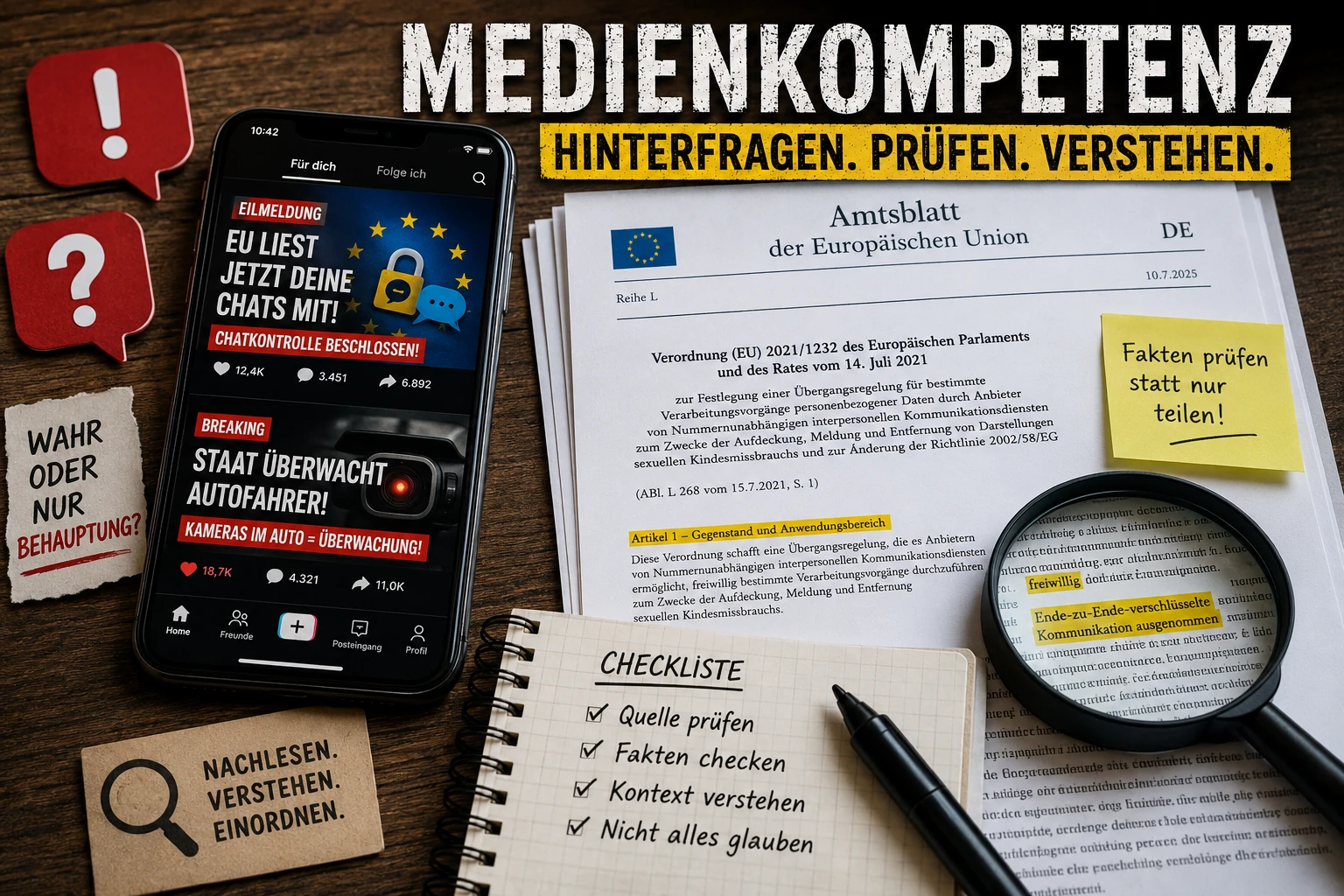
How Facts Turn into Disinformation – and Why Media Literacy is More Important Than Ever
Anyone who uses social media today no longer needs a newspaper. News, opinions, analyses, and supposed revelations reach us around the clock. TikTok, Facebook, Instagram, and X have become for many people the most important source of information.
The problem here is not that information is being spread there.
The problem is that often no distinction is made between facts, opinions, and speculation.
In recent days, two examples have shown how quickly real events can turn into stories that have little to do with the actual reality.
The Camera in the Car as Evidence of State Surveillance
A few days ago, a video went viral on TikTok showing what is known as a driver monitoring system. Modern vehicles now have cameras that can detect whether a driver is tired, distracted, or looking away from the road for an extended period.
The technology exists indeed.
It is even mandated and is supposed to help prevent accidents.
But a glance at the comments quickly showed where the discussion was heading.
Suddenly, there was talk of state surveillance. Users claimed that the government could now monitor what drivers do at any time. Others saw this as the next step toward a surveillance state.
What was remarkable about this was not the criticism.
Criticism of new technology is legitimate.
What was remarkable was how quickly a technical fact turned into a political claim.
Because there is a huge difference between the two statements.
The statement:
„The vehicle has a camera that monitors the driver’s attention.“
is a verifiable fact.
The statement:
Die Regierung überwacht damit die Autofahrer.
is a claim.
And precisely this difference is often lost in many discussions.
The Second Example: The Allegedly Approved Chat Monitoring
This pattern became even clearer after the vote of the European Parliament last Thursday.
Within a few hours, posts on TikTok and other platforms were overflowing.
„Chat monitoring has been approved.“
„The EU will now read your messages.“
„The end of digital privacy.“
Anyone who only consumed such videos had to conclude that the European Union had just approved the controversial „Chat monitoring 2.0.“
But that is not what happened at all.
What Actually Was Approved
Those who read the official documents instead of TikTok videos encounter a much less dramatic reality.
The subject of the vote was the extension of an existing transitional regulation. This allows platform operators like Microsoft, Google, Meta, and other providers to voluntarily search for depictions of child sexual abuse and grooming attempts.
The decisive term here is:
voluntary.
The providers may use such systems.
They are not required to.
This regulation has existed for several years already.
It is now set to be extended until 2028.
Therefore, there can be no talk of a newly introduced surveillance of private communication.
A Detail That Many Videos Overlook
Particularly interesting is a point that is entirely omitted in many of the circulating videos.
The European Parliament explicitly stated in its position that end-to-end encrypted communication services should be exempt from these measures.
In other words:
Messenger services that are based on real end-to-end encryption should not be captured by these voluntary scans.
This point is remarkable because it contradicts what many videos claim at the moment.
While those videos create the impression that all private messages will be monitored in the future, the actual position of the Parliament even includes additional protections for encrypted communication.
This does not automatically mean that all criticism is unfounded.
The debate over the so-called „Chat monitoring 2.0“ is still open.
Data protection advocates, civil rights organizations, and IT security experts have been warning for years about possible intrusions into privacy.
Discussions over these issues must continue.
But at least we should discuss what was actually voted on.
The Real Danger Is Not the Facts
Many people imagine disinformation as a completely made-up story.
Someone makes a false claim, and others believe it.
In reality, disinformation often works much more sophisticated today.
It often begins with a real fact.
The camera in the car exists.
The EU vote took place.
The facts are real.
That is why the stories constructed from them appear credible.
From a camera, state surveillance suddenly emerges.
From a vote on an existing voluntary regulation, the supposedly approved total surveillance of private communication emerges.
The transition often happens so subtly that many people do not even notice it.
Why Such Content Is So Successful
The success of such posts has a simple reason.
They provide simple answers to complex questions.
A sober explanation of what a driver monitoring system actually does generates little attention.
A video with the title
„The government is now monitoring you even in your car!“
on the other hand does.
The same applies to chat monitoring.
A legal discussion about European data protection regulations is complicated.
The Statement
„The EU is now reading your chats.“
fits perfectly into a 30-second video.
Social media rewards attention.
Not accuracy.
Not differentiation.
Not context.
The stronger a message is emotionally charged, the greater its reach, likes, and comments often are.
The dangerous difference between skepticism and distrust
A democratic society needs critical citizens.
It is right to question state decisions.
It is right to voice concerns about privacy.
It is right to critically follow political initiatives.
Yet critical thinking does not mean accepting every claim uncritically, as long as it fits one’s worldview.
Skepticism asks questions.
Distrust already knows the answer beforehand.
Who is skeptical seeks evidence.
Who merely wants confirmation of what they already believe will see any contradiction as part of the problem.
Exactly why many discussions fail at the very beginning.
Who refers to official documents is quickly labeled naive.
Who reads a resolution instead of relying on a TikTok video is suddenly seen as part of the system.
Not the source decides the credibility of a statement.
But the facts.
Media literacy starts with a simple question
Perhaps the most important skill of our time is no longer finding information.
A smartphone suffices for that today.
The real challenge is being able to contextualize information.
When someone reads or hears a claim, they should first ask themselves a simple question:
Where does this information actually come from?
Does it come from a video?
From a comment?
From a clipped excerpt?
Or from the actual document the claim refers to?
Often, this first step is enough to determine that significant differences exist between the original event and its portrayal on social media.
Conclusion
The greatest danger for an informed society is not differing opinions.
The greatest danger arises when people stop verifying claims.
The examples from recent days impressively show how quickly real facts can turn into false stories.
A camera in a car becomes state surveillance.
A vote on an existing voluntary regulation becomes an alleged decision on Chat Control 2.0.
Not because the facts are wrong.
But because conclusions are drawn from them that no one has substantiated.
Exactly why media literacy is more important than ever.
Don’t believe everything.
Don’t reject everything.
But check what actually happened.
Because disinformation rarely starts with an obvious lie.
It usually starts with a true statement—and ends with a claim that no one has checked.
Many TikTok videos give the impression that Chat Control 2.0 has already been decided. In reality, the timing of a possible final vote is still not clearly set. The so-called Chat Control 2.0 still exists only as a proposal to be voted on at some point.
Sources and further information
Those who want to form their own opinion should not stop at TikTok videos or social media posts, but look at the original sources:
Council of the European Union
Council moves to reinstate interim measure to combat child sexual abuse online
Press release from the Council of the European Union on the reinstatement or extension of the interim measure for voluntary actions to detect and report online content involving child sexual abuse. The Council emphasizes the voluntary nature of these measures.
European Commission
Continued voluntary detection and reporting of child sexual abuse online
https://ec.europa.eu/commission/presscorner/detail/de/ip_25_3130
Press release from the European Commission on the continuation of the existing interim measure until a decision on a permanent legal solution is made.
EUR-Lex
Directive 2002/58/EC (ePrivacy Directive)
https://eur-lex.europa.eu/legal-content/DE/ALL/?uri=celex%3A32002L0058
The ePrivacy Directive forms the data protection legal basis for the confidentiality of electronic communications within the European Union. The interim measure for voluntary detection and reporting of online content involving child sexual abuse constitutes an exception to certain provisions of this directive.
Those who want to form a well-founded opinion should therefore not rely solely on short videos, social media posts, or commented excerpts. The original documents are publicly accessible. One just has to read them.