

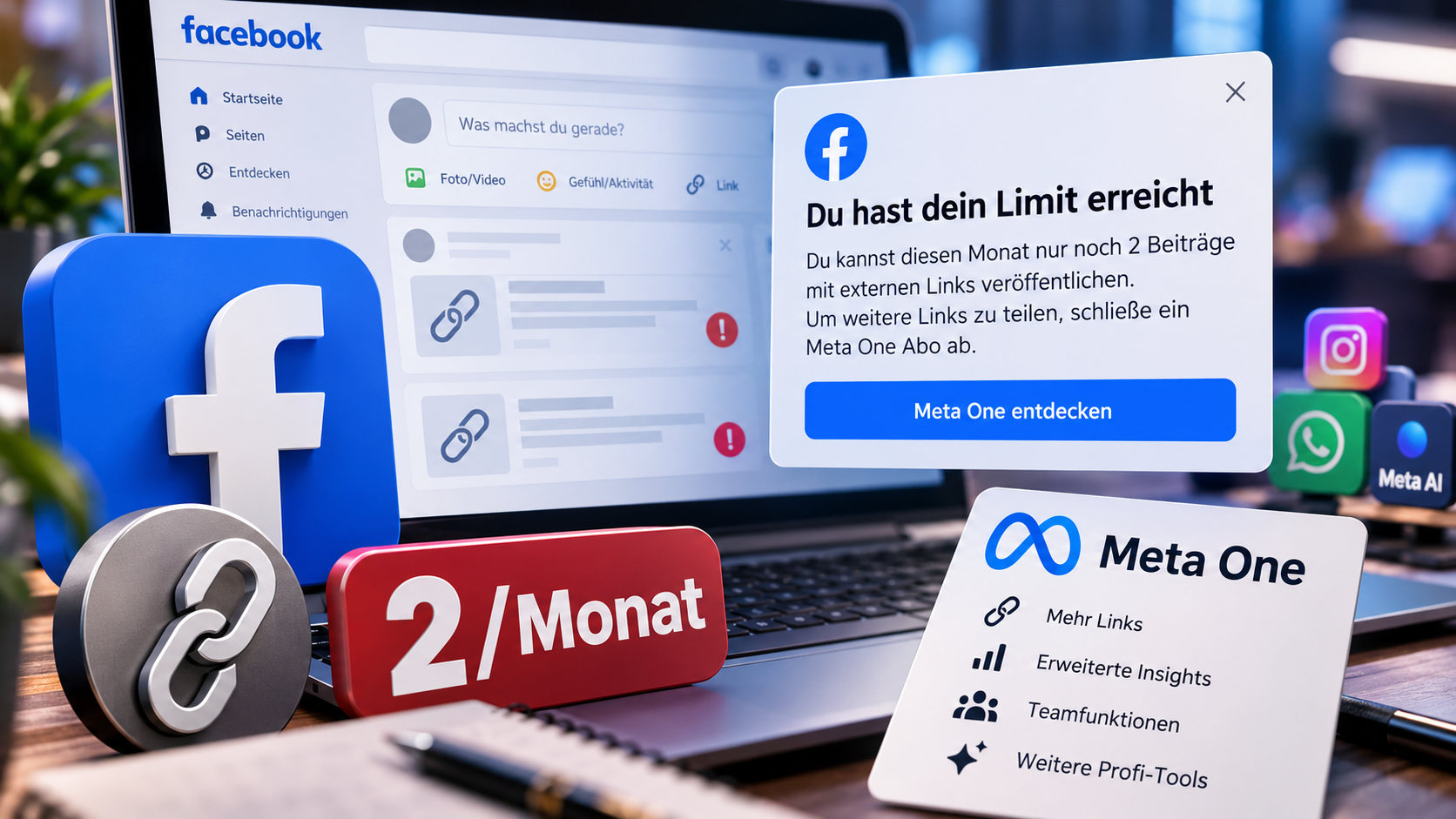
Who runs a Facebook page and regularly refers to their own website, a blog, or other external content, should currently take a closer look. Meta is testing a restriction for external links, under which affected accounts can only publish two posts with external links per month. Those who want to set further links afterwards will be offered a paid subscription.
This sounds initially like a new general Facebook rule. However, this is not yet the case.
The restriction is not applied equally to all pages and accounts. Rather, it is a test that Meta has already started at the end of 2025 and is apparently now being extended to further Facebook pages.
Those who are not affected today cannot automatically assume that this will still be the case in a few weeks or months.
The Two-Link Limit is Not New
The test did not start with the launch of Meta One.
Already in December 2025, TechCrunch reported on a corresponding test . Meta confirmed at that time that certain Facebook pages and profiles in Professional Mode could only publish two posts with external links, provided they did not use a paid Meta-Verified offer.
Meta explained at that time that they wanted to find out with this limited test whether the possibility of publishing more posts with links would offer additional benefits for paying users.
An important statement at that time was also that publisher pages should explicitly not be part of the test. Additionally, links could still be published in comments at that time.
So from the beginning, it was not a general rule for all Facebook pages.
Now the Limit Appears on Further Pages
In September 2026, the situation has changed.
After the launch of Meta One for businesses and creators, more and more page administrators of classic Facebook pages report that they are also shown a limit of two link posts per month.
Social Media Today reported on September 17, 2026, about several corresponding cases . According to this, it seems that Meta has extended the test that had already started in 2025 to further Facebook pages.
Also Mimikama documented on September 23, 2026, corresponding cases . Among others, German-language screenshots are visible there, in which Facebook refers to Meta One after two posts with external links.
The crucial point here: Not all Facebook pages are still affected.
So there is no general rule according to the motto: Every Facebook page may now only publish two external links per month.
And who is actually affected now?
Exactly here it becomes difficult.
There is no publicly accessible list, based on which one can clearly determine which pages fall under the restriction, at the moment.
Originally, the test was directed at certain professional accounts and Facebook pages. Publishers were excluded according to Meta’s statements at that time.
However, page administrators of classic pages now also report the two-link limit. This suggests that Meta is now extending the test to further pages.
Whether a specific Facebook page is affected can therefore not be determined solely based on the page type at the moment.
This also applies, for example, to a small blog that runs its own Facebook page and links to its articles.
It can be that the page can currently publish external links normally. However, it can also be that Facebook activates the corresponding restriction at some point.
In short: Nothing is certain.
Those who are not affected now cannot safely assume that this will remain the case permanently.
What happens after the two links?
For affected accounts, a notice from Facebook appears after the quota is exhausted. It informs that further link posts are only possible with a paid offer.
Mimikama describes a concrete German case , in which Facebook refers to Meta One after two link posts.
This turns an originally described as a test restriction into an increasingly integral part of the new paid offer for professional users.
This does not mean, however, that Meta has officially announced that all Facebook pages will now have to pay for external links in the future.
There is currently no reliable basis for this.
What is Meta One?
Meta One is a new subscription model that Meta officially introduced on September 15, 2026.
Meta describes Meta One as a paid additional offer for Facebook, Instagram, WhatsApp, and Meta AI . The normal functions of the platforms are to remain free according to Meta. Users will pay for additional features and tools.
There are several tariff levels for creators and businesses.
The cheapest Business or Creator tariff starts at 14.99 US dollars per month according to Meta. Above that comes Advanced at 49.99 US dollars. Expert starts at 149 US dollars and the most comprehensive tariff, Max, at 499 US dollars per month.
Meta explicitly points out that prices, functions, and availability may vary depending on region, app, and account.
The official price range is therefore currently from 14.99 to 499 US dollars per month.
Particularly interesting is the tariff for 49.99 dollars
For the discussion around external links, the Advanced tariff is particularly interesting.
Meta explicitly mentions for this tariff extended publishing functions. These include, among other things, planned publications as well as links in organic posts and Reels.
This does not automatically mean that every user will receive exactly the same features for $49.99 monthly.
Meta itself notes that the available features may vary depending on the region, app, and account.
Therefore, those who want to know what is actually offered for their own account must ultimately visit their own Meta-One area.
What does Meta One cost in Germany?
Here it gets even more interesting.
The official Meta prices are initially given in US dollars. In Germany, the actually displayed prices may differ.
Mimikama has documented specific prices for a German-speaking account. There, Essential was offered for €13.49 monthly, Advanced cost €43.99, Expert €139, and Max €439 monthly.
These prices should not be understood as a general German price list.
They only show which prices Meta displayed for a specific German account. Other accounts may receive different prices or different features.
With this, the offer is currently roughly between a low two-digit amount and several hundred euros monthly.
And precisely for this reason, it is worth checking one’s own Facebook page before making a general price rule based on individual screenshots.
Facebook as a Distributor – but not as a Foundation
For a blog, this raises a fundamental question: How important is Facebook actually for one’s visitor flow?
I deliberately follow a dual-track strategy at ChristiansBlog. Social media is part of it, but the actual website remains the central point of access. Facebook is used, among other things, to announce new posts and to direct people directly to the respective article. At the same time, the content is structured in such a way that it can also be found via search engines.
These are two completely different ways to reach visitors.
A Facebook post can reach many people within a short time. However, its reach depends on an algorithm that the page administrator cannot control. What works well today may have significantly less reach tomorrow. And if Meta additionally limits the number of free external links, another dependency is added.
Search engines work differently. A well-written article can still bring visitors to one’s own website months or even years after its publication. No one needs to publish a new Facebook post for that, and no one needs to sign up for a monthly subscription on a social platform.
This difference is especially significant for a blog with many permanently relevant articles.
Therefore, I do not see Facebook as a replacement for one’s own website, but rather as an additional channel. Social media can generate attention and make new readers aware of an article. However, the actual reach should not depend solely on that.
At my blog, this difference has become quite clear over several years. Already for about four to five years, I have noticed that the website is increasingly found via search engines and that accordingly more visitors come to the articles via search engines.
This is a decisive advantage for a blog. A post does not disappear from a feed after a few hours just because thousands of other posts have been published. If the content is relevant for a search query and is found well, an article can still bring visitors to one’s own website years after its publication. This is also evident in the use of AI models, such as ChatGPT or Perplexity. Here, my content is very frequently used as a source.
Exactly this is what differentiates search engines from social networks. Facebook can generate attention and visitors in the short term. A search engine, on the other hand, can ensure that an article remains findable in the long term.
Therefore, I do not see Facebook as a replacement for one’s own website, but rather as an additional channel. Social media can generate attention and make new readers aware of an article. The actual reach should, however, not depend solely on that.
For me personally, this strategy has been confirmed for years: Social media and search engines complement each other, but the own website remains the center. If Meta decides at some point that two free external links per month are sufficient, that is certainly annoying for me, but no reason to base my entire strategy on it.
The blog belongs to me.
The content is on my own website, is findable via search engines, and can additionally be subscribed to via my RSS-Feed . Exactly this combination is more interesting to me in the long term than relying entirely on the reach of a single social platform.
This makes one’s own website more independent from individual platforms.
And precisely for this reason, a limitation of external links would be annoying for me personally, but no reason to fundamentally change the blog’s strategy. If Facebook decides at some point that two free links per month are sufficient, then that is just another reminder of who the platform belongs to.
The blog belongs to me.
The content is on my own website, is findable via search engines, and can additionally be subscribed to via my RSS-Feed . Exactly this combination is more interesting to me in the long term than relying entirely on the reach of a single social platform.
No general Facebook rule has emerged from this yet
This should not be overlooked in the entire discussion.
Currently, it cannot be seriously claimed that Meta has limited all Facebook pages to two external links per month.
The original test was already confirmed by Meta by the end of 2025. At that time, certain professional accounts and pages were affected. Publishers were explicitly excluded.
In September 2026, there are now indications that the test is being expanded to more Facebook pages.
Social Media Today reports on several affected Page Managers , while Mimikama has since also documented German-speaking cases .
There is still no official statement from Meta that future Facebook pages will only be allowed to publish two external links for free.
That is an important distinction.
What does this mean for your own Facebook page?
Actually, it means: observe.
Those who can currently publish as many external links as they want do not need to suddenly sign up for a Meta-One subscription.
If Facebook ever displays a corresponding message on your page, the situation will be different.
Then, each page administrator must decide for themselves whether a paid subscription is worth it in light of their own usage.
For someone who publishes two or three links per month, the question will be different than for a blog that publishes new articles multiple times a week.
And other functions of Meta One also play a role in this decision. The offer consists of more than just the possibility to publish more external links.
It is still worth looking at the development
What is especially interesting is the temporal development.
In December 2025, Meta first tested a limit for certain professional accounts and Facebook pages, and nine months later a new paid Meta-One model was introduced.
At the same time, more page administrators report that Facebook presents them with a paid offer after two link posts.
Whether this will ultimately become a general rule remains open.
Meta could roll back the test. The company could expand it to more pages. It could change the conditions or permanently tie the link function to certain subscriptions.
Currently, we simply do not know which of these possibilities will ultimately become reality.
For operators of their own websites, the development is still interesting.
Because those who build their reach exclusively through Facebook are always dependent on the rules that Meta currently sets.
Today, a link to your own blog can be published for free. Tomorrow, two posts per month could be the free limit.
And whether your page is affected, you may only find out in the moment when Facebook displays the corresponding message.
That is why it is worth keeping an eye on the development.
Personally, I do not expect this model to become permanent. For my blog, I will definitely not pay money for the right to link to my own posts on Zuckerberg.
That is why I will probably think about whether I can offer a newsletter in addition to my existing RSS-Feed . However, I want to remain true to my previous approach: as little tracking as possible, no unnecessary cookies, and no monitoring of who actually opens or reads an article.
Another possibility is the RSS-Feed itself. Those who use a feed reader such as Feeder will automatically see new posts as soon as they are published on the website. You do not have to constantly check Facebook to see if there is something new, and you do not need to subscribe to a newsletter.
Feeder is Open Source and is available via F-Droid . A version is also available in the Google Play Store .
Perhaps it is not so bad in the end if one becomes a bit more independent from the big platforms again.
