

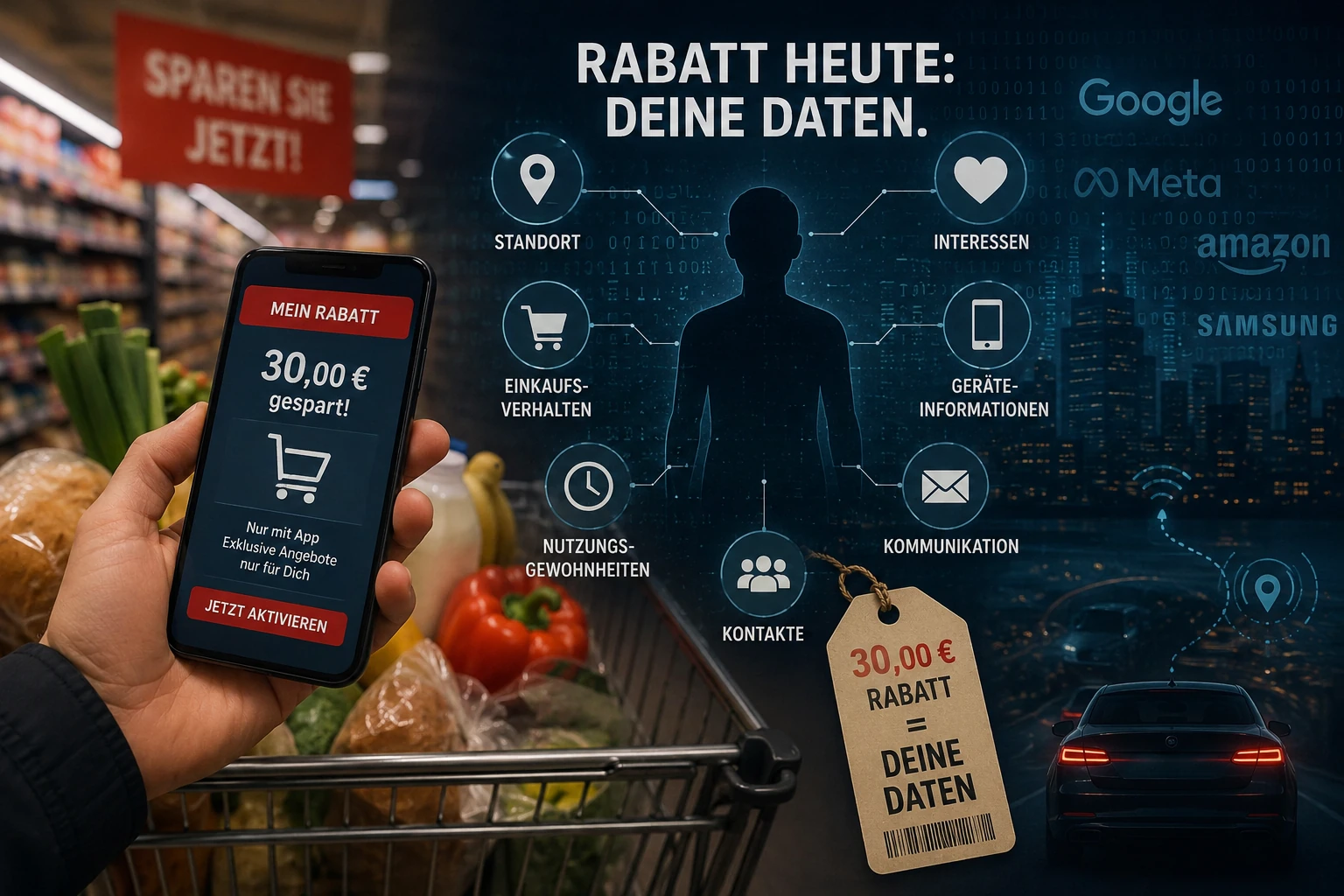
Recently, I was at the checkout of a discount store.
The cashier had scanned the last items of my purchase and politely asked:
„Do you have our app?“
I replied negatively.
She then explained to me that I could have saved around 30 Euros with the app on this purchase.
30 Euros are no small amount. Especially in times of rising prices, this could be a convincing argument for many people. The cashier certainly meant well. After all, mentioning the respective app has now become almost standard practice for many retail chains.
Yet before I could even think about whether I had actually given up 30 Euros, another thought shot through my head:
If a company gives me 30 Euros in discount – what do they get in return?
The question was not meant as a criticism. Companies need to make money. There’s nothing wrong with that. But no company gives away money permanently without receiving something in return.
And exactly this thought kept me awake on my way home.
When discounts were simply discounts
Perhaps it’s due to my age. Perhaps it’s because I remember a time when discounts were much simpler.
Back then, promotional brochures were in the mailbox. Special offers were advertised with large red price tags. At the bakery, there was a stamp card, and at some gas stations, you could collect discount coupons. If someone wanted to use an offer, they simply bought the product at the advertised price. That was all that was required.
Nobody asked for a registration. Nobody wanted an email address. Nobody asked for a phone number. Nobody expected you to install an app, set up a customer account, and confirm several privacy policies before making a purchase.
The discount was simply available to everyone.
Today, this world seems to be disappearing more and more. Customers often only get the best prices through apps, loyalty programs, or digital customer accounts. Those who don’t participate often end up paying more.
Of course, this is convenient. Offers land directly on the smartphone, coupons are automatically activated, and at the checkout, a simple scan is enough.
Yet exactly at this point, the question arose in my mind: have we perhaps already become accustomed to a kind of exchange that is rarely spoken about anymore?
Because maybe we are not paying these discounts exclusively with money.
The true cost of convenience
The discount app at the supermarket is just one of many examples.
Anyone who goes through the digital world today encounters the same principle almost everywhere. The social networks we use daily cost nothing. Yet they are not free offers. The operators live off gaining as much information about their users as possible, in order to display targeted advertisements.
The same applies to smartphones. Many people spend several hundred Euros on a new device and go about their lives as if they have already paid for it. In reality, the actual business relationship often only begins after turning the device on.
Suddenly, a user account needs to be created. Contacts are synchronized. Photos end up in the cloud. Location data helps with navigation. Apps want permissions, and digital assistants are supposed to make daily life easier.
None of this is inherently bad. On the contrary. Many of these functions are practical and significantly ease daily life.
Nevertheless, something is created in the process that was almost nonexistent before: a digital ecosystem that aims to keep the user bound to it for as long as possible.
The same phenomenon is now observable in many other areas. Modern televisions want to be connected to the internet. Cars are becoming rolling computers. Even operating systems are pushing users more strongly towards online accounts.
When someone today sets up a new computer with Windows, they quickly realize that Microsoft wants to bind the user to a Microsoft account as early as possible. Cloud storage, data synchronization, and additional services are seamlessly integrated. Similar developments can be observed with Google, Apple, and numerous other platform providers.
At the same time, we are observing a second change.
Previously, people bought a product and owned it afterwards.
Today, people often buy the hardware and then receive the offer to unlock additional features for recurring fees. Streaming services have largely replaced the ownership of movies and music. Software is increasingly offered as a subscription. Even in the automotive industry, experiments have already been conducted with models where existing features are only unlocked for additional payments.
From the perspective of companies, this is understandable. Recurring revenue is economically more attractive than one-time sales. For consumers, however, it means a fundamental change.
The customer is no longer just a customer.
He is a user, a data source, a target group for advertising, and a subscriber at the same time.
The data is already there
Those who believe such considerations are exaggerated should take a look at the research surrounding the so-called Databroker Files.
For a long time, the trade in user data was almost invisible to most people. It was only through journalistic investigations that it became clear how much information is now collected, analyzed, and traded.
It wasn’t about individual purchases or isolated location queries.
It was about billions of data sets.
Location information, movement profiles, usage behavior.
Information from which surprisingly accurate conclusions about people’s daily lives can be drawn.
What was alarming to me was less the technical possibility.
Technically, a lot is possible today.
What was alarming was rather the realization that these data already exist.
Not sometime in a dystopian future.
But today.
Of course, such information does not automatically come from a single discount app. Yet it shows how valuable data has become and why companies have such a strong interest in learning as much as possible about their users.
Another example was provided by the investigation “Wir wissen, wo dein Auto steht”, which made headlines at the end of 2024. Here too, it became clear how extensive data collection has become in modern, connected vehicles.
The car was once primarily a means of transportation.
Today, it is simultaneously a computer, a communication device, and a data source.
Many people hardly think about this. Perhaps because data collection occurs gradually. Perhaps, however, it is simply because we have long since gotten used to it.
Must we accept all of this?
No.
At least not completely.
Of course, few people today will be able or want to completely do without digital services. The Internet, smartphones, and modern technology offer many advantages after all.
Nevertheless, digitalization does not automatically mean accepting every form of data collection without question.
I myself have been using a Volla Phone for over two years. Although the device is based on Android, it largely does without the close connection to Google services that many users of classic Android smartphones are familiar with.
There are also alternatives when it comes to apps. Instead of getting every application from the well-known app stores, I prefer to use open-source software from the F-Droid store. There, numerous applications are available whose source code is publicly accessible and which often collect significantly less data than many commercial alternatives.
This does not make anyone invisible.
It also does not prevent every form of data collection.
But it shows that consumers do have choices.
The real challenge often lies in knowing these alternatives in the first place.
Because increasingly, there is the impression that certain platforms, apps, or services are alternatives-free.
But that is often not the case.
Conclusion
Please don’t misunderstand me: I have neither anything against digitalization nor against apps or discount programs. Every person should be able to decide for themselves which data they are willing to share and which benefits they consider worth the trade-off. It becomes problematic for me when this exchange becomes invisible and we no longer even realize that we are entering into it.
That seems to be increasingly the case. Discounts are tied to apps, products to user accounts, and functions to subscriptions. Data collection is becoming more and more a prerequisite for services that we could previously use without registration or user profiles. Many people accept this development as a normal part of digital daily life without questioning what they are actually giving up in return.
But it’s no longer just about personalized advertising or discount coupons. The research around the Databroker Files has impressively shown what conclusions can already be drawn today from large amounts of location and usage data. If such information is collected over a longer period and linked together, detailed movement profiles can be created. Home addresses, workplaces, regular places of stay, and personal habits become visible.
The question is therefore not only which data is collected today, but also what conclusions can be drawn from it tomorrow. Information that seems harmless today can suddenly take on a completely different meaning in another context. It can be used to track individuals, predict their behavior, or evaluate their habits. At the latest since the war in Ukraine, we know that location data is not only interesting for advertising. Under certain circumstances, it can even gain military relevance.
That is why I am not trying to condemn data collection altogether. Companies have a legitimate interest in improving their products, better understanding their customers, and working economically successfully. I also do not consider any form of data analysis or evaluation to be inherently wrong. What is crucial to me, however, is that it is openly communicated which data is collected, for what purpose, and what compensation the user receives. Transparency is not a minor issue—it is the prerequisite for people being able to make an informed decision.
Perhaps that is why this topic concerns me so much, because as the operator of this website, I know exactly what technical possibilities exist today. It would be entirely possible to collect extensive visitor statistics, create user profiles, integrate tracking services, or pass on data to advertising networks. The tools for this are easily available and are used by many websites without hesitation.
I have deliberately chosen against this.
Not because it would be technically impossible. Not because there would be no economic benefit. But because I believe that people should be able to visit a website without being constantly observed, analyzed, and evaluated. Those who visit this page should be able to read information without immediately becoming part of an advertising profile.
Of course, I won’t change the digital world by doing this. But every decision starts with small steps. Companies make decisions. Website operators make decisions. And we, as users, also make decisions—every day.
At the checkout, I chose to forgo the 30 Euro discount. Whether this was the economically wisest decision is certainly open to discussion. For me, however, something else was more important: I want to be able to decide myself when I exchange my data for a benefit and when not.
Because the question is no longer just about what a product costs today.
Rather, it is increasingly also about whom we give insight into our lives – and what price we are willing to pay for it.
Further Reading and Research
Those who want to get closer to the topics of data trading, tracking, movement profiles, and connected vehicles are recommended the following sources:
Databroker Files – netzpolitik.org & Bayerischer Rundfunk
One of the most comprehensive German-language investigations into the trade of location data. The Databroker Files show how detailed movement profiles can be created from supposedly anonymous advertising and location data, and what risks arise for privacy and security. The research documents, among other things, a dataset with 3.6 billion location data points from Germany, which allow inferences about home addresses, workplaces, and personal habits.
- https://netzpolitik.org/databroker-files/
- https://netzpolitik.org/2024/databroker-files-die-grosse-datenhaendler-recherche-im-ueberblick/
- https://netzpolitik.org/2024/databroker-files-firma-verschleudert-36-milliarden-standorte-von-menschen-in-deutschland/
Location Data as a Security Risk
The research shows that location data can reveal much more than just shopping or movement habits. They allow inferences about government employees, military personnel, or staff of sensitive facilities, raising questions about national security.
- https://netzpolitik.org/2024/databroker-files-wie-datenhaendler-deutschlands-sicherheit-gefaehrden/
- https://www.br.de/nachrichten/deutschland-welt/verkauf-von-standortdaten-spionagerisiko-fuer-eu-personal,V1VGzZ9
„Wir wissen, wo dein Auto steht“ – Chaos Computer Club
At the end of 2024, the Chaos Computer Club drew attention to the risks of connected vehicles with a presentation about a data leak in the Volkswagen Group. It concerned movement data from around 800,000 vehicles as well as contact information of vehicle owners. The presentation impressively shows what modern vehicle data can reveal.
- https://fahrplan.events.ccc.de/congress/2024/fahrplan/talk/Q8ZAV9/
- https://media.ccc.de/v/38c3-wir-wissen-wo-dein-auto-steht-volksdaten-von-volkswagen
Documentation: Gefährliche Apps – Im Netz der Datenhändler
The documentation by Bayerischer Rundfunk examines the Databroker-Files research and shows, through concrete examples, how location data is traded and what consequences this can have for consumers.
- https://www.ardmediathek.de/ (Search for: „Gefährliche Apps – Im Netz der Datenhändler“)
Privacy-Friendly Alternatives
For readers who want to explore data-efficient alternatives:
- Volla Phone: https://volla.online/de/
- F-Droid (Open-Source App Store): https://f-droid.org/
