

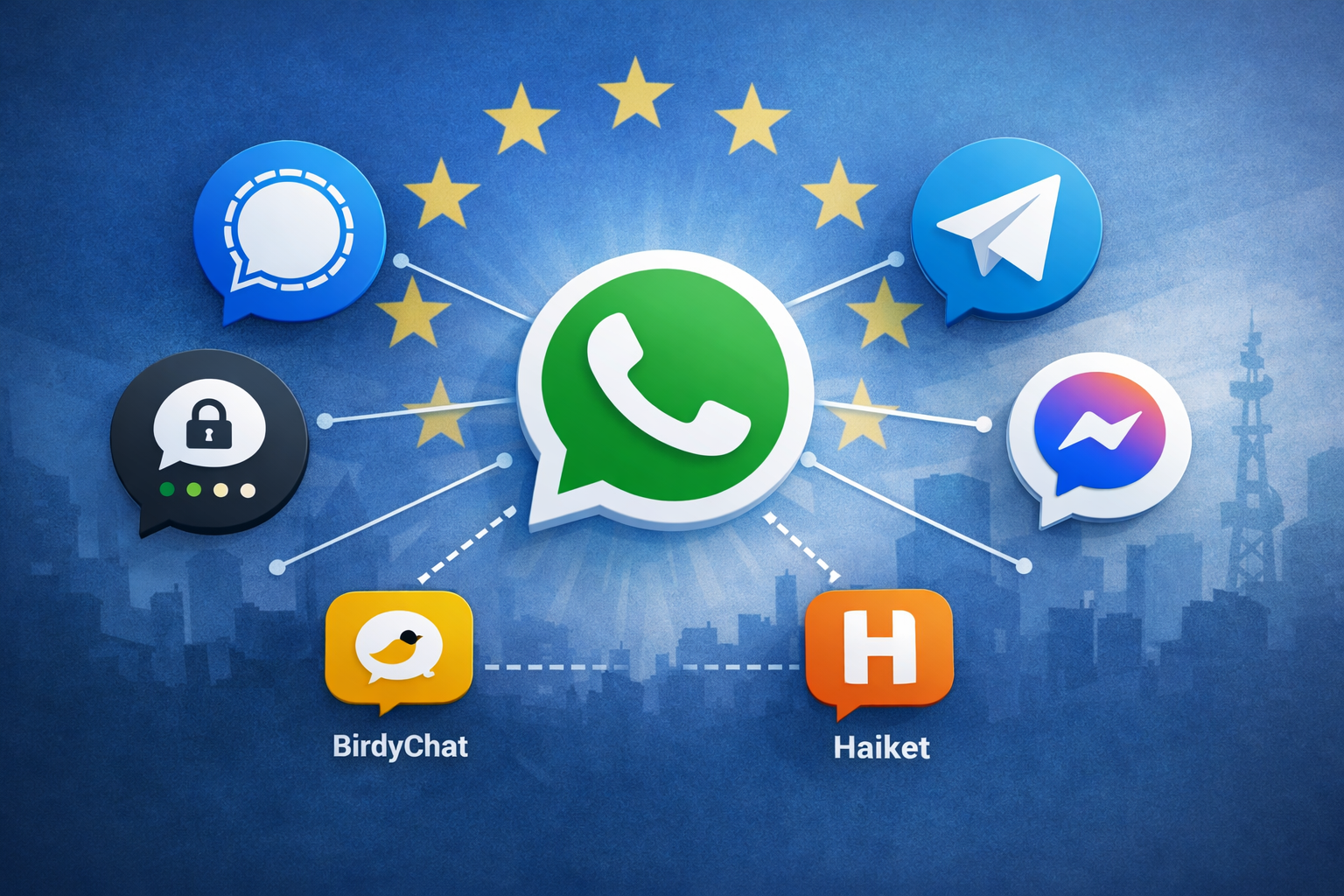
WhatsApp opens up to third-party providers – Interoperability remains a work in progress
With the introduction of third-party chats, WhatsApp is implementing a central EU requirement for the first time. Users in Europe can now generally use the Messenger for communication with other services.
Although the technical foundation has been created, it is clear: The new interoperability is more theory than practice so far.
Background: The Digital Markets Act forces openness
The changes are based on the Digital Markets Act (DMA).
With this law, the EU aims to limit the market power of large digital companies. Companies like Meta Platforms are considered so-called “Gatekeepers” and must open their services to competitors.
For messengers, this means specifically: Services like WhatsApp must provide interfaces so that messages can be exchanged with other platforms.
New Feature: Third-party chats in WhatsApp
In the EU version of WhatsApp, a new feature has been introduced:
- Activatable third-party chats
- Communication with external messenger services
- Support for:
- Textnachrichten
- Bilder
- Sprachnachrichten
- Dateien
The integration is optional. Users can decide themselves whether external chats appear in the main overview or are managed separately.
A central point remains security: End-to-end encryption should continue to be in place – however, only if the respective third-party provider supports a compatible encryption system.
Current Status: Minimal real-world usage
Despite the existing technology, the practical use is currently heavily limited.
Few connected services
Currently, only a few, scarcely known services are integrated:
Both are still in an early phase and are partially only accessible via waiting lists.
Established messengers are completely missing, including:
- Matrix
- Signal
- Threema
- Telegram
Thus, the function remains practically irrelevant in everyday life.
Why interoperability is stalled
1. Technical barriers
Different protocols, encryption methods, and identity models significantly hinder seamless communication.
Particularly affected are:
- Group communication
- Media transmission
- End-to-end encryption across system boundaries
In addition, requirements for metadata (e.g., phone numbers) can create new privacy issues.
2. Lack of incentives – and concrete rejection from practice
That large messengers are not participating at the moment is not just a guess – it is confirmed by the providers themselves.
So Threema stated upon request that interoperability poses significant risks for privacy and security from their perspective. Particularly problematic is that different messengers differ significantly in central aspects – for example, in user identification (anonymous IDs vs. phone numbers) and handling of metadata.
A central criticism point: When connecting different systems, the security level would inevitably be determined by the “weakest link.” For privacy-focused services, this would be a step back – and thus not an option.
From the Matrix environment, there is also a clear assessment:
- Matrix is not a single messenger, but an open protocol with many clients and servers
- Development resources are already heavily occupied
- Integrating WhatsApp would tie up resources that are lacking elsewhere
In addition, there are already so-called “bridges,” which are connections to other services. However, these are considered technically complex, not user-friendly, and bring additional privacy concerns with them.
Another pragmatic point: Someone who consciously chooses a privacy-friendly messenger would hardly want messages to run through the infrastructure of a large corporation in the background.
In summary, it shows: The hesitation is not a short-term decision, but a conscious strategic trade-off in favor of security, architecture, and privacy.
3. Dependence on third-party providers
The technical infrastructure alone is not enough: Other providers must actively implement the interfaces.
As long as this does not happen, interoperability remains practically ineffective.
Security and privacy concerns
Once different messengers are connected, a fundamental principle applies:
The security of communication is only as strong as the weakest participating system.
This makes it difficult to ensure consistently high security guarantees – especially for end-to-end encryption across system boundaries.
Conclusion: Regulatory success, practical standstill
With the third-party chats, Meta or WhatsApp formally fulfills the requirements of the DMA.
In practice, however, the function remains largely theoretical. As long as large messengers like Matrix, Signal, Threema, or Telegram do not participate, no real added value is created.
The coming months will show whether more providers will join – or whether the opening of WhatsApp is mainly a regulatory compliance statement.
Currently, it seems more like a classic case of: “Requirements fulfilled – but without noticeable effects in everyday life.”
