

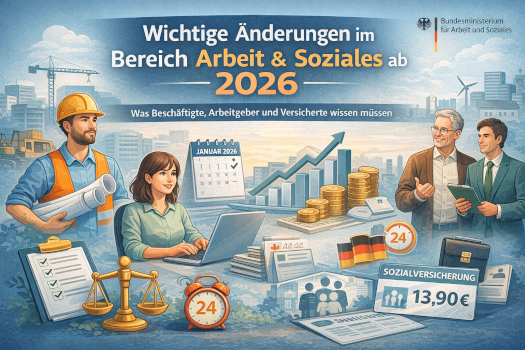
With the New Year 2026, a whole range of changes in the area of work and social affairs will come into effect that directly affect employees, employers, and insured persons. This article summarizes the most important points within the jurisdiction of the Federal Ministry for Labour and Social Affairs (BMAS) compactly and clearly.
Labour Market Policy and Short-Time Work
The surcharge rate for insolvency benefits remains at 0.15 percent in 2026, and the contribution rate for labour promotion stays unchanged at 2.6 percent. Important for companies: The duration of short-time work allowance will be extended to a maximum of 24 months until December 31, 2026, to create more planning security during crisis times.
Interesting for people with foreign qualifications: The Federal Employment Agency will gradually take over the recognition and qualification counselling by 2029, for which a three-year transition period starts in 2026. During this phase, it will build up the necessary expertise and structures together with the previous IQ counselling projects.
In the construction industry, the surcharge rate of the winter employment surcharge for 2026 will be reduced to 1 percent, of which employers bear 0.6 percent and employees 0.4 percent. This relief is financed from around 200 million euros from the reserve fund of the winter employment surcharge.
Labour Law, Skilled Workers, and Minimum Wage
As of January 1, 2026, “Fair Integration” starts as a legally anchored counselling offer for nationals of third countries in labour and social law matters. Employers in Germany who recruit persons from third countries abroad will have to indicate the possibility of this information and counselling in future.
The statutory minimum wage increases at the beginning of 2026 to 13.90 euros gross per actual hour of work, based on the recommendation of the Minimum Wage Commission. For many low-paid employees, this means a noticeable plus in their wallet and simultaneously affects mini-job limits and social security thresholds.
For people in retirement age, the labour market will become more flexible: The ban on subsequent employment for fixed-term contracts without cause is abolished for persons who have reached the statutory retirement age. Thus, they can re-enter with a fixed-term contract without cause at their former employer again if both parties wish it.
Pension, Retirement Age, and Calculation Amounts
The contribution rates in the statutory pension insurance remain stable at 18.6 percent in general pension insurance and 24.7 percent in the miners’ pension insurance in 2026. In parallel, the gradual increase of the retirement age continues, so that the birth year 1960 reaches the statutory retirement age only with 66 years and 4 months.
The social security calculation amounts are adjusted according to wage development in 2024 and form the basis for contribution and benefit calculations. These include, among others, the reference amount of 3,955 euros monthly as well as the contribution assessment ceilings in health, nursing, and pension insurance.
The minimum contribution for voluntary insurance in statutory pension insurance is from January 2026 at 112.16 euros per month. In the Artists’ Social Insurance, the levy rate decreases slightly from 5.0 to 4.9 percent, while farmers pay 325 euros monthly into the retirement security for farmers.
Mini-jobs, Transition Area, and Benefits in Kind
The remuneration limit for mini-jobs increases on January 1, 2026, from 556 to 603 euros per month, in line with the higher minimum wage. In agriculture, the time limits for short-term employment are expanded to 15 weeks or 90 working days per calendar year.
In the transition area between 603.01 and 2,000 euros monthly remuneration, the new factor F of 0.6619 applies from 2026, which relieves employees from reduced employee contributions. In this way, persons with lower and medium incomes should be spared from social security contributions in particular.
The benefits in kind are also adjusted to price development: The value for catering increases from 333 to 345 euros per month, with 71 euros for breakfast and 137 euros each for lunch and dinner. The benefit in kind for accommodation increases moderately from 282 to 285 euros monthly.
AI in Social Administration and Pension Package 2025
From January 2026, there will be a clear legal basis in the Tenth Book of the Social Code for the development of AI models and AI systems with anonymized or pseudonymized social data. The goal is to support the work processes of social benefit providers and at the same time create legal certainty for this technology.
New is also case management in SGB VI, with which pension insurance providers can accompany insured persons with complex needs throughout the entire rehabilitation process. This should avoid breaks in the rehabilitation course and better coordinate benefits.
With the Pension Package 2025, the holding line for the pension level at 48 percent until 2031 is extended to prevent a decline in the pension level. In this way, it should be ensured that the development of pensions does not permanently lag behind wage development.
Source: Press Release BMAS
