

The Federal Ministry for Labour and Social Affairs (BMAS) presented an updated concept in July 2026 for “efficient and bureaucracy-free occupational health and safety.” According to the ministry, the planned measures are expected to relieve the economy and administration by approximately one billion euros annually. At the same time, it is emphasized that the existing level of protection for employees must be maintained.
At first glance, this sounds like a sensible modernization: less paperwork, more digitalization, and occupational health and safety focused more on actual hazards. However, upon closer examination, the question arises whether only bureaucracy is being reduced or if important safety structures are gradually disappearing.
A closer look is particularly worthwhile for the transport and logistics sector.
What does the BMAS plan?
The concept is divided into three reform packages. The most important points include:
- Fewer mandatory safety representatives in companies
- Digitalization of documentation and proof obligations
- Elimination of certain duplicate inspections
- Simplification of inspection obligations
- Increased responsibility for employers
- Strengthened controls by supervisory authorities
Especially the planned changes regarding safety representatives are causing discussion.
The advantages for freight forwarders
Less administrative burden
Many transport companies are already struggling with enormous documentation efforts today. Digital training, electronic proofs, and the elimination of outdated written form requirements can indeed provide relief here.
Freight forwarders, especially smaller ones that do not have their own HR or occupational health and safety department, benefit from the simplification of processes.
Fewer duplicate inspections
Another positive aspect is the planned abolition of occupational health and safety duplicate inspections for vehicles that are already inspected according to StVZO regulations.
For fleet managers, this means:
- less scheduling effort
- lower costs
- fewer vehicle downtime periods
Provided that road safety continues to be fully guaranteed, this step is understandable.
More flexibility
Many regulations will in the future be aligned more closely with actual hazards.
A small transport company with ten employees and manageable risks may indeed not require the same organizational effort as a logistics center with several hundred employees.
Here, a risk-oriented approach can be useful.
The disadvantages for drivers and employees
While the advantages lie mainly on the corporate side, the situation looks significantly more differentiated from the perspective of employees.
Fewer safety representatives mean fewer points of contact
The BMAS wants to significantly reduce the obligation to appoint safety representatives.
This is exactly where the problem begins.
Safety representatives are often the first point of contact in many companies when employees want to report hazards. They know the daily routines, talk to colleagues, and often notice risks before an accident occurs.
Anyone who has worked in freight forwarders or logistics centers for years knows:
Not every driver goes directly to management with a problem.
Not every warehouse worker reports a defect in writing.
Often, communication happens informally through colleagues or precisely through safety representatives.
If these positions are eliminated, part of this safety culture also disappears.
Occupational health and safety lives on people – not on forms
In political discussions, it is often pretended that occupational health and safety consists mainly of paperwork.
The opposite is actually the case.
A safety representative does not prevent an accident by filling out a form.
He prevents accidents because he:
- reports damaged fall protection,
- notices missing high-visibility vests,
- points out defective equipment,
- alerts colleagues to hazards.
Exactly this practical safety work is threatened to be weakened.
More self-responsibility can also mean less control
The BMAS emphasizes that the self-responsibility of employers should be strengthened.
In principle, there is nothing against this.
However, reality in parts of the transport industry often looks different:
- high time pressure,
- shortage of skilled workers,
- tight staffing levels,
- increasing cost pressure.
Under such conditions, there is a risk that safety measures will no longer be seen as necessary protection but as a cost factor.
The fewer binding structures exist, the more the quality of occupational health and safety depends on the sense of responsibility of individual companies.
What does this mean concretely for professional drivers?
For drivers themselves, the changes will probably not be noticeable immediately.
However, the following developments could occur in the long term:
Positive effects
- less bureaucratic effort for training
- faster digital processes
- lower costs for companies
- more efficient vehicle inspections
Possible risks
- fewer internal points of contact
- reduced presence of occupational health and safety in daily life
- greater dependence on the employer’s self-responsibility
- later detection of safety defects
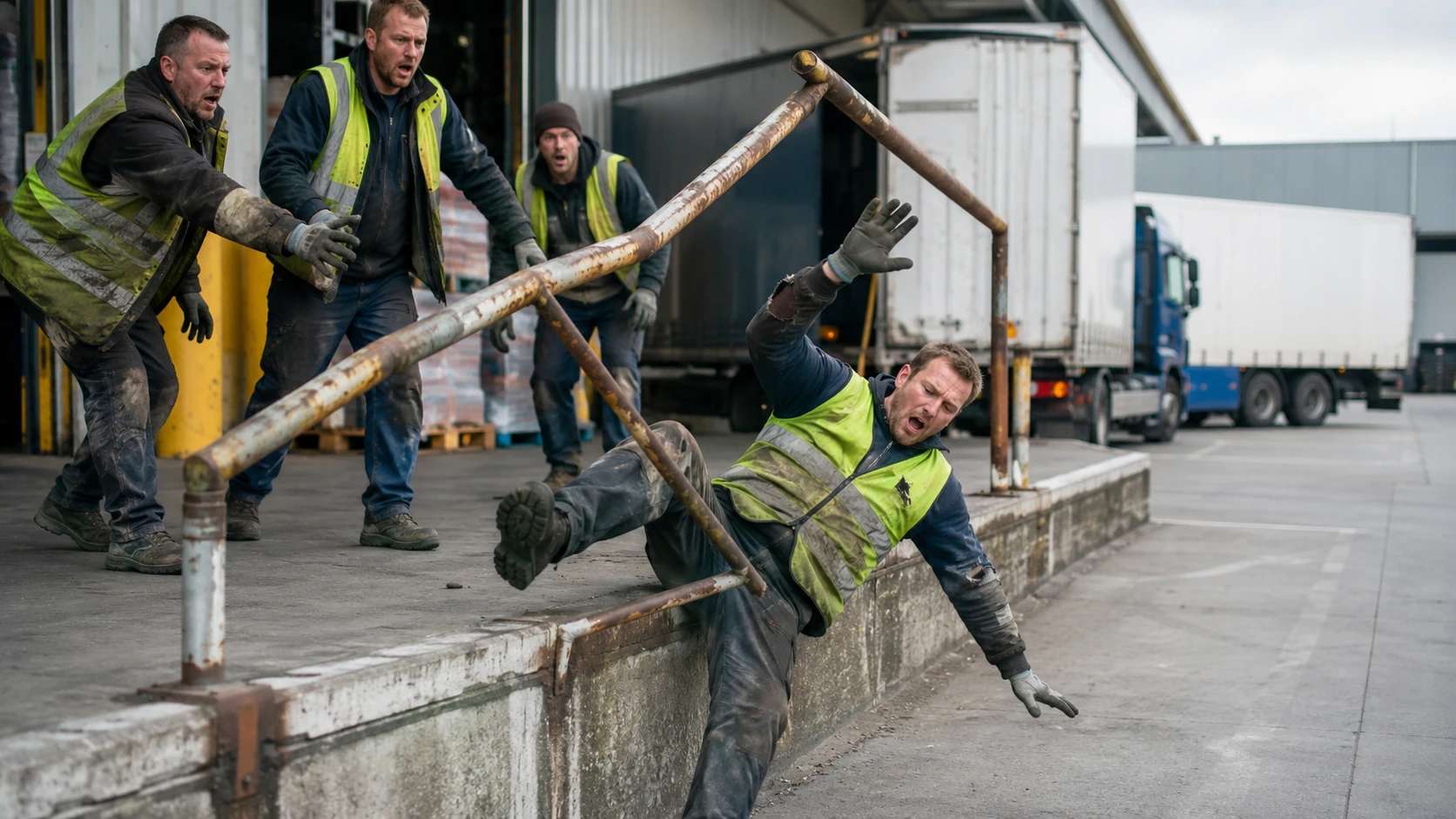
Many work accidents, especially at depots, loading ramps, and in warehouse areas, do not occur through spectacular events but through small defects that are overlooked over a long period.
Here, safety representatives often play an important role.
Bureaucracy reduction must not be an end in itself
No one will seriously dispute that there is unnecessary bureaucracy in occupational health and safety.
Digital procedures, the reduction of duplicate inspections, and modern documentation options are sensible steps.
However, problems arise when structures that have proven effective in practice disappear under the banner of “reducing bureaucracy.”
Safety representatives are not bureaucrats.
They are employees from within the company who identify hazards, raise awareness among colleagues, and contribute to preventing accidents.
Reducing their numbers may save money.
Whether safety is maintained as a result will only become clear in the coming years.
Conclusion
The BMAS concept contains numerous sensible approaches to digitizing and simplifying occupational health and safety. For freight forwarders in particular, this could lead to genuine relief.
However, the planned reduction of safety representatives should be viewed critically.
Occupational health and safety does not arise solely from laws, regulations, and digital forms. It is created primarily by people who pay attention to risks every day and speak up about shortcomings.
If reducing bureaucracy leads to fewer such people, the bill could ultimately be significantly more expensive than the promised savings.
Source
Federal Ministry for Labour and Social Affairs (BMAS): Concept for an efficient and low-bureaucracy occupational health and safety – Update 2026
