

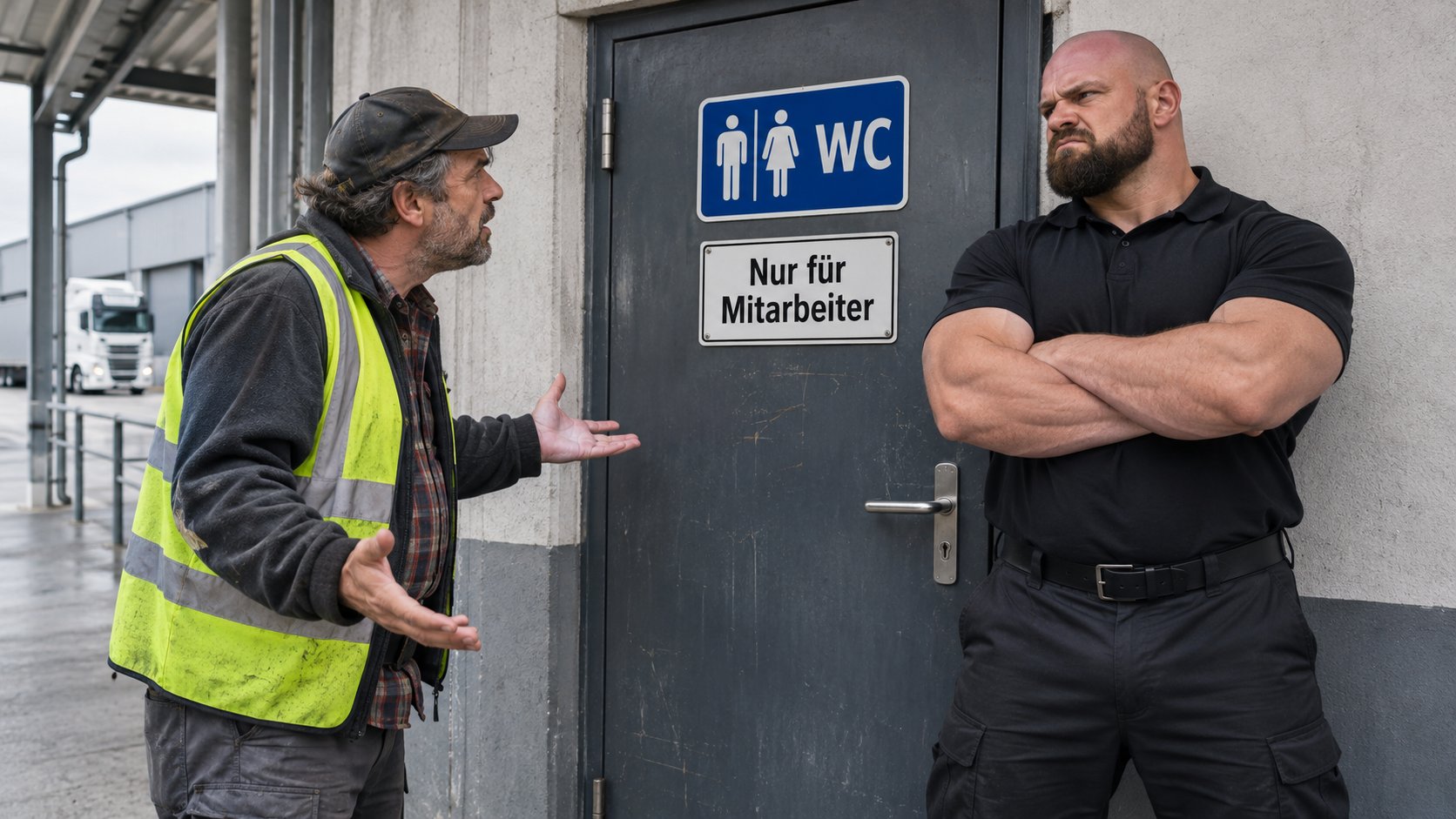
Professional drivers do not work only at a fixed workplace. Their working and rest periods often extend over several days and nights. They rely on changing public and company infrastructure. Existing regulations cover individual aspects but do not reliably close the supply gap. What is required is a directly applicable, controllable regulation backed by effective sanctions for the mobile workplace in road freight transport.
Here, a distinction must be made between existing law and political demands. The ArbStättV is today not fully applicable to the cab in public transport. This limited applicability is a central part of the need for action.
Why the mobile workplace requires its own consideration
The professional driver performs his work at changing locations: in the cab, at service areas and parking lots, at loaders and receivers, at ramps, at depots and partly at roadworks. He cannot assume that he will be able to return to a fixed workplace after a few hours. In long-haul transport, he spends several days and nights outside his home base. The cab is a workplace, place of stay and place of rest; sanitary supply, by contrast, must be organised mainly outside the vehicle.
Comparison with a roadworks site
Employees at a long motorway roadworks site also work mobile and may use toilet vans or mobile, non-plumbed toilet cabins. The regulation explicitly recognises such special places of deployment. The essential difference lies in the temporal and spatial life situation: employees at roadworks usually return home after their shift or have accommodation with sanitary facilities when working away from home. The long-haul driver can be on the road for days and depends on the availability and usability of facilities along the route and at the approached businesses.
If public toilets are closed, defective, dirty or non-existent and access to the toilets of a customer business is simultaneously denied, the driver may be left with no reasonable alternative. The suggestion that he could visit another service area does not solve the problem if that area is unreachable, closed or also inadequately equipped.
The Corona period made this structural dependence particularly visible: while many service areas and catering establishments were closed, professional drivers had to continue their work. Dixi toilets set up provisionally without adequate hand-washing facilities were an emergency measure, but not a permanently acceptable hygiene standard.
Practical example: access at the customer
A driver arrives at a large logistics site, checks in at the registration area, and sees an existing toilet marked with “WC for staff only”. Despite his official presence on the business premises, access is denied to him. He is directed to the next highway service area. The driver then has to ask the staff there for the fulfillment of a basic need, even though he is there to carry out a transport assignment.
The problem is not solved by a recommendation or an individual agreement to be concluded at some point. With a large number of changing loading and unloading locations, an individual agreement cannot be assumed for every site.
Current legal situation: Where do the regulations apply – and where not?
Workplaces Ordinance (ArbStättV)
§ 1 paragraph 2 number 2 ArbStättV explicitly states that for means of transport used in public transport, only § 5 ArbStättV (non-smoking protection) and appendix number 1.3 apply. The remaining requirements of the ordinance do not apply to these means of transport in the same way as to a stationary workplace. This concerns in particular the regular requirements for workrooms, break rooms, and sanitary rooms.
This exception is the legal core of the special status of the cab. It does not mean, however, that all occupational health and safety obligations towards professional drivers are eliminated. The Occupational Health and Safety Act, working time regulations, and further provisions must be considered separately. Likewise, a distinction must be made between the vehicle in public transport and work areas on a business premises.
Sanitary rooms under ArbStättV and ASR A4.1
Appendix number 4.1 ArbStättV provides for toilet rooms with closable access, a sufficient number of toilet basins, and handwashing facilities. For work outdoors and on roadworks with few employees, mobile, non-plumbed toilet cabins near the workplaces may be sufficient. ASR A4.1 specifies requirements for sanitary rooms and contains special provisions for roadworks.
For roadworks, ASR A4.1 permits mobile cabins under certain conditions. It also stipulates requirements for handwashing facilities, cleaning, and distance from the workplace. This regulation for roadworks is an example that mobile workplaces do not necessarily have to remain without binding minimum standards. However, it is not a standalone basis of claim that can be directly transferred to every changing truck loading and unloading site.
Occupational Health and Safety Act and cooperation of multiple employers
Sections 3 and 5 of the Occupational Health and Safety Act (ArbSchG) oblige employers to take necessary occupational health and safety measures and to assess hazards. Section 8 of the Occupational Health and Safety Act (ArbSchG) obliges employers to cooperate when employees of multiple employers are active at a workplace. Hazards and protective measures must be coordinated.
These provisions are important, but they do not clearly and directly resolve the concrete access situation: Section 8 of the Occupational Health and Safety Act (ArbSchG) is a duty to cooperate. It does not explicitly formulate for the driver a simple, directly enforceable claim on site for opening the existing employee toilet. This gap is to be examined and closed by the legislature.
DGUV Rule 114-006: Driver’s cab and sleeping berths
DGUV Rule 114-006 (May 2023 edition) deals with driver’s cabs with sleeping berths, roof sleeping cabins, and rest rooms of articulated buses. It describes technical specifications and experiences from prevention work, including noise, vibration, heating, air conditioning, lighting, blackout, steps, and dimensions. For rooms with sleeping berths, it provides for a stationary heater and stationary air conditioning independent of the vehicle engine for adequate temperature control; a stationary air conditioning unit may be omitted if other suitable measures ensure a health-compatible temperature.
The DGUV Rule is an important professional regulation. However, it does not expand the scope of application of the Workplace Ordinance (ArbStättV) and does not replace a legal regulation that creates a comprehensive, directly enforceable protection standard for the mobile workplace. Its technical orientation can be used for legal concretization.
An important open question: BMAS statements 2026
In a reproduction of answers from the Federal Ministry for Labour and Social Affairs published on 5 September 2026, the BMAS stated that the Occupational Health and Safety Act, the Workplace Ordinance based on it, and the associated workplace rules applied in full to professional drivers and professional drivers. The ministry pointed out that employers must ensure access to sanitary facilities during work and should check whether driving operations can be organised so that drivers can regularly use existing sanitary facilities at loading and unloading sites, agreements on shared use were also mentioned as an option.
This statement is significant. However, it stands in a relationship requiring explanation with the wording of § 1 paragraph 2 number 2 of the Workplace Ordinance, which states that only certain parts of the ordinance apply to vehicles used in public transport.
The statements do not necessarily have to imply a contradiction: the BMAS may have meant general employer duties and work at the premises of loaders and receivers, while the cab as a vehicle used in public transport remains subject to the special regulation. The published answer does not sufficiently clarify this distinction.
This leads to a concrete request to the ministry: the scope of the BMAS statement must be explained in writing and in a legally secure manner. In particular, it must be clarified which duties fall on the operator of a loading or unloading facility if a professional driver working there needs a toilet and access is denied.
The supply gap in everyday life
Public rest areas: toilets may be missing, closed, defective, dirty or not sufficiently cleaned. An existing toilet building is not automatically actually usable.
Unmanaged parking lots: Often there are no showers and no comprehensive washing facilities. Existing toilets may be unusable for periods of time.
Loading and unloading sites: Drivers stay there within the scope of their transport assignment, wait, and perform further operational tasks depending on the sequence. Nevertheless, access to existing staff toilets can be denied to them.
Mobile toilet cabins: A Dixi cabin can offer a minimum option in an acute emergency. Without handwashing facilities, regular cleaning, and a hygienically adequate condition, however, it is not an equivalent substitute for proper sanitary supply.
Showers and body hygiene: The need does not end with using the toilet. For multi-day tours, washing and showering facilities are relevant. Their availability must not depend solely on chance or the goodwill of individual companies.
The peculiarity lies in the combination: The driver is away from home for a long time, has no fixed sanitary area at the workplace, depends on changing third parties, and cannot simply compensate for inadequate or denied supply by returning to the company site.
Legislative need – Target picture
The goal should not be an unrealistic claim that every mobile workplace must provide the same equipment as a fixed company building. Rather, what is required is an independent minimum standard adapted to the mobile character, taking into account the actual duration and organisation of professional driver activities.
Immediate access to sanitary facilities at customer sites
Professional drivers engaged in a transport assignment on a business or logistics site must be granted access to an adequate, existing toilet and handwashing facility during their official stay. Access may not be made dependent on a prior individual agreement between the transport company and the site operator. The legal regulation must address the operator directly and enable the driver to invoke it on the spot.
Minimum standard for mobile sanitary solutions
Where fixed sanitary facilities are objectively unavailable, a mobile solution must meet a clearly defined minimum standard: hygienic condition, regular cleaning and emptying, safe usability, and an immediately accessible possibility for hygienic handwashing with water and suitable means. A mere cabin without a handwashing facility must not be regarded as a regular standard. Mobile solutions are to be treated as a limited substitute solution, not as a free pass for permanently inadequate supply.
Supply along the route and on multi-day tours
The regulatory framework must take into account that drivers can be on the road for several days. It should therefore not only consider individual depots but also the practical availability of toilets, handwashing facilities, and showers along the course of typical long-haul and multi-day assignments. Opening hours, accessibility, functionality, and actual usability must be taken into account.
Clear responsibility and no escape via agreements
Responsibility must be clearly assigned by law. Agreements between employers and site operators can support organisation but must not be a prerequisite for supply and not the only legal basis. An agreement must neither replace nor restrict a statutory minimum claim.
Control and sanctions
A right that cannot be enforced in everyday life remains practically ineffective. The regulation should therefore provide for a competent supervisory authority, a simple complaint and proof possibility, as well as effective sanctions in case of intentional or repeated refusal. Possible are fine-imposed obligations for operators and clear control responsibilities of the occupational health and safety authorities. The concrete design is to be examined legally. The existing fine regulations of the Workplace Ordinance (§ 9) apply only within the scope of the duties covered there and do not automatically resolve the special access situation.
Proposal for the legal path to a solution
The Ministry should examine whether the existing Workplace Ordinance should be specifically supplemented or whether an independent, binding regulatory section for mobile workplaces in road freight transport should be created. What is decisive is not the formal designation, but that the regulation actually closes the previous gap.
Option A – Supplement to the Workplace Ordinance: An explicit special regulation for professional drivers that establishes binding access to sanitary facilities at loading and unloading sites as well as minimum requirements for mobile sanitary supply.
Option B – independent statutory regulation or special legal provision: A sector-specific framework for the mobile workplace that considers the cab, accommodation and rest conditions as well as the necessary external sanitary infrastructure together.
Option C – binding specification by ASR: An ASR can specify technical and organisational minimum requirements. However, it should not be the sole solution if the driver’s immediate claim against a foreign site operator still has to be created. For this, a clear legal or regulatory basis is needed.
The DGUV Rule 114-006 and the existing ASRs should provide technical building blocks. They do not have to be generally abolished. Rather, their role needs to be redefined: recommendations and technical rules must not replace the binding statutory minimum protection. Where they so far only cover partial areas, the law must establish the missing rights and duties.
Concrete questions for the Federal Ministry
How does the BMAS interpret the statement from 2026, according to which ArbSchG, ArbStättV and ASR apply in full to professional drivers, given the restriction in § 1 paragraph 2 number 2 ArbStättV?
What immediately applicable obligation does a shipper or receiver have today to grant a professional driver access to an existing toilet and handwashing facility during his official stay?
On what legal basis can a driver invoke on site if access is denied? Which authority is competent and what short-term remedy is possible?
Is § 8 ArbSchG, in the view of the Federal Government, sufficient to ensure sanitary supply at changing loading and unloading sites, or does a regulatory gap exist?
Is the Federal Government willing to examine an immediately applicable and fine-imposed obligation for operators of loading and unloading sites that ensures access to adequate sanitary facilities?
What minimum requirements should apply to mobile toilets, in particular regarding handwashing facilities, cleaning, maintenance, accessibility and actual usability?
How are washing and showering facilities taken into account in a binding minimum standard for multi-day long-haul operations?
Summary of demands
Professional drivers require a statutory minimum protection that corresponds to their actual working situation. This includes an immediately enforceable right of access to adequate sanitary facilities at loading and unloading sites, a hygienically acceptable alternative solution where fixed facilities are missing, and reliable provision for multi-day tours. The right must not depend on the goodwill of individual staff at reception, voluntary self-commitments, or thousands of individual agreements.
The mobile workplace is a special case – but not a law-free zone. Where existing regulations do not sufficiently cover this special case, the legislature must close the gap. The regulation must be clear, directly applicable, controllable, and sanctionable in case of violations.
Sources and legal references
- Workplaces Ordinance (ArbStättV) , in particular § 1 paragraph 2 number 2, § 3a, Annex number 4.1 and § 9.
- Occupational Health and Safety Act (ArbSchG) , in particular §§ 3, 5 and 8.
- BAuA: ASR A4.1 “Sanitary rooms” , September 2013 issue, last amended 2022.
- BAuA: Overview of Technical Rules for Workplaces .
- DGUV Rule 114-006 , May 2023 issue.
- BMAS responses on working conditions for professional drivers, reproduced by Nordision , 5 September 2026.
- Professional drivers’ petition 2711/2014 and background paper, in particular the sections on cab, ArbStättV and DGUV rulebook.
The concrete design of a direct claim against foreign site operators as well as the competence for control and sanctions require further legal review.
