

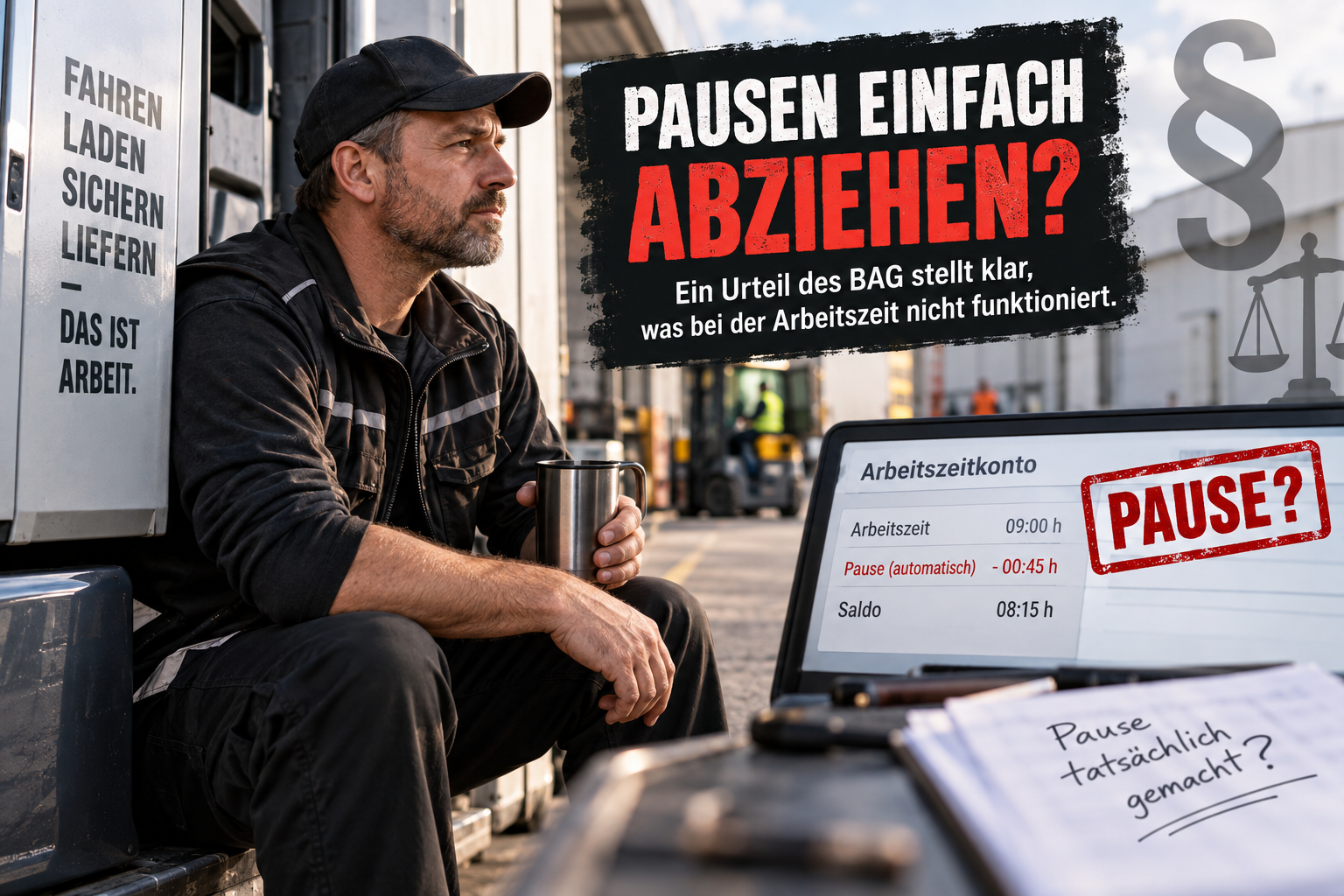
Who doesn’t know it: The workday is long, and at the end of the working time account, for example, nine hours of presence are listed. From this, 30 or 45 minutes automatically disappear in the system. Reason: When more than six or nine hours of working time are involved, a corresponding rest break must be considered.
On paper, everything is clean. The break was subtracted, the working time account is now correct again, and the employer can refer to the fact that the statutory rest break was considered.
But what if these 30 or 45 minutes were actually not taken as a break at all?
Exactly with this question had to deal the Federal Labor Court. The ruling from February 12, 2025, has the file number 5 AZR 51/24 and is also interesting for the discussion about working time accounts for professional drivers. Because the court made it clear that an entry in the time recording system does not automatically prove that an employee actually took a break.
The case before the Federal Labor Court
A resident physician sued. In her working time account, breaks were automatically subtracted if she did not document the start and end of a break via the time recording system. For corresponding working hours, 30 or 45 minutes were removed from the working time account.
The physician, however, claimed that she had actually worked during these times. For the period from September 2018 to August 2019, she claimed a total of 59 hours and three minutes of overtime. She also counted the times as working hours for which the employer had automatically subtracted breaks.
The employer argued against this, stating that the breaks had been granted due to the company’s regulations.
The Federal Labor Court did not follow this argument. It clearly stated that the technical entry „automatically subtracted break“ does not show whether the employee actually took a break.
The decisive sentence of the ruling reads:
„The automatic subtraction of break times does not replace the factual statement regarding the granting and use of breaks.“
A break must actually take place
A statutory rest break is not a calculation.
According to § 4 Working Time Act, work must be interrupted by at least 30 minutes of rest when the working time is more than six to nine hours. For a working time of more than nine hours, a total of at least 45 minutes is required. The rest breaks can be divided into sections of at least 15 minutes each. In addition, employees may not be employed for more than six hours consecutively without a rest break.
This does not mean: Achieve the corresponding working time, subtract the prescribed break time from the account, and that’s it.
The break must actually take place as an interruption of work. Exactly here does the ruling of the Federal Labor Court focus.
In the decided case, the time recording system had merely automatically considered breaks. From this, the employer could not simply conclude that the employee had actually taken these breaks.
The Federal Labor Court required the employer to provide a concrete statement regarding which tasks were assigned to the employee at the respective times and when she actually did not perform these tasks. A general reference to the automatic system subtraction was not sufficient.
The decisive difference between booking and actual break
Exactly here lies the practical significance of the ruling.
An employer can in a working time account book a break. He can also let it be automatically subtracted by software. But this does not automatically prove that the employee was actually released from work during this period.
This is an important difference.
If an employee continues to work during the alleged break period, the automatic entry does not retroactively become an actual rest break.
The Federal Labor Court did not generally decide that automatic break bookings are not allowed. What is decisive is that such an automatic entry in a dispute does not replace the proof that the break was actually granted and taken.
What happens if the employee says: „I worked through“?
Then the employer cannot simply point to the working time account and say: „There is a break listed.“
The Federal Labor Court has described the burden of proof for the employer in its ruling. The employee must first state when he worked. The employer must then substantiate this and specifically state which tasks he assigned to the employee and when the employee did not comply with these instructions.
In the concrete procedure, it was therefore not sufficient for the Federal Labor Court that the employer denied with non-knowledge that the physician had worked during the automatically subtracted periods.
The court pointed out that the employer himself must know which tasks he assigned to the employee at the respective times. The automatic break subtraction could not replace this knowledge.
For practice, this is an important difference.
A working time account documents times. An automatically generated break entry is not automatically proof that the employee did not work during this period.
Working time recording becomes even more important
The ruling is also not isolated. Already in 2022, the Federal Labor Court in the case 1 ABR 22/21 determined that employers are obliged, under § 3 Abs. 2 Nr. 1 ArbSchG, to introduce a system with which the working time performed by employees can be recorded.
The time tracking should clearly show when actual work was performed.
A time tracking system loses its purpose, however, if an automatically generated break entry is then treated as proof that no work was done during that time.
Exactly this distinction is made clear by the ruling of the Federal Labor Court (BAG).
For employees, the actual working time counts
Whether a break actually took place is not decided solely based on a subsequent booking in the time account. It is essential to determine whether the employee was actually able to take a break and whether the break was indeed taken.
An employee, for example, may still perform work tasks during an automatically subtracted break period. In such a case, it is not sufficient for the time account to merely indicate a break.
Exactly here lies the practical significance of the BAG ruling: The technical recording and the actual work processes must align. An automatically generated break entry cannot replace proof that the break was actually granted and taken.
What does this mean for professional drivers?
For professional drivers, the Regulation (EC) No. 561/2006 also comes into play.
According to Article 7, a driver must generally take a continuous break of at least 45 minutes after a driving period of four and a half hours, provided he does not take a rest period. This break can generally be split into a minimum of 15 minutes and then a minimum of 30 minutes.
It is crucial to understand what such a driving break actually means. Article 4, letter d, of the regulation defines it as a period during which the driver must not perform any driving activity or other work and which is exclusively for recovery. “Other work” includes, according to Article 4, letter e, activities defined as working time.
This has a practical consequence for the driver.
If the truck is, for example, parked at a ramp and is being loaded or unloaded, this time is not automatically a driving break just because the driver is not driving. If the driver has to perform tasks such as loading/unloading, securing the load, monitoring the loading process, or performing other work, these activities are not compatible with a driving break under Article 7.
An automatically entered 45-minute break block in the time account does not change this.
The driving break under Regulation 561/2006 must actually be considered as a break in driving activity and other work. While software can record this time, it cannot turn working time into a driving break simply by booking the time period.
The BAG ruling does not concern professional drivers directly. However, its statement regarding automatic break deductions is not limited to a specific profession: A software can book a break. Whether a break was actually taken is not decided solely by this.
This does not mean that every automatic break deduction is prohibited
One should look closely. It is not possible to conclude from the ruling that all automatic break bookings are generally prohibited.
The Federal Labor Court has not issued a general ban on automatic break bookings. What is essential is rather what statement such an entry makes in a dispute.
The court’s statement is clear:
An automatic break deduction does not prove that the break was actually granted and taken.
If an employer actually organizes a break, enables the employee to take it, and documents the actual break in a verifiable manner, this is different from a system that automatically deducts time from the account after a certain working duration.
The technical entry alone cannot replace the necessary factual statement regarding the actual break.
What remains from the ruling?
The actual message of the Federal Labor Court is less sensational than the headline “Break deduction is prohibited,” but it is much more credible:
A break cannot be created solely by a booking process.
If an employee specifically claims to have worked during an automatically deducted break period, the employer must address this. The employer cannot rely solely on the fact that his time tracking system indicates a break for that period.
This does not mean that every deducted break must be paid back as working time retroactively. Someone who actually took a rest break cannot simply retroactively declare it as working time.
However, if a break only exists on paper and the employee has verifiably continued working, the automatic deduction is not sufficient as a justification.
And precisely for this reason, one should not only look at the number at the end of the day when it comes to time accounts. One should look at how this number actually came to be.
Because there can be a significant difference between “a break was booked” and “a break was actually taken.”
