

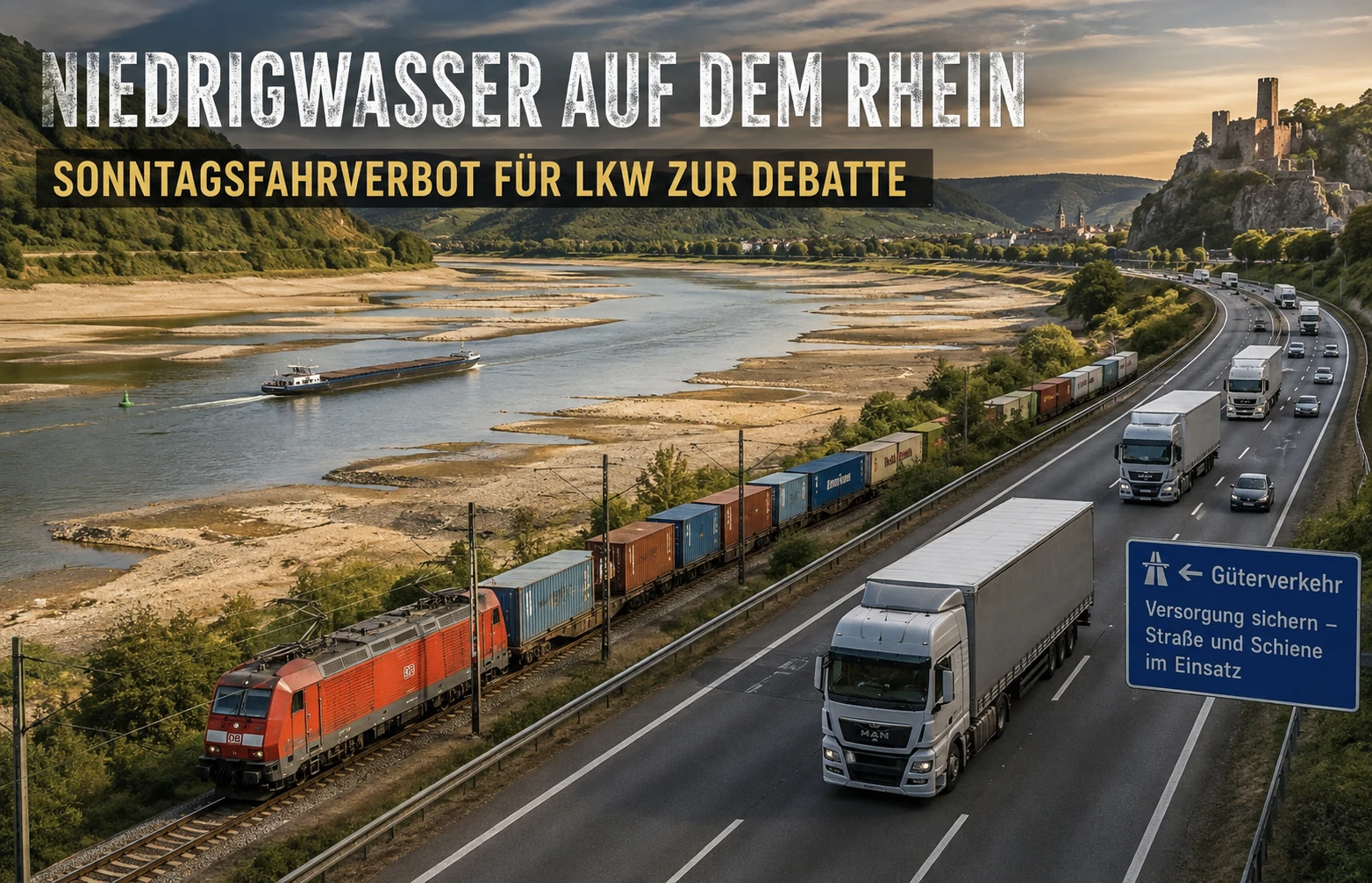
Historical low water levels on the Rhine are increasingly becoming a stress test for the economy and logistics. Many inland vessels can currently only transport their cargo at significantly reduced capacities, and some sections are barely economically navigable for larger ships. The consequence: raw materials, semi-finished goods, and energy carriers reach companies more slowly or must be shifted to other modes of transport. Sectors particularly affected include the chemical, steel, and energy industries, whose supply chains rely heavily on inland shipping.
Against this background, Federal Transport Minister Steffen Bilger has invited representatives from business, ports, shipping, logistics, and authorities to a crisis meeting in Bonn. The goal was to identify short-term measures to mitigate the effects of low water levels and keep supply chains as stable as possible.
One such measure is the temporary relaxation of the ban on Sunday and holiday driving for certain truck transports. Several federal states have already issued corresponding exemptions.
But what does this actually mean for the road – and especially for drivers?
Is a Second Splitting of the Rhine Looming?
The current situation now goes beyond the known problem that inland vessels must reduce their cargo at low water levels. According to the German Inland Shipping Association (BDB), a further deterioration of the situation could even lead to a kind of “splitting” of the Rhine.
Especially critical is the area around Kaub. The Rhine serves as a central link between the northern seaports and the industrial and economic regions in the south. If such a section becomes uneconomical or only passable under significant restrictions for commercial shipping, the consequences extend far beyond the directly affected vessels.
Cargo cannot simply be transferred to another mode of transport at any arbitrary location. If a central section of the waterway fails, not only individual ship cargoes must be replaced; in the worst case, large parts of an entire transport connection must be shifted to road and rail in the short term.
This gives the discussion about additional truck trips a completely different dimension. It is no longer just about whether a few extra trucks are allowed to drive on Sunday. It is about how a significant portion of European freight flows can be absorbed if one of the continent’s most important waterways can no longer fully deliver its transport performance.
And it is precisely at this point that the question arises: how much additional capacity road and rail can actually provide in the short term.
More Than Just Relaxing the Sunday Driving Ban
In the initial reports, the possible relaxation of the Sunday and holiday driving ban was primarily in focus. In fact, this is only part of the measures package.
The federal government is relying, among other things, on enabling additional transports by road and rail. At the same time, necessary permits for heavy transport should be issued more quickly, avoidable highway construction sites should be postponed as much as possible, and additional capacities in rail freight transport should be created.
Long-term measures are also on the political agenda. These include investments in waterways, improvements to important shipping channels, and support for vessels that can be used economically even at low water levels.
The current situation thus once again shows how dependent the German economy is on a functional interplay of different modes of transport.
A Discussion That Is Not New
That exceptions to the Sunday driving ban are discussed during crisis times is by no means new.
Already during the Corona pandemic, exemptions were temporarily issued in numerous federal states. At that time, the focus was mainly on ensuring the supply of the population with food, medical products, and other essential goods. The Sunday and holiday driving ban was partially relaxed, as was the holiday driving ban.
The situation back then differed significantly from today’s low water crisis. However, the basic pattern is similar: when supply comes under pressure, existing traffic regulations are temporarily flexibilized to create additional transport options.
Is the Sunday Driving Ban Therefore Lifted?
No.
And it is precisely this distinction that is important for professional drivers.
The current regulations mean no general lifting of the Sunday driving ban. The exemptions relate to specific transports directly or indirectly connected with coping with the consequences of low water levels. Under the respective conditions, necessary empty runs can also be included.
In contrast, an ordinary transport does not become permitted Sunday traffic solely because a federal state has issued an exemption due to low water levels.
For drivers and dispatchers, this means: The statement “The Sunday driving ban is lifted” is too general.
What matters is always the specific trip and whether it actually falls under the scope of the respective general order.
Large trucks and heavy transports are explicitly excluded from the corresponding NRW exemptions.
The Holiday Driving Ban Also Plays a Role
Another point is interesting for professional drivers that often goes unnoticed in public discussions.
During summer holidays, in addition to the Sunday and holiday driving ban, the driving ban under the Holiday Travel Ordinance applies. It concerns certain heavy trucks on designated highways and federal roads and is valid on Saturdays between 7 am and 8 pm.
Exceptions have also been created in connection with the low water levels. Affected replacement transports can thus travel on Saturdays on routes that are otherwise closed, provided the respective regulation applies.
This can be particularly significant for traffic along the Rhine. If cargo needs to be shifted from the waterway to the road on short notice, it would be unhelpful if part of this additional transport capacity were blocked on a Saturday by the holiday driving ban.
However, the exception still does not apply universally to every truck.
What must drivers observe during an inspection?
For drivers, it is therefore not only important whether an exception exists, but also whether it can be clearly demonstrated why the specific trip falls under this exception.
A dispatcher cannot simply say: “The Sunday driving ban has been lifted in North Rhine-Westphalia.”
The trip must actually be directly or indirectly related to dealing with the consequences of low water levels.
This could be, for example, a transport that replaces a ferry service that has been cancelled or restricted due to low water levels. Under the corresponding conditions, necessary empty runs can also be covered.
Therefore, during an inspection, it should be clear why the trip is covered by the exception. For companies and dispatchers, the respective general order is therefore the decisive basis—not a shortened report from social media or the statement that “the driving ban has been lifted.”
And for those driving across multiple federal states, extra care must be taken. The states have issued their own regulations, whose conditions and duration of validity can differ from one another.
Does the measure help at all?
Opinions diverge precisely at this point.
Industry and logistics generally welcome additional possibilities. After all, the transport performance that is partially lost on the Rhine must be replaced in the short term at least partially by other modes of transport.
The Federal Association of Freight Transport, Logistics and Waste Management (BGL) views the measure much more cautiously.
The reason is understandable: an additional day of driving does not automatically mean additional transport performance.
Those who drive on Sundays are still subject to European driving and rest time regulations. The exception from the driving ban therefore creates no additional driving time.
A driver cannot simply drive an extra Sunday and continue their previous weekly planning unchanged. The prescribed daily and weekly rest times remain in force.
This is exactly where the difference lies between theoretically available road capacity and actually available transport capacity.
In addition, additional transports will only work if shippers, warehouses, and recipients also operate accordingly. If goods receiving or loading operations are closed on weekends, an additional possible day of driving achieves little.
More driving opportunities do not automatically mean more transports
This becomes even clearer when looking at the driver shortage.
Today, tens of thousands of professional drivers are already missing from the German transport sector. Many companies have difficulty filling open positions or using existing vehicles permanently.
A truck standing in the depot due to a lack of drivers will not start moving even if the Sunday driving ban is lifted.
And even if a driver is available, legal limits remain. The additional Sunday drive must fit into the overall tour and rest time planning.
In addition, there are other employees: dispatchers, shippers, warehouse staff, and recipients. These work processes must also function on weekends if an additional legally permitted driving opportunity is to result in an additional transport.
The temporary exception can therefore be useful where round-the-clock operations take place—for example, in the chemical, petroleum, or energy sectors. For general freight transport, however, the effect will likely be significantly less than a simple statement like “more trucks on Sunday” might suggest.
Ultimately, one sentence sums it up:
A driving ban can be nullified by a general order. However, the long-standing driver shortage cannot be addressed.
Criticism also comes from employees
The criticism is not limited to the question of whether the measure is logistically sufficient.
There are reservations on the part of employees as well. The trade union ver.di rejects the relaxation of the Sunday and holiday driving ban and warns that additional Sunday drives could ultimately increase pressure on employees.
This argument is not entirely without merit. The transport industry already works with tight time windows, personnel shortages, and significant stress today. If additional days of driving become possible, there quickly arises an expectation that these opportunities will actually be utilized.
For professional drivers, it is therefore crucial that a voluntarily created additional opportunity does not gradually turn into an expectation that can only be met by working even more on weekends.
Because one thing remains unchanged:
The driving ban is lifted—but the legal limits on driver working hours remain.
From “Systemically Relevant” to a Stopgap?
During the Corona pandemic, professional drivers were frequently described as essential to the system. Today, there is once again a debate about whether additional driving opportunities need to be created to cushion the effects of a crisis in another mode of transport. This inevitably raises the question of how much additional burden one can impose on a professional group that already struggles today with driver shortages, time pressure, and high workloads.
An exception to the driving ban can be sensible. However, it must not be confused with an additional obligation to work on Sundays. The statutory driving and rest times continue to apply – and an opportunity must not become an expectation.
Where the exception can still be sensible
Despite all criticism, it would be wrong to dismiss the measures as fundamentally ineffective in principle.
Industrial companies with continuous production often operate around the clock. If urgently needed raw materials or semi-finished products cannot be delivered by inland waterway in sufficient quantities due to low water levels, every additional transport day can help.
Especially for time-critical replacement traffic, the road can play to its strengths: it is flexible and can take over transports relatively quickly.
Therefore, exceptions are indeed sensible as crisis instruments.
However, they do not solve the fundamental capacity problem.
Why doesn’t the railway simply take this over?
This question was asked of me several times after the publication of the article – and it is quite justified.
In fact, the rail sector is also supposed to take over a larger share of transport. DB Cargo has announced that it will provide additional capacity and organize further freight wagons.
So the question is not wrong. On the contrary: If inland shipping fails, this would be exactly the opportunity for the railway to show what it can do.
However: The railway does not have unlimited reserves either.
The rail network is already heavily utilized on many important routes. In addition, there are construction sites, renovation work, limited track capacities, and a lack of vehicles or personnel. Even the Federal Minister of Transport has pointed out in the past that there is hardly any room for additional trains on heavily demanded routes.
This does not mean that the railway cannot perform. It can and should take over additional transports.
But even the railway cannot conjure up capacity within a few days that was not available over years.
An inland vessel is not simply a truck with water around it
In addition, there is the sheer scale involved.
A single modern inland vessel can – depending on ship type, cargo, and water level – transport the load of significantly more than one hundred trucks.
If a ship has to reduce its cargo considerably due to low water levels, this quickly creates an enormous additional transport volume that must be distributed between road and rail.
These volumes cannot simply be shifted at the push of a button.
With the railway, free tracks, suitable freight wagons, locomotives, train drivers, shunting capacities, and corresponding terminals are needed. Moreover, the existing infrastructure must be able to accommodate the additional trains at all.
And on the road, vehicles, drivers, loading times, and recipients must also be available.
Therefore, those who ask why the railway does not simply take over the failure of inland shipping are asking the right question – but they underestimate the dimensions of the task.
Three modes of transport instead of a mindset of competition
The current low water situation therefore shows above all one thing: Our freight transport functions as a complete system.
Road, rail, and inland shipping are not separate worlds from one another. They complement each other.
Inland shipping transports huge volumes with comparatively little personnel and energy. The railway can move large quantities over long distances. The truck is particularly flexible for this and can practically reach every company directly.
If one of these modes of transport partially fails, the other two inevitably come under pressure.
The crucial insight is therefore not:
“The truck must do more.”
or
“The railway must do more.”
But rather:
Germany needs all three modes of transport.
And Germany needs sufficient reserves and infrastructure capable of dealing with extraordinary situations in all three modes of transport.
Low water is not a new phenomenon
For many professional drivers, the current situation is by no means new.
Low water levels on the Rhine have already led in the past to transports being shifted from inland shipping to road traffic in the short term.
During my time in overseas container transport, it was almost part of daily life in some summers to drive containers from southern Germany northwards because ships could only transport their cargo with limited capacity due to low water levels.
At the same time, the railway often lacked the necessary capacity to take over the additional quantities completely.
So the low water of today is not a completely new problem.
The question is rather how frequently such situations occur, how long they last, and how well our transport system can cope with them.
Weather or climate?
Of course, a single low water event cannot be directly attributed to climate change.
Weather and climate are two different things.
That the Rhine has experienced extreme low water levels in the past is undisputed. Just as undisputed is that there have always been years with extraordinary drought.
The crucial question is therefore not whether there was once little water in the Rhine.
The question is whether the frequency, duration, and intensity of such situations will change in the long term—and what consequences this has for our infrastructure and economy.
Precisely for that reason, one should not compare individual years or individual weather events with each other, but rather examine long-term measurement series.
And if one does not simply turn a blind eye to the facts, something else becomes apparent: The glaciers in the Alps have been retreating significantly for decades. For the Rhine, alpine meltwater is particularly in summer part of the natural water balance. At the same time, we repeatedly experience prolonged periods of heat and drought. Both belong to the factors that can influence the water balance and thus also the situation on the rivers.
This development can also be observed in our forests.
Phases with a high risk of forest fires occur more frequently and begin earlier in the year in many places. One can also recognize the changes directly from the wood itself.
For example, if a beech tree was felled in the past, the cut surfaces were often so moist that one ended up with wet hands afterwards. Today, it happens increasingly often that one only has sawdust on their hands.
This is not a scientific measurement, but an observation from my long-standing practice in wood transport. However, it aligns with forest condition reports that have documented increasing drought stress in many forests for years.
Initially, it mainly affected spruce trees. Many attributed this primarily to monocultures. Certainly, the tree species and thus also the type of forest management play a role.
But since beeches, oaks, and other deciduous trees are increasingly suffering from drought stress as well, it becomes clear that the problem cannot be explained solely with the question “monoculture or mixed forest?”.
If the soil is deprived of water for a long period, even a natural mixed forest reaches its limits.
Those who read the annual forest condition reports recognize that this development is by no means new.
The real challenge lies elsewhere
Precisely for that reason, the current discussion falls short in my view.
It is not only about whether trucks will be allowed to drive on Sundays and public holidays in the future.
It is also not only about whether the railway can run a few additional freight trains in the short term.
And it is not only about how deep the Rhine shipping channel can be dredged.
The real question is:
How resilient is our entire freight transport system to situations in which an important mode of transport temporarily reaches its limits?
Short-term exceptions can help alleviate acute bottlenecks.
However, they do not replace a long-term strategy.
This includes having sufficient drivers and personnel, capable roads and rail routes, functioning transfer terminals, adequate capacity on the railways, and inland shipping that can continue to operate economically even at lower water levels for as long as possible.
If low water levels become a more frequent problem for logistics in the future, we must therefore not only ask how we can get additional trucks onto the road as quickly as possible next time.
We must also ask why our transport system has so few reserves that the partial failure of one mode of transport immediately pushes the other two to their stress limits.
NoteThe prohibition on driving on Sundays and public holidays under § 30(3) of the Road Traffic Act (StVO) remains in principle in force. The current regulations create only temporally and substantively limited exceptions for certain transports related to coping with the consequences of low water levels.
European driving and rest time rules also remain unchanged. An exception from the driving prohibition is not an exception from social regulations for professional drivers.
Sources and further informationThe following sources form the basis for the statements and classifications in this article. Regarding current regulations on driving bans, I have used publications from the competent authorities where possible.
Current low water levels and their impact on inland shipping
- Tagesschau: Low water: Inland ship operators warn of a split in the Rhine – current development, historical water levels, and warning about a possible “split” of the Rhine.
- Tagesschau: Only “limited alternatives for inland shipping” – impact on industry and logistics as well as limited possibilities for shifting to other modes of transport.
- German Inland Shipping Association (BDB): Information on low water and NIWIS – current information on low water, loading capacities, and impact on shipping.
- Federal Agency for Water Management (BfG): Low water 2018 – scientific evaluation of the 2018 low water event and its consequences for inland shipping.
Sunday driving ban and current exceptions
- Ministry for Environment, Nature Conservation and Transport of North Rhine-Westphalia: NRW temporarily lifts Sunday and holiday driving ban – general order and conditions for the current exception in North Rhine-Westphalia.
- Federal Office for Logistics and Mobility (BALM): Holiday driving bans for trucks 2026 – general regulations on driving bans.
- Federal Ministry of Transport (BMV): Truck driving ban during holiday travel season – regulations on the holiday driving ban, in particular on Saturday driving bans from July 1 to August 31.
- BGL: Driving bans – overview of Sunday and holiday driving bans as well as the holiday driving ban.
Crisis summit and political measures
- Tagesschau: Low water on the Rhine: Bilger invites to crisis meeting – background to the crisis meeting and the announced measures.
- Tagesschau: What the relaxation of the truck driving ban means – classification of current exceptions and their practical significance.
Driver shortage, driving and rest times, and practical implications
- BGL: Statements and position papers – positions of road freight transport on driver shortage, working conditions, and traffic policy measures.
- Nordision: NRW relaxes Sunday driving ban due to low water – what truck drivers need to know now – practical classification of the NRW regulation, driving and rest times, holiday driving ban, and conditions for the exception.
Forest, drought, and forest fire risk
- Federal Ministry of Agriculture, Food and Consumer Protection: Results of the 2025 Forest Condition Survey – current forest condition and development of damages.
- German Weather Service (DWD): Forest fire danger index – definition and classification of the forest fire danger index into five danger levels.
- Tagesschau: Forests in Germany suffer from drought consequences – classification of the current forest condition survey and the consequences of drought.
Historical context
- Federal Agency for Water Management: Low water on the Rhine in summer and autumn 2018 – historical data and impact of low water on Rhine shipping.
- Federal Agency for Water Management: Low water 2018 – Impact on water bodies and shipping – detailed scientific investigation of the 2018 low water event.
Note: Personal experiences and observations from my long-term work in freight transport are explicitly marked as such in the article. They do not represent a scientific measurement and are supplemented there, where possible, by publicly available data and reports.
Update from August 10, 2026Since the original publication of this article, the situation has become more concrete. Several federal states have issued corresponding exceptions to the Sunday and public holiday driving ban due to low water levels.
These include North Rhine-Westphalia, Rhineland-Palatinate, Saarland, and Lower Saxony. However, the respective regulations differ in details and regarding their period of validity.
For North Rhine-Westphalia, the corresponding exception applies initially until August 31, 2026. It concerns transport operations and associated empty runs that are directly or indirectly related to coping with the consequences of low water levels on the Rhine. A general release for truck traffic is explicitly not included.
The holiday travel regulation is also affected. Where the conditions of the respective regulation are met, corresponding replacement transports can also be carried out during the Saturday driving ban.
Important: Anyone who does not fall under the scope of the respective general order must continue to comply with the existing driving bans. Therefore, especially for cross-border trips, it should be checked which regulation applies in the respective federal state.
Another important clarification concerns driving and rest times: The current exceptions from the driving ban change nothing about European social regulations. Daily and weekly driving time as well as prescribed rest periods remain unchanged.
The originally discussed question of whether special exceptions for driving times could be provided in addition to the driving ban is therefore not part of the currently published regulations. For such a special regulation, I still have no reliable official basis.
UPDATE: Truck Sunday Driving Ban Relaxed in 15 Federal States
Regarding the truck Sunday driving ban, there has since been a remarkable development:
Due to the ongoing low water levels on Germany’s rivers, 15 out of 16 federal states have now created temporary exception regulations.
Only Saxony-Anhalt has so far decided against any corresponding relaxation.
Affected are:
- Baden-Württemberg
- Bavaria
- Berlin
- Brandenburg
- Bremen
- Hamburg
- Hesse
- Mecklenburg-Vorpommern
- Lower Saxony
- North Rhine-Westphalia
- Rhineland-Palatinate
- Saarland
- Saxony
- Schleswig-Holstein
- Thuringia
In most states, the exceptions apply initially until August 31, 2026. Rhineland-Palatinate and Saarland have even extended the regulation until September 30, 2026.
However, it is important to note: This does not automatically mean that every truck may now drive on Sundays and public holidays.
In almost all federal states, the exceptions refer to transports that are directly or indirectly related to the consequences of low water levels – in particular to goods that must be shifted onto road transport due to restricted inland waterway shipping.
There is a special case in Thuringia: There, the Sunday driving ban has been temporarily lifted for all trucks, regardless of which goods are being transported.
The Saturday driving ban in July and August is also partially affected by these special regulations.
The background is clear: Due to the extremely low water levels, many inland vessels can no longer transport their usual cargo volume. To maintain supply chains and the provision for the economy, more road freight traffic is therefore temporarily shifted onto roads.
This creates a rather unique situation at the moment:
15 federal states relax the truck driving ban – only Saxony-Anhalt remains with the previous regulation.
Source: ADAC, as of August 14, 2026.
