

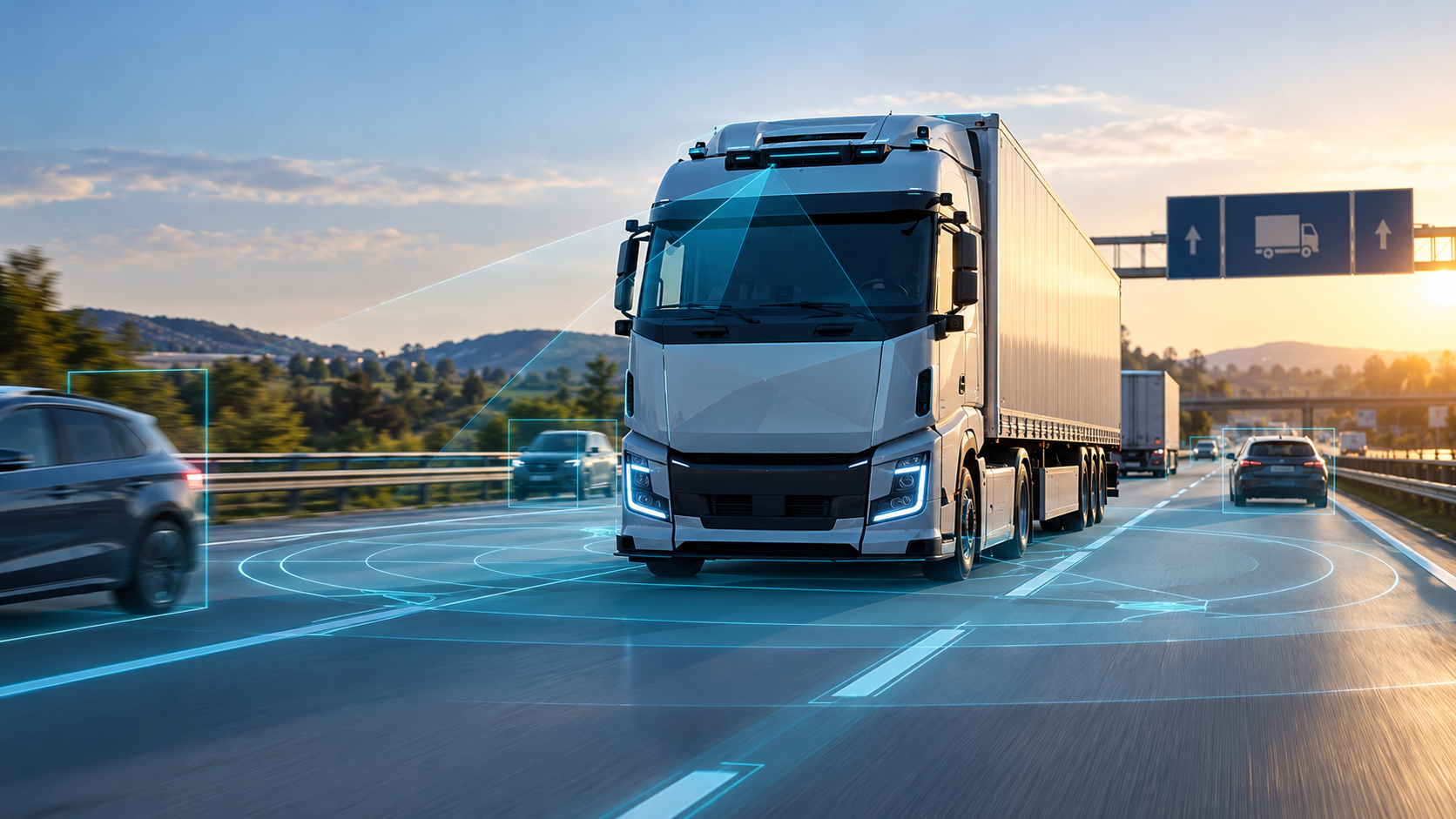
When a car steers, brakes, and accelerates on its own, it quickly creates the impression that it can already drive autonomously. This leads to misunderstandings in many modern vehicles. A vehicle that automatically follows the lane and maintains distance from the car ahead in traffic jams can still be technically far from true autonomous driving.
To distinguish between the different development stages, the automotive industry uses SAE Levels 0 to 5. What matters is not how many cameras, radar sensors, or assistance systems a vehicle has. What matters is who takes over the driving task and who must monitor traffic conditions.
Level 0 – No Automation
At Level 0, the human drives. The vehicle can support them through warnings or individual automatic interventions.
For example, an emergency braking assistant can initiate braking on its own. A lane departure warning system can warn the driver. However, the vehicle does not take over the driving task permanently.
The human remains fully responsible for driving.
Level 1 – Assisted Driving
At Level 1, the vehicle takes over either longitudinal or lateral control.
An adaptive cruise control system can regulate speed and distance while the driver steers. Conversely, a lane-keeping assistant can support steering while the driver controls speed and distance themselves.
The driver must continue to monitor the traffic situation constantly.
Level 2 – Partially Automated Driving
Many modern passenger cars and commercial vehicles are currently at this level.
The vehicle can steer, accelerate, and brake simultaneously. For example, an adaptive cruise control system is combined with lane centering.
This can already seem quite impressive in everyday life.
For instance, someone standing in traffic with a modern vehicle experiences the car automatically accelerating, braking, maintaining distance, and following the lane. Nevertheless, this is still not autonomous driving.
The driver must continue to monitor traffic conditions and be able to intervene at any time.
This is also the crucial point for a vehicle like my BYD Seal U DM-i. The fact that the car partially takes over steering, braking, and acceleration in traffic jams or on highways does not make it a Level 3 vehicle.
Level 2 means: The car supports the driver. The driver remains responsible for monitoring.
Level 3 – Conditional Automation
With Level 3, the role of the human shifts.
The automated system takes over the driving task within a precisely defined operational area. The driver does not need to permanently monitor the driving task during this automated phase.
However, this does not mean that the driver can simply get out or sleep.
If the system reaches its limits and requests a takeover, the driver must be able to regain control.
The difference between Level 2 and Level 3 is therefore crucial:
At Level 2, the driver must monitor. At Level 3, the system monitors the driving situation within its intended operational area and requests a takeover from the driver if necessary.
Level 4 – Highly Automated Driving
Level 4 goes significantly further.
The vehicle can take over the complete driving task itself within a defined operational area. A driver is no longer required there.
This operational area can be, for example, a specific highway section, a logistics center, a port, a terminal, or a fixed hub-to-hub connection.
Thus, the vehicle does not need to be able to drive autonomously everywhere and under all conditions.
This is exactly where the crucial difference to Level 5 lies.
A Level 4 truck can, for example, be developed for a specific highway connection between two logistics centers. Outside of this so-called Operational Design Domain, the vehicle cannot take over its automated driving task.
And this technology was one of the interesting topics at IAA TRANSPORTATION 2026 in Hannover.
Level 5 – Autonomous Driving Without Restrictions
Level 5 is the highest stage.
The vehicle can take over the complete driving task without requiring a human driver. There are no restrictions to a specific route or operational area.
Humans become passengers finally.
A Level 5 vehicle should fundamentally be able to drive autonomously everywhere that a human could drive with a corresponding vehicle.
The series vehicle world is currently still far from this.
Overview of the Six Levels
| SAE-Level | Automation | Role of the Human |
|---|---|---|
| 0 | No permanent automation | Human drives completely |
| 1 | Steering or speed is supported | Human monitors and drives |
| 2 | Steering and speed are supported | Human must monitor permanently |
| 3 | Vehicle takes over driving task within defined conditions | Human must respond to takeover request |
| 4 | Vehicle drives autonomously within a defined operational area | No driver required |
| 5 | Vehicle drives autonomously without restrictions | Human becomes a passenger |
Level 4 for Trucks: It became concrete at the IAA
Whoever believed that Level 4 was still pure science fiction for commercial vehicles had to take a closer look at IAA TRANSPORTATION 2026.
The Skyworth Z9 stood out particularly. The Chinese manufacturer presented a heavy-duty electric 6×4 tractor unit in Hanover, developed for autonomous driving at Level 4.
The Z9 is equipped with five LiDAR sensors, five millimeter-wave radars, and ten HD cameras, enabling the vehicle to perceive its surroundings all around. Skyworth initially envisions the truck for clearly defined application areas such as ports, steel mills, shunting yards, and logistics corridors.
This is important because that is exactly how one must understand Level 4: it is not about the truck driving from Hamburg to Munich without a driver tomorrow and handling any arbitrary situation.
It is initially about clearly defined and technically manageable application areas.
Going even further at IAA was the Chinese provider Pony.ai in collaboration with GAC Commercial Vehicle. A new Level 4 robotruck based on the battery-electric GAC T9 was presented. Pony.ai announced series production for the vehicle as early as 2026. Planned applications include long-haul traffic, defined logistics routes, and port operations.
Maxus also showcased an autonomous vehicle at IAA: The RoboVan is stated to operate at Level 4 according to IAA reports and is intended for driverless city logistics.
And what are the European manufacturers doing?
The view of IAA might initially create the impression that mainly Chinese manufacturers are making progress with autonomous trucks. However, this would be too short-sighted.
European manufacturers have also been working on Level 4 systems for years.
MAN is a particularly interesting example in this regard. In April 2024, the company became the first commercial vehicle manufacturer to receive a Level 4 test approval on German autobahns. Shortly thereafter, a MAN TGX completed an autonomous drive of approximately ten kilometers on the A9. The vehicle drove autonomously on the autobahn as part of the ATLAS-L4 project.
MAN is also working on autonomous trucks for so-called Hub-to-Hub traffic. The idea behind this is relatively simple: A truck drives autonomously, for example, from one logistics center to another. Within the defined application area, the system takes over the driving task.
DAF is also concretely working on Level 4. Together with the Swedish company Einride, the autonomous “Einride Driver” system is to be integrated into DAF’s electric truck platform. Initial tests and validations are planned for 2026, with integration into a DAF truck scheduled for 2027. However, no date has yet been given for a Level 4 truck available for regular purchase.
At Iveco, a concrete project is also underway. Together with PlusAI, two Iveco S-Way tractor units are to be equipped with an SAE Level 4 system. The vehicles are to be tested in regular freight transport for the logistics company Sesé on a route of approximately 300 kilometers between Madrid and Zaragoza in 2026. During the trial period, a safety driver will still be on board.
Daimler Truck is also working on autonomous trucks. Among other things, cooperation with the US company Torc plays a role. IAA reported in 2026 on the ongoing development of autonomous trucks.
China versus Europe?
Especially at IAA TRANSPORTATION 2026, an interesting difference could be observed.
On the Chinese side, several vehicles were presented where Level 4 was already shown very concretely as part of the vehicle or the intended application. Skyworth showed the Z9, and Pony.ai presented a Level 4 robotruck together with GAC.
The situation was different with BYD.
BYD presented the ETT 44, a new electric 44-ton tractor unit with up to 1,000 hp, a 651-kWh battery, and a stated range of around 600 kilometers. The company also presented other electric commercial vehicles. However, in official IAA reporting, the ETT 44 is referred to as an electric truck and not as a Level 4 vehicle. Therefore, there is currently no reliable evidence that BYD presented a Level 4 truck at IAA 2026.
With SuperPanther, the situation is somewhat more nuanced. The company already presented technologies supporting Level 4 functions at IAA in 2024. In 2026, however, the focus for SuperPanther was primarily on the production start of the eTopas 600 in Austria. Therefore, current IAA documents do not indicate that a series-ready Level 4 SuperPanther was presented at the fair as an autonomously driving truck.
This makes the matter even more interesting: Level 4 has visibly arrived at the fair with Chinese manufacturers, but European manufacturers have long been working on corresponding systems.
The difference currently lies mainly in how close the respective projects are to a concrete commercial application and in which application area they are intended to function.
The autonomous truck will probably not come first on the entire long-haul route
With passenger cars, it is often discussed that a car will eventually drive completely autonomously from home to the vacation destination.
The path there for trucks will likely look different.
A Level 4 truck does not need to immediately master every country road, roundabout, and unclear construction site area. For logistics, it is much simpler to automate a clearly defined application area first.
An example would be a fixed connection:
Logistics center → Autobahn → Logistics center
Or:
Port → defined road connection → Logistics center
Or even:
Terminal → Container transshipment → Parking area
Such scenarios are currently being developed by manufacturers and technology companies.
This also explains why Level 4 is already more tangible for commercial vehicles than a universally deployable Level 5 vehicle.
What does this mean for professional drivers?
For the driver of a current Level 2 truck, little changes regarding fundamental responsibility initially. The vehicle can assist with steering, braking, and acceleration, but the driver must continue to monitor the driving task and traffic conditions.
With a Level 4 truck, however, the concept changes fundamentally.
Within the operating area approved for the system, a driver is no longer strictly required. A truck could, for example, drive autonomously between two logistics centers without a professional driver sitting behind the wheel during this trip.
This raises a question that is often overlooked in discussions about autonomous trucks: What actually happens to the profession of the professional driver when the core task of the profession is automated?
Loading and unloading generally do not belong to the actual activities of the professional driver today; warehouse and loading personnel are responsible for this depending on the operation. Dispatching is also an independent area of activity. Maintenance and technical upkeep also do not belong to the actual profession of the professional driver. This does not necessarily mean that there is a ban here. There are indeed companies where loading and unloading is part of the driver’s daily task, mainly because there is no other way. Similarly, maintenance and minor repairs can be part of everyday life.
Therefore, an autonomous truck would not simply take over some tasks of the driver. It could automate exactly the central activity for which the professional driver is needed: safely driving the commercial vehicle on public roads.
Of course, professional drivers could take on additional tasks in the future. Examples might include activities during vehicle takeover and handover, inspections, certain logistical tasks, or other tasks surrounding transport. This would then be an expansion or change of the job profile. These activities do not automatically become the classic tasks of a professional driver.
Especially with Level 4 traffic on fixed routes, a fundamental question therefore arises: If a truck drives autonomously between two logistics centers and no longer requires a driver within this operating area, what task remains for the professional driver there?
This is precisely where one of the greatest challenges lies that autonomous driving could bring to the profession. It is no longer just about an assistance system supporting the driver. At Level 4, the technology can fully take over the actual driving task within its operating area.
Whether this actually leads to fewer jobs or changes the job profile cannot be answered categorically today. What will be decisive is how quickly autonomous vehicles are deployed, which transport routes are suitable for this, and how companies organize their processes.
One thing should be clearly distinguished in this discussion: If a professional driver takes on other tasks in the future that are currently performed by warehouse personnel, dispatching, or other employees, this does not automatically mean that these tasks belong to the original job profile of the professional driver. Rather, it would be a change of the profession and its area of use.
The more interesting question is therefore perhaps not:
“When will the autonomous truck replace the driver?”
But rather:
“Which parts of today’s work of a professional driver will be taken over by the machine in the future – and which tasks will remain with humans?”
It is precisely at this point that it will be decided how the profession could change. The autonomous truck does not necessarily replace an entire person initially. It automates a specific activity: driving the vehicle. What happens to the job profile afterwards depends on which new tasks actually emerge and whether these tasks are continued to be taken over by professional drivers.
The IAA TRANSPORTATION 2026 has certainly shown that this development no longer exists only on presentation slides. Several manufacturers and technology companies are already conducting concrete trials and planning deployments of Level 4 commercial vehicles.
Sources and further information
SAE Levels and Definitions
- SAE International – J3016: Taxonomy and Definitions for Terms Related to Driving Automation Systems – Current definition of SAE Levels 0 to 5.
- SAE International – Overview of SAE Levels 0 to 5 (PDF) – Graphic overview of the various levels of automation.
Legal Basis in Germany
- Gesetze im Internet – § 1b StVG – Rights and obligations of the vehicle operator when using automated driving functions.
- Gesetze im Internet – Straßenverkehrsgesetz (StVG) – Full text of the Road Traffic Act.
Autonomous Commercial Vehicles and IAA TRANSPORTATION 2026
- IAA TRANSPORTATION – Skyworth Z9: Autonomous Electric Truck with Level 4 – World premiere of the Level 4 designed Skyworth Z9 at IAA TRANSPORTATION 2026.
- IAA TRANSPORTATION – Press Day 2026 – Overview of the Skyworth Z9 and other autonomous commercial vehicles at the IAA.
- Pony.ai – Gen-4 Robotruck with GAC Commercial Vehicle – Level 4 robotruck presented at IAA 2026 based on the GAC T9.
European Manufacturers
- MAN – ATLAS-L4 and autonomous trucks – Information on MAN’s development of Level 4 trucks and autonomous hub-to-hub transport.
- DAF Trucks – Collaboration with Einride – Development of autonomous electric trucks according to SAE Level 4.
- IVECO – Level 4 program with PlusAI – Testing of heavy-duty Level 4 trucks in freight transport in Spain.
