

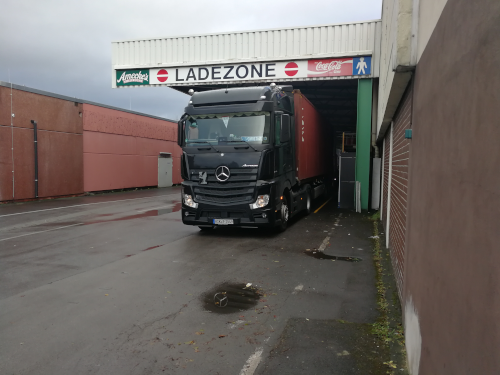
It is often told again and again, the tale that we professional drivers are not allowed to load and unload our vehicles. Someone once heard that there is a law that would state this. Unfortunately, this is again and again fueled by certain, often shining with half-knowledge, actors in social networks. But to be honest: This law does not exist. And there is also no law from which you could currently derive this factually.
The Loading and Unloading Ban
To take a closer look at how one even comes up with this narrow beam?
It is actually simple, because often the § 412 HGB is named, in which exactly this would be stated. But let’s first take a look at what exactly is stated in the 412th section:
§ 412 Loading and Unloading. Regulatory Authority
(1) Unless the circumstances or the traffic situation indicate otherwise, the sender must load, stack and secure the goods (loading) and unload them in a transport-safe manner. The freight carrier must ensure the operationally safe loading.
(2) For the loading and unloading time, which, in the absence of a different agreement, is measured according to a reasonable period for the circumstances of the case, no special remuneration may be claimed.
(3) If the freight carrier waits beyond the loading or unloading time due to a contractual agreement or for reasons not attributable to his risk area, he is entitled to a reasonable remuneration (standgeld).
(4) The Federal Ministry of Justice is authorized, in agreement with the Federal Ministry for Digital and Transport, to issue regulations by law that do not require the consent of the Bundesrat, for inland waterway transport, taking into account the type of vehicles intended for transport, the type and quantity of goods to be loaded, the technical means available for the goods handling, and the requirements of an accelerated traffic flow, to determine the conditions for the start of the loading and unloading time, its duration, and the amount of standgeld.
So, that is the complete paragraph 412 as it stands in the HGB. However, often the loading and unloading ban is derived from the first paragraph.
(1) Unless the circumstances or the traffic situation indicate otherwise, the sender must load, stack and secure the goods (loading) and unload them in a transport-safe manner. The freight carrier must ensure the operationally safe loading.
With a lot of imagination, one could derive a loading and unloading ban for BKF from this. However… However, there is much to consider here.
Already the first sentence states that circumstances or traffic situation can lead to the fact that as a BKF you have to load and also unload the goods.
But also further on, even though it states what the obligations of the sender are, it does not state that he may not delegate this or make it a condition of the transport order. We still have a contract law in Germany.
To put it even clearer: Just because it states that the sender must load and secure the goods in a transport-safe manner, it does not say how he must or may do it. And what actually also belongs to the basic knowledge of a BKF: The freight carrier is not necessarily also the one who actually drives it from A to B.
In the comments, which exist for every law, this becomes even clearer: Guckst du .
There is no ban
Let us summarize: There is no general loading and unloading ban in Germany. The only exception is here the CMR law, which only applies in cross-border transport. That means: Only because you have a CMR bill of lading for a national transport does not mean that the CMR law also applies here. One of the few exceptions here: Overseas containers. They only have to secure the containers on the chassis so that they do not fall down. Even the doors of the container may you not open . Practically, however, it is done, and in many companies it is even expected. Once, the refusal to open the doors led to a lifetime house ban for me. Well, I didn’t care. I had the instruction from my former employer: You don’t open the doors. I had that instruction in writing.
So once again: There is no general loading and unloading ban in Germany. It would not be feasible to realize it in many areas.