

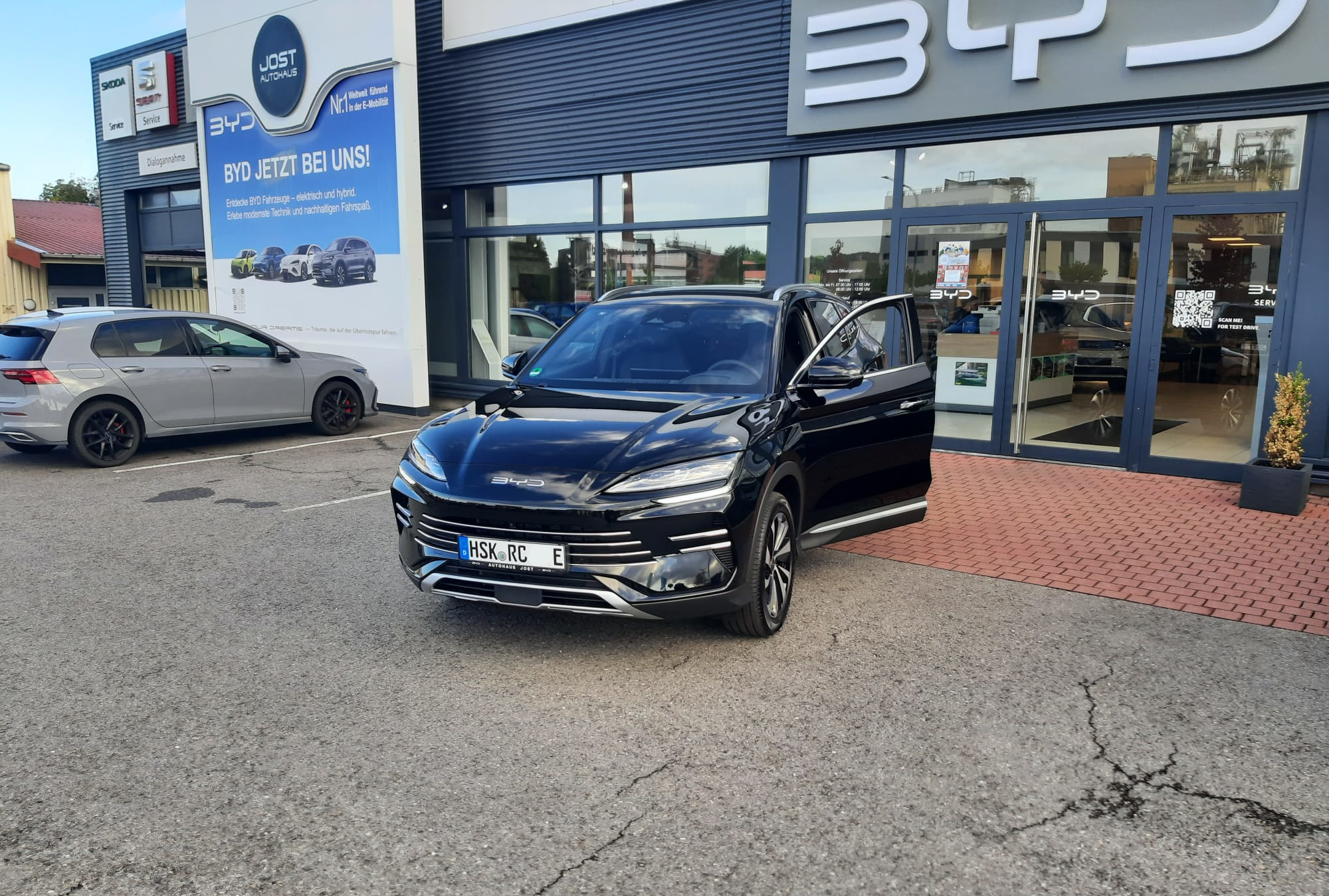
The first 1,000 kilometers with my BYD Seal U DM-i are almost completed. There are still exactly 50 km left. It’s time for a first interim report.
Of course, this is still not a long-term test. For that, 1,000 kilometers are still too little. But it’s enough to get a first impression of whether the car lives up to what I expected.
And my answer is quite clear: Yes.
The First 1,000 Kilometers
I must honestly say: The car has met my expectations.
What I had previously read and heard about BYD has so far been confirmed by my vehicle. So far, I haven’t found any reason to question the many positive impressions I had collected before purchasing the car.
The Seal U DM-i drives exceptionally quietly. There is no clattering inside, no rattling, and so far, there are no noises that make me wonder where they are coming from.
Especially after the first few kilometers, you pay particular attention to such things. After all, you want to know whether the good first impression also holds up in everyday driving. Especially when you, like me, are still familiar with the behavior of the Chinese on the IAA Nutzfahrzeugmesse in Hannover.
Voice Control and Safety Thinking
A feature I find particularly cool is the voice control.
I can operate many functions in the vehicle simply by speaking. For example, I can say that the windows should be opened or closed, turn on the seat heating, or operate the panoramic sunroof. Many functions of the infotainment system can also be controlled by voice.
At first, this might sound like a nice technical toy. For me, however, there is something else behind it: I don’t have to navigate through the screen or search for a switch anymore for many functions.
That is especially useful during a drive.
And that brings us to a point that is becoming increasingly apparent to me with the Seal U DM-i: BYD seems to have not only focused on fitting as much technology as possible into the vehicle. Much of it is also related to the topic of safety.
This starts with the assistance systems and goes up to the fundamental design of the vehicle. A feature I find particularly important, even though I no longer have small children, is the Child Forgetting Detection, also known as the detection of whether someone is left behind after locking the car.
The system monitors the interior of the vehicle after parking and locking it for signs of life. If a person or even an animal is detected, the vehicle can alert the driver or the surroundings with hazard lights and horn. Basically, the driver is informed or alerted via the vehicle app. Depending on the situation, the air conditioning is also activated. I don’t know how this works with-in-laws, though… small joke.
For me, this is a good example that safety in a car doesn’t start only at the time of an accident. A child or a pet left accidentally in the vehicle can quickly be in life-threatening danger, especially at high outside temperatures. The ADAC also points out that a parked vehicle can heat up significantly even at moderate outside temperatures.
Interestingly, the look at China also shows that the Child Presence Detection was first included in the C-NBA safety rating in 2024. This is meant to explicitly promote the development of such systems.
And exactly these features I mean when I speak of safety thinking at BYD. This is not a function that stands out during a normal drive. In the best case, you never even see it. But if it is ever needed, it can make a decisive difference.
Safety Doesn’t Start Only at the Time of an Accident
Regarding the topic of safety, I like that BYD relies on an extensive package of modern driver assistance systems. In everyday driving, I have access to adaptive cruise control, lane-keeping and lane-change assistant, blind-spot monitoring, traffic sign recognition, collision warning, emergency braking assistant, and a 360-degree camera. This is now no longer a special feature in many vehicles. Therefore, I find it more interesting how consistently the various systems are combined with each other.
Regarding the high-voltage battery, BYD relies on its own Blade Battery. The Seal U DM-i Boost is equipped with an 18.3-kWh battery based on lithium iron phosphate (LFP). BYD refers to the LFP chemistry as an important factor for the thermal stability and safety of the battery.
An example of this is the so-called Nail-Penetration-Test . I link here exceptionally to YouTube. In this test, a nail is driven through a battery cell to provoke an internal short circuit. BYD shows in its own video such a test and compares the Blade Battery with an NCM battery. In the demonstrated experiment, the NCM battery reacts much more strongly, while no smoke or fire is visible with the Blade Battery.
It is important to note, however, that this is a test conducted and published by BYD itself. Therefore, it is not an independent comparison test. I still find it interesting because it provides a concrete insight into the safety approach of the manufacturer. For me, less important is the spectacular video than the fact that BYD clearly places battery safety at the center of its battery technology.
Of course, this does not mean that a car would be accident- or fire-safe. That would be a completely wrong conclusion. But it shows that BYD is at least very intensively dealing with the question of how to manage the risks of a high-voltage system.
Euro NCAP has also examined the SEAL U. During the crash test, the passenger cell remained stable in the frontal impact. In the side impact test, the vehicle achieved the maximum score. Overall, 90 percent was achieved in the protection of adult occupants, 86 percent in the protection of children, and 77 percent in the safety assistance systems. The evaluation refers to the 2023 tested SEAL U and includes the PHEV variant Boost.
What I like about this: Safety is not reduced to airbags. It begins long before the actual accident – with the driver’s attention, with the support of assistance systems, and with the question of how the vehicle reacts in an emergency.
After just under 1,000 kilometers, I can of course not yet make any statement about how these systems will perform over years. But in daily use, I do get the impression that BYD has not simply compiled a long list of features, but rather considers many of these functions as part of the overall concept.
I am also positively surprised by the range. BYD states a combined range of up to 1,150 kilometers for the Seal U DM-i. After the first drives, I can at least say: This magnitude is not completely out of the world. Of course, the actual range depends on driving style, route, weather, speed, and charge state. But the figure does not seem to me like a pure brochure number that comes about under completely unrealistic conditions.
My personal retarder
A function particularly appeals to me as a professional truck driver.
The Seal U DM-i does not naturally have a retarder like a truck. However, the driving experience when descending a hill with the cruise control activated reminds me of that.
When the cruise control maintains a speed and the vehicle descends a hill, the vehicle does not simply try to speed up. Instead, the vehicle is decelerated through regenerative braking and thus maintains the set speed.
For me, this is a quite pleasant feature.
With trucks, I have known this principle for years. Maintaining speed downhill without constantly having to use the service brake. With the Seal U, this happens electrically.
And in this case, the energy is not simply converted into heat. Through regenerative braking, part of the kinetic energy is converted back into electrical energy and stored in the battery.
This is one of the points where I actually notice in daily life that I have committed myself to a different powertrain technology.
The equipment is also impressive
I have opted for the Boost variant. And the equipment is another point where the Seal U DM-i makes a quite good impression.
Technical and standard equipment of the BYD Seal U DM-I
Equipment of the BYD Seal U DM-I in the Boost variant
Equipment of the BYD Seal U DM-i Boost
| Area | Equipment | Boost |
|---|---|---|
| Exterior | Metallic paint | ✓ |
| LED headlights with automatic | ✓ | |
| LED daytime running lights | ✓ | |
| Dynamic welcome light | ✓ | |
| High beam assistant | ✓ | |
| LED tail lights | ✓ | |
| Panoramic sunroof with electric sunshade | ✓ | |
| Aluminum roof rail | ✓ | |
| Electric tailgate | ✓ | |
| 19" alloy wheels | ✓ | |
| Electric, heated, and adjustable exterior mirrors | ✓ | |
| Front windshield with heat and sound insulation | ✓ | |
| Rain sensor | ✓ | |
| Interior | Multifunction steering wheel in vegan leather | ✓ |
| Heated steering wheel | ✓ | |
| Seats with vegan leather upholstery | ✓ | |
| Driver’s seat electrically adjustable | ✓ | |
| Driver’s seat heated and ventilated | ✓ | |
| Driver’s seat with memory function | ✓ | |
| Passenger seat electrically adjustable | ✓ | |
| Passenger seat heated and ventilated | ✓ | |
| Rear seats 40:60 foldable | ✓ | |
| Multicolored ambient lighting | ✓ | |
| Automatically dimming interior mirror | ✓ | |
| Ventilation ducts in the rear | ✓ | |
| PM2.5 air filter and air purification system | ✓ | |
| Infotainment | 12.3" driver display | ✓ |
| 15.6" touchscreen, electrically adjustable | ✓ | |
| DAB+/FM | ✓ | |
| Infinity® sound system | ✓ | |
| Head-up display (HUD) | ✓ | |
| “Hi, BYD!” voice control | ✓ | |
| 4G connectivity | ✓ | |
| BYD App / Cloud service | ✓ | |
| Apple CarPlay / Android Auto | ✓ | |
| USB-C ports front and rear | ✓ | |
| Wireless smartphone charging | ✓ | |
| Assistance & Safety | Adaptive cruise control (ACC) | ✓ |
| Intelligent Cruise Control (ICC) | ✓ | |
| Lane-keeping assistant (LKA) | ✓ | |
| Lane departure warning (LDW) | ✓ | |
| Lane change assistant (LCA) | ✓ | |
| Blind-spot detection (BSD) | ✓ | |
| Traffic sign recognition | ✓ | |
| Intelligent speed limiter | ✓ | |
| Emergency braking assistant | ✓ | |
| Cross-traffic warning front/back | ✓ | |
| Front/back collision warning | ✓ | |
| Attention warning | ✓ | |
| 360° camera | ✓ | |
| Parking sensors front and back | ✓ | |
| Comfort & Technology | Auto-Hold | ✓ |
| Electric parking brake | ✓ | |
| Hill start and assist | ✓ | |
| 11-kW onboard charger | ✓ | |
| V2L – Vehicle-to-Load | ✓ | |
| Keyless Entry & Keyless Start | ✓ | |
| Pre-cooling via BYD App | ✓ | |
| Driving modes Eco / Normal / Sport / Snow | ✓ | |
| Tire pressure monitoring system | ✓ | |
| Safety | Driver/Passenger airbag | ✓ |
| Front center airbag | ✓ | |
| Side and curtain/shoulder airbags | ✓ | |
| ISOFIX/i-Size | ✓ | |
| Child forgetting detection | ✓ | |
| eCall emergency call system | ✓ |
Because a long list of assistance systems and technical features may sound impressive. What’s essential for me, however, is whether I can actually use them in daily driving.
I would find it even better if the cruise control not only regulated the distance, but also functioned like in a truck, guided by GPS. That would be a clear advantage for economical driving, as the cruise control could adapt my driving behavior to the conditions of the roads. In other words: rolling where it’s possible, maintaining or increasing speed when necessary.
The Seal U DM-I is still available in the variants Design, Comfort and AWD. The differences here are actually only the battery size. Good for the AWD variant, the all-wheel drive is also added.
Here are a few pictures of the interior:
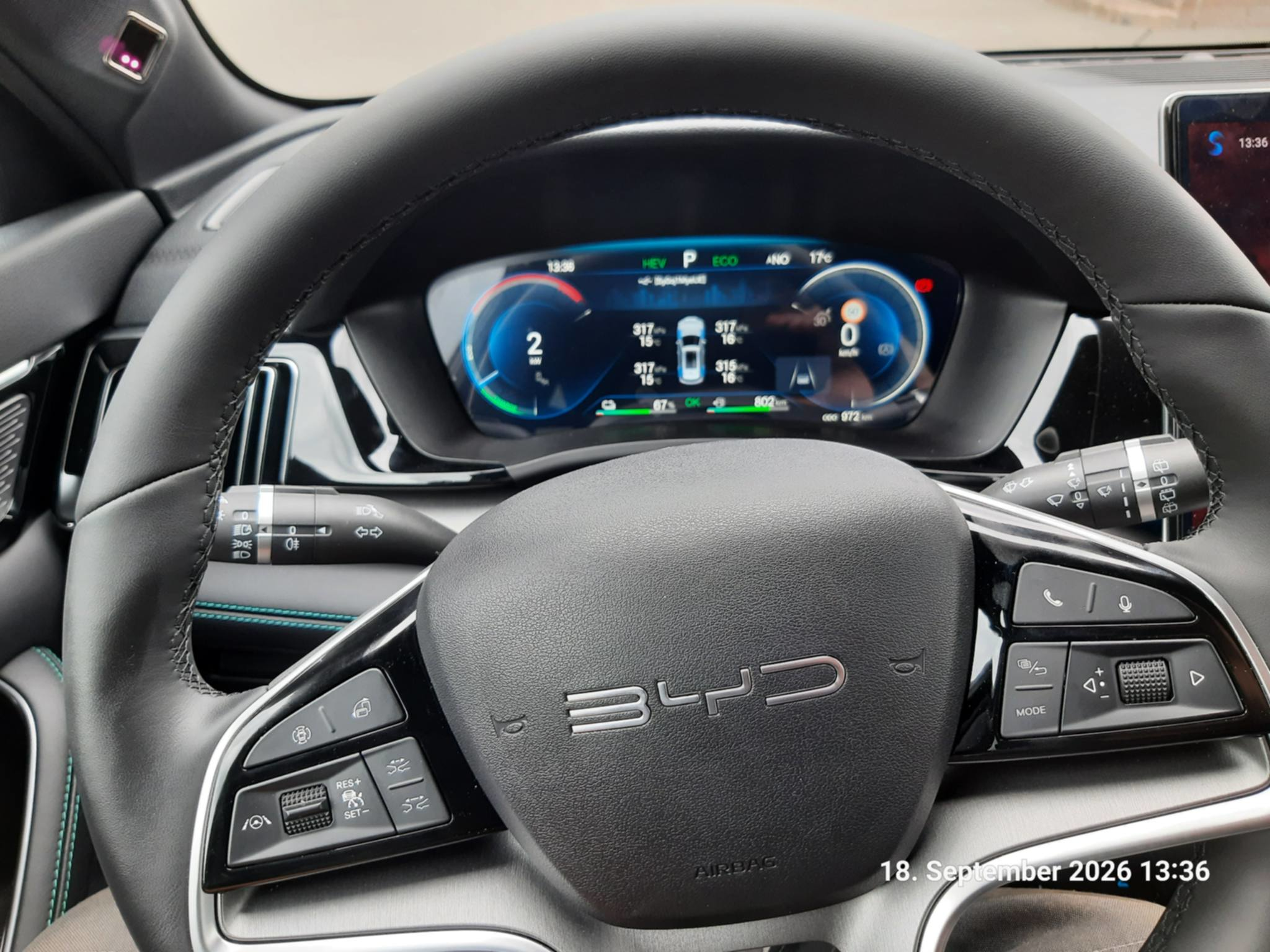
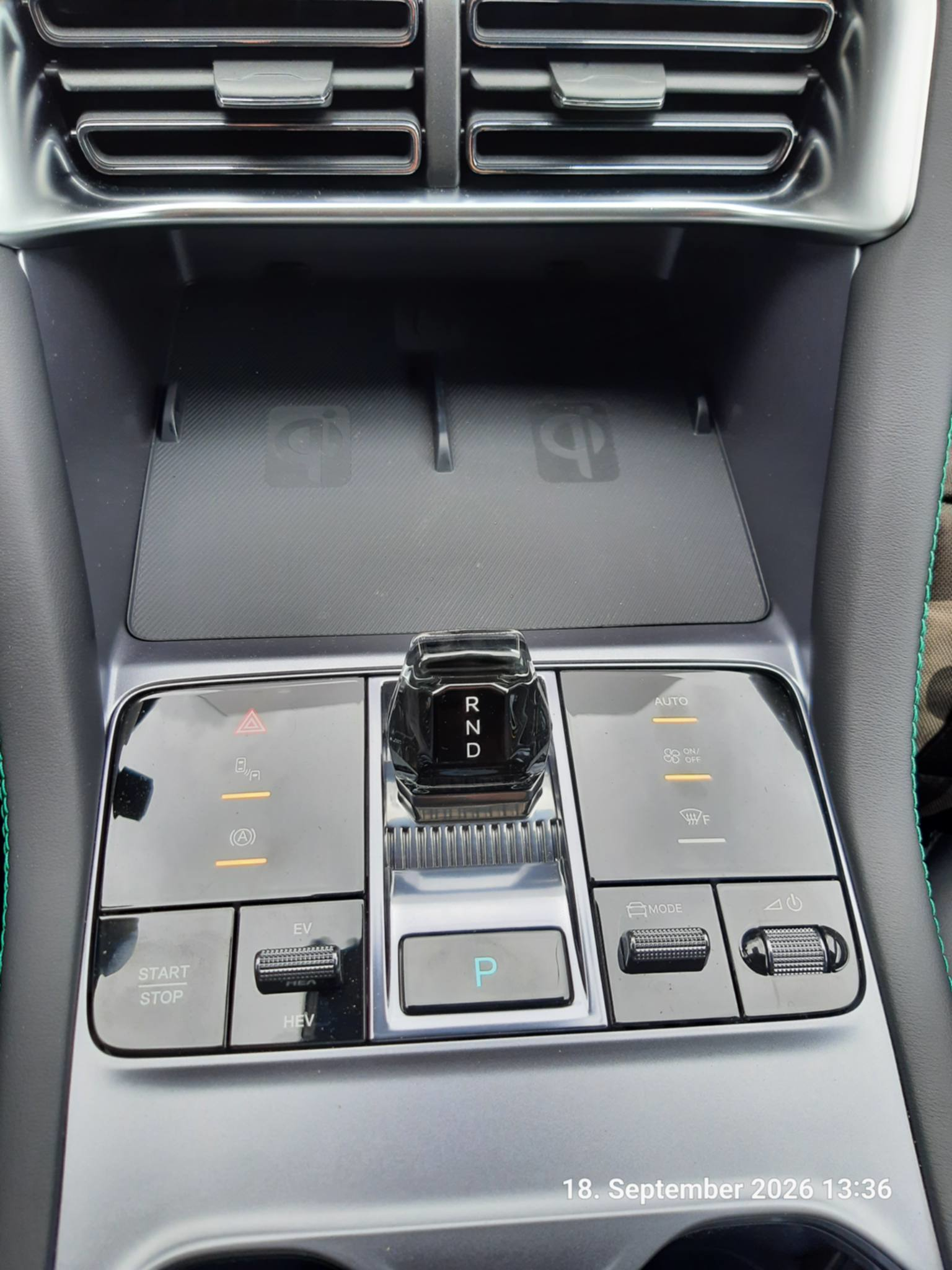

Behind the gear selector, indicating in which direction you want to drive, there are two charging pads for wireless smartphone charging.
And no joke, accessories for the car can be bought cheaply at Temu and that fits as well.
Of course, not everything is gold that shines
Of course, there are already things that bother me. I’ve never really been a fan of automatic high beams. Although it may have advantages here and there when the high beams are automatically activated.
But the fact that the high beams already turn on when I drive through a heavily wooded area or that I can’t permanently deactivate them via the lever bothers me personally, even though the light already reacts to oncoming traffic that I haven’t even seen yet.
Well, you have to activate the intelligent high beams yourself in the menu and also deactivate them again. At my car, it remains deactivated, as I want to decide myself when I need high beams and when not.
And then there are the social networks
I actually wanted to write here simply about my new car.
Buying a car, driving it, gathering experiences and sharing these experiences with others.
So simple it was and is, however, not. As soon as I started reporting about the BYD, I received not only factual questions but also some rather clear reactions.
I was accused, among other things, of being a “Germany-hater”.
Others claimed that I don’t care about the German industry and the German economy at all. Some even accused me of being an “job killer” by buying a Chinese car. Then there were comments like: Some have national pride, others buy a Chinese car.
The fact that someone buys a certain car and suddenly a political or economic stance is constructed from it is hardly surprising anymore in today’s time.
Especially from people with a – um … “patriotic” – mindset, some reactions were quite remarkable. Obviously, for some people, it’s already enough to buy a Chinese car to construct an attack on Germany, the German economy, or even the entire domestic industry from it.
This has little to do with rational criticism. As soon as the arguments run out, it quickly becomes personal.
I didn’t buy the Seal U DM-i to embarrass the German automotive industry.
I bought a car because I like it and because it fits what I expect from a car. Exactly the same way I did with my two Ford Kuga, my BMWs and my two VW Passat. At that time, I didn’t think about whether my purchase decision sent any message to the automotive industry. Why should it be any different today?
Of course, I know the significance of the German automotive industry for our country. It employs millions of people directly and indirectly and is an important part of our economy. Recognizing this doesn’t mean I have to stick to German brands when buying a car.
I can value the German automotive industry highly and still drive a BYD.
For me, this is no contradiction. It’s simply the decision for the car I want.
And honestly? That right-wing nonsense is annoying. If the “Chinaschrott” thing bothers you so much, then throw away your smartphone, smart TV, and even your car. There are also parts from China in those as well.
A car is not a religious confession
I believe, exactly here lies one of the problems of such discussions.
When it comes to cars, it’s no longer just about technology, fuel consumption, comfort or price. For some people, the brand seems to almost express a kind of political or economic affiliation.
Who drives a German manufacturer is the good one.
Who buys a Chinese manufacturer is suddenly against Germany.
But the reality is not that simple.
I will therefore continue to report about my Seal U DM-i. Not because I want to defend BYD and also not because I want to convince anyone to buy a BYD as well.
Rather, because I now collect experiences with this car.
And exactly these experiences are, in my opinion, more interesting than any discussions about what a car is supposed to be able to do, where it was built, or what someone thinks about it on the internet.
After the first 1,000 kilometers, I can at least say:
The BYD Seal U DM-i has met my expectations.
It drives quietly, so far without clattering or shaking, the range makes a good impression, and the regenerative braking when going downhill is particularly nice.
Now let’s see what the next 5,000 or 10,000 kilometers bring.
