

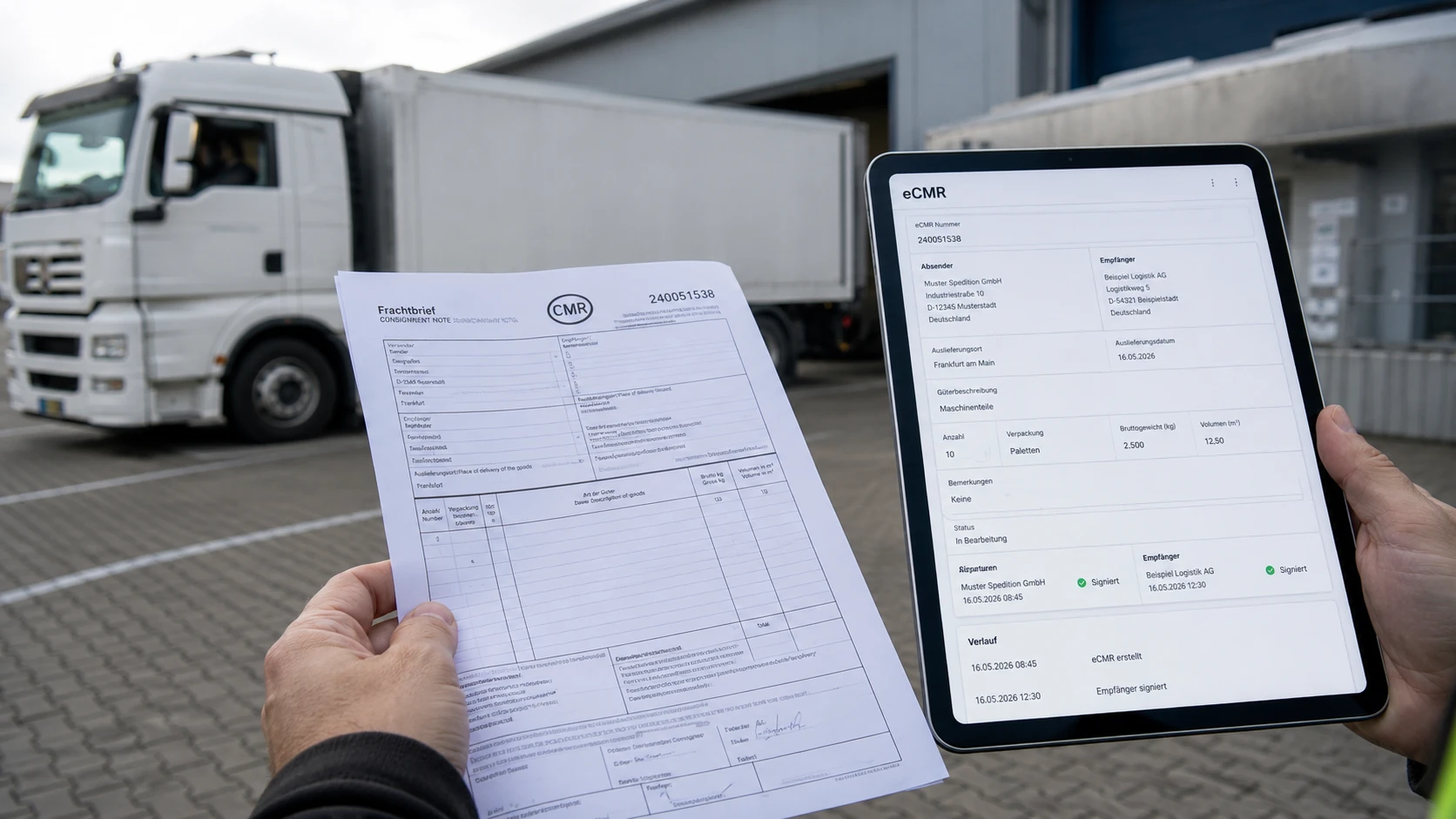
Electronic Consignment Note (eCMR): What is actually changing
Barely does the term electronic consignment note (eCMR) come up before the first objection arises:
“Digital documents can be manipulated much more easily!”
Or:
“And what about the paperwork during inspections?”
The discussion is understandable. After all, the classic paper CMR consignment note has been part of daily life in freight transport for decades.
However, much of what is currently discussed regarding the eCMR is based on a misunderstanding:
An electronic consignment note is not simply a PDF on a tablet.
In reality, it involves a legal and technical framework that goes significantly further.
What exactly is the eCMR?
The eCMR is the electronic version of the international CMR consignment note.
The basis for this is the Additional Protocol to the CMR Convention of 2008, which legally permits electronic consignment notes and which Germany has since joined.
The goal:
To digitally represent transport documents in a traceable and legally secure manner.
And it is exactly here that the difference begins from the notion:
“Simply scan paper and save as a file.”
Because that is precisely not how the eCMR is intended.
What does the law actually stipulate?
The CMR Additional Protocol does not simply state:
“From now on, please go digital.”
Instead, there are concrete requirements for electronic transport documents.
An eCMR system must provide procedures that:
Ensure authenticity
- Who created the consignment note?
- Who confirmed it?
- Who signed it?
Guarantee integrity
- Was anything altered afterwards?
- Were entries manipulated?
- Changes must be traceable.
Enable traceability
Operations must be logged.
- Who changed something and when?
- Were there subsequent additions?
Be legally equivalent to paper
A correctly implemented eCMR should have the same legal effect as a classic paper consignment note.
In short:
The legislature has not provided for someone to quietly alter a document without it becoming traceable.
The EU adds additional requirements
In addition to the eCMR, there are further regulations from the European Union.
eIDAS Regulation: Digital Signatures
The eIDAS Regulation (EU 910/2014) governs electronic signatures within the EU.
Simplified, this means:
An electronic signature must ensure that:
- the signatory is identifiable
- the signature can be uniquely assigned
- subsequent changes are noticeable
- the signatory had control over the signature
Or put more simply:
If someone alters something afterwards, that must become visible.
Therefore, many eCMR systems work with:
- Timestamps
- Audit trails
- Version histories
- Certificates
- Change logs
Not because it sounds modern — but because the legal situation practically demands it.
eFTI Regulation: Inspections go digital
Then there is also the eFTI Regulation (EU 2020/1056).
This gets particularly interesting.
Because the EU initially does not oblige companies to work digitally.
Instead, it obliges authorities to be able to accept digital transport information.
From July 9, 2027, authorities in the EU must generally accept electronic freight data, provided it is supplied via approved systems.
This changes the logic of inspections.
Today it often says:
“Please provide vehicle documents.”
In the future, it might rather say:
“We access the transport data.”
What does this mean for drivers?
A question that keeps coming up is:
“Do I then need paper at all?”
And exactly here it gets interesting. Many drivers know the provisions from § 7 Abs. 1 No. 3 GüKG (German Road Transport Act).
Documents for the trip must be available for inspection — traditionally often as paper in the vehicle.
The exciting question is therefore:
How does this work with the eCMR?
Because if data is digitally available, the actual control shifts.
No longer:
“Does the driver have the papers?”
But rather:
“Are the transport data complete, correct, and accessible?”
An interesting insight from BALM
Because I was particularly interested in this question, I asked a staff member at BALM (Federal Office for Logistics and Mobility) directly:
“How do you actually inspect an eCMR?”
The answer came surprisingly pragmatically:
“Quite simple, access to the database — and soon also while driving.”
If this becomes established in practice, control in freight transport would change significantly.
Because then it would no longer necessarily be about whether the driver has a paper folder or a tablet somewhere.
The real question would then rather be:
Are the transport data complete, correct, and accessible?
This naturally raises new questions:
- How does this work in dead zones?
- What happens in case of system failures?
- Is there an offline solution?
- How transparent are such inspections for drivers and companies?
Because digitization can simplify processes — but it also changes how control works in general.
But does this work in practice?
And exactly here come the justified doubts.
Because digitization is only good if it works in everyday life.
Drivers ask questions entirely reasonably:
- What happens with an empty battery?
- Does it work without mobile network?
- What happens in case of a server failure?
- Are there fallback solutions?
- How does an inspection go at night on the rest stop?
Because reality on the road often looks different than a concept paper in Brussels.
Digitization does not automatically solve problems.
Poorly implemented, it often produces only new ones.
A Look at the ATLAS Customs System
An interesting comparison is the ATLAS system in customs.
There, customs processes have already been handled digitally for years.
Here too, it concerns:
- digital traceability
- audit trails
- documented changes
- verifiable datasets
Neither is perfect or completely tamper-proof.
But:
Tampering becomes more difficult — and above all, more traceable.
In this direction, the electronic consignment note will likely develop in the long term as well.
My Conclusion
The statement:
“You can manipulate things much more easily digitally!”
is only half the truth.
Yes — digital documents can be manipulated. Paper can too.
The crucial difference is:
A good eCMR system should make manipulations more visible and traceable.
You can imagine it like this:
An eCMR is ideally not a loose sheet of paper, but rather like a document with audit stamps. If someone changes something later, the corresponding proofs suddenly go missing — or the change appears visibly in the system. In other words:
Not every manipulation becomes impossible. But it leaves traces instead.
The real change therefore does not lie in paper disappearing, but in the logic of control changing.
Previously:
Does the driver have the papers?
In the future rather:
Are the data correct, plausible, and retrievable?
Whether this ultimately becomes progress is not decided by technology alone.
But whether the systems are practical for drivers, companies, and customs authorities alike.
