

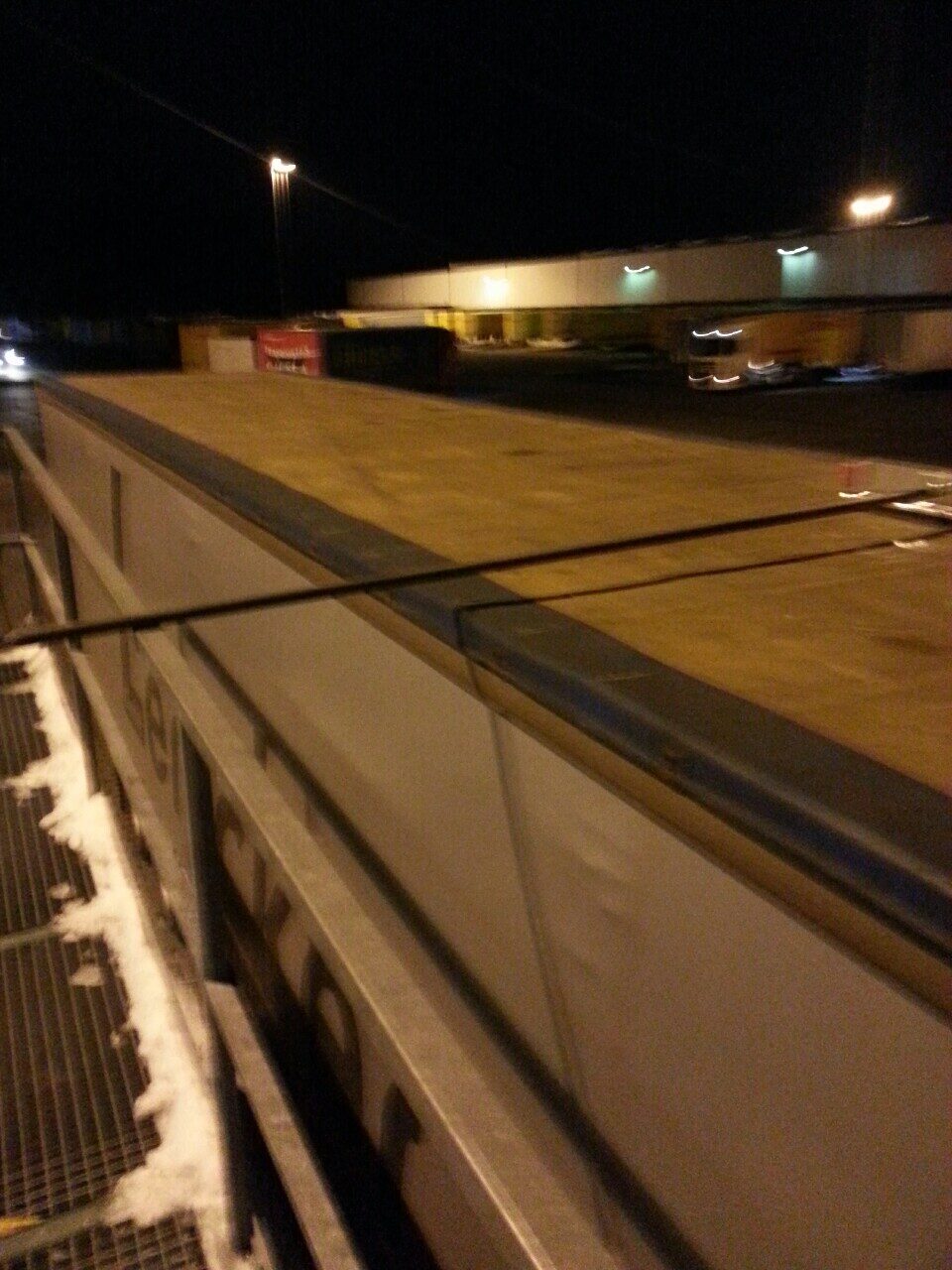
As every year, people discuss a topic that truck drivers seemingly don’t want to understand: ice sheets and the associated dangers.
It’s not that accidents have already occurred during this “season,” but apparently, the issue must be revisited on a half-yearly basis until someone finally understands it.
Accidents on Highways
Accidents happen daily on highways. Many of them are avoidable simply by fulfilling one’s obligations as a vehicle operator (regardless of the type of vehicle used in road traffic). Especially during this time of year, it is crucial to inspect vehicle superstructures to ensure nothing is lying on top that could fall off and endanger other road users.
Ice Sheets – A Topic That Recurs Every Year
The sad part is that this topic comes up again at the same time every year. Even though climate change is currently a hot topic, we still experience winter in Germany at the same time each year. And just like that, there are always the same people who try to evade responsibility with weak, recurring excuses instead of taking action.
Snow Removal Racks – The Advertised Panacea
Certainly, snow removal racks are one of many options that help remove snow and ice masses from superstructures. However, no matter where you read about ice sheets—even in specialized press—if you don’t have a rack nearby, they won’t help you at all.
Legally speaking, I am not allowed to drive my vehicle unless I have ensured that it does not pose any danger. This means: remove the debris before starting the journey. There is no other option!
Alternatives are often overlooked or left under the table.
I am one of the few who consistently highlight these alternatives.
If you have a snow removal rack available at the parking lot where you’re currently stationed, that’s great. But what do you do if there isn’t one?
This is always forgotten. Why?
There are sensible alternatives that can be used anytime. There are ladders specifically developed for this purpose and even approved by the BG . This means: You are insured when using these ladders in accordance with the safety regulations!
Then there’s also the RSAB—the Roof Safety Airbag. It’s an air hose mounted under the roof of trailer superstructures and inflated using the vehicle’s own air supply. For this to work properly, you should park your vehicle during your daily or weekly rest period—not just in the morning hoping the device will destroy the ice sheets. The hose cannot do that!
But my boss…
That’s another popular excuse: “My boss won’t pay for it, and I can’t agree to finance it with my own money.”
Or another commonly used excuse: “As long as the entrepreneur is not legally obligated to take action, nothing will happen anyway.”
Regarding point one, I recommend the Deminimis funding program of the Federal Office for Road Transport. Through this program, entrepreneurs can subsidize these measures. To put it in numbers: per year and per vehicle, an entrepreneur can apply for up to €2,000 annually or a total of €33,000 for various measures.
These include, for example, further training, work clothing, and items that make the vehicle safer, such as the RSAB and/or the mentioned ladder .
Regarding point two: Fortunately, there is already a legal obligation for entrepreneurs. This is specified in paragraphs §31 StVZO and §69a of the StVZO .
Conclusion
Snow removal racks have both advantages and disadvantages.
The advantage is that the driver doesn’t need to dig out a ladder to reach the roof.
A more or less up-to-date list of locations for these racks can be found, for example, here for download . Unfortunately, this list is currently not updated. You should also ensure you can get a parking spot there. Driving to such a location is not permitted without proper preparation.
And that’s also the disadvantage at the same time: they are stationary, and many colleagues simply park them away too easily.
There must be a middle path here: use snow removal racks when one is available nearby; otherwise, use ladders and RSABs. There will certainly be a way to securely attach the ladder to the vehicle and, above all, protect it from theft.
One small note: If nothing is done despite the employer’s obligation, ultimately it is the driver who must leave the vehicle behind. Work refusal can indeed be accused of someone in such cases, but that accusation is baseless. Work refusal would only apply if the boss provides the equipment and the driver refuses to use it and fulfill their own obligations under §23 StVO . If you haven’t received the equipment and leave the vehicle behind for that reason, it is not work refusal—you are fulfilling your obligation by not bringing a non-roadworthy vehicle into traffic. Whether the truck has a valid TÜV (technical inspection) and SP (safety pass) is irrelevant in this context.
