

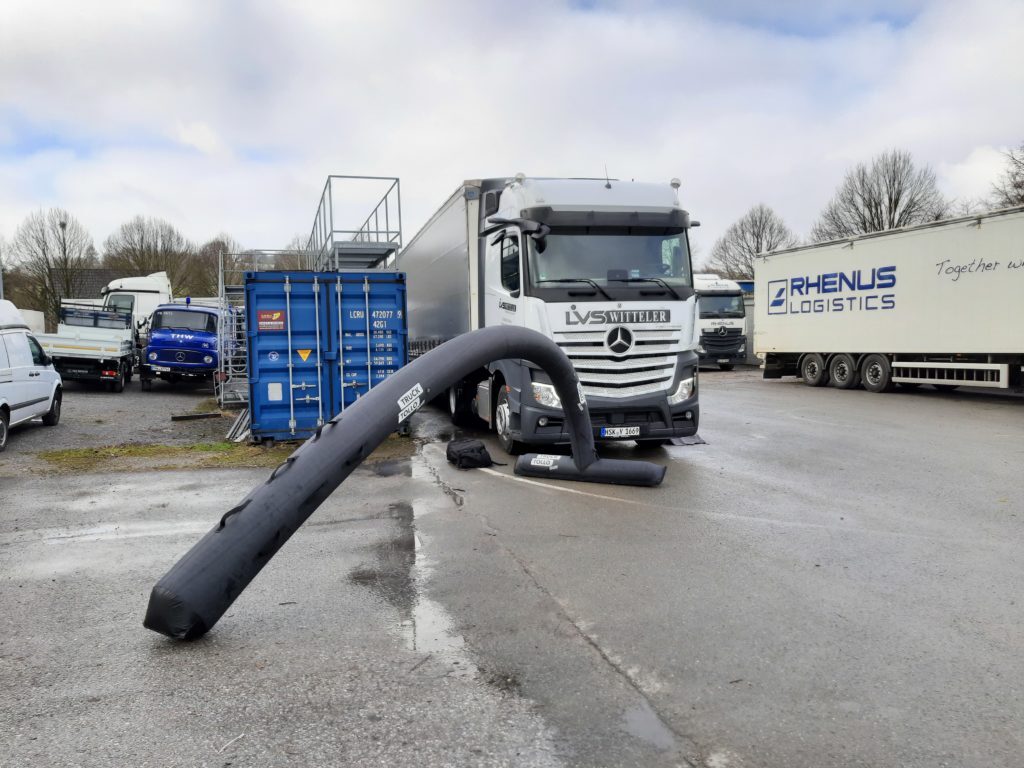
TruckTollo Dozer - The Live Test
Not too long ago, I reported on the startup TruckTube and their products, the TruckTollo Breaker and the TruckTollo Dozer. In that article, I stated that a test of both products would give me more insight.
I was now given the opportunity to examine both systems and also to test them. However, the test could not be done by me alone; other drivers and entrepreneurs were also able to get an impression of the TruckTollo Dozer. To be honest, we took the Breaker out of the bag, inflated it briefly, as assembly was neither possible nor feasible due to time constraints.
Ice sheets have no place on truck bodies
We don’t need to talk anymore about the fact that ice sheets have no place on truck bodies.
 Sure, the list of excuses isn’t that long; they are just constantly repeated. But we all agree: this stuff must come down.
No one belongs on the roof
I know there are some drivers who assume one must go onto the roof of the trailer, semi-trailer, etc., to remove the ice sheets. That was wrong before the test and even more so after the test.
It is true that one has no business being on the body itself. But one never had to climb onto it anyway; only up to roof height, which means one just needs to reach the roof.
This can still be done with a BG-compliant ladder and a slider, but also with a snow scaffolding if one happens to have one nearby.
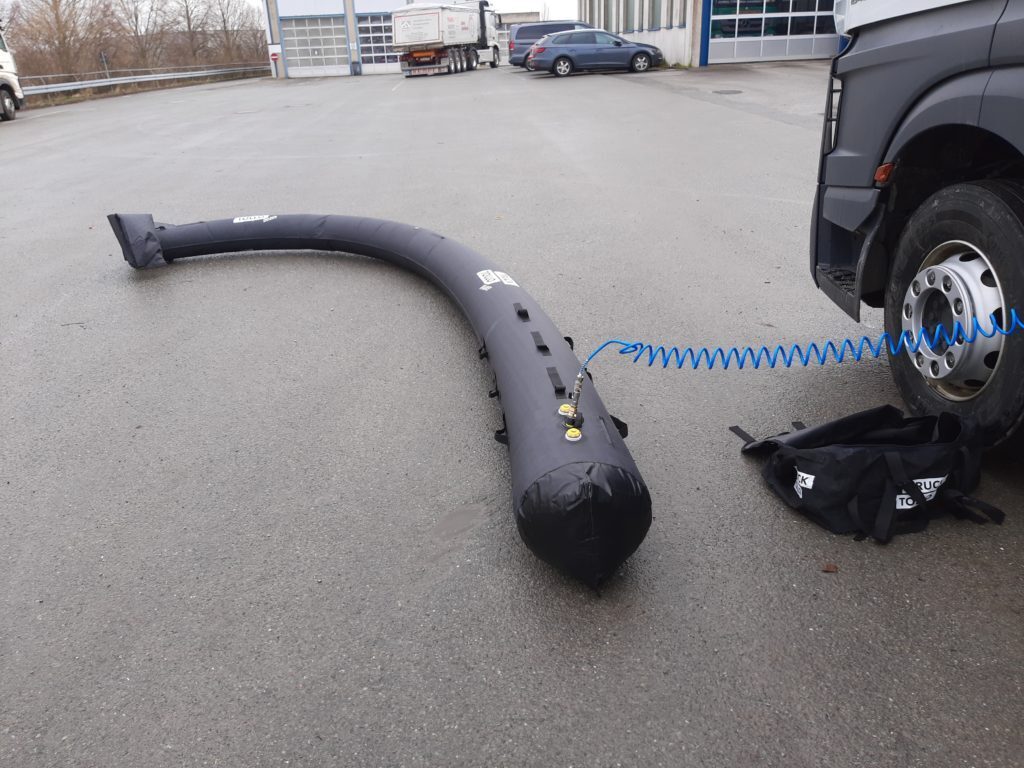
Or, as of recently, also with the TruckTollo Dozer. The system is simply explained:
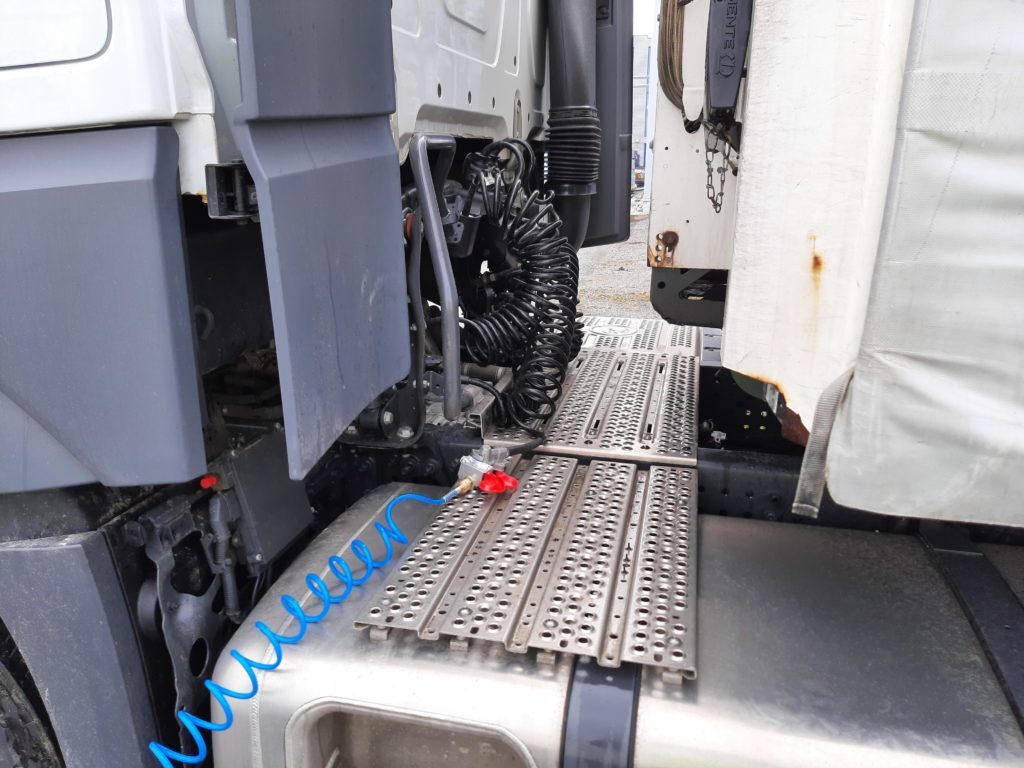
We have a slider about 5 - 6 meters long, which is inflated using the truck’s board air.
 | |
|---|
And suddenly one has a great device ready to remove snow and ice from the body.
Sounds too good to be true? Well, almost.
As can be seen in this video , the slush and also the ice sheets can be removed from the body.
But to get one thing out of the way beforehand: the trailer has the RSAB system installed, which was operated incorrectly here, but thanks to the Dozer, it still leads to the final result. Snow and ice are off the roof.
Here, it was thought that one could remove the ice sheets from the body using the RSAB. The driver then realized himself that this is wrong.
The RSAB is inflated before ice sheets can form, so basically before parking the trailer/semi-trailer. Then no sheets can form either.
The RSAB is just like the TruckTollo Breaker a preventive system intended to prevent the formation of ice sheets from the start. Neither the RSAB nor the Breaker are suitable for removing existing ice sheets. Whether the hose is inflated or not has no effect on working with the Dozer.
The Test
My first attempt to inflate this with the supplied pump failed solely because the power supply was too much. The pump is not designed for 24 volts; I found neither a hint in the accompanying description nor on the cigarette lighter plug. This should still be changed. It would be great if both 12 and 24 volts were possible, since not every truck has a 12-volt socket.
In my opinion, the supplied filling hose is not suitable for keeping the Breaker in operation over the long term. Since one must take care not to crush and/or damage it during loading and unloading—because the hose does not run along the outside of the body like the RSAB, but comes underneath the tarp—the hose made a very “cheap” impression on us.
Whether one can now run it similarly to the RSAB at the front outer side of the bulkhead is unknown to me, since the hose is attached laterally to the Breaker. Either an angle should be made on the filling hose, or the air connection should be relocated accordingly.
Filling itself is very loud. If one were to inflate the hose at night in a parking lot, one would quickly make new “friends”. In terms of volume, I would say a radiator is quieter.
Just like in my previous article on this topic, I do not see the Breaker as an alternative to the RSAB, even if the mobility of the Breaker might provide the only advantage here. But even entrepreneurs present whom I showed the Breaker told me that with a new trailer, the RSAB would be ordered along with it and the Breaker would not come into question as an alternative.
Here is the video for the installation of the TruckTollo Breaker. As can be clearly seen, the buckles of the roof tarp are already loosened here and remain loose. The hose itself is attached laterally to the Breaker and runs laterally between the tarp and the slats. This brings with it, in my opinion, the problem that I have to keep an eye on the filling hose during loading and unloading with the forklift so that it does not get damaged.
I also see problems with the hose during crane loading. Perhaps a driver from the Eberl logistics company could comment on this.
The pump shown in the video is not the one I received. Likewise, one must know that this is optional accessories and must therefore be purchased additionally. Although the Breaker can be filled without this pump, I am not aware of how to get the air out of the Breaker again without the pump, especially when the vehicle is loaded.
How do I evaluate all of this now
| Advantages | Disadvantages |
|---|---|
| Easy to store in a storage compartment | High time consumption when clearing snow masses and ice plates, as visibility from above the roof is missing, requiring multiple trips over the roof |
| Suitable for people with acrophobia | Narrow grooves where ice plates have formed cannot be cleared (especially in the front area of a trailer) |
| Subsidization via Deminimis possible | High cost compared to a BG-compliant ladder with slider (1750 €) |
| Ice plates can be smashed | Risk of injury when sliding coupling heads together (once not paying attention and you already have your fingers pinched) |
| Can be operated with one hand | Space is needed to work with the dozer. |
| Can be used in conjunction with the TruckTollo Breaker or RSAB if forgotten to inflate them before the break | Folding up the dozer takes longer than inflating it. |
| Inflated in approx. 1:30 minutes | |
| Suitable for use with box body constructions |
After I have now tested the dozer myself and also had a chance to “touch” the Breaker (yes, I know, inflating is more than just touching 😛), I can form a better picture of it, unlike in my previous article.
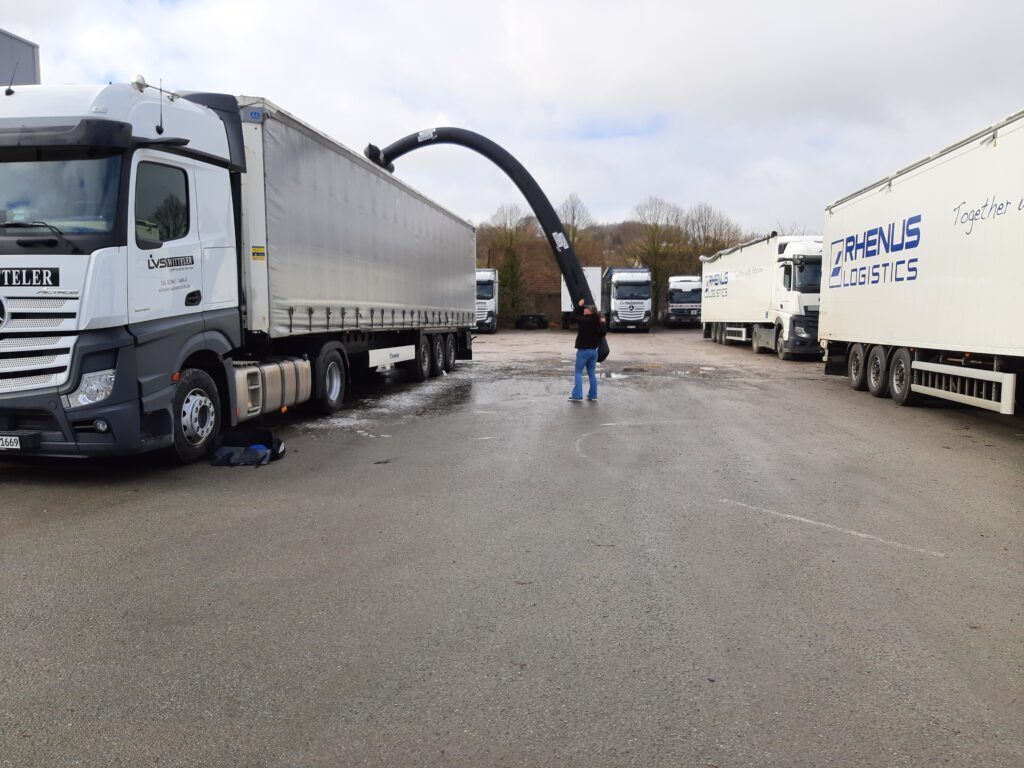 And yes, even a woman can handle it. Although it is somewhat… awkward.
As I already told Marcus Mann from TruckTollo, I cannot imagine using the Breaker in active operation. The effort required to mount it every time during trailer exchange in winter, preventing me from focusing on the essentials when loading and unloading, makes the system unusable for me, but not time-consuming enough. Especially since the pump, which has given up the ghost due to missing voltage labeling on my unit, is only available as optional accessories, and I have no way to release air from the hose while loaded. Thus, I cannot continue driving as I exceed 4 meters.
Well, in combination with the dozer, entirely new possibilities arise with existing hose systems under the roof (TruckTollo Breaker, RSAB, or also the AirPipe System). For example, passive systems can be turned into active ones.
I think I have shown the pros and cons of both systems in this article. Improvements are possible for every system. With the dozer, I wish that I could also clear ice plates from the front part of the Edscha roof.
What was missing when smashing the ice plates was the lack of feedback, which is due to the fact that one cannot smash the plates quietly. Quiet in the sense of the impact of the hard edge on the roof.
The prices of both systems are also not something one can call cheap. Although Deminimis funding is now possible, the dozer comes at 1750 € and the Breaker at 1500 €. In a phone call with Marcus, he told me that both systems could be obtained in a package for 2999 €.
However, I see another disadvantage for both systems. Durability will not last long, as one must ensure that it is dry when folding up the systems. With the Breaker, I see no problems if this is done on the trailer. With the dozer, however, which is folded up outside and cannot even be done quickly, one must use a drying cloth over wet spots if the ground is not dry, which unfortunately was not the case during the test. This is not a direct disadvantage of the dozer, but not every driver will go to that trouble.
Whether and how one handles it is ultimately irrelevant. With the TruckTollo Dozer, there is another system in the fight against snow and ice on vehicle bodies. For me, the advantages prevail, insofar as I would use this part if I am forced by the vehicle combination I drive to remove snow and ice from the body.
However, I do not agree with the time stated on the manufacturer’s website , which claims that the roof can be cleared within 3–4 minutes. As I mentioned in the video, I estimate a half hour, and perhaps even more. The colleague with his small trailer also took approximately 15 minutes to remove everything. The drawback is simply that you cannot see where remnants are still lying; as was clearly visible in the video, various people repeatedly retrieved debris from the trailer. Therefore, one needs not only space but also time if you want to do a thorough job.
To conclude, I would like to extend my heartfelt thanks to everyone who participated in this test. Special thanks go to LVS Witteler GmbH , represented by Bernhard Gollan, for providing the vehicle, and to Mona Gaebel for providing the video.
