

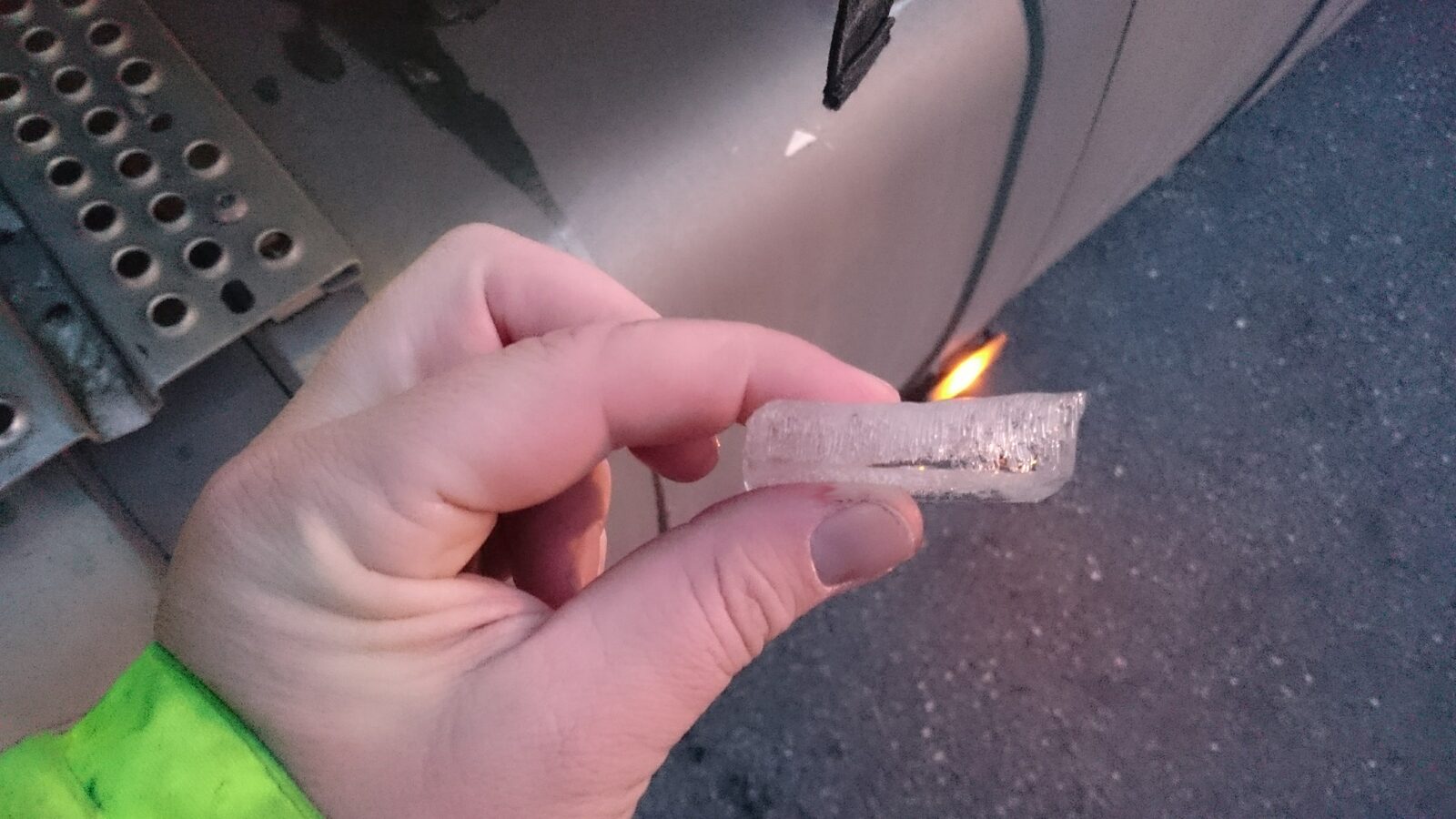
As every year, this winter season has also brought about this “surprising” cold period again.
We call it winter and usually recognize it by the fact that it gets cold, roads become slippery, and some strange white stuff falls from the sky. That is called snow.
Unfortunately, it doesn’t stop there; ice (which mostly forms when water solidifies at a certain temperature) not only forms on roads and bodies of water, but also on the tarps of trucks and transporters.
One should assume that other road users are aware of this and at least do during this season what they cannot manage all year round: maintain distance from the vehicle in front. However, I already know that this won’t work either.
As every road user knows, one is obligated to ensure that the tarps on top are also cleared of ice. § 23 StVO applies to passenger cars as well!
Clearing a truck’s roof of ice can sometimes be difficult. A ladder is not always available in the right length, and the UVV (occupational health and safety regulation) prohibits climbing onto the roof of a trailer or semi-trailer.
On the SVG-Hamburg homepage, there is a list of ice-clearing stations that truck drivers can visit to have their superstructures cleared of ice.
It would be nice if more freight forwarders equipped their vehicles with a so-called Roof Safety AirBag . In this case, a hose-like device is placed under the tarp and inflated with air, thereby lifting the roof slightly and ensuring that water collected on the roof can drain off immediately.
It should also be mentioned that through the De-minimis funding program , costs for such systems, as well as other things like training costs, can be reimbursed up to 90%. One just needs to register in time.
The deadlines for this are listed on the De-minimis page of BAG.
I wish all drivers and female drivers a good journey and a safe return home!