

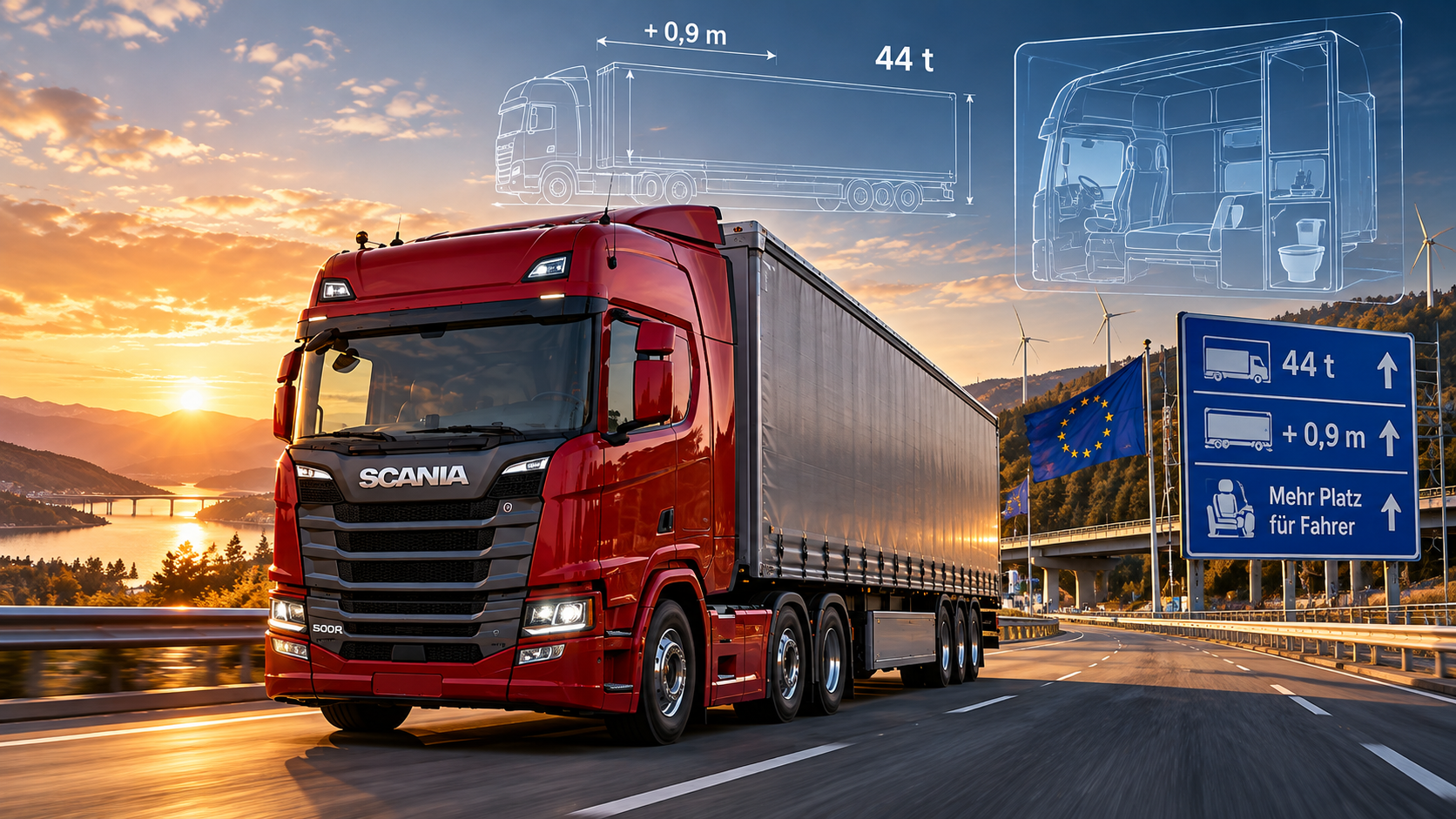
The European Union is working on a comprehensive reform of the weight and dimension regulations for heavy goods vehicles (HGVs). This goes far beyond the planned increase in permissible gross vehicle weight to up to 44 tonnes. Longer vehicle combinations, additional space for new propulsion technologies, and even the size of driver cabs are also under discussion. At the same time, the European HGV market is changing. In Switzerland, more than one in four newly registered heavy trucks is now electric. What does all this mean for transport companies and, above all, for professional drivers?
A semi-trailer combination may weigh up to 40 tonnes, be 16.50 metres long and 4 metres high in cross-border European freight transport. For classic tractor units, a maximum length of 18.75 metres applies. Of course, there are various exceptions, national special provisions, and specific regulations for certain types of transport.
These limits date back to a time when electric drives played virtually no role in heavy goods vehicles. Things have changed since then. Manufacturers are developing battery-electric tractor units, more and more transport companies are using such vehicles, and at the same time, requirements for transport capacity, road safety and economic viability are growing.
That is why the European Union wants to fundamentally revise Directive 96/53/EC.
The European Parliament adopted its position on 12 March 2024. On 4 December 2025, the Ministers of Transport of the Member States finally agreed on a common position.
Since then, negotiations have been taking place on the final version.
As of October 2026, the reform is not yet complete. Nevertheless, it can already be seen in which direction the regulations could develop.
44 Tonnes: What the EU actually wants to change
When discussions are currently underway about raising the permissible gross weight to 44 tonnes, one might assume that such vehicles have never been allowed on European roads before.
However, this is not correct.
Vehicle combinations are already permitted to weigh up to 44 tonnes under certain conditions in combined transport today. Germany has had corresponding regulations for this purpose for decades.
What is decisive here includes, among other things, which vehicle combination is used and whether the journey is actually part of a permissible combined transport operation.
In regular road freight transport, the European weight limit for conventional semi-trailer combinations is fundamentally set at 40 tonnes.
This is exactly where the planned reform of EU Directive 96/53/EC starts.
The aim is not to reinvent the existing 44-tonne regulations in combined transport. Rather, permissible weights are to be adjusted, particularly for zero-emission vehicles, and existing regulations in cross-border transport are to be further developed.
The background is primarily the higher own weight of new propulsion technologies.
In battery-electric tractor units, the battery systems can cause significant additional mass. Without corresponding weight allowances, this would reduce the possible payload in weight-critical transports.
Therefore, the EU is discussing granting additional weight reserves for zero-emission vehicle combinations, which could go beyond the pure weight of the propulsion technology under certain conditions.
However, the reform is not yet complete. Which weight limits will apply to which vehicle combinations in the future must still be clarified in the final legislative procedure.
Axle loads must also match
What good are 44 tonnes of gross weight theoretically for a company if the drive axle is already at its permissible load limit?
Especially with battery-electric tractor units, weight distribution can pose a challenge. Battery systems, drive components and vehicle structure influence how mass is distributed across the individual axles.
Therefore, adjustments to axle load regulations are also being discussed in connection with the reform.
An increase in the permissible drive axle load from 11.5 to 12.5 tonnes belongs to the approaches under discussion. Whether and under which conditions such a change will actually become part of the final directive is still open.
I have another small anecdote from my professional life that comes to mind in this regard.
During a traffic control in the Paderborn area, a police officer once tried to explain to me that axle loads of eight tonnes were generally only permitted in Germany. He did not accept our ten tonnes registered in the vehicle registration document.
I then explained to him that the vehicle manufacturer had installed these axles themselves, the TÜV had approved the vehicle after assembly according to the specifications, and the district government had issued us a permit for 44 tonnes based on these technical data. The registration office had also approved the vehicle with exactly these axle loads.
In other words: Several authorities had already dealt with the vehicle and its technical data.
The police officer’s response? Such axles did not exist in Germany at all.
Well. A look at § 34, paragraph 4 of the German Road Traffic Licensing Regulations (StVZO) would have actually clarified the matter quite quickly. There, up to ten tonnes are provided for non-driven single axles and even up to 11.5 tonnes for driven single axles, of course taking into account further legal and vehicle technical limits.
If the official had thought things through consistently, he would actually have had to take the vehicle out of service if he was truly convinced that we were operating with an impermissible axle construction.
However, he did not go that far. Perhaps by the end, he was no longer entirely sure about his own position.
When I now read that even higher drive axle loads are being discussed within the framework of the EU reform, I am inevitably reminded of this inspection.
What would the official have said about a drive axle with 12.5 tonnes? 😄
But back to the planned reform.
In all considerations regarding higher axle loads, the impact on roads and bridges must naturally also be taken into account.
After all, a heavier electric truck does not load the road surface any less just because it lacks a diesel engine.
The challenge lies in enabling technical developments without excessively straining the existing transport infrastructure.
And this brings us to another interesting change.
Trucks could become longer in the future
In addition to higher weights, changes to vehicle dimensions are also planned.
According to the position of the EU Council, emission-free vehicles could be granted up to an additional 90 centimeters in length.
However, this extension is not simply intended as additional cargo space; it is primarily meant to facilitate the installation of emission-free drive technologies.
The impact this will have on the construction of future trucks remains to be seen.
Manufacturers could thereby gain more opportunities to accommodate batteries, hydrogen systems, or other technical components without necessarily having to sacrifice existing installation space.
However, one should distinguish between vehicle length and the length of the driver’s cab.
Since September 2020, under certain conditions, extended, aerodynamically designed driver cabs have been permitted. They are intended, among other things, to reduce air resistance and improve the driver’s direct visibility.
These existing regulations have already led to new cab concepts.
An example of this are the particularly spacious driver cabs of the DAF-XG and XG+ series.
The current EU reform now takes a step further in this regard.
For the first time, the needs of drivers are also explicitly addressed in this context.
More space in the driver’s cab – even sanitary facilities are being discussed
This point is likely to be particularly interesting for many professional drivers.
In its position from March 2024, the European Parliament explicitly stated that additional vehicle dimensions for emission-free technologies should not come at the expense of available space in the driver’s cab.
Quite the opposite: Driver comfort should be improved.
Furthermore, where possible, concepts that create additional space for sanitary facilities within the driver’s cab should be examined and promoted.
That is truly remarkable.
For decades, road freight transport has been discussing how to transport more cargo on as little road surface as possible.
Vehicles are aerodynamically optimized, drives made more efficient, and trailers utilized down to the last centimeter.
Meanwhile, the driver may spend several days or weeks traveling on just a few square meters.
Of course, today’s long-haul cabs are hardly comparable with the driver cabs of past decades; standing height, sleeping comfort, storage space, and technical equipment have improved significantly.
Nevertheless, space remains limited.
Anyone who regularly travels internationally in long-haul transport knows that a driver’s cab is not just a workplace. During daily rest periods, it often also serves as a sleeping and living area.
This raises the question of why, when developing vehicle dimensions further, it should not also be considered more strongly that people live and work in these vehicles.
A larger cab could provide additional storage space, better sleeping options, and more freedom of movement.
Whether toilets or other sanitary facilities can sensibly be accommodated in a truck, however, depends on numerous technical and hygienic prerequisites.
Water tanks, sewage disposal, cleaning, and the necessary space for these must be taken into account.
Moreover, public infrastructure remains important. A toilet in the driver’s cab would not fundamentally solve the lack of reasonable sanitary facilities at European truck parking lots.
So far, it is merely a political demand from the European Parliament to examine and promote corresponding concepts.
There is no binding regulation for larger driver cabs or even toilets in trucks.
Nevertheless, it is a remarkable approach.
For this reason, working and living conditions of drivers finally also appear in a discussion that previously focused mainly on vehicle dimensions and transport efficiency.
Long trucks and cross-border transports are also affected
The reform does not apply only to conventional semi-trailers and rigid trucks.
So-called European Modular Systems, or EMS, also play a role.
Behind this lie longer or heavier vehicle combinations that can be assembled from existing vehicle modules.
In Germany, we know such vehicles, among others, as long trucks.
Member States have different national regulations for this. What is permitted in one country may already be impermissible just beyond the next border.
The EU aims to facilitate cross-border use of such combinations between Member States that permit these systems.
This does not mean that every Member State will be required to permit long trucks in the future.
However, transport between countries with corresponding authorizations could become easier.
The European Parliament also calls for an examination of the potential impacts of new EMS routes on road safety, infrastructure, and other modes of transport before they are implemented.
Discussions are also underway regarding a uniform marking system for particularly long vehicle combinations.
For professional drivers, this could mean that cross-border trips with such combinations will become less complicated in the long term.
Of course, the prerequisite remains that the planned routes must be suitable for these vehicles.
Less paperwork for heavy goods transport
Another part of the reform concerns the transport of indivisible loads.
Anyone who regularly deals with heavy or oversized cargo is familiar with the effort involved in different authorization procedures.
Depending on the country, requirements, processing times, and sometimes even regulations for escort vehicles differ.
Here, greater harmonization and digitalization are intended.
The European Parliament calls for electronic authorizations and improved cooperation between Member States.
Furthermore, a European information portal is under discussion, through which information on permissible vehicle weights, dimensions, and certain route restrictions could be made accessible.
This would be a sensible development, especially in international transport.
It is of little help if companies have to search numerous different national information sources for cross-border trips to determine which regulations apply.
A common information system could at least reduce part of this effort.
However, it must also be noted here: these are still proposals within an ongoing legislative procedure.
While the EU negotiates, the market is already changing
The planned reform coincides with a time when the European commercial vehicle market is undergoing significant changes.
Switzerland is particularly interesting in this context.
According to the industry association auto-schweiz, purely electric trucks of 16 tonnes or more accounted for 27.4 percent of new registrations by the end of September 2026.
In the segment between 3.5 and 16 tonnes, the electric share was even 40.8 percent.
Thus, among newly registered heavy trucks, more than one in four is now electric.
These figures must not be confused with the entire vehicle fleet.
It is not already the case that 27.4 percent of all Swiss trucks are electric on the road; the figures refer exclusively to new registrations.
Nevertheless, they show how quickly a market can change when technical prerequisites and economic framework conditions align.
Numbers are also rising within the European Union.
According to the European manufacturers’ association ACEA, a total of 171,933 new trucks were registered in the first half of 2026.
The share of rechargeable electric vehicles increased from 3.6 percent to 4.8 percent compared to the previous year’s period. This drive category includes both battery-electric vehicles and plug-in hybrids.
In Germany, corresponding new registrations rose by 88.5 percent; the Netherlands recorded an increase of 44.5 percent, and France saw a rise of 43.7 percent.
Together, these three countries accounted for 74 percent of rechargeable electric truck new registrations within the EU.
However, diesel remains by far the most important drive with a market share of 92.1 percent among new registrations.
Therefore, there is no talk of a complete replacement of diesel trucks.
Nevertheless, a development is emerging that goes far beyond individual test vehicles.
Why Switzerland is so far ahead with electric trucks
That electric trucks are achieving such high market shares in Switzerland is not a coincidence.
Besides technical application possibilities, economic framework conditions also play a decisive role.
In Switzerland, heavy goods vehicles must generally pay a performance-dependent heavy goods transport levy, known as the LSVA.
It is based on the route driven, the relevant vehicle weight, and the emission class.
For a modern Euro-6 diesel, the levy currently amounts to 2.39 cents per tonne-kilometer.
What this means in practice can be shown with a simple calculation.
A semi-trailer truck with a relevant LSVA weight of 40 tonnes covers 100,000 kilometres on Swiss roads within a year.
At a levy rate of 2.39 cents, this results in a heavy goods transport levy of 95,600 Swiss francs.
This is a model calculation; the actual burden depends, among other things, on driving performance in Switzerland and the relevant levy weight.
A comparable electric truck is currently exempt from the LSVA.
This is a significant economic advantage.
Of course, an electric truck often still costs significantly more to purchase than a comparable diesel vehicle. However, looking only at the purchase price considers only part of the costs.
Decisive is what a vehicle costs over its entire useful life.
And if a company can save several tens of thousands of francs annually on the heavy goods transport levy, this changes the calculation considerably.
However, this complete exemption will not remain in place indefinitely.
In early October 2026, the Swiss Parliament decided to gradually include electric and hydrogen trucks in the LSVA from 2031 onwards.
Initially, significant discounts are still planned. From 2036, the regular levy rate should generally apply.
This gives transport companies at least a timeframe to plan their investments.
Germany also relies on economic incentives
Germany too promotes the use of zero-emission commercial vehicles through toll exemptions.
Electric trucks with a technically permissible gross mass exceeding 4.25 tonnes remain exempt from the truck toll until June 30, 2031.
In contrast, heavy diesel vehicles can accumulate significant toll costs.
For an Euro-6 semi-trailer with at least five axles in CO₂ emission class 1, the current toll amounts to 34.8 cents per kilometre.
Over 100,000 tollable kilometres, this equates to €34,800 annually.
An exempt electric truck saves this amount in full initially.
However, the German and Swiss systems differ.
While the Swiss LSVA is levied on the entire public road network, the German truck toll applies only to federal motorways and federal roads.
Therefore, the two example calculations are not directly comparable.
Furthermore, an electric truck requires electricity, charging infrastructure must be acquired or used, and the higher vehicle price needs to be offset economically.
A transport company with its own charging points and favourable electricity contracts operates under entirely different conditions than a business whose vehicles must rely predominantly on public fast-charging stations.
This illustrates how differently the economic viability of electric commercial vehicles can turn out.
Technology alone does not determine success; state frameworks also influence whether the investment pays off.
How does this change drivers’ daily work?
Amid all these figures and regulations, one must not forget that vehicles ultimately need to be driven by people.
For professional drivers, the question is less about whether a truck has a diesel or electric engine.
What matters is how the vehicle can be used in everyday operations.
A driver must comply with statutory driving time breaks and rest periods, meet delivery deadlines, reach loading and unloading sites, and handle situations that cannot always be predicted in advance.
With electric trucks, charging planning comes into play.
Therefore, a vehicle’s range alone tells little about how well it performs in actual transport operations.
A company regularly supplying the same branches and able to charge its vehicles overnight at its depot has different options than an international long-haul operator with constantly changing destinations.
There is also a point often overlooked in discussions: charging an electric truck belongs just as much to a driver’s professional duties as refuelling a diesel vehicle.
Connecting the vehicle, operating the charging technology, and possibly monitoring the charging process can constitute working time.
A legally mandated driving break or rest period exists only if the corresponding conditions are actually met.
If an employer requires a driver to perform additional tasks during the charging process, this time cannot simply be recorded as a rest break.
Therefore, charging infrastructure and transport planning must be coordinated so that drivers can actually comply with their statutory rest periods.
And of course, no one can expect every driver to install a charging pile in front of their home just because the transport company has acquired electric vehicles.
That is an operational task.
New vehicles require new solutions
The development of the electric truck shows that freight transport will change in the coming years.
This concerns not only the drive system but also vehicle dimensions, weight limits, and infrastructure requirements, which must be adapted to new technical possibilities.
A higher permissible gross mass can help offset the additional battery weight.
Greater vehicle length can open up new constructive possibilities for manufacturers.
Improved regulations for cross-border transport could reduce administrative burdens.
And if this development also leads to better space conditions in driver cabs, not only transport companies will benefit.
Finally, those who travel daily in these vehicles would be properly considered.
However, the planned EU reform will not solve all problems.
Suitable truck parking spaces are still lacking, public charging infrastructure must be expanded, and many rest areas already lack reasonable sanitary facilities today.
A larger driver cab alone does not turn a poorly equipped parking space into a suitable place for daily or weekly rest periods.
Nor will every transport order automatically be suitable for an electric truck just because such vehicles may weigh up to 44 tonnes in the future.
Where is European freight transport heading?
Current developments show above all one thing: the commercial vehicle market is undergoing a transformation process.
Switzerland demonstrates how quickly electric drives can gain market share among new registrations when economic conditions are favourable.
Germany and other European countries also record increasing registration numbers, albeit at a significantly lower level.
At the same time, the EU is working on legal provisions intended to enable further development of heavy commercial vehicles.
This concerns not only electric trucks.
Longer vehicle combinations, modernised driver cabs, digital approval procedures, and more uniform rules for international freight transport are also on the agenda.
Whether all proposals at the end will actually be implemented remains to be seen.
For professional drivers, however, it is particularly interesting that the European Parliament has explicitly addressed more space and better conditions in driver cabs.
After all, transport efficiency is important. Economic viability is of course also essential.
But when we discuss what the truck of the future should look like, we should not only ask how much cargo it can carry, how far it travels, and how little energy it requires.
We should also discuss under what conditions the people who operate these vehicles every day work and live.
Perhaps that is exactly one of the most important points of this reform.
Sources and further information
Research status: October 24, 2026.
- European Parliament – Legislative procedure 2023/0265(COD)
- European Parliament – Position of March 12, 2024
- Council of the European Union – Opinion on weights and dimensions of December 4, 2025
- auto-schweiz – New registrations of electric trucks in 2026
- ACEA – European commercial vehicle registrations, first half of 2026
- Swiss Federal Office of Customs and Border Protection – LSVA calculation
- Swiss Parliament – Reform of the heavy goods vehicle tax, case 25.058
- Toll Collect – Toll regulations for alternative drives