

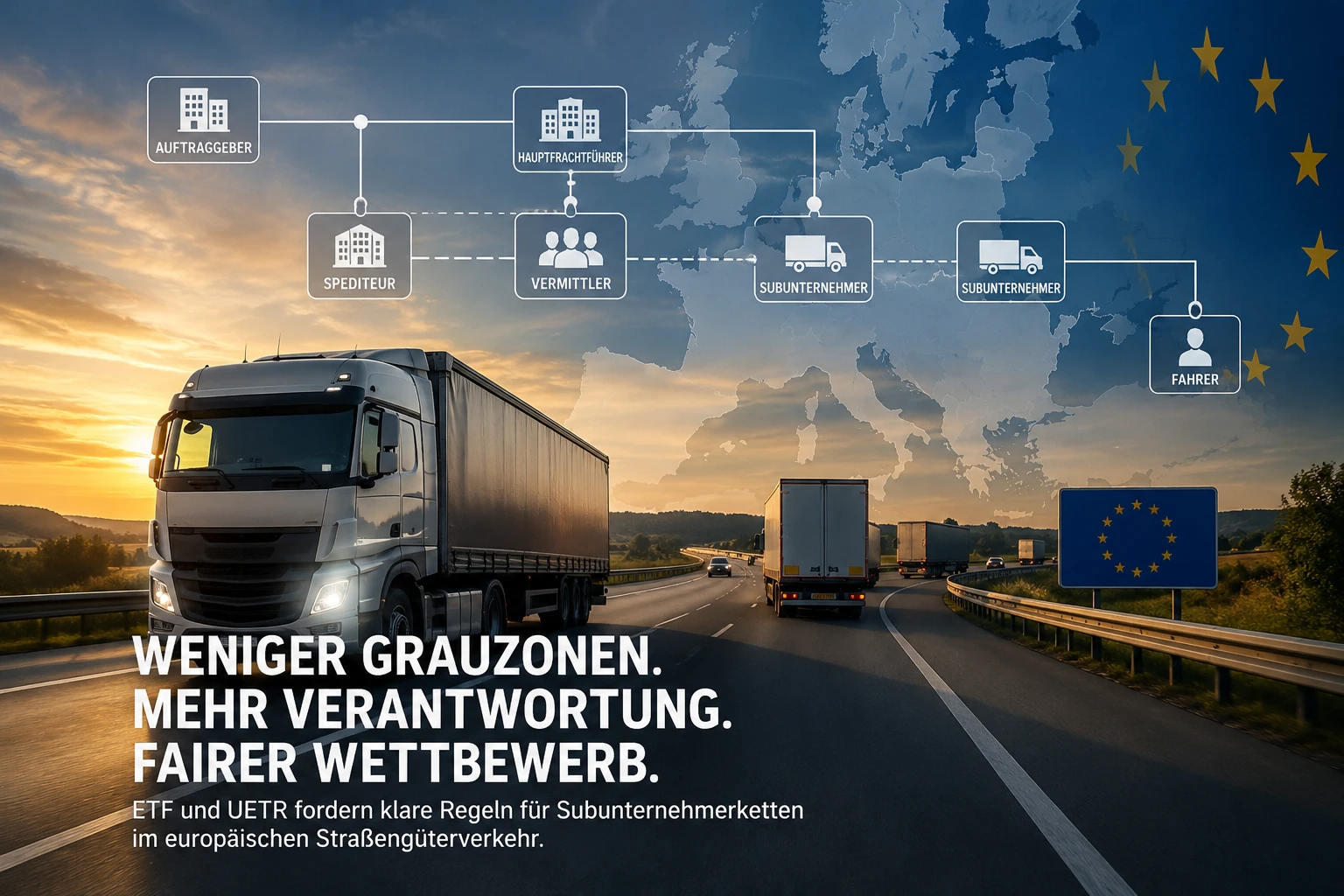
When Trade Unions and Entrepreneurs Issue the Same Warning
Why Europe’s Road Freight Transport is facing a transparency problem
It doesn’t happen often that trade unions and entrepreneurs’ associations make the same demands of the political authorities. However, this is currently happening in European road freight transport – and this unique situation alone should draw attention.
The European Transport Workers’ Federation (ETF) and the Union of European Road Transport Companies (UETR) have jointly addressed members of the European Parliament. In a joint letter, they are demanding stricter rules for subcontracting in road freight transport. Specifically, they are calling for limitations on subcontractor chains, more transparency, continuous liability along the transport chain and stricter rules for labor agencies.
That labor representatives and transport entrepreneurs are making these demands together is remarkable. Because usually, these two sides stand against each other on central issues in the industry – for example, on wages, working hours or regulation. If they are suddenly in agreement, it indicates a problem that goes deeper than a classic interest conflict.
A System of Intermediate Layers
In European road freight transport, transport orders often pass through complex chains of companies today. An order is awarded, passed on, and subcontracted again – often across several countries.
At the end, there is often a driver on a parking lot somewhere in Europe. But who actually bears the responsibility?
Is it the original client? The main freight forwarder? An intermediary? Or the last subcontractor in the chain?
The longer a subcontracting chain becomes, the more difficult it is to assign responsibility. At the same time, the risk increases that labor standards are violated, social regulations are circumvented, or competition conditions are distorted.
For authorities, this creates a practical problem: Who actually controls whom, when companies, contracts, and responsibilities are spread across several member states?
The Single Market knows no borders – control often does
The European single market allows for free goods movement across national borders. Transport passes through several countries daily, without this being an organisational exception.
The control structures, however, remain largely nationally organised in many areas.
Labor law, social security, authority responsibilities, and sanction mechanisms often end at national borders or differ significantly between member states. For cross-border supply chains, this creates a grey zone: The transport is organised on a European level, but the control is often fragmented.
Exactly at this point, the joint demand of ETF and UETR is directed.
The associations are demanding, among other things:
- a limitation of subcontractor chains,
- more transparency about all involved companies,
- clear liability along the entire chain,
- stricter rules for labor agencies and intermediate structures.
The goal is to make responsibility traceable again and to curb competitive distortions.
More than just a wage problem
For a long time, the crisis in European road freight transport has been discussed mainly as a question of wages and social standards. These topics remain central.
Yet possibly, this perspective is now too narrow.
Because low wages, problematic employment models, or violations of social regulations do not arise in a vacuum. They are often enabled by hardly traceable corporate structures and nested subcontracting chains.
In other words:
It is not the lack of regulations alone that could be the problem – but the lack of traceability, who along the chain actually bears responsibility and who economically benefits.
An unusual warning signal
The political value of the current debate lies less in individual detailed demands than in the unusual alliance itself.
When trade unions and entrepreneurs’ associations simultaneously declare that existing structures are no longer functioning adequately, it indicates a structural market problem.
The central question is therefore not only how many rules Europe still needs.
But whether a cross-border market can function fairly in the long term if responsibility along the supply chain can no longer be traced transparently.
For European road freight transport, this question is likely to gain importance in the coming years – not only for companies and drivers, but also for consumers and an economy that is increasingly reliant on stable and reliable supply chains.
