

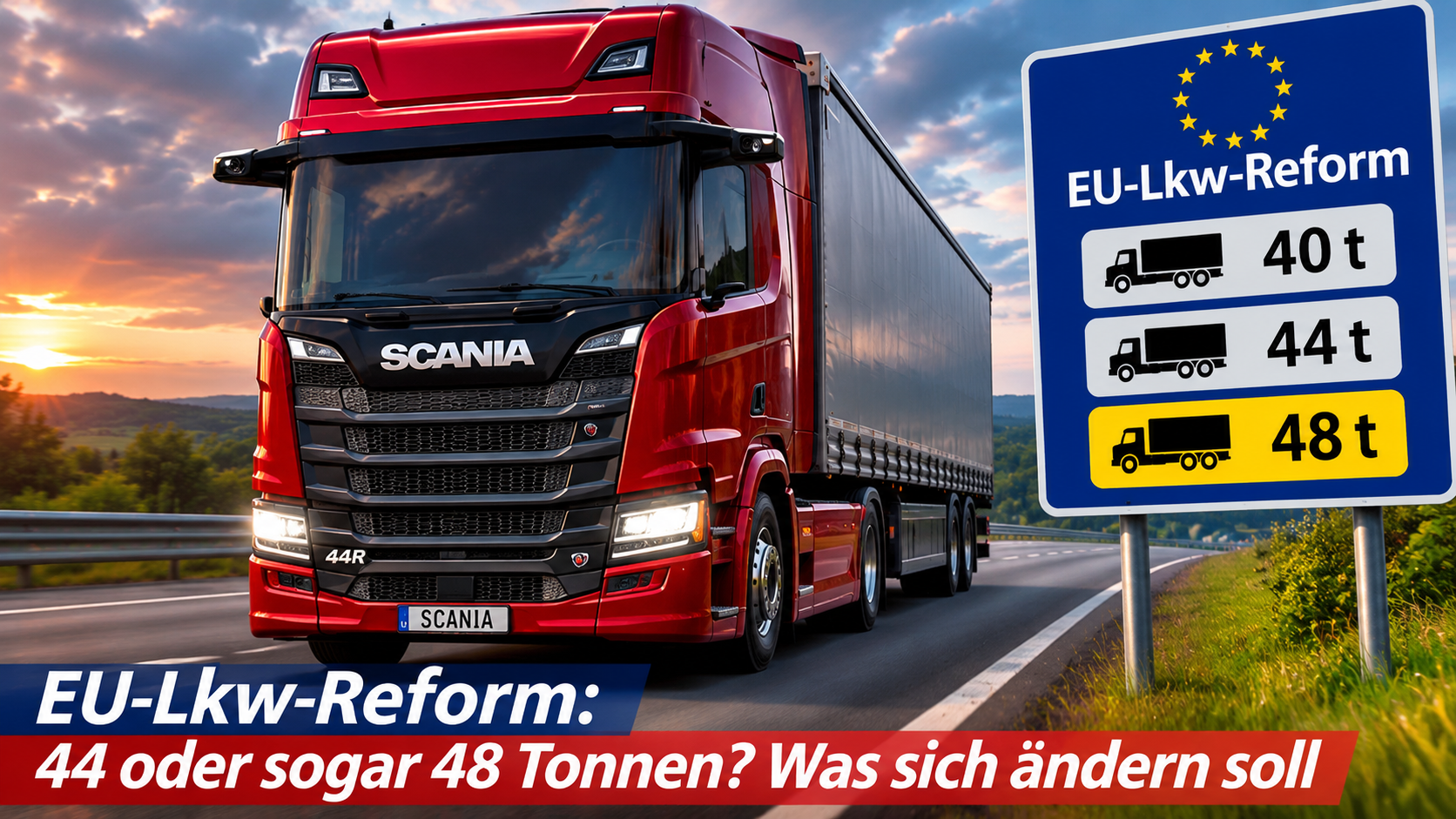
The European Union is working on a comprehensive reform of the regulations for the weights and dimensions of commercial vehicles. It is no longer just about the frequently discussed 44 tonnes. Even 48 tonnes are now being considered for certain zero-emission vehicle combinations. Longer trucks, larger cabins, and new regulations for cross-border freight transport are also being discussed. But what actually applies today, what should change, and why are there such different views between the Member States?
This article is being updated continuously. New developments in the EU legislative procedure 2023/0265(COD) will be documented at the end of the contribution with a date. As long as the Parliament and the Council have not reached a final agreement, the planned changes are not yet binding law.
Current status: 25 November 2026 – Negotiations are continuing. A final agreement on the new weight limits has not yet been reached.
What is already allowed today
Before we look at the changes the EU plans, we should first clarify which regulations currently apply.
Because if you follow the discussions on social networks, you might sometimes believe that the possibility of being on the road with a total weight of 44 tonnes is a completely new invention.
That is of course nonsense.
The fundamental European regulations are set out in Directive 96/53/EC. It establishes, among other things, the maximum permissible vehicle dimensions for national and international traffic as well as certain weight restrictions for cross-border traffic.
For conventional tractor trailer combinations with five or six axles, 40 tonnes generally apply in international traffic.
However, there are exceptions.
In combined transport, higher weights have been permissible under certain conditions for decades. Depending on the type of transport and vehicle configuration, 42 or 44 tonnes may be allowed.
In Germany, there are additional regulations that allow 44 tonnes under certain conditions in combined transport.
A blanket claim that every truck over 40 tonnes is automatically overloaded is therefore just as wrong as the assumption that one can generally drive with 44 tonnes across all of Europe.
What matters is the vehicle combination, the type of transport, and the applicable regulations in each case.
Current vehicle dimensions
In terms of dimensions, the European framework sets the following limits as a general rule:
| Vehicle type | Permissible dimension |
|---|---|
| Trailer combination | 16.50 meters length |
| Truck | 18.75 meters length |
| Single motor vehicle | 12.00 meters length |
| Standard vehicle width | 2.55 meters |
| Refrigerated vehicles with corresponding insulation | 2.60 metres width |
| Vehicle height | 4.00 metres |
Exceptions also exist, for example for certain long-haul truck concepts, vehicle bodies, or aerodynamically designed driver’s cabs.
Since September 2020, longer aerodynamic driver’s cabs may be used under certain technical conditions, without necessarily having to lose cargo space for that purpose.
The additional length serves, among other things, road safety and the reduction of air resistance.
And so we come to a question that is particularly interesting for electric trucks.
How heavy may electric trucks be today?
Zero-emission commercial vehicles are already permitted under current EU law to receive a weight allowance of up to two tonnes under certain conditions.
In the case of a standard tractor-trailer combination, the permissible gross weight can thus increase from 40 to 42 tonnes.
This allowance is intended to offset the additional own weight of zero-emission drive technologies.
Corresponding regulations also apply to single vehicles.
However, the allowance is not a free pass to load the vehicle arbitrarily heavy.
The permissible axle loads, technical vehicle limits, and any further legal restrictions must continue to be observed.
Especially important is also a distinction: An existing national 44-tonne regulation in combined transport does not automatically mean that an additional two tonnes are permitted for an electric truck.
The EU wants to regulate exactly such differences in its reform.
What the European Commission wants to change
On 11 July 2023, the European Commission submitted its proposal to amend Directive 96/53/EC.
The legislative procedure bears the number 2023/0265(COD).
The Commission pursues several objectives with this.
On the one hand, zero-emission road vehicles should be easier to put into operation. At the same time, cross-border transport is to be simplified and existing differences between national regulations are to be reduced.
This is by no means exclusively about the permissible gross weight.
Vehicle lengths, certain types of transport, approval procedures and technical features of new drive systems are also to be taken into account.
Up to 44 tonnes for zero-emission vehicle combinations
A key proposal concerns the additional weight allowance for zero-emission trucks.
The Commission wants to increase the current allowance from a maximum of two tonnes to four tonnes.
For a zero-emission vehicle combination where 40 tonnes normally apply, up to 44 tonnes would then be possible.
The key difference from the previous regulation is not just the amount of the allowance.
The Commission wants to enable the additional four tonnes in principle regardless of how much extra weight the zero-emission drive technology actually causes.
If batteries and electric drive systems become lighter in the future, additional payload could potentially arise as a result.
This would be economically interesting for weight-critical transports.
In the case of a tractor-trailer combination transporting mainly light goods and already utilizing its available cargo space before reaching the weight limit, the permissible gross weight plays a lesser role.
The situation is different for steel, construction materials, beverages, or other heavy goods.
Here, an additional tonne of payload can decide whether a transport order can be carried out in an economically sensible manner.
Suddenly, even 48 tonnes are being discussed
It becomes even more interesting in the context of intermodal transport.
Here, the proposal from the European Commission envisages also taking into account the additional weight allowance for zero-emission propulsion technologies.
For a vehicle combination that today already falls under the corresponding 44-tonne regulation, up to 48 tonnes could potentially become possible in the future.
However, it is important to note: these 48 tonnes are not a general proposal for all electric trucks.
This concerns certain zero-emission vehicle combinations in intermodal transport.
In addition, the remaining technical requirements must be met.
The fact that the 48 tonnes is by no means a settled matter is shown by the dispute between the European institutions.
While the Commission has proposed a far-reaching increase and the European Parliament supports higher weight limits, the Council of the European Union wishes to proceed much more cautiously.
According to the current state of negotiations, the Council position provides for up to 44 tonnes for certain six-axle zero-emission vehicle combinations in regular traffic.
In intermodal transport, up to 44 tonnes shall be possible for certain five-axle combinations and up to 46 tonnes for six-axle combinations.
The possible 48 tonnes thus remain one of the open points of contention.
And as we will see shortly, the Netherlands play an interesting role in this discussion.
The Netherlands: Up to 50 tonnes are already permitted nationally
While the EU is discussing 44 or 48 tonnes, up to 50 tonnes are already permitted for suitable vehicle combinations in national traffic in the Netherlands.
However, this does not mean that a Dutch transport company can automatically drive to Germany with 50 tonnes.
The national regulations of a Member State do not apply without further ado in cross-border traffic.
This difference is precisely one of the problems the EU is dealing with.
The Dutch transport association Transport en Logistiek Nederland, short TLN, has been calling for years to facilitate the cross-border use of 44-tonne vehicle combinations between countries that already permit such weights in national traffic.
This is not only about electric vehicles.
Conventional vehicle combinations should also be permitted to be used cross-border with 44 tonnes under certain conditions according to this demand.
The Commission and the European Parliament support corresponding relaxations in principle for a limited period until the end of 2034.
However, the matter remains controversial in the Council. It was recently discussed whether at least six-axle vehicle combinations could be taken into account.
There is no final agreement yet.
What the Dutch government says about this
Particularly interesting is a recent statement by the Dutch government to the Parliament.
In it, it shows itself to be fundamentally flexible regarding higher permissible gross weights for emission-free trucks.
The reasoning is obvious: In the Netherlands, higher weights are already permitted nationally than the EU is currently discussing.
However, there is a clear limit.
The Dutch want to stick to the current permissible driving axle load of 11.5 tonnes.
Higher gross weights should therefore not automatically mean higher loads on individual axles.
This is an important difference.
By supporting additional weight allowances, the Netherlands simultaneously wants to limit the load on its road infrastructure.
Germany is by no means the European benchmark with its 40 tonnes.
A look at the existing national regulations shows that the discussion about 44 or even 48 tonnes does not start from zero.
The European Commission has already noted in the preparation of its reform that numerous Member States allow significantly higher gross weights in national freight transport than the 40 tonnes generally provided for cross-border transport.
In Belgium, France, Italy, Luxembourg, Ireland and Portugal, 44 tonnes are already permissible under certain conditions. In the Netherlands, it is even 50 tonnes.
Czechia also permits up to 48 tonnes for suitable vehicle combinations.
This is by no means exclusively about electric trucks. Many of these regulations also apply to conventionally powered vehicles.
The differences become even greater when we look at Northern Europe.
Sweden and Finland have long been driving with significantly more weight.
In Sweden, suitable vehicle combinations on roads of load-bearing class BK4 may weigh up to 74 tonnes.
Finland permits up to 76 tonnes for corresponding axle configurations. This weight limit was introduced there as early as 2013.
Denmark currently allows up to 56 tonnes for vehicle combinations with at least seven axles. From 1 January 2027, the limit is to rise to 58 tonnes.
This of course does not mean that every ordinary tractor trailer may travel in these countries with such weights.
Higher gross weights require corresponding vehicle configurations. Axle distances, the number of axles, and the load-bearing capacity of the road network also play a role.
Nevertheless, the examples show that heavier vehicle combinations have long been part of transport daily life in Europe.
Belgium: 50 tonnes already permitted in part
The situation is also interesting with our western neighbour.
Belgium generally permits 44 tonnes for suitable vehicle combinations.
In Flanders and Wallonia, 50 tonnes can be permitted under additional conditions.
These include certain axle configurations and technical requirements for the vehicles.
Wallonia introduced these possibilities as early as 2018. Flanders followed in December 2021.
In addition, longer and heavier vehicle combinations are also used regionally within the framework of special programmes.
The fact that Belgium permits higher weights in domestic traffic does not, however, mean that these vehicles are automatically allowed to cross the border into Germany with 50 tonnes.
France: 44 tonnes in national freight transport
France also permits a total weight of up to 44 tonnes for certain vehicle combinations with more than four axles.
One of the prerequisites is that the road transport takes place entirely within France and that the corresponding technical requirements are met.
Here too, a distinction must be drawn between nationally permissible weights and the regulations governing international transport.
The EU wants to harmonise these differing regulations more strongly with its reform.
Spain: 44 tonnes – and up to 57 tonnes for roundwood transport
Particularly interesting is the development in Spain.
There, a change to national vehicle regulations was published in July 2025, raising the permissible gross weights for certain vehicle combinations.
Since October 23, 2025, gross weights of up to 44 tonnes are generally possible for suitable combinations with at least five axles.
There are even special regulations for roundwood transport.
For such transports, vehicle combinations with five axles may weigh up to 52 tonnes. For six or more axles, weights of up to 57 tonnes are permitted under the specified conditions.
The exception concerns certain routes between neighbouring provinces or transports of up to 150 kilometres between the forest and the nearest wood-processing plant.
Given my professional experience with roundwood transport, I find this regulation remarkable.
While we in Germany may have to rely on special permits for such transports, Spain has established its own higher weight limits for certain roundwood haulage.
Of course, these regulations cannot simply be transferred to Germany. In addition to vehicle technology, road infrastructure and respective national conditions also play a role.
Nevertheless, the example shows that other countries have already intensively dealt with the specific requirements of individual transport types.
Why do we still need an EU reform at all?
The answer lies mainly in cross-border freight transport.
What is allowed in the Netherlands with 50 tonnes or in France with 44 tonnes may not automatically be driven in Germany either.
The different national regulations can therefore lead to a vehicle being legally allowed to carry more weight within a country, but having to comply with other weight limits when crossing the border.
This is exactly where the EU wants to start.
It is not about enabling heavier trucks on European roads for the first time. They have long existed.
Rather, it is to be regulated under which conditions higher weights could be permissible in cross-border traffic in the future.
And especially for zero-emission vehicle combinations, the question arises how the additional weight of the drive technology is to be taken into account.
The planned 44 or even 48 tonnes are therefore part of a much larger discussion on the harmonisation of European freight transport.
Sources:
- European Commission – Impact assessment of Directive 96/53/EC
- Belgium/Flanders – National 50-tonne regulation
- France – Article R312-4 of the Code de la route
- Sweden – Load-bearing classes
- Finland – Traficom, heavy vehicle combinations
- Denmark – New weight limits from 2027
- Spain – Regulation PJC/780/2025
From my own experience: suddenly stopped at the border
I experienced these differences in national weight regulations myself during my professional career.
When I worked for a Dutch transport company, we regularly travelled with a total weight of 50 tonnes on domestic Dutch trips. And that with a completely ordinary vehicle combination consisting of a two-axle tractor unit and a three-axle trailer.
If the trip was instead from the Netherlands to Belgium, it was over at 44 tonnes.
Later, when I was again employed in Germany on a silo transport in the Ruhr area, I encountered these differences again.
Driving from Belgium to the Netherlands, I was travelling with up to 44 tonnes. When continuing from the Netherlands to Germany, we had to restrict ourselves again to 40 or 40.8 tonnes.
And all this with fundamentally comparable vehicle combinations and axle loads.
At the border, neither the number of axles nor the technical load-bearing capacity of the vehicle changed. What changed were the regulations under which we were allowed to drive.
Of course, different road and bridge infrastructure has an influence on which weights a country can allow. Nevertheless, this example shows how complicated the different national regulations can become in international freight transport.
This is exactly where one of the main starting points of the planned EU reform lies. It is not just about enabling heavier trucks in the future, but also about reducing existing differences between Member States and creating more uniform rules for cross-border transport.
The dispute over axle loads
What good is a theoretical maximum gross weight of 48 tonnes to a transport company if the vehicle cannot distribute that mass onto its axles?
This is a legitimate question, especially for electric trucks.
Batteries, drive technology, and the construction of a tractor unit affect weight distribution.
That is why the European Commission originally also proposed an increase in the permissible drive axle load from 11.5 to 12.5 tonnes.
According to the Dutch transport association TLN on 24 November 2026, this proposal did not find sufficient support in the negotiations so far.
Accordingly, it should remain at 11.5 tonnes.
This is an important development compared to the original Commission proposal, even though the final directive has not yet been adopted.
Incidentally, a small anecdote from my professional life comes to mind.
During a traffic control in the Greater Paderborn area, a police officer once tried to explain to me that in Germany, axle loads of eight tonnes were generally permitted only. He did not want to accept the ten tonnes registered in our vehicle registration certificate.
I then explained to him that the vehicle manufacturer had fitted these axles themselves, the TÜV had approved the vehicle after assembly according to the specifications, and the district government had issued us a permit for 44 tonnes based on these technical data. The registration office had also approved the vehicle with exactly these axle loads.
The police officer’s response? Such axles would not exist in Germany at all.
A look at § 34 paragraph 4 StVZO would have actually clarified the matter quite quickly.
There, up to ten tonnes are provided for non-driven single axles and up to 11.5 tonnes for driven single axles, of course taking into account further legal and vehicle technical limits.
If he had thought it through consistently to the end, the officer would have actually had to take the vehicle out of service if he had indeed been convinced of an inadmissible axle construction.
However, he did not go that far.
If I now read that the EU originally even discussed up to 12.5 tonnes for drive axles, I am inevitably reminded of this inspection.
What the officer would have said about that?
But back to the reform.
The fact that axle loads cannot be increased arbitrarily has a comprehensible background.
Roads and bridges are designed for specific loads.
An electric truck ultimately does not load the road surface less than a diesel truck, just because it does not have an internal combustion engine.
The challenge consists in enabling additional transport capacity without overburdening the infrastructure.
Longer trucks: Up to 90 centimeters additional length
In addition to weights, the permissible vehicle dimensions are also to be adjusted.
According to the current state of negotiations, it is becoming apparent that emission-free vehicles could receive up to 90 centimeters of additional length.
This is intended to facilitate the accommodation of the drive technology in particular.
It is therefore not simply about extending the cargo space of a conventional tractor-trailer by 90 centimeters.
Rather, manufacturers are to be given additional constructive room for maneuver.
The Dutch association TLN reports that agreement has now been reached on this point to a large extent.
The change will become legally binding only with the completion and implementation of the reform.
Larger and more comfortable driver’s cabs?
Particularly interesting in this context is the position of the European Parliament.
As early as March 2024, the Members of Parliament called for additional dimensions for emission-free drive technologies not to come at the expense of the available space in the driver’s cab.
In addition, concepts that allow more space in the cabs are to be examined and promoted.
Possible sanitary facilities are explicitly mentioned.
This is remarkable.
For decades, vehicle manufacturers have been working to make the most efficient use of the available interior space.
Engines are becoming more compact, vehicles more aerodynamic, and trailers are optimized for maximum transport volume.
Meanwhile, long-haul drivers often spend several days on their tours on just a few square meters.
Of course, modern driver cabs have improved significantly compared to the past.
Nevertheless, the question remains whether more can be achieved for the working and living conditions of drivers in future vehicle concepts.
A larger cab could, for example, provide additional storage space and more freedom of movement.
However, a built-in toilet would be technically associated with quite specific challenges. Water and wastewater tanks, cleaning, hygiene, and disposal would have to be taken into account.
And one thing should also be clear: Even if trucks with their own sanitary facilities are eventually offered, that must not be a substitute for the urgently needed expansion of sensible sanitary facilities at rest stops.
So far, the proposal of the European Parliament is in any case not a binding obligation for manufacturers.
Nevertheless, it shows that the needs of drivers are being included in the discussion at least to a greater extent.
15-meter trailers and longer container combinations
Another development concerns the length of certain semi-trailers.
According to TLN, it is becoming apparent that 15-meter trailers could be explicitly taken into account in the European regulatory framework under certain conditions in the future.
This concerns shuttle transports in particular.
How these are precisely defined and under what conditions such vehicles may be used cross-border is not yet finally clarified.
Interestingly, the Netherlands are more critical of this initiative.
Both the transport association TLN and the Dutch government have expressed concerns regarding longer trailers.
This concerns road safety and possible competitive disadvantages among other things.
In contrast, a different change is emerging for the intermodal transport of 48-foot containers.
Here, the permissible vehicle combinations could receive up to 1.5 meters of additional length.
That too is not yet binding law.
According to the current TLN report, the proposal to introduce an additional vehicle height of 30 centimetres for the transport of certain high-cube containers could not be implemented.
The planned changes certainly show that the EU wants to revise far more than just the permissible gross weight of heavy goods vehicles.
Long-haul lorries and European modular systems
Cross-border use of longer vehicle combinations also plays a role.
In Germany, such vehicles are known, among other things, as long lorries.
At the European level, the term European Modular Systems, or EMS, is frequently used.
This refers to vehicle combinations assembled from existing vehicle modules that may exceed certain national standard dimensions.
So far, the regulations for such combinations differ significantly between Member States.
The EU wants to facilitate cross-border use between countries that already allow corresponding vehicle concepts.
Information on suitable routes and the applicable regulations should be made more accessible.
In June 2026, the negotiating parties already reached a provisional partial agreement in this area.
However, this does not replace the pending overall political agreement on the directive.
What does the reform mean for existing trucks?
A question that many professional drivers are likely to ask is whether the changes apply only to new vehicles.
The answer depends on which regulation is in question.
New cab concepts, additional constructive length for emission-free drive technology, or certain technical facilities will naturally mainly affect newly developed vehicles.
With changed weight limits, things could look different.
In some cases, already licensed vehicles could also benefit from new regulations, provided that technical approval, axle loads, and all other requirements are met.
However, a higher statutory weight limit does not automatically mean that every existing vehicle can subsequently be loaded heavier.
What matters are still the technical data and the specific provisions of the final regulation.
The electric truck market is already changing
While the European institutions are still negotiating future regulations, the commercial vehicle market continues to develop.
This is particularly evident in Switzerland at present.
There, purely electric trucks over 16 tonnes already accounted for a share of 27.4 per cent of new registrations in the first nine months of 2026.
This does not mean that already more than every fourth truck on Swiss roads is electric. The existing vehicle fleet continues to be predominantly composed of diesel vehicles.
In the European Union too, the registration numbers for electric trucks are rising.
However, there are significant differences between the individual countries.
These do not depend exclusively on the available vehicle technology.
Economic framework conditions also play an important role.
In Switzerland, electric trucks are currently exempt from the performance-dependent heavy transport tax, the so-called LSVA.
For a diesel truck with a 40-ton gross weight and 100,000 kilometres of annual mileage on Swiss roads, this tax can amount to 95,600 Swiss francs.
The exemption thus represents a significant economic advantage.
In Germany, there is also a financial incentive in the form of a time-limited toll exemption for emission-free trucks.
Nevertheless, such benefits should not be confused with the fundamental economic viability of every vehicle configuration.
An electric truck must be suitable for the respective transport task.
In addition to the payload, charging infrastructure, electricity costs, and route planning play a role.
The planned EU reform could eliminate some technical and legal obstacles.
Whether it actually leads to a significantly faster market uptake, however, also depends on how vehicle prices and infrastructure develop.
What has been achieved so far – and what is still open
In the negotiations, approximations between the European institutions are emerging at several points.
According to the Dutch transport association TLN, these include additional vehicle lengths for emission-free trucks, certain relaxations for long trucks, and regulations for longer trailers.
Progress also seems to be made in simplifying approval procedures for heavy and oversized transport.
However, the greatest disagreements still exist regarding permissible gross weights.
Particularly controversial are the 44 tonnes for certain cross-border transport with conventional propulsion and the possible 48 tonnes for emission-free vehicle combinations in intermodal transport.
Furthermore, it is not yet definitively clarified which weight supplements should apply to electrically powered trailers.
The originally proposed increase of the drive axle load to 12.5 tonnes has not found sufficient support according to the current state of negotiations.
The EU must therefore still clarify some open questions.
And even a political agreement would not mean that all changes would apply on German roads the next day.
Since this is a directive, the prescribed steps for transposition into national law are still required after its adoption.
Continuous EU Reform Ticker
In this section, I document the key developments of the legislative procedure 2023/0265(COD).
Entries will be added chronologically, with the latest developments listed first. Already documented developments will be retained so that the evolution of the positions of the European institutions can be traced.
25 November 2026 – Dutch government comments on 48 tonnes and axle loads
In a recent response to the Dutch Parliament, the government stated that it is fundamentally open to higher permissible gross weights for zero-emission lorries.
In this regard, she points out that in the Netherlands, up to 50 tonnes are already permitted nationally.
At the same time, the government insists on maintaining the maximum drive axle load of 11.5 tonnes.
It also supports a stronger harmonisation of weight regulations for cross-border transport.
Status: National position confirmed. No new EU agreement.
24 November 2026 – 44 and 48 tonnes remain the sticking points
The Dutch transport association TLN reports on the current state of negotiations.
Accordingly, there is now broad agreement on several changes to vehicle dimensions.
These include additional length for emission-free trucks, facilitations for certain long truck combinations and possible new regulations for 15-metre trailers.
However, the planned higher weight limits remain open.
Particularly controversial are the 44-tonne regulation for certain cross-border transports with conventional vehicles and the possible 48 tonnes for emission-free combinations in intermodal transport.
According to TLN, the proposal to increase the driving axle load to 12.5 tonnes is no longer part of the current compromise.
Status: Negotiations ongoing. No final agreement.
10 November 2026 – Further technical negotiations
The European institutions continue their deliberations on the amended directive text.
An amended four-column document documents the state of negotiations following the twelfth interinstitutional technical session.
A final political agreement on the controversial weight limits will not be announced.
Status: Further convergence, but no overall agreement.
11 June 2026 – Preliminary partial agreement on EMS
A preliminary understanding is reached during the trilogue negotiations on the cross-border use of European modular vehicle combinations.
This concerns in particular EMS traffic between Member States that already allow such vehicle combinations.
The fundamental disputes over higher permissible gross weights for emission-free trucks remain open.
Status: Preliminary partial agreement, no final directive yet.
4 December 2025 – EU Transport Ministers agree on a common position
The Council of the European Union agrees on its negotiating position on the revision of Directive 96/53/EC.
In doing so, it supports additional weight allowances for emission-free vehicles but wishes to limit them more strictly than the Commission’s original proposals.
This position forms the basis for further negotiations with the European Parliament.
Status: Council position adopted.
12 March 2024 – European Parliament votes on the reform
The European Parliament adopts its position on the planned revision of the weight and dimensions directive.
This includes, among other things, higher weight limits, zero-emission commercial vehicles, longer vehicle combinations, and improved working conditions for drivers.
The possibility of additional space for sanitary facilities in driver cabs is also explicitly addressed.
Status: Parliamentary position adopted.
11 July 2023 – European Commission submits reform proposal
With the proposal COM(2023)445, the legislative procedure 2023/0265(COD) begins.
The Commission wants to enable, among other things, higher permissible weights for zero-emission vehicles, additional vehicle lengths, and more uniform rules for cross-border freight transport.
Status: Legislative procedure initiated.
What happens next?
At the end of November 2026, the EU Transport Council will once again address the outstanding questions.
For 6 December 2026, the Dutch transport association TLN announces another round of negotiations between the Commission, Parliament and Council.
Whether an agreement will be reached remains to be seen.
According to the association’s assessment, the final directive could be published at the earliest in mid-2027, even in the event of a timely agreement.
Subsequently, the Member States must implement the provisions into national law within the specified deadline.
Therefore, a binding date by which all new weight and dimension limits would apply in Germany is not yet fixed.
I will update this article as soon as new negotiation results, concrete decisions, or changes to the planned weight limits become known. The most important distinction remains: what is politically demanded, what has actually been decided, and what a professional driver may do on the road today?
In the end, it is not the total weight mentioned somewhere in a press release that counts, but what actually stands in the law.
Sources and further information
Official EU documents
- EU legislative procedure 2023/0265(COD) – European Parliament
- European Commission – Proposal COM(2023)445
- European Parliament – Position of 12 March 2024
- EU Council – Position of 4 December 2025
- Directive 96/53/EC – EUR-Lex
Netherlands and current negotiations
- Transport en Logistiek Nederland – Report of 24 November 2026
- Dutch Parliament – Government answers to the Transport Council meeting on 30 November 2026
- CLECAT – Trilogue negotiations and EMS partial agreement
Market development