

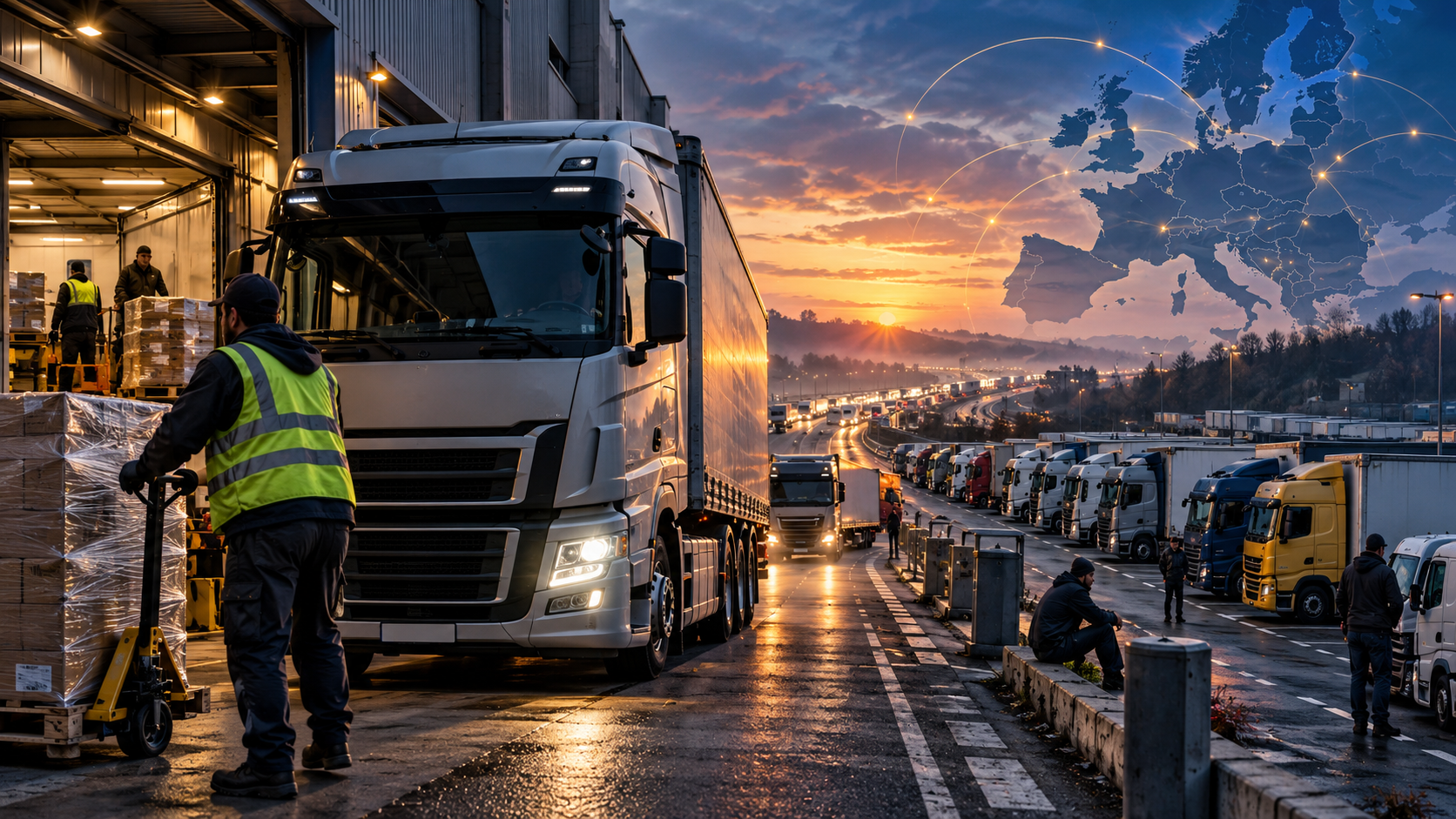
The European Union has launched a new project aimed at addressing the driver shortage in European road freight transport. Under the “Skilled Driver Mobility for Europe II” (SDM4EU II) initiative, a total of 600 professional drivers from Egypt and Morocco will be trained. Subsequently, 200 of them are planned to be facilitated into the European labour market with support. Drivers from Egypt will be employed in Romania, while those from Morocco will work in Italy.
The project has been running since June 2026 and is scheduled to conclude by the end of November 2028. In addition to vocational training, language courses, assistance with residency procedures, and integration into the labour market are planned.
At first glance, this sounds like a quite reasonable measure. The European transport sector lacks qualified professional drivers, and if people from other countries are given the opportunity to work here under fair conditions, there is fundamentally nothing against it.
However, this raises a question for me that has been far too rarely answered in the discussion about the driver shortage over the years: Why does one keep trying to recruit new people for this profession while hardly anything changes at the conditions under which they are supposed to work?
Recruiting drivers is easier than eliminating the root causes
Already back in June of this year, I dealt extensively with the causes of the driver shortage in my article “The driver shortage is not a youth problem – but a symptom of an industry under pressure” .
There, among other things, we discussed the economic pressure on transport companies, working conditions for employees, lack of truck parking spaces, waiting times at ramps, and the increasing shift of additional tasks onto professional drivers.
After around 30 years in this profession, I am convinced that we will not solve the driver shortage solely by putting more people behind the wheel.
Of course, the industry needs new blood. There is an ageing workforce, and eventually experienced drivers will retire. This is neither surprising nor a problem affecting exclusively road freight transport.
What concerns me, however, is the question of why people leave the profession long before reaching retirement age or why many experienced drivers advise their own children against becoming professional drivers as well.
Anyone who only thinks about where the next drivers should come from is merely dealing with part of the problem.
When the professional driver suddenly becomes a warehouse worker
One point that is particularly important to me in this discussion concerns the additional tasks that professional drivers are increasingly expected and required to take on.
This does not explicitly mean that drivers should fundamentally not load or unload their vehicles themselves. Depending on the transport order, this has been part of the daily routine for decades and is entirely understandable.
The problem arises where the actual transport performance has long been completed, yet the driver is suddenly expected to take on tasks belonging to internal warehouse logistics.
There, plastic films are removed from pallets, goods are repacked because the original pallet does not fit into the high-bay warehouse, or deliveries are sorted afterwards. Sometimes it is even demanded that drivers store goods themselves in high-bay racks or take on picking tasks, as for example at Kaufland.
And this, although we are neither responsible for the original packaging nor for the organisation of the warehouse.
I have experienced such situations myself during my professional life. These are not always individual misunderstandings at a ramp. In some places, fixed routines have developed over years from these situations.
The driver then faces the decision to take on the additional work or risk a discussion that might cost him hours. Because while work continues in the warehouse, the next transport order is waiting outside.
What impact such work has on working time, what qualifications might be required, and who bears responsibility in case of an accident are questions that are by no means trivial.
And now I ask myself: What should change if in the future a professional driver from Egypt or Morocco stands at this ramp?
Will he be less pressured? Will he be able to defend himself more easily against additional demands? Or is there not rather the danger that someone who may not yet sufficiently master the language and depends on their job will simply accept such conditions initially?
This is not an argument against foreign professional drivers. It is an argument for finally taking existing working conditions seriously. Because we European drivers face the same problems. Because this pressure is also exerted on us.
Additional drivers do not create new parking spaces
Another problem concerns infrastructure.
For years, suitable truck parking spaces have been missing on European motorways. Drivers must comply with their legally prescribed driving and rest times but often find no suitable place to park their vehicle, especially in the evening hours.
In addition come rest areas whose sanitary facilities do not meet requirements, lack of safety measures, and the fact that many drivers spend their rest periods over longer durations away from their families.
The EU has indeed recognised these problems. There are funding programmes, European regulations for safe parking areas, and provisions for the protection of employees.
However, there is a significant difference between political objectives and the actual situation on an overcrowded highway parking lot.
The European Mobility Package has indeed brought important improvements. Yet regulations alone are insufficient if they are not adequately enforced or if the necessary infrastructure is lacking.
Finally, an additional professional driver requires just as much space for parking, access to a toilet, and a suitable place for rest breaks as any other driver.
Economic causes persist
Furthermore, economic competition within the European transport sector plays a major role.
Freight forwarders face considerable cost pressure. Clients expect low transport prices, short delivery times, and high flexibility. At the same time, operating costs are rising, while many companies struggle to secure economically viable freight rates.
This pressure inevitably has consequences for employees.
Of course, there are freight forwarders that pay their drivers fairly, value their work, and strive for good working conditions. It would be wrong to judge all companies by the same standard.
Nevertheless, it must not be overlooked that economic pressure can be passed down along the transport chain until it finally reaches the people who actually transport the goods.
As long as this does not change, there remains the risk that the sector will continue to need new drivers because others leave the profession.
The crucial question is therefore not only how many people are attracted to work in road freight transport. Equally important is how many still wish to work voluntarily in this profession after five or ten years.
That is why I contacted the European Commission directly
On October 9, 2026, I therefore sent a detailed inquiry to Apostolos Tzitzikostas, the EU Commissioner for Sustainable Mobility and Tourism, and to Magnus Brunner, the EU Commissioner for Home Affairs and Migration.
I also wrote to Magda Kopczyńska, Director-General of the Directorate-General for Mobility and Transport (DG MOVE).
My inquiry does not aim to question the pilot project in principle or to deny professional opportunities to the drivers involved.
Rather, I am interested in how the European Commission intends to reconcile the recruitment of additional professional drivers with the structural problems of the sector that have been known for years.
Among other things, I asked what concrete measures are planned to retain already employed drivers in their profession in the long term. I also wanted to know how the Commission assesses the increasing transfer of warehouse tasks to professional drivers and how it will ensure that such work is properly recorded as working time.
Furthermore, I raised questions about economic pressure within transport chains, the parking situation, and the protection of recruited drivers.
I am particularly interested in how the success of the pilot project will be evaluated later.
Is it sufficient if 200 out of 600 people are successfully placed in employment? Or will it also be examined how many of them still work as professional drivers after one or two years, what experiences they have gained, and under what conditions they are employed?
Because a successful placement is far from a guarantee that someone will remain in this profession permanently. And we have already seen in Germany that recruiting professional drivers from third countries can also bring significant problems.
A particularly alarming case became public in November 2018 in Ense-Höingen, in the district of Soest. There, working conditions for 16 Filipino professional drivers came into the spotlight; they were deployed in European road freight transport through a network of Polish and Danish companies. The drivers regularly made trips on behalf of the logistics company NTG Logistics based there—a company for which my former employer briefly worked as well. Fortunately, I only had to make one trip there. After that, I refused to be deployed there again.
According to their own accounts, some of the men lived exclusively in their trucks for up to 18 months. They cooked outdoors, washed their clothes on the parking lot, and at weekends sometimes did not even have access to running water. In addition, there were serious payment issues. According to reports at the time, the contractual base salary was only 428 euros per month.
When the conditions became public, trade unions and authorities intervened. Several drivers had to be temporarily accommodated elsewhere. Later, eight of those affected received a total of 45,000 euros as part of an out-of-court settlement. NTG emphasized that it had not been the direct employer of the drivers but had hired a Danish subcontractor.
The case shows how quickly recruited workers can fall into dependency if they do not know their rights, have few opportunities to defend themselves against poor working conditions, and if actual responsibilities blur across multiple subcontractors.
Of course, this does not mean that such conditions must repeat themselves under the new EU pilot project. But precisely for that reason, the European Commission should be able to explain how it intends to prevent drivers from third countries from being employed under comparable conditions.
Because recruiting additional professional drivers will not solve the driver shortage if they are merely placed into a sector whose existing problems remain untouched.
Source: Soester Anzeiger
The Commission’s response is still pending
Whether and to what extent the addressed representatives of the European Commission will respond to my questions remains to be seen.
In any case, I hope for a substantive engagement with the issues raised, rather than merely being referred to existing European regulations.
For in my view, the question of the driver shortage cannot be answered without also discussing the daily lives of those who have been behind the wheel for many years.
Once again: I have absolutely no objection to professional drivers from Egypt, Morocco or other countries being given the opportunity to work within the European Union. They have just as much right to fair pay, reasonable working conditions and respectful treatment as their European colleagues.
But if we recruit people from other countries only to make them work under the same conditions that many experienced drivers already criticize today, we should not be surprised if the driver shortage remains an issue in some years to come.
Perhaps we should therefore stop discussing only where the next 600 professional drivers will come from.
And instead finally discuss what needs to change so that those who already practice this profession also wish to continue doing so.
As soon as I receive a statement from the European Commission, I will report on the answers and contextualize them accordingly.
Sources and further information
