

Was ist die Fahrerkarte?
Kurzüberblick
- Die Fahrerkarte ist im gewerblichen Güter- und Personenverkehr Pflicht.
- Ohne gültige Fahrerkarte darf grundsätzlich nicht gefahren werden.
- Bei Verlust, Diebstahl oder Defekt gilt eine Ausnahme von maximal 15 Tagen.
- Eine Ersatzkarte muss innerhalb von 7 Kalendertagen beantragt werden.
- Die Fahrerkarte ist 5 Jahre gültig.
- Die Daten müssen spätestens alle 28 Tage ausgelesen werden.
- Seit dem 31.12.2024 müssen Nachweise über die letzten 56 Tage mitgeführt werden.
Die Fahrerkarte ist eine personalisierte Chipkarte für den digitalen Fahrtenschreiber.
Sie speichert:
- Lenkzeiten
- Ruhezeiten
- Arbeitszeiten
- Bereitschaftszeiten
Sie ist Pflicht im gewerblichen Güter- und Personenverkehr.
Darf man ohne Fahrerkarte fahren?
Nein. Ohne gültige Fahrerkarte darf grundsätzlich nicht gefahren werden.
Ausnahmen bestehen nur, wenn die Fahrerkarte:
- defekt ist
- verloren wurde
- gestohlen wurde
In diesen Fällen darf maximal 15 Tage ohne Fahrerkarte gefahren werden.
Eine Ersatzkarte muss spätestens nach 7 Kalendertagen beantragt sein! Jetzt ist es allerdings auch so, dass man nicht einfach morgens losfahren darf und das war es dann. Beim Fahren, ohne Karte gelten gewisse Dinge, die man zu beachten hat, denn schließlich unterliegt man immer noch der Dokumentationspflicht.
- Vor Fahrtbeginn einen Ausdruck machen
- Auf diesem Ausdruck, das Datum, die Uhrzeit, den Anfangskilometerstand, den Namen, die Nummer der Fahrerkarte ODER des Führerscheins sowie die vom Vortag geleisteten sonstigen Arbeitszeiten eintragen und das ganze noch durch die eigene Unterschrift bestätigen.
- Beim Feierabend müssen die im Tacho aufgezeichneten Lenkzeiten und deren Unterbrechungen / Ruhezeiten ausgedruckt und ggf. um die sonstigen Arbeits- und Bereitschaftszeiten (handschriftlich) ergänzt werden. Ebenfalls darf der Name und die Nummer der Fahrerkarte ODER des Führerscheins nicht fehlen.
Die o.g. Dinge müssen auch bei einem Fahrzeugwechsel (zwischen analogem und digitalem Tacho) gemacht werden. Die Ausdrucke sind stets dem Arbeitgeber sowie ggf. dem zuständigen Kontrollbeamten auf Verlangen auszuhändigen. Auch hierbei besteht eine Mitführungspflicht von 28 Tagen! Dass die Fahrerkarte alle 28 Tage ausgelesen werden muss, versteht sich eigentlich von selbst. Der Tacho alle 90 Tage.
Privatfahrten mit dem LKW
Bei Privatfahrten mit dem LKW muss natürlich keine Fahrerkarte gesteckt sein. Allerdings ist hier das Gewicht entscheidend. Bei Fahrzeugen bis 7,5 Tonnen zulässiges Gesamtgewicht, brauche ich keine Fahrerkarte zu stecken. Bei Fahrzeugen ab 7,5 Tonnen unterliege ich jedoch wieder der Lenk- und Ruhezeiten und muss meine Fahrerkarte stecken. Somit wäre das theoretisch keine Privatfahrt, auch wenn ich bspw. sonntags mit meiner Zugmaschine zum Bäcker fahre. Für LKWs mit H-Kennzeichen gilt diese Regel nicht.
Anders gesagt, wenn ich für Freunde einen Umzug machen will, mein LKW aber über 7,5 Tonnen liegt, muss ich den Umzug ggf. absagen, wenn ich für die Zeit keine Lenkzeit mehr habe oder meine Wochenruhezeit dadurch nicht einhalten kann!
Defekte Fahrerkarten mit der Chipnummer E 216
Seit Februar 2011 ist bekannt, dass Fahrerkarten mit der Chipnummer E 216 einen Defekt aufweisen können. Hier löst sich in der Regel der auf der Karte aufgeklebte Chip. Die Herstellerfirma Zauner (ZA-ARC) geht zwar laut einer Pressemitteilung davon aus, dass es an der eingesetzten Software liegt, doch wenn kein Chip mehr auf der Karte ist, gibt es keine Software, die diese auslesen kann. Man wird gebeten, sich bei einem Defekt mit der Herstellerfirma in Verbindung zu setzen. Ansprechpartner ist Herr Kowalewski unter Telefon +49 (6104) 699174.
Andere Tätigkeiten
Für andere Tätigkeiten, die nicht der VO 561/2006/EG unterliegen, muss der Arbeitgeber eine Bescheinigung ausstellen, dass man kein Fahrzeug bewegt hat, welches der genannten Verordnung unterliegt. Hier ist aber auch ein Nachtrag (Arbeitszeit) im digitalen Tacho legitim.
Der Krankheitsfall
Was tun, wenn man nun längere Zeit krank war, so wie ich nach meinem Herzinfarkt? Krankheit lässt sich jedoch schlecht auf der Fahrerkarte nachtragen. Doch jetzt wird es etwas kompliziert. Wie ja einigen bekannt ist, wurde kürzlich erst die Fahrpersonalverordnung »überarbeitet«. Jetzt besagt hier der § 20 in Abs. 1
(1) Selbstfahrende Unternehmer und Fahrer, die die in dieser Verordnung, in Artikel 36 Absatz 2 der Verordnung (EU) Nr. 165/2014 oder in Kapitel III Artikel 12 Absatz 2 Satz 1 des Anhangs zum Europäischen Übereinkommen über die Arbeit des im internationalen Straßenverkehr beschäftigten Fahrpersonals (AETR) vorgeschriebenen Nachweise nicht oder nicht vollständig vorlegen können, weil sie an einem oder mehreren der vorausgegangenen 28 Kalendertage
- ein Fahrzeug gelenkt haben, für dessen Führen eine Nachweispflicht nicht besteht,
- erkrankt waren,
- sich im Urlaub befanden oder
- aus anderen Gründen kein Fahrzeug gelenkt haben, haben diese Zeiten durch manuelle Nachträge nach den Absätzen 2 oder 3 zu belegen. Der Unternehmer hat dafür zu sorgen, dass der Fahrer die manuellen Nachträge nach den Absätzen 2 oder 3 vornimmt.
The question that is now arising for me is, illness I cannot report as such, so I would have to put on a break. But that would be just 6 weeks. The certificate visible on the image I am theoretically not allowed to present, as I have a digital tachograph and it is reasonable to require me to report this event. I have written to the BAG about this again. Let’s see what comes of it. As soon as the answer arrives, I will update this section and attach the answer as a download to this article.
UPDATE
I have received a response from the Federal Office for Goods Transport in the meantime. According to the statement of Mr. Arne Mantowsky, the illness case is recorded as a rest period. There is no other way. However, since I was sick for more than 5 days, I can also use a certificate of days free of consideration as proof of my absences, according to the email.
If the driver’s card becomes invalid
The driver’s card is valid for exactly 5 years, like the driver’s license. Therefore, it is important to apply for a so-called follow-up card before the driver’s card expires. In general, it takes 10 days until the new card arrives. Prices can vary depending on the driver’s license office / federal state. I paid 46 € in December 2015 here in the Hochsauerlandkreis. Just as a note.
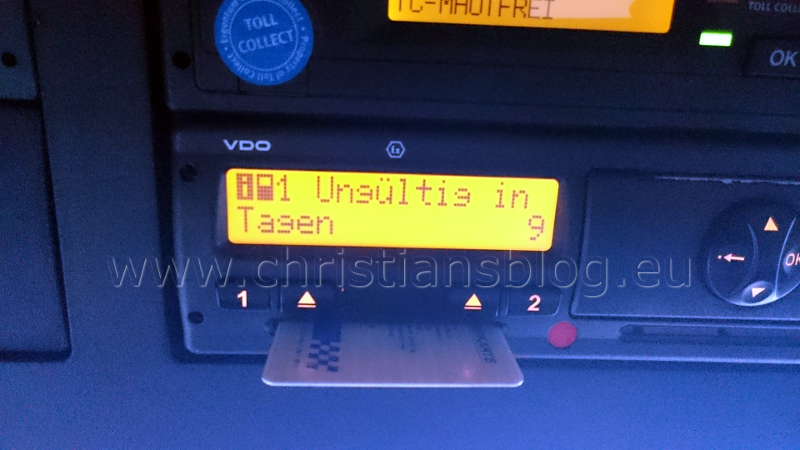
Modern tachographs show how many days the driver’s card becomes invalid, so it is always a good idea to check the tachograph when removing the card.
What can the employer do with my card and what cannot?
What the employer is allowed to do with my driver’s card and what is not, is quickly explained. Because he is only allowed to do one thing: read my driver’s card within the framework of the documentation obligation and nothing more!
So that no further questions arise, he is not allowed to:
- keep the card,
- pass it on to third parties (another driver, for example, so that he can continue driving)
- prevent me from reading the data myself
Thus, his actions with my card are limited to what I described above: He is only allowed to read it and nothing more! The card is issued in my name and is therefore my property!
The read data must be archived and must be passed on to the authorities upon request. Data of the driver must not be disclosed to unauthorized third parties.
From when do I need a driver’s card / tachograph?
In general, one must first clarify from when a tachograph is required.
Because here there are certain weight classes for which no tachographs are required. In the case of a commercial transport, tachographs are required if:
- The vehicle / vehicle combination, which currently weighs more than 3.5 tons.
- Buses with more than 8 passenger seats
If the vehicle is operated privately, no driver’s card is needed, even if a tachograph is installed. Here, the weight plays no role.
For vehicles between 2.5 tons and 3.5 tons, there is no obligation to equip the vehicle with a tachograph. However, if one is installed, it must be used.
Thus, it can be concluded: I only need a driver’s card in the case of commercial transport of goods / people.
The craftsmen’s regulation
Here is another special case, when you don’t need a driver’s card.
The so-called craftsmen’s regulation. In rough terms, this regulation states that a craftsman, who merely transports the materials he needs on his construction site and then proceeds with his actual task, does not need to present a driver’s card within a radius of 100 kilometers (until 02.03.2015, a radius of 50 km was valid) around the company’s headquarters.
In reverse, if the distance exceeds this 100 km, a driver’s card is required.
Working hours
Inserting and removing the driver’s card, as well as operating the tachograph, counts towards working hours. That means, before I insert the driver’s card into the tachograph and remove it again from the tachograph, I must make sure that the tachograph is set to working hours (the two hammers).
That also means, if I leave the card in the tachograph for the whole week, I must make sure, before I record the start and end of the journey, that the tachograph is also set to working hours.
Otherwise, it costs money: Per violation 75 € for the driver, 225 € for the company.
I always remove the card while the engine is running, because I let the truck run a bit longer, even though it is no longer necessary today. During this time, I can remove the card, as the tachograph automatically switches to working hours when stopping.
Printout, what should I pay attention to here?
Occasionally, it can happen that one has to make a printout. Basically, only when one has to document a violation.
In general, the thermal paper is, if you do not have to pay for it yourself, the property of the company. Therefore, also what is printed on it. And also the reason why one made a printout is irrelevant in the first place.
Such a printout must be kept for 28 days, if it is to be used for documentation in the case of violations or in the case of the 15-day period, if the new driver’s card has not arrived yet.
UpdateSince December 31, 2024, a retention period of 56 days applies.
However, there is a claim for a copy of the made printouts!
Who is responsible for the storage of the driver’s card?
The driver card is and remains the property of the driver to whom the card was issued. Therefore, it is only he who is solely responsible for its secure storage. In other words, carelessly leaving it lying around or the often preferred “Leave it in the tachometer” or even handing it over to the boss for storage does not fall under the term secure storage.
At this point, the question often arises whether the boss is allowed to retain the driver card. The answer to this is surprisingly simple: No. The employer may read the card within the framework of his legal obligations, but he may not retain it permanently or store it on behalf of the driver. The responsibility for the card always remains with the driver.
If someone else uses the card here, this constitutes a criminal misuse, for which the card owner may also be held liable under certain circumstances.
Driver card of the next generation
Since June 15, 2019, there has been the so-called intelligent tachograph. This records not only driving and rest times, or other times such as break, working and readiness time, but also via GPS the location of the vehicle at the beginning, end and every 3 hours. Of course, violations are also still recorded.
But the new tachograph also necessitates a new generation of driver cards. Sure, you can still use the old card with the new tachograph until the card expires, but then not all data will be available on the card.
Because in addition to the position of the vehicle, other data must also be stored if the driving time exceeds 3 hours:
- Date and time, if the uninterrupted driving time of the cardholder exceeds 3 hours
- Position of the vehicle
- GNSS-accuracy , date and time of the position determination
In fact, the driver card must be able to store a total of 252 data sets.
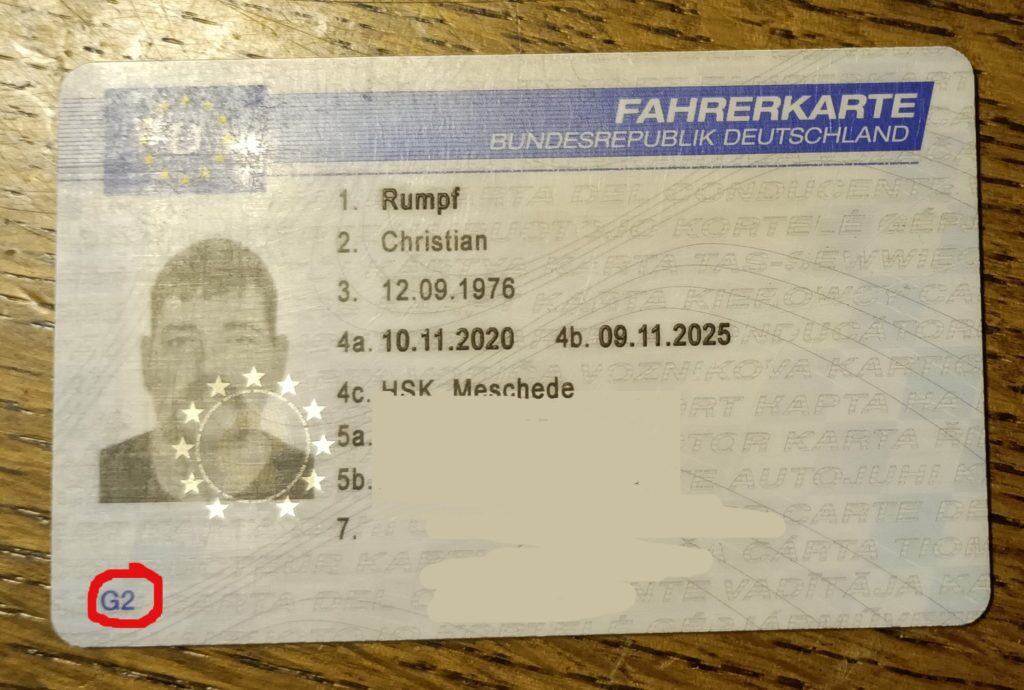
The second-generation driver cards can be recognized by G2 in the bottom left corner of the front side of the card.
NoteThe following information stems from the Corona pandemic and is retained solely for documentation and research purposes. For current regulations, the current guidelines of the relevant authorities apply.
Applying for a driver card during Corona times
One thing upfront, the way in which a new driver card must be applied for can vary from region to region!
Here in the Hochsauerlandkreis, the process currently works as follows: you receive a form, fill it out, stick a passport photo in, transfer 46 euros to the account of the district savings bank, and receive your driver card within the shortest time possible.
Driver’s license
I would also like to briefly touch on the driver’s license here. Because not everyone has the same renewal periods and we don’t all have to run to the office at the same time.
Normally, we all have to prove our 5 refresher courses every 5 years to renew our driver’s license.
Due to Corona, this is currently not possible. The EU and our government are aware of this. Therefore, as in 2020, the EU has again ensured the possibility of renewal without refresher course proof.
Documents that expire between September 1, 2020, and April 30, 2021, can be extended by an additional 7 months without proof.
But WARNING! The EU member states CAN adopt these options. They do not have to. The BMVI has not yet made any statements on this. However, a query has been made.
Emergency transports
Due to the war in Ukraine, there are many emergency transports going to the Polish/Ukrainian border. But what regulations apply here? Just set the tachograph to “Out” and off you go with the Luzi? Or do you still have to insert the card?
What does the VO561/2006/EG say about this? Article 3, letter d states:
This Regulation does not apply to transport by road with the following vehicles:
d) Vehicles — including vehicles used for non-commercial transport for humanitarian aid — used in emergencies or in rescue operations;
This means: If the emergency transport is not commercial, i.e., if the entrepreneur does not usually get paid for the transport, the driver is not subject to driving and rest times and thus does not need to insert the driver card.
Driver card Type 1 or 2?
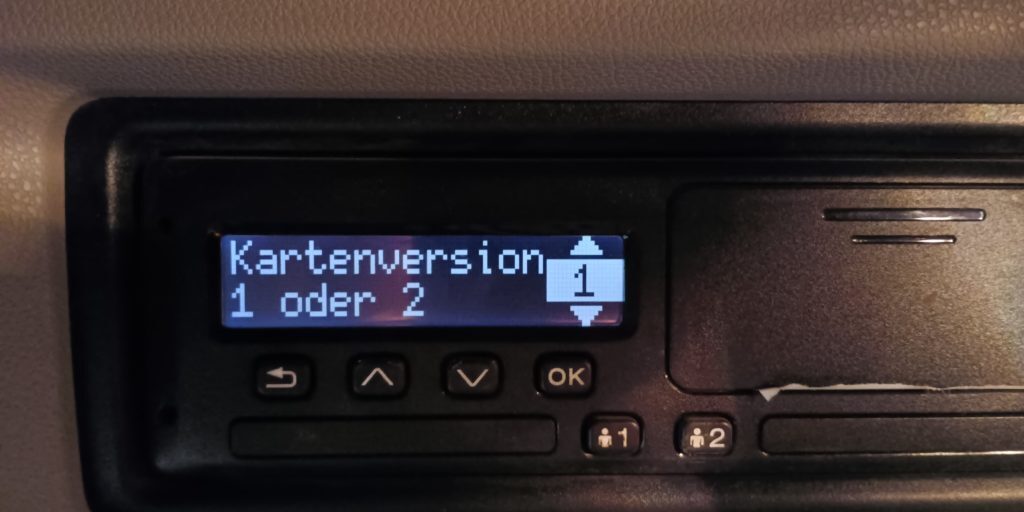
It may have occurred to some that when you want to print out a copy of the driver card, you are asked whether the driver card is of Type 1 or 2. This has to do with the new tachographs that have been required since July 1, 2020.
These tachographs not only record, as previous versions did, your driving time and any other possible violations, but they also store the location of the vehicle at the beginning and end of the “day” as well as every 3 hours at the time of the location determination. These locations are also stored on a Type 2 driver card.
How can I tell which card I have?
At the bottom left of the card, it says either G1 or G2. In the future, all cards will only be of this type. Therefore, the control authorities will always know where you were. Of course, also the start and end of your working day. And this type of tachograph will be in all vehicles by about summer 2025.
Existing vehicles also need to be upgraded to the current version of the tachograph at the time. And yes, there are exceptions here as well.
Perhaps there’s still something else regarding the renewal of the driver’s card. There will be one or two people who cannot apply for everything at the same time (driver’s license, driver’s card, certificate 95). Now one might come up with the glorious idea of reporting the driver’s card as stolen, lost, or something else. In the case of “I lost my driver’s card,” I can now report from my own experience: The Hochsauerlandkreis (I think other authorities are the same), sends you to a notary for an oath to confirm that the driver’s card is indeed lost. The notary is not cheap. It can also happen that a civil servant happens to be in the office, who can also certify this declaration. Cost here: 40 Euros plus another 43 Euros for the new driver’s card. The driver’s license, passport photos, and certificate for the 95 have already cost me nearly 100 Euros. In total, I had to pay 183 Euros.
Frequently Asked Questions about the Driver’s Card
Do I have to always carry the driver’s card?
Yes, as soon as you are on the way in commercial traffic and a tachograph is required.
What happens if I am caught without a driver’s card?
This can get expensive – fines for the driver and the company are possible.
How often must the driver’s card be read?
The data of the driver’s card must be read and archived no later than every 28 days.
How long can I drive without a driver’s card?
In the case of loss, theft, or defect, you may drive without a driver’s card for a maximum of 15 calendar days.
When must a replacement card be applied for?
No later than within 7 calendar days after loss, theft, or defect.
How long is a driver’s card valid?
The driver’s card is valid for five years.
Who is the owner of the driver’s card?
The driver’s card remains the property of the driver whose name it was issued under.
May my employer keep my driver’s card?
No. The driver’s card remains the property of the driver. The employer may use it for reading the data, but may not keep it permanently.
How many days must be proven during inspections?
Since December 31, 2024, proof of the last 56 days must be kept.
Do I need a driver’s card for private trips with a truck?
Not necessarily. The decisive factors are the specific circumstances of the trip as well as the permissible total weight of the vehicle. The details are explained in the section “Private Trips with a Truck.”
