

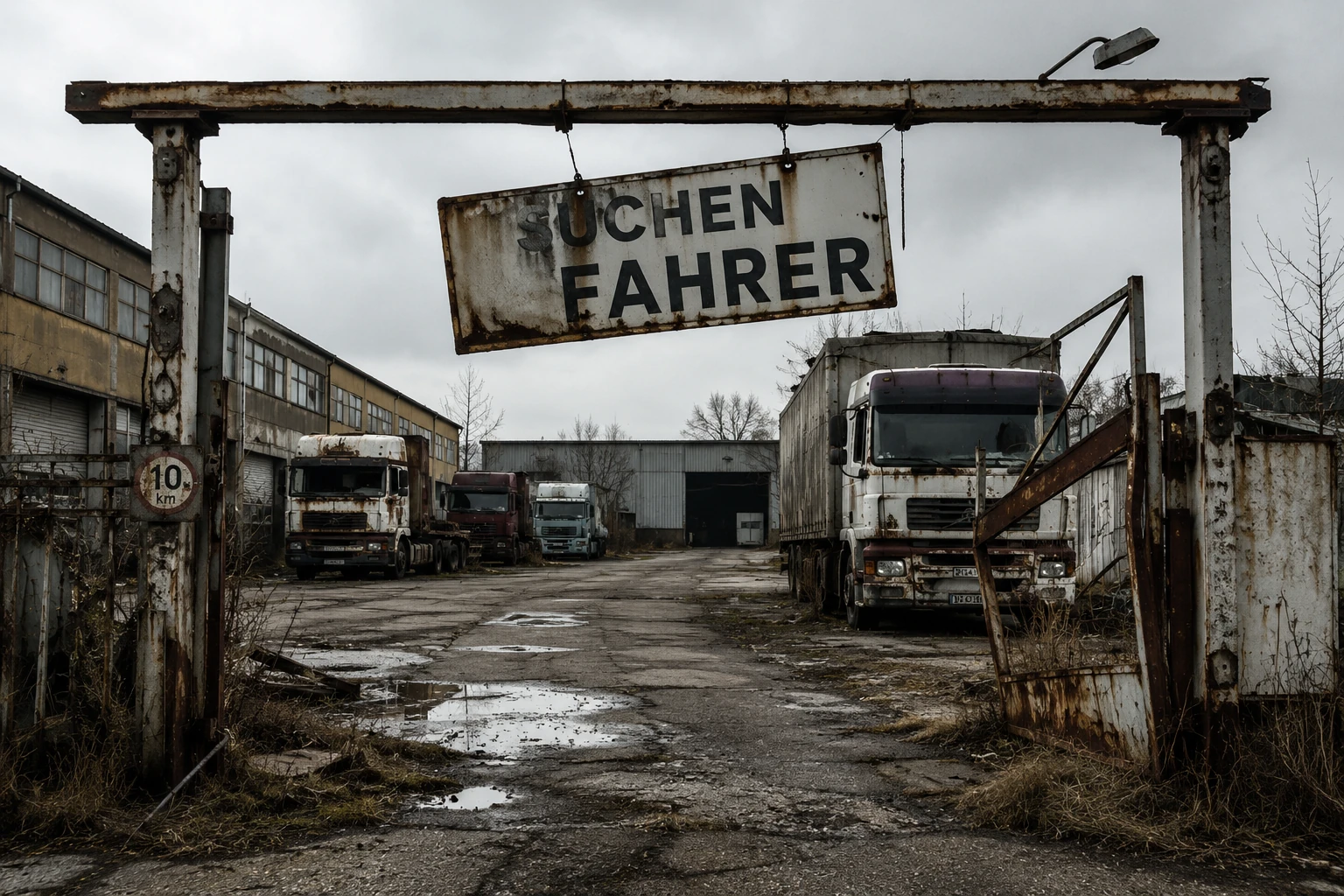
“We do not have a shortage of drivers. We have a shortage of cheap drivers who are willing to work under these conditions.”
Even if this statement sounds exaggerated: it describes a conflict that has plagued the industry for years. For, while discussions often revolve around how new drivers can be recruited, far less frequently is the question asked as to why many experienced drivers leave the profession or advise their own children against following the same path.
NoteAuthor’s Note
This article summarizes insights from several previously published contributions and supplements them with current developments and European legal frameworks.
Few industries are perceived as taken for granted as much as road freight transport.
As long as supermarkets are supplied, production lines run, and packages arrive on time, few people think about how dependent our society is on a functioning logistics system.
It is only when supply chains break down – be it due to a pandemic, extreme weather conditions, or other extraordinary events – that the central role of road freight transport for the economy and supply becomes visible.
At the same time, the industry has been under pressure for years. Drivers are missing, companies struggle with rising costs, and an increasing number of businesses are disappearing from the market.
Often these developments are considered separately.
However, they may be more closely linked than they first appear.
What this article is about
Therefore, this article deals not only with the shortage of drivers.
It examines the situation of the industry as a whole and addresses, among other things, the question of:
- why previous measures have not been able to solve the driver shortage sustainably,
- why economic problems of companies and the driver shortage may be related,
- what challenges characterize the daily work life,
- and why many experienced drivers would no longer recommend their children to take up the same profession today.
The central thesis is:
As long as the causes driving people out of the profession are not eliminated, every measure to recruit new drivers will have only limited effect.
The Wrong Question
When politics or the media talk about the shortage of drivers, the discussion often revolves around the same question:
How do we recruit more professional drivers?
The answers to this are now largely known.
The minimum age for obtaining certain driver’s license classes has been lowered, the recognition of foreign vocational qualifications is to be simplified, and companies are increasingly recruiting drivers from third countries. At the same time, many freight forwarders invest in recruitment campaigns, bonus programs, or advertising measures to attract new employees.
All these measures pursue a comprehensible goal.
They aim to increase the number of available professional drivers.
However, it is exactly at this point that another question arises, which is discussed much less frequently:
Why do experienced professional drivers leave their profession?
Because even if it succeeds in recruiting thousands of new drivers every year, this will only solve the problem permanently if, at the same time, fewer people leave the profession again.
This is exactly where, in my view, the crucial difference lies between a recruitment problem and an attrition problem.
Recruiting young talent or retaining skilled workers?
Almost every industry today faces the challenge of finding qualified skilled workers. At the same time, many companies invest considerable resources to bind experienced employees to the company in the long term.
In road freight transport, however, for many years there was often the impression that the focus lay primarily on recruiting new drivers.
However, the question inevitably arises:
What measures were actually taken to retain the drivers who are already active in the profession?
This question is not directed exclusively at politics.
It is also addressed to companies, clients, associations, and ultimately all parties involved along the transport chain.
Because the attractiveness of a profession is not decided only at the start of a career.
It is decided anew every single workday.
An uncomfortable question
Many professional drivers have been reporting similar experiences for years.
Here it is often not just about pay. Long absences from home, lack of planning security, increasing time pressure, waiting times at loading and unloading sites, or the feeling that the requirements for the profession are constantly rising while the framework conditions in many places hardly improve are mentioned.
Of course, there are companies that regularly share in the economic development with their employees, invest in modern vehicles, and create attractive working conditions.
They show that it is indeed possible to do things differently.
At the same time, however, there are also businesses in which little has changed over the years.
Precisely this difference raises an interesting question:
Why do some companies succeed in binding drivers to themselves for many years, while other businesses are permanently on the lookout for personnel?
More than just wages
Wages undoubtedly play an important role.
Many professional drivers report that significant salary increases are often only possible when they change employers. Those who remain loyal to their company for years or even decades, on the other hand, often receive only minor adjustments. This frequently creates the impression that loyalty is financially rewarded less than a job change.
Of course, there are companies that regularly involve their employees in economic development and continuously invest in better working conditions. They show that things can indeed be done differently.
At the same time, however, the question arises as to why many companies apparently fail to retain experienced drivers in the long term.
The answer probably does not lie solely in wages.
Even where pay is fair, drivers frequently cite other reasons for switching jobs or even leaving the profession altogether. These include lack of predictability, long periods away from home, a lack of appreciation, or working conditions that have deteriorated over the years.
Wages are therefore an important part of the discussion – but not the only one.
The Big Picture
It is precisely at this point that it becomes clear why driver shortages should not be viewed in isolation.
A profession is not made attractive simply by allowing new people to enter it.
It remains attractive when those who already practice it have good reasons to stay in the profession in the long term.
At the same time, the question arises as to why many companies are under economic pressure despite full order books, and why the number of insolvencies in the sector has been rising for years.
These developments are often viewed separately from one another.
However, they may be more closely linked than they first appear.
Before we turn to the economic problems of the sector, it is therefore worthwhile to take a look at the daily reality of the profession itself.
After all, the job of the professional driver has also undergone fundamental changes in recent decades.
The Profession Has Changed
Many discussions about driver shortages revolve around the question of how new drivers can be recruited.
Far less frequently is there talk about how the profession itself has changed over the past decades.
Indeed, hardly any other training occupation in the transport sector has experienced a comparable transformation.
Anyone driving a truck across Europe today works under completely different conditions than twenty or thirty years ago.
Many of these developments are fundamentally positive.
Driving and rest periods are now controlled much more consistently than before. Digital tachographs make manipulation more difficult and contribute to greater road safety. Occupational health and safety has also improved in many areas.
At the same time, however, new burdens have emerged that are often barely noticed in public discourse.
More Responsibility Than Ever Before
Modern trucks are now equipped with assistance systems that would have been unthinkable a few decades ago.
Emergency braking assistants, lane-keeping assistants, turn-assistants, and numerous other systems support the driver in everyday life and demonstrably contribute to road safety.
Nevertheless, responsibility ultimately remains with the human behind the wheel.
Anyone moving a semi-trailer with a total weight of up to 40 tonnes through densely populated city centres, highway construction sites, or urban delivery zones bears a responsibility that far exceeds that of many other professions.
Every mistake can have serious consequences.
This responsibility does not end after a few minutes of concentrated work.
It accompanies professional drivers for hours – often throughout the entire daily driving time.
Concentration is Work
In many professions, physical strain is immediately perceived.

The strain caused by sustained concentration is, in contrast, frequently underestimated.
Anyone moving a heavy commercial vehicle on public roads for nine or ten hours a day must constantly make decisions, assess traffic situations, identify risks, and react to unforeseeable events.
Unlike often assumed, a break prescribed under Regulation (EG) No 561/2006 does not mean that all burdens disappear.
It serves to restore fitness for driving.
However, the mental strain on a driver does not automatically end after a 45-minute break.
Precisely for this reason, the question arises as to whether tasks that are actually assigned to warehouse or loading personnel should additionally be transferred to drivers.
When Drivers Become Warehouse Workers
The actual task of a professional driver is to transport goods safely and on time from one place to another.
In practice, however, much more often goes into it than just driving. Depending on the transport order, it has been customary for decades for drivers to unload their vehicles themselves. This is neither unusual nor fundamentally problematic. On the contrary: After several hours behind the wheel, many drivers even welcome the physical movement involved in unloading as a pleasant counterbalance to the long time spent sitting.
Therefore, this discussion explicitly does not concern the question of whether drivers should generally be allowed or required to load or unload. In many areas, this is a fixed component of the transport service and often cannot be done any other way practically.
The real question begins where the driver’s activity goes beyond transport and unloading.
Thus, in practice, it happens again and again that, after delivery, drivers are additionally asked to remove films and packaging materials, sort goods, repack damaged pallets, or prepare deliveries so that they can subsequently be processed in automated high-bay warehouses.
Such requirements are now part of daily practice in many places, especially at large trading and logistics centers. These are often not spontaneous demands from individual employees on site, but rather processes that have become established over the years.
At this point, a fundamental question arises:
Where does the transport service end, and where does warehousing begin?
Neither the packaging of goods nor their assembly or storage is carried out by the driver. Nevertheless, it is frequently expected of him to resolve issues that only arise after the completion of the actual transport order.
For example, if a pallet is rejected because it does not meet the recipient’s requirements or does not fit into the designated warehouse systems, the additional work often remains with the driver. Although neither the packaging nor the palletization was performed by him, he is expected to make the necessary adjustments.
This is not about individual exceptions or occasional on-site support. The transport industry has always been characterized by pragmatism and mutual assistance.
However, problems arise where additional tasks become taken for granted and duties that were originally assigned to the warehouse or loading area are permanently shifted onto the driver.
Against the backdrop of the current shortage of drivers, this discussion is gaining increasing importance.
While politics and business advise on how to recruit new drivers, at the same time the question arises whether the professional profile of the truck driver has been expanded further over the years.
Anyone who has already been on the road for nine or ten hours carries not only physical but above all a considerable mental burden. Responsibility for a vehicle with a total weight of up to 40 tonnes does not end upon reaching the destination.
Therefore, the question is not whether drivers are willing to pitch in.
The real question is rather:
Which tasks should still belong to the professional profile of the truck driver in the future – and which should remain reserved for warehouse and loading personnel?
A Look at Europe
The question of which tasks belong to the professional profile of a truck driver and which do not is now being discussed not only in Germany.
Several European countries have introduced legal regulations in recent years that redefine the role of the driver in loading and unloading operations.
Spain is particularly well-known for this.
In 2022, a far-reaching ban on loading and unloading was introduced for professional drivers there. The basic idea behind this regulation is that drivers are primarily responsible for the transport of goods and should not permanently undertake tasks that actually belong to warehouse or loading personnel.
Similar regulations now also exist in Portugal. In addition, other countries have begun to consider comparable measures or are putting corresponding provisions into place.
The backgrounds of these decisions are remarkable.
The discussion there was not conducted solely from the perspective of occupational safety. Rather, the question also played a role of how the profession can be made more attractive in the long term and which activities should actually be expected of drivers in the future.
It is not about prohibiting every form of assistance during loading or unloading.
Rather, the fundamental consideration is whether it makes sense for drivers to undertake additional tasks after a long journey that are only indirectly related to the actual transport.
Regardless of how these regulations are evaluated individually, they clearly show one thing:
Other European countries are already leading this discussion.
The question is no longer whether this topic is relevant.
The question is rather why there is currently no uniform regulation across Europe and why comparable discussions play only a subordinate role in many other member states.
Discussion QuestionThe European Union regulates today very detailed:
- Driving times
- Rest periods
- Tachographs
- Professional driver qualification
- Cabotage
- Posting of workers
In contrast, a uniform regulation across Europe delineating driving and warehousing activities does not yet exist.
Would you recommend this profession to your own child?
A question that repeatedly arises in discussions about the shortage of drivers is:
Why do so few young people decide today to pursue the profession of truck driver?
The answers are diverse.
But perhaps another question is worth asking:
Would experienced truck drivers recommend their own children to follow the same career path?
The answer often comes out discouragingly.
This is often not about drivers rejecting their profession in principle. Many still identify with their work. They are proud of their experience, their responsibility, and their role within the supply chain.
Nevertheless, numerous drivers would advise their children today to choose a different career path.
The reasons for this often do not lie in driving itself.
They lie in the working conditions.
Long absences from home, irregular working hours, increasing traffic, lack of predictability, and growing economic pressure have led many drivers to assess the attractiveness of the profession differently today than they did a few decades ago.
There is another aspect to consider.
Truck drivers spend a significant part of their working life in public road traffic. They experience accidents, dangerous situations, and the consequences of human errors up close.
Many drivers are therefore very well aware of the risks they face on a daily basis.
Not a few justify their negative attitude towards their children’s profession not with a lack of appreciation for the job itself, but with concern for their safety and quality of life.
This development alone should be thought-provoking.
For a profession is not made attractive merely by attracting new people to it.
It becomes attractive when those who already practice it can recommend it to the next generation in good conscience.
At this point, I would also like to share my personal assessment without reservation.
If someone asks me today whether I would recommend becoming a professional driver to my own children, my answer is: No.
Not because I fundamentally reject my profession.
Not because I consider the work unimportant.
And not because I did not enjoy practicing the job.
On the contrary.
After decades in the industry, I know what responsibility professional drivers take on daily and how significant their work is for our society.
Nevertheless, I advised both my daughter and my son to pursue different career paths.
My daughter is currently completing her training in the field of freight forwarding and logistics. I have also already advised my son to choose a different path later than becoming a professional driver himself.
The reason for this does not lie in a lack of appreciation for the profession.
Rather, it lies in the experiences one gathers after many years on the road.
These include long working hours, the difficult work-life balance, the often unpredictable nature of daily life, and the burdens that many drivers face over the years.
In addition come the risks associated with this profession.
Anyone who travels extensively in long-haul transport inevitably encounters things that remain hidden from outsiders. Accidents, dangerous situations, and the consequences of human error unfortunately belong to the reality on Europe’s roads.
I have seen drivers die. I witnessed how a good colleague crashed into a traffic jam at the end of a queue during a severe accident and lost his life.
The sight of the destroyed vehicle still haunts me today. Such experiences leave marks.
They change one’s perspective on the profession and the risks associated with it.
Perhaps this is exactly where one of the most important clues to the actual cause of the driver shortage lies.
For if even people who have practiced their profession for decades often recommend other career paths to their own children, this should be reason enough to reflect on the reasons behind it.
Precisely for this reason, the discussion about the driver shortage should not be reduced solely to how new drivers can be recruited.
Perhaps we should instead ask ourselves why many experienced drivers now recommend other career paths to their own children.
Companies Under Pressure
When discussing the driver shortage, the conversation often focuses on the employee side.
Far less frequently is there a discussion about the economic conditions under which many transport companies operate today.
However, developments over the past few years show a trend that is at least as worrying as the lack of drivers: an increasing number of companies in the transport and logistics sector are coming under economic pressure or disappearing from the market entirely.
Especially affected are small and medium-sized enterprises.
These are precisely the businesses that formed the backbone of European road freight transport for decades. Family-owned companies with 20, 50, or 100 vehicles that trained drivers, invested regionally, and often survived across generations.
Today, many of these companies are struggling with a multitude of challenges simultaneously.
Rising energy prices, higher workshop costs, increasing financing costs, the expansion of truck tolls, growing bureaucracy, and sustained price pressure along the supply chain are severely burdening the industry.
In addition comes an economic development that many companies can only influence to a limited extent.
Weak economic growth, declining industrial production, and increasingly intense competition lead to the situation where the costs for many businesses rise significantly faster than their revenues.
The real problem often does not lie in a lack of orders.
Numerous companies still have well-filled order books.
The challenge lies rather in the fact that there is ever less room between an order and profit.
In other words:
Transport operations continue to be carried out.
Yet this happens more and more frequently under conditions that are neither sustainable for companies nor for employees in the long term.
The Price of Free Competition
Many of today’s problems cannot be understood without taking a look at the development of the industry over the past decades.
When I started my career in 1995, the effects of a fundamental change were still clearly noticeable. Until the early 1990s, binding tariff systems such as the Reichskraftwagentarif (RKT) and later the Güterfernverkehrstarif (GFT) existed in German freight transport. Freight rates were based, among other things, on distance, type of goods transported, and other specified criteria. The aim of these regulations was, among other things, to prevent ruinous price competition.
With the liberalization of freight transport, these tariff bindings were abolished. The expectation was that more competition would lead to greater efficiency, better offers, and a more dynamic market.
In reality, however, this development also led to the situation where price increasingly became the decisive competitive factor.
Even in the years following liberalization, it became evident that not every freight forwarder would benefit from this development. Companies disappeared from the market because they could not withstand the growing price pressure. At the same time, a competitive situation emerged in which transport contracts were increasingly awarded based on the lowest price.
Later, the opening of the European market and the EU enlargement further intensified these dynamics. Suddenly, companies from states with vastly different labor, tax, and social costs began competing on the same market.
From the perspective of shippers, this increased the range of options available.
For many transport companies, however, it meant additional pressure on already tight margins.
The consequences of this development are still felt today.
While many other sectors can regularly adjust their prices to rising costs, road freight transport has been engaged in competition for decades that is often decided solely by the lowest price.
Therefore, the question is not only why drivers are missing.
The question is also whether a market that, over many years, was primarily oriented toward declining transport prices can actually create the economic conditions necessary to provide companies and employees with a stable long-term perspective.
Historical BackgroundUntil the early 1990s, freight rates in German long-distance goods transport were regulated by tariff systems such as the Reichskraftwagentarif (RKT) and later the Güterfernverkehrstarif (GFT).
With the liberalization of the market, these regulations were abolished. Transport prices were thereafter freely negotiated between shippers and transport companies.
The hoped-for benefits of freer competition came at the same time with increasing price and cost pressure within the industry.
Consequences of European Market Opening
The liberalization of European goods transport and the subsequent EU enlargement fundamentally changed the market.
While in the 1990s many national and medium-sized companies shaped road freight transport, in the following decades increasingly large international fleet associations emerged.
Companies with several thousand vehicles and pan-European structures became significant market players. At the same time, competition intensified between companies from countries with very different labor, tax, and social costs.
For shippers, this often meant lower transport prices and a wider selection of service providers.
For many transport companies, however, it meant additional pressure on already tight margins.
Competition increasingly took place on a European market, while numerous costs remained shaped at the national level.
This development contributed to making price an ever more decisive competitive factor in goods transport.
At the same time, it also became evident that low transport prices often do not remain without consequences.
The repeated driver protests at German highway rest areas, particularly the strikes by drivers of international freight forwarders at the Gräfenhausen service area, drew European-wide attention to problems that few people had previously been aware of.
Outstanding wage payments, precarious working conditions, and questions about responsibility along complex corporate structures thus came more sharply into focus in public debate.
The events showed that European goods transport was long no longer solely a matter of vehicles and transport prices.
It is also a question of working conditions, social responsibility, and fair competition within the European single market.
When Full Order Books Are No Longer Enough
From an outside perspective, the situation often appears contradictory.
How can a company declare insolvency while its vehicles are on the road and order books appear to be full?
The answer lies in margins.
Many transport companies have been operating for years with profit margins that often amount to only a few percent. Even relatively small increases in costs can therefore have significant effects on a company’s economic stability.
If diesel prices rise, tolls increase, or spare parts become more expensive, these changes immediately affect operating costs.
At the same time, many companies are only able to pass on these costs to their shippers to a limited extent.
Competition in European road freight transport has for years been conducted to a considerable degree based on price.
For many shippers, transport has become an interchangeable service.
Whoever drives cheaper receives the order.
Whoever demands higher prices risks losing the customer.
The result is a cycle that increasingly reinforces itself.
Declining margins make investments in vehicles, personnel, and working conditions more difficult.
Lack of investments makes it harder to retain experienced drivers.
A shortage of driver personnel in turn increases pressure on companies.
Thus, a situation emerges in which drivers and companies often suffer from the same structural problems – albeit from different perspectives.
A Problem That Is Long No Longer an Isolated Case
Anyone who has followed the development of recent years will have noticed that insolvencies in the transport sector are no longer rare.
Known names repeatedly disappear from the market. Companies that have existed for decades sometimes give up, seek investors, or must declare insolvency.
In many cases, these are not operations lacking orders.
Rather, a similar picture emerges again and again: rising operating costs, high energy prices, increasing competitive pressure, and profit margins that leave little room for unexpected burdens.
Examples such as the insolvency of Betz International or the cessation of transport activities by other established companies stand in for a development that has affected large parts of the industry.
What is striking here is that many of these cases are initially perceived publicly as isolated incidents.
Sometimes there is talk of management errors, sometimes of an unfavorable market development, or of individual wrong decisions.
However, when over the years more and more companies from the same sector struggle with similar problems, it inevitably raises the question of whether indeed only individual companies have failed – or whether the causes lie deeper.
For the more frequently the same problems repeat themselves, the more difficult it becomes to speak of mere isolated cases.
Eventually, the picture of a structural problem emerges.
The SME Sector as the Backbone of the Industry
Those particularly affected by this development are often small and medium-sized transport companies.
These are precisely the enterprises that for decades formed the backbone of road freight transport: family businesses with a few dozen vehicles, training drivers, rooted regionally, and often lasting across generations.
However, precisely these companies frequently do not have the financial reserves of large logistics corporations.
When costs for diesel, tolls, workshop services, financing, or personnel rise, these burdens often hit medium-sized enterprises particularly hard. At the same time, there is frequently a lack of market power to fully pass on higher costs to customers.
In addition, there is competition that has been conducted primarily through price for many years.
While large logistics companies can draw on international networks, extensive warehousing capacities, and significant financial reserves, smaller enterprises often lack this room for maneuver.
Yet it was precisely these companies that were an important part of the industry over decades.
They trained new talent, invested in modern vehicles, created regional jobs, and ensured competition in the market.
When such companies disappear, the industry loses not only vehicles and jobs.
It also loses experience, expertise, and established structures.
Market Concentration
While many medium-sized enterprises are under economic pressure, another development can be observed at the same time.
The market is increasingly concentrating on a few large providers.
Acquisitions, mergers, and international participations lead to the fact that ever larger market shares are held in the hands of fewer companies.
A prominent example of this was the sale of DB Schenker to the Danish logistics group DSV. This created one of the world’s largest transport and logistics companies.
In itself, such an acquisition cannot be evaluated as either positive or negative.
However, it illustrates a development that has been observable for years:
While many smaller and medium-sized enterprises are struggling for survival, large market players continue to grow through mergers and acquisitions.
The danger does not lie solely in individual insolvencies.
The real question is rather how diverse and resilient the transport economy will still be in the future if more and more medium-sized companies disappear from the market.
Recruiting Drivers Is Easier Than Retaining Them
Despite all justified criticism of political decisions, market changes, and economic framework conditions, an uncomfortable question also arises for the companies themselves:
Was sufficient done in the past to bind experienced drivers to the enterprises in the long term?
There is no blanket answer to this.
There are companies that have invested for years in modern vehicles, better working conditions, and fair pay. Many of these enterprises have comparatively few problems finding or retaining qualified drivers.
At the same time, however, there are also companies that have benefited for many years from the fact that sufficient drivers were available.
In an industry where competition has often been conducted through price, investments in personnel were not always a top priority.
Many drivers therefore report on a development that still seems difficult to follow for them today.
While new employees are often recruited with attractive starting salaries, long-term employees frequently receive comparatively low wage adjustments.
This creates the impression among many drivers that loyalty towards the employer is financially rewarded less than a job change.
Anyone who has to change companies regularly to achieve a noticeable salary increase will sooner or later ask themselves what value long-term company loyalty still possesses.
Of course, the economic room for maneuver of many companies must also be taken into account here.
Anyone standing under considerable cost pressure cannot pay arbitrarily higher wages.
Nevertheless, the question remains whether some problems of today’s driver shortage have already emerged in a time when sufficient personnel was available and the long-term binding of experienced drivers did not have the priority that it perhaps should have had in retrospect.
Perhaps what is showing itself today is the belated bill for decisions made in the industry many years ago.
Two Sides of the Same Coin
At this point, the circle closes to the question with which this article began.
The shortage of drivers is often considered an independent problem.
The economic difficulties faced by many transport companies are also frequently viewed in isolation.
However, both developments may be more closely linked than they first appear.
Companies under significant economic pressure have limited options to pay higher wages on a sustained basis, offer additional social benefits, or noticeably improve working conditions for their drivers.
At the same time, drivers leave the profession because they no longer wish to accept the burdens or find more attractive conditions in other industries.
The result is a cycle that increasingly reinforces itself.
Companies lose personnel.
The staff shortage increases pressure on remaining drivers.
Rising costs exacerbate the economic problems of companies.
And lack of financial room for maneuver makes investing in personnel and working conditions even more difficult.
Therefore, the driver shortage and the economic problems of many transport companies may not be independent developments.
Rather, both could be expressions of the same structural problem.
Perhaps this very connection explains why many measures to combat the driver shortage have so far shown only limited effectiveness.
As long as the root causes are not addressed, every newly recruited specialist will sooner or later face the same problems as their predecessors.
Precisely for that reason, it is short-sighted to consider the driver shortage solely as a recruitment problem.
Rather, it may be the symptom of an industry that has been under economic, structural, and social pressure for years.
Europe has already regulated much
Anyone following the discussion on the driver shortage might easily get the impression that politicians and lawmakers have ignored the issue for years.
That is not true in fact.
Few other professions are today regulated as comprehensively by European regulations as that of professional drivers.
Driving times, rest periods, working hours, tachographs, professional driver qualification, cabotage rules, posting regulations, and numerous other provisions directly intervene in the daily work life of drivers and companies.
Many of these regulations pursue sensible and important goals.
They aim to increase road safety, prevent social dumping, create fair competitive conditions, and improve working conditions for drivers.
In particular, the EU Mobility Package has brought about numerous changes in recent years.
These include stricter rules for cabotage operations, new posting regulations, mandatory return of vehicles, and provisions for the return of drivers to their home location.
Thus, the European Union has indeed engaged intensively with road freight transport.
The crucial question remains:
Have previous measures actually eliminated the causes of the driver shortage – or merely addressed individual symptoms?
Fair competition remains an unsolved problem
Many European regulations aim to create equal competitive conditions within the single market.
Nevertheless, the question arises whether this goal has actually been achieved in road freight transport.
While driving times, rest periods, tachographs, and qualification requirements have been largely harmonized across Europe, significant differences still exist regarding labor costs, social contributions, tax burdens, and economic framework conditions.
Companies therefore compete on a common European market, but not under identical conditions.
This is precisely what many industry representatives see today as one of the central reasons for the persistent price pressure in road freight transport.
The demand for pan-European collective agreements or uniform wage standards is therefore repeatedly raised.
At first glance, this idea seems reasonable.
However, closer examination quickly reveals that economic differences within the European Union are substantial.
Cost of living in Bulgaria, Romania, or Lithuania differs significantly from that in Germany, the Netherlands, or Denmark.
A pan-European collective agreement would therefore inevitably raise the question of which wage level should serve as a benchmark.
The discussion highlights a fundamental problem:
The European Union has harmonized many technical and legal framework conditions.
However, truly uniform economic framework conditions are still far from reality in European road freight transport.
Precisely for that reason, the question of fair competition within Europe remains the subject of controversial debates.
Rules are only as effective as their enforcement
The discussion on fair competitive conditions does not end with the question of which regulations exist.
Equally important is the question of how consistently these regulations are actually enforced.
In recent years, the European Union has established numerous provisions to curb social dumping and unfair competitive advantages. These include posting rules, minimum wage regulations, and proof obligations for companies and drivers.
In practice, however, it becomes clear that enforcing these provisions is considerably more difficult than, for example, checking driving and rest times.
A digital tachograph provides concrete data that can be read out and verified immediately.
Controlling employment contracts, payslips, or actual remuneration paid is significantly more complex.
Furthermore, the intensity of control within Europe is perceived differently.
Many drivers report that in some Member States, compliance with posting and minimum wage regulations is checked very intensively, while in other countries it is checked much less frequently.
Whether this impression always corresponds to reality is difficult to assess.
However, based on my personal experience, this exact impression arises.
In more than three decades as a professional driver, I can count the number of inspections where I myself was checked on two hands. In just the past seven years, I was inspected only three times.
This personal experience is, of course, not representative for the entire industry.
It does, however, show why many drivers doubt whether existing regulations are actually enforced to the extent required for fair competition.
Undoubtedly, regulations alone do not create fair competition.
Rules only take effect when their compliance can also be effectively verified.
Between Regulation and Reality
Previous European measures have undoubtedly led to greater harmonization.
However, they have not solved all problems.
Because many challenges facing drivers and companies today do not arise solely from missing regulations.
They emerge where economic reality diverges from political objectives.
Perhaps this very circumstance explains why the discussion about driver shortage has been repeated for years without a fundamental improvement in the situation.
New regulations can alleviate symptoms.
However, the actual causes do not automatically disappear as a result.
What is still missing
Previous European measures have covered many areas of road freight transport.
Driving times, rest periods, working hours, tachographs, professional driver qualification, posting regulations, and cabotage rules now belong to the established regulatory framework of European transport.
Nevertheless, the same problems keep surfacing in discussions about driver shortage for years.
It is noteworthy that many of these problems are by no means new.
Already under the former SPD Bundestag member Udo Schiefner, several round tables on the topic of driver shortage took place. Numerous challenges facing the industry were discussed there in detail.
In the Transport Committee of the German Bundestag, topics such as driver shortage, lack of truck parking spaces, economic pressure on transport companies, and working conditions for professional drivers have been addressed repeatedly.
Among the problems mentioned were, for example, the shortage of truck parking spaces along motorways, long waiting times at loading and unloading sites, and activities that drivers must undertake in addition to actual transport.
So the problems were known.
The crucial question is therefore not whether the causes of driver shortage are known.
Rather, the crucial question is why many of these topics have been inadequately resolved to this day.
Documented discussions in the German BundestagThe challenges facing the transport and logistics industry were addressed repeatedly in the Transport Committee of the German Bundestag in recent years.
Further sources:
Hearing of the Transport Committee on 27.03.2023: https://www.bundestag.de/dokumente/textarchiv/2023/kw13-pa-verkehr-logistikbranche-938432
Transcript of the hearing: https://www.bundestag.de/resource/blob/983546/37-Protokoll-27-03-2023-OeA.pdf
Bundestag document 20/6423: https://dserver.bundestag.de/btd/20/064/2006423.pdf
Bundestag document 20/7482: https://dserver.bundestag.de/btd/20/074/2007482.pdf
Opinions of the experts: https://www.bundestag.de/resource/blob/983572/25c8d72aa7bc259da89e4ea1e35436f2/37-Protokoll-Anlagenkonvolut.pdf
Lack of parking spaces has been known for years
Few problems are mentioned as frequently by professional drivers as the shortage of suitable truck parking spaces.
This is by no means a new development.
For years, associations, companies, drivers, and political bodies have pointed to the insufficient number of parking facilities along major traffic routes. The problem did not arise unexpectedly.
Warnings were already issued from within the industry years ago that existing parking capacities would no longer suffice for growing freight transport in the long term. Nevertheless, in the past, parking areas were sometimes even reduced or their importance underestimated.
Today, it is often shown how difficult it is to compensate for the deficits created thereby.
Furthermore, there is another problem that is repeatedly raised by many drivers: Even existing parking spaces are not always available.
Existing parking areas are repeatedly closed for extended periods or only partially available. Sometimes this happens due to construction work, sometimes areas are temporarily used for other purposes.
An example of this are the parking lots Pfahlgraben and Hardt on the A45 in the area of the Gambacher Kreuz. Both areas have been closed for a long time. From the drivers’ perspective, no visible construction activity could be observed for weeks. Even after maintenance work was carried out in the meantime, the parking lots remained closed.
Whether technical, organizational, or administrative reasons exist for such closures, drivers often cannot assess from the outside. However, what is perceived above all else is that urgently needed parking spaces are not available for weeks or months.
The shortage of parking spaces is not caused solely by the fact that too few new parking lots are being built; it is further exacerbated by existing capacities being temporarily unusable.
The consequences are well known.
Drivers already begin searching for a free parking space in the early afternoon, even before their daily driving time has been fully utilized.
Other drivers are forced to park at entrances and exits, in industrial areas, or on unsuitable surfaces.
This creates not only safety issues.
It is also about quality of life.
Those who travel for weeks spend a significant portion of their lives at rest stops and parking lots. Therefore, the quality and availability of this infrastructure directly affect the attractiveness of the profession.
Despite years of discussions, numerous studies, and recurring political promises, the shortage of parking spaces remains a reality in many regions to this day.
Precisely for this reason, the question arises as to why a problem whose causes have been known for years has still not been sustainably resolved.
Dilapidated infrastructure is not a new problem
The shortage of truck parking spaces is not the only infrastructure issue that has accompanied the industry for years.
The condition of many roads, bridges, and traffic structures has also been known for a long time.
This is by no means new knowledge. Numerous bridges have been considered in need of renovation for years or even decades. Nevertheless, drivers frequently experience that little changes at the actual situation.
Instead of comprehensive renovations, speed limits, weight restrictions, distance regulations, or additional controls often follow initially.
These measures may be necessary for safety reasons, but they do not solve the actual problem.
From the perspective of many drivers, this creates the impression that known deficiencies are managed over years rather than permanently eliminated.
Examples of this can be found in many regions of Germany.
Anyone who regularly travels on the A44, A45, or A4 knows numerous bridge structures that have been the subject of restrictions, controls, or discussions for decades.
The Fuldatal Bridge on the A44 has been inseparably associated with speed limits due to bridge damage for many drivers for years.
At the Kreuz Olpe-Süd, restrictions for heavy trucks have existed for many years due to the condition of individual structures.
Speed and traffic regulations also accompany drivers on the A45 or in the area of the Wetzlar interchange, sometimes already for a significant part of their professional lives.
This is not about questioning necessary safety measures.
The real question is rather why known infrastructure problems often persist for long periods before permanent solutions are implemented.
Such restrictions have direct consequences for the transport industry.
They extend driving times, complicate planning, and increase strain on diversion routes.
While discussions focus on the shortage of drivers, another aspect frequently falls into the background:
A capable and reliable transport infrastructure is also a prerequisite for goods transport to function efficiently and economically.
Time losses at ramps remain an underestimated problem
Few topics have accompanied the transport industry for as many years as long waiting times at loading and unloading sites.

The issue has been regularly addressed in trade press, industry associations, events, and political discussions for decades.
Nevertheless, for many drivers, it still belongs to their daily work life today.
Even if one arrives punctually at the customer site, one cannot often assume that loading or unloading will also take place punctually.
Waiting times of one, two, or several hours are not uncommon in many areas.
For companies, this may initially appear as an organizational problem.
For drivers, however, this time has direct effects.
Waiting times extend the working day, complicate route planning, and increase pressure to use the remaining working time as efficiently as possible.
The situation becomes particularly problematic when delays at the beginning of a tour are later to be compensated by the driver.
Lost time ultimately does not disappear.
It merely becomes noticeable elsewhere in the daily schedule.
The problem is by no means new.
Rather, it is one of those topics that have been known for years without a sustainable solution having been found so far.
The consequences of long waiting times are not limited to the immediate stay at the ramp.
Every hour lost during loading or unloading is missing later in route planning.
It can decide whether a driver reaches their planned parking space in time, whether another customer can still be visited, or whether delays continue until the end of the workday.
Precisely for this reason, the question arises as to why a problem that is regularly discussed and whose effects are known has still not been effectively resolved.
When break time becomes waiting time
In addition, there is a practice that has been discussed within the industry for years.
To limit the effects of long waiting times on the rest of the day’s schedule, breaks are often taken during loading or unloading.
Sometimes this happens at the initiative of the drivers themselves, but sometimes there is also the impression that operational or organizational constraints play a role.
The problem here is that a break should serve its original purpose of recovery.
Those who unload goods during this time, secure cargo, remove shrink wrap, sort pallets, or perform other tasks are effectively not on a rest break.
The lost time does not disappear as a result.
It is merely recorded as a break on the control device, while the actual burden on the driver remains.
Practice shows how great the pressure has become in parts of the industry.
For this does not eliminate the actual cause.
The time lost at the ramp remains lost.
It is simply compensated for elsewhere.
This problem has been known for many years.
Nevertheless, it still belongs to the daily routine for numerous drivers.
Where does the transport service end?
Another question that has been discussed for years concerns the distinction between transport services and activities that were originally assigned to the warehouse or loading/unloading area.
The issue is not about whether a driver may generally participate in loading or unloading.
In many areas of freight transport, this has long been part of professional daily life.
For example, those working in the roundwood sector, the construction materials sector, or other specialized transport segments often unload themselves or actively participate in the unloading process.
There is nothing unusual about this in principle.
The real discussion begins where drivers increasingly take on tasks that have only an indirect connection to the actual transport.
These include, for example, removing packaging material, repacking damaged goods, preparing pallets for high-bay warehouses, or other tasks traditionally assigned to warehouse and loading personnel.
Therefore, the question is not whether a driver may generally help with loading or unloading.
Rather, the question is where the transport service ends and where activities begin that should actually be assigned to other areas.
This discussion is not only taking place in Germany.
Some European countries have attempted to define this distinction more clearly in law over the past few years.
Spain, Portugal, and Romania are particularly frequently mentioned in this context.
In Spain, a law came into force as early as 2022 that prohibits professional drivers from loading and unloading their vehicles in many cases. The regulation was created after years of demands from the industry and is intended to relieve drivers of tasks that do not directly belong to the actual transport.
Portugal has also established corresponding regulations. There, driver participation in loading and unloading processes has been restricted. At the same time, provisions for waiting times and the provision of suitable resting areas for drivers have been introduced.
Even in Romania, legal regulations are now being discussed that should protect drivers from future obligations to load and unload. Violations are even planned to be punished with substantial fines according to current plans.
Further information:
- Spain: https://www.eurotransport.de/fahrer/urteile/be-und-entladeverbot-in-spanien/
- Spain: https://www.verdi.de/psl/be-und-entladen-spanien-lkw-fahrer-gesetz-verboten
- Portugal: https://trans.info/de/be-und-entlade-verbot-fuer-fahrer-und-kuerzere-wartezeiten-an-der-rampe-als-mittel-zur-behebung-des-fachkraeftemangels-in-der-branche-259558
- Portugal: https://trans.info/de/portugal-fuehrt-strafen-ein-wenn-fahrer-zum-be-und-entladen-gezwungen-werden-werden-andere-laender-diesem-beispiel-folgen-246733
- Romania: https://trans.info/de/kein-zwang-beim-be-oder-entladen-lkw-fahrer-458095
Proponents of such regulations argue that drivers are thereby relieved and can focus more strongly on their actual task: the safe transport of goods.
Critics, on the other hand, fear additional costs, organizational problems, and higher personnel requirements on the part of shippers and consignees.
Regardless of how one evaluates these regulations, they show above all one thing:
The question of the distinction between transport and warehouse activities is by no means only a German topic.
It has been discussed for several years in several European countries.
If the European Union has created detailed regulations on driving times, rest periods, tachographs, posting rules, and cabotage, why does there currently not exist a uniform European regulation distinguishing transport and warehouse activities?
The driver shortage is not a youth recruitment problem
After many discussions about driver shortages, parking spaces, infrastructure, waiting times, company insolvencies, and working conditions, a question arises:
Is the driver shortage actually a youth recruitment problem?
Or is it rather a symptom of an industry whose problems have been known for years?
In recent years, numerous measures have been decided upon.
The minimum age was lowered, the professional driver qualification was adapted, the recognition of foreign driving licenses was facilitated, and various programs for recruiting new drivers were launched.
All these measures pursue a comprehensible goal:
To attract more people to the profession.
However, the crucial question is why, at the same time, so many experienced drivers are leaving the profession or advising their own children against this career path.
Those who speak with drivers rarely hear complaints about the actual profession.
Most of them like driving. That is not different for me either. As long as I can drive, I am satisfied.
They enjoy the freedom of being on the road, the responsibility, and the variety of daily professional life.
Criticism is directed rather at the framework conditions.
Against missing parking spaces.
Against hour-long waiting times.
Against lack of planning security.
Against additional tasks that have little to do with the actual transport anymore.
Against economic pressure that becomes noticeable along the entire transport chain.
And not least against the experience that many of these problems have been known for years without being permanently resolved.
In addition, there is another aspect about which little is spoken.
A professional driver can often only plan their daily life to a limited extent.
Medical appointments must be postponed.
Private obligations are often difficult to reconcile with professional demands.
Family celebrations, club activities, or social contacts frequently come into conflict with tour schedules and working hours.
This also contributes to the fact that many drivers today evaluate the profession differently than they did a few decades ago.
This is not about a lack of resilience.
It is about the question of which burdens people are willing to accept in the long term.
Remarkably, most of the problems addressed in this article have not emerged unexpectedly.
The shortage of truck parking spaces, long waiting times at ramps, the economic situation of many transport companies, working conditions for professional drivers, and questions regarding competitive conditions have been discussed for years.
Even under the former SPD member of parliament Udo Schiefner, several round tables on the topic of driver shortages took place.
These topics were also repeatedly addressed in the Transport Committee of the German Bundestag.
Hearings, expert opinions, and various parliamentary documents show that the challenges facing the industry have been known for a long time.
Precisely because of this, the question arises as to why many of the problems discussed back then still belong to the daily lives of drivers and companies today.
The longer the same problems are known without any perceptible improvement in the situation, the more difficult it becomes to speak about individual shortcomings.
Eventually, an image of a structural problem emerges.
Over three decades on the road, I have experienced much.
I have seen colleagues come and go. I have trained new drivers, supported apprentices and trainees as they “learned by doing” in the industry.
I have seen companies grow and disappear. And I have witnessed the consequences that the daily burdens of the profession can have.
Some images are unforgettable. I still see before me today the destroyed truck of a colleague who missed an end of a traffic jam.
Such experiences remind us of the responsibility professional drivers carry day after day.
Therefore, anyone speaking about driver shortages should not only discuss how new drivers can be recruited.
The equally important question is:
Why do experienced drivers leave the profession?
As long as the causes that drive people out of the profession persist, any measure to recruit new drivers will have only limited effect.
Perhaps the real problem does not lie in too few people being able to drive a truck.
Perhaps the problem lies in too few people being willing to accept existing conditions in the long term.
Then driver shortages would not be the cause of the crisis.
But its most visible symptom.
