

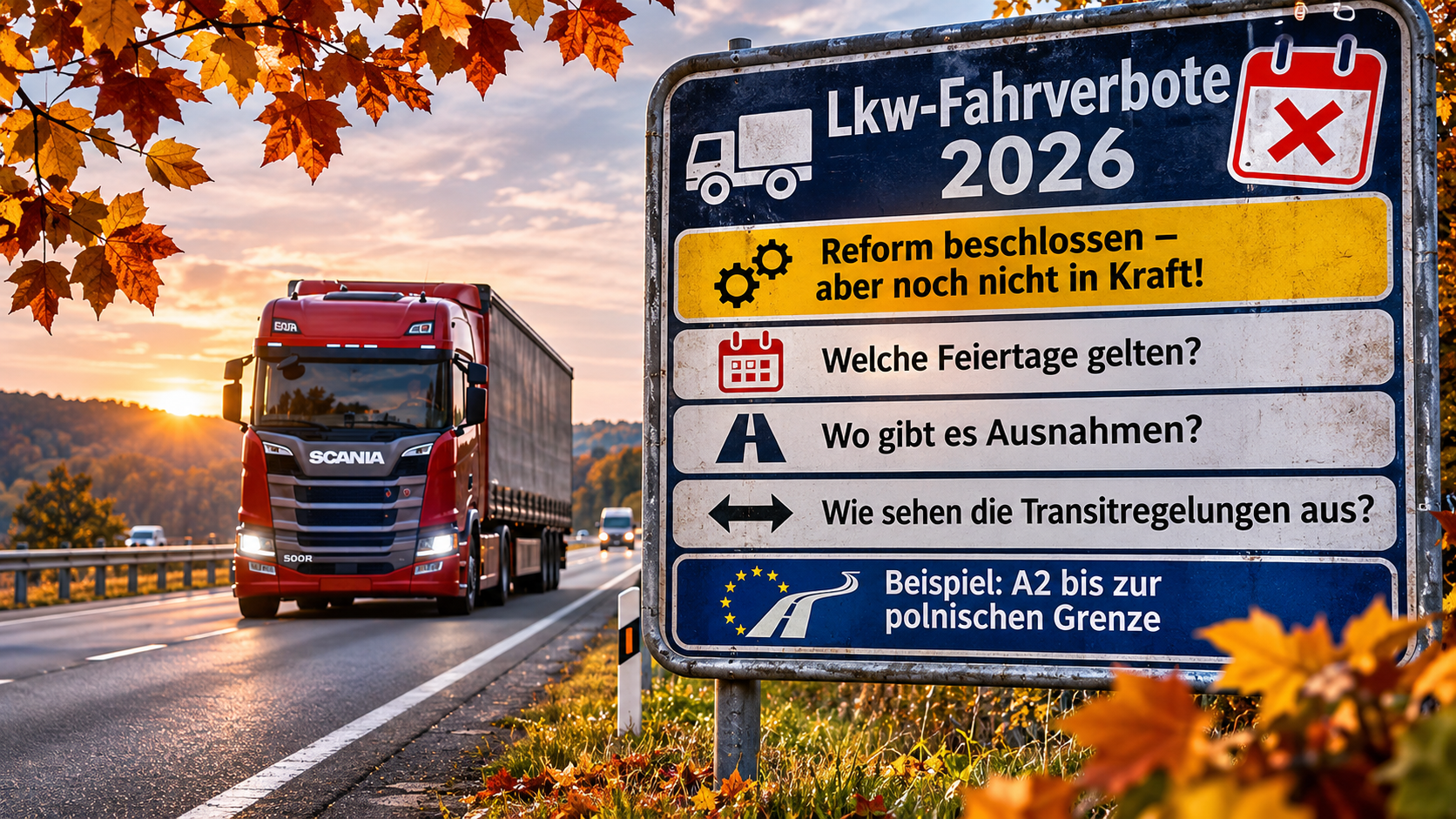
The German Federal Government wants to abolish the truck driving ban on regional public holidays. The corresponding amendment was already decided in July 2026, as I reported earlier . However, on Reformation Day, trucks remain stationary in several federal states. A number of exceptions are intended to allow at least certain transit trips. Anyone who believes they can drive freely through Germany with this may quickly experience a nasty surprise.
On October 31 is Reformation Day. Therefore, the public holiday driving ban for commercial freight transport with heavy trucks applies in principle in nine federal states.
The day after follows All Saints’ Day. This holiday affects other federal states again.
This year, November 1 also falls on a Sunday. Consequently, the nationwide Sunday driving ban applies in principle.
For logistics companies, this means additional planning. Drivers must know when they are allowed to start their tour, which roads are open, and whether an exception permit exists.
There should actually be no more of this patchwork soon.
The Federal Government has already decided on the reform
On July 15, 2026, the Federal Cabinet adopted a package of measures for reducing bureaucracy in the transport sector.
Included therein is the planned abolition of the truck driving ban on non-uniform statutory public holidays.
This concerns three holidays:
- Corpus Christi
- Reformation Day
- All Saints’ Day
The Federal Government wants to restrict the public holiday driving ban to nationwide uniform holidays in the future.
This should eliminate different regulations between neighboring federal states and avoid additional standstill times in freight transport.
However, the Cabinet decision is not yet a valid regulation.
The amendment must go through the intended legislative procedure. Only with the proper promulgation and entry into force of the amended Road Traffic Act (StVO) can the new regulation be applied.
By October 31, 2026, this has not happened.
The regional public holiday driving bans remain in § 30 Paragraph 4 StVO.
Source: Federal Government – Less Bureaucracy in the Transport Sector, July 15, 2026
Which trucks are affected at all?
According to § 30 Paragraph 3 StVO, the Sunday and public holiday driving ban applies in principle to commercial or paid freight transport including empty trips with:
- Trucks over 7.5 tonnes permissible gross mass
- Trucks with trailers, regardless of whether the tractor unit exceeds the limit of 7.5 tonnes
The driving ban applies in principle from 0 to 22 hours.
It affects not only motorways but the public road network within its respective spatial scope of application.
Crucial are also the vehicle type and the purpose of the trip. Not every heavy vehicle automatically falls under the ban with every use.
On which holidays does the truck driving ban apply?
The following table shows all holidays that § 30 Paragraph 4 StVO explicitly covers.
| Holiday | Federal States with Driving Ban |
|---|---|
| New Year’s Day, January 1 | Nationwide |
| Good Friday | Nationwide |
| Easter Monday | Nationwide |
| Labour Day, May 1 | Nationwide |
- Ascension Day | Nationwide |
- Whit Monday | Nationwide |
- Corpus Christi | BW, BY, HE, NRW, RP, SL |
- German Unity Day, October 3 | Nationwide |
- Reformation Day, October 31 | BB, HB, HH, MV, NI, SN, ST, SH, TH |
- All Saints’ Day, November 1 | BW, BY, NRW, RP, SL |
- First Christmas Day | Nationwide |
- Second Christmas Day | Nationwide |
BW = Baden-Württemberg, BY = Bavaria, HE = Hesse, NRW = North Rhine-Westphalia, RP = Rhineland-Palatinate, SL = Saarland, BB = Brandenburg, HB = Bremen, HH = Hamburg, MV = Mecklenburg-Vorpommern, NI = Lower Saxony, SN = Saxony, ST = Saxony-Anhalt, SH = Schleswig-Holstein, TH = Thuringia.
Other regional holidays such as the Holy Three Kings, Assumption of Mary, or Repentance and Prayer Day do not in themselves trigger a public holiday driving ban under § 30 StVO.
If such a holiday falls on a Sunday, the general Sunday driving ban applies naturally.
Source: § 30 StVO – applicable provision
Which statutory exceptions apply on all Sundays and public holidays?
Regardless of which holiday it is, there are explicitly regulated exceptions in § 30 Paragraph 3 StVO.
Combined Transport
Allowed under the legal prerequisites:
Rail-Road: Trips from the consignor to the nearest suitable loading station or from the nearest suitable unloading station to the recipient within the legally defined distance of at most 200 kilometers.
Port-Road: Loading and unloading in combined transport between the loading or unloading point and a port within a radius of at most 150 kilometers.
These exceptions do not apply to arbitrary transports just because a station or port is passed along the way.
Certain Perishable Foods
Exempt from the driving ban are transports of:
- Fresh milk and fresh dairy products
- Fresh meat and fresh meat products
- Fresh fish, live fish, and fresh fish products
- Easily perishable fruit and vegetables
The exception regulation is limited to the goods specified by law.
Not every cargo transported under refrigeration automatically falls under this category.
Other Explicitly Regulated Exceptions
These include transports of certain animal by-products, the use of rescue, towing, and breakdown assistance vehicles in accidents or emergencies, as well as the transport of live bees.
Also, the empty trips mentioned in § 30 related thereto are exempt.
In addition, there are special regulations for certain requested vehicles and for militarily required transports.
Important: An empty trip is not permitted simply because the truck is not carrying a load. The exception must also cover the relevant empty leg of the journey.
Corpus Christi: Driving Ban in Six Federal States
Corpus Christi fell on June 4, 2026. In the coming year, the holiday will be observed on May 27, 2027. Whether the regional truck holiday driving ban still applies then depends on whether the planned Road Traffic Act (StVO) reform has come into force by that time.
The holiday driving ban applies in Baden-Württemberg, Bavaria, Hesse, North Rhine-Westphalia, Rhineland-Palatinate, and Saarland.
In the remaining federal states, there is no corresponding driving ban due to Corpus Christi.
This is particularly problematic for transit traffic.
For example, if you are traveling from Lower Saxony to Rhineland-Palatinate or from Saxony to Baden-Württemberg, you may not drive through the respective holiday state solely because the start and destination lie outside it.
There is no nationwide, blanket permission for all transit trips on Corpus Christi.
In addition to statutory exceptions, route-specific state regulations and individually granted exception permits may apply. Whether such a permit can be used for a planned trip must be checked based on the respective valid order.
This also applies to international transports.
An overseas destination does not lift the driving ban.
Reformation Day: Nine Federal States Affected
On October 31, the holiday driving ban applies in Brandenburg, Bremen, Hamburg, Mecklenburg-Western Pomerania, Lower Saxony, Saxony, Saxony-Anhalt, Schleswig-Holstein, and Thuringia.
Difficulties arise, especially on important east-west connections.
However, there are several exception regulations.
Sources and further information:
- Lower Saxony – Exception regulations for the truck driving ban on Reformation Day
- Federal Office for Logistics and Mobility – Exception permit for Berlin traffic on October 31, 2025 and 2026 (PDF)
The exceptions apply only under the respective specified conditions. In particular, the approved highway sections must be observed, as well as the actual departure or destination location in the case of the Berlin regulation. A general permission for transit traffic through all affected federal states does not exist.
Lower Saxony: Trips Allowed Until 6 AM
For Reformation Day 2026, Lower Saxony has issued a general exception.
Accordingly, affected trucks may drive between 0 and 6 AM.
Between 6 AM and 10 PM, certain transit routes are permitted:
| Highway | Approved Connection |
|---|---|
| A1 | Fixed section in the area of Osnabrück/Lotte |
| A2 | Between North Rhine-Westphalia state border and Saxony-Anhalt |
| A30 | Certain sections in the area of Bad Bentheim, Rheine, and Osnabrück |
| A31 | Between Schüttorf and the North Rhine-Westphalia state border |
| A33 | Between Osnabrück-South and the North Rhine-Westphalia state border at Dissen |
The permission applies only to the highway sections precisely designated in the order.
It does not apply to arbitrary trips via country roads or to loading stations outside the approved route.
The regulation is valid until December 31, 2030.
Source: IHK Hannover – Exception regulations Lower Saxony and North Rhine-Westphalia
Eastern Germany: Special Regulation for Trips to and from Berlin
Another exception was agreed upon for Reformation Day 2025 and 2026 between Berlin and several eastern German federal states.
It enables trips on designated highways through Brandenburg, Mecklenburg-Western Pomerania, Saxony, Saxony-Anhalt, and Thuringia from 0 to 10 PM on October 31.
These include sections of the A2, A4, A9, A10, A11, A12, A13, A14, A15, A17, A19, A20, A24, A38, A71, A72, A73, A111, A113, A114, A115, A117, and A143.
However, there is a crucial prerequisite:
The trip must have its starting point or destination in Berlin.
Merely driving through Berlin or over the Berlin Ring is not sufficient.
Furthermore, the highways may generally not be left. Exceptions exist in particular for certain necessary diversions during full closures or towing operations.
Source: Free State of Saxony – Exception permit for truck driving ban
Example: From North Rhine-Westphalia via A2 to Poland
How differently the regulations apply is shown by a trip from North Rhine-Westphalia towards the Polish border.
The route goes via the A2 through Lower Saxony and Saxony-Anhalt, then via the A10 and A12 through Brandenburg to the border crossing Frankfurt (Oder).
On Reformation Day 2026, the following situation arises for normal commercial freight transport:
| Section | Between 6 AM and 10 PM |
|---|---|
| North Rhine-Westphalia, A2 | No regional holiday driving ban on October 31 |
| Lower Saxony, A2 | Permission on the approved section |
| Saxony-Anhalt, A2 | Generally driving ban |
| Brandenburg, A10 and A12 | Generally driving ban |
The Berlin exception does not automatically help with a trip to Poland. After all, the destination lies in Poland, not in Berlin.
Even a mere stopover in Berlin does not automatically turn a transit trip into “Berlin traffic” within the meaning of the exception permit.
Therefore, for a continuous trip to Poland during the ban period, another legally appropriate exception must exist.
The regulation in Lower Saxony does not automatically allow continued travel through Saxony-Anhalt and Brandenburg.
All Saints’ Day: North Rhine-Westphalia with Own Exception
All Saints’ Day is celebrated on November 1.
The holiday driving ban applies in Baden-Württemberg, Bavaria, North Rhine-Westphalia, Rhineland-Palatinate, and Saarland.
A special feature exists in 2026: November 1 falls on a Sunday.
This principle also applies to the nationwide Sunday driving ban in other federal states.
NRW allows travel from 0 to 6 AM
North Rhine-Westphalia has published a circular dated January 14, 2026, which enables an exception to the holiday driving ban effective November 1st.
Affected trucks are permitted to drive between 0 and 6 AM.
The circular explicitly clarifies that this exception also applies if All Saints’ Day falls on a Sunday.
From 6 AM to 10 PM, certain highway sections are also opened:
| Highway | Opened Section |
|---|---|
| A1 | AK Lotte/Osnabrück to the state border at Osnabrück-Nord |
| A2 | AK Bad Oeynhausen to the state border at Bad Eilsen |
| A30 | State border at Rheine-Nord to Hasbergen-Gaste |
| A30 | State border at Bruchmühlen to AK Bad Oeynhausen |
The openings apply in both directions.
This circular is also valid until December 31, 2030.
Source: Land NRW – Circular on the exception to the holiday driving ban for All Saints’ Day
What applies on other holidays?
For nationwide uniform holidays, the general statutory exceptions under § 30 Paragraph 3 of the Road Traffic Regulations (StVO) apply initially.
This includes New Year’s Day, Good Friday, Easter Monday, May 1st, Ascension Day, Whit Monday, German Unity Day, and both Christmas days.
There is no general transit exemption solely due to a foreign departure or destination location on these days.
In addition, possible individual or permanent exception permits may apply.
These are issued by the competent authorities under statutory conditions and must be in place before the relevant trip.
This results in two distinct cases:
Statutory Exception: A trip falls directly under an exemption provision of the StVO.
Administrative Exception Permit: A trip that is generally prohibited is allowed based on a special permit.
Both cases must be distinguished. An urgent delivery is not automatically considered an approved trip.
Source: § 46 StVO – Exception permits
Additional Special Regulations: Low Water Levels and Extraordinary Transport
In addition to holiday regulations, time-limited general orders for specific transports may apply.
A current example is the low water levels on German inland waterways in autumn 2026.
Since ships can only carry less cargo, additional road transport becomes necessary.
Several states have therefore granted exceptions to the Sunday and holiday driving ban for transports directly or indirectly related to managing the consequences of low water levels.
Berlin published a corresponding new general order on October 29.
The regulations may also include necessary empty trips and provide further facilitations for large-scale and heavy transport.
However, this does not constitute a general exemption for freight traffic.
The connection to the respective purpose of the exception must exist. Furthermore, the orders are valid only within their spatial and temporal scope.
Source: Berlin – General Order on Low Water from October 27, 2026
The Holiday Travel Ban Must Also Be Considered
In addition to § 30 of the StVO, there is an additional truck driving ban during peak travel season.
The Holiday Travel Ordinance prohibits certain commercial truck trips on Saturdays from July 1st through August 31st inclusive between 7 AM and 8 PM.
Unlike the Sunday and holiday driving ban, this regulation does not apply to the entire road network but only to specific sections of highways and federal roads.
Exceptions also exist for this, including for certain food transports, combined transport, and other explicitly regulated cases.
Additionally, exception permits can be applied for.
A route that does not fall under the holiday travel ban on a Saturday in summer may still be subject to the nationwide Sunday driving ban on a Sunday.
Therefore, the regulations must be assessed independently of each other.
Source: Holiday Travel Ordinance – Current Version
What Will Actually Change with the Reform?
If the planned amendment to the StVO comes into force as announced, the regional truck holiday driving bans for Corpus Christi Day, Reformation Day, and All Saints’ Day will be abolished.
This would particularly simplify the planning of cross-border freight traffic within Germany.
A trip from North Rhine-Westphalia to Poland would then no longer need to be interrupted on Reformation Day solely due to regional holiday regulations in Lower Saxony, Saxony-Anhalt, or Brandenburg.
Trips through North Rhine-Westphalia on All Saints’ Day would also no longer be affected by the ban solely due to this regional holiday.
However, there is an important limitation:
If a regional holiday falls on a Sunday, the nationwide Sunday driving ban remains in effect.
This applies, for example, to All Saints’ Day 2026.
Even after the reform, affected trucks would generally not be allowed to drive on Sunday, November 1, 2026, unless another exception applies.
Similarly, the reform would not lift other national or international driving bans.
For instance, a transport to Poland would still need to consider the applicable holiday driving bans in that country.
Contextualization: A Driving Ban, Sixteen Federal States, and Many Exceptions
The following section contains editorial commentary.
It is understandable that the legislature wishes to unify the different holiday driving bans.
The current situation means that a transport within Germany depends on the holiday regulations of individual federal states.
However, transport needs do not end at a state border.
This is particularly evident on the A2. Lower Saxony permits passage on Reformation Day, whereas in Saxony-Anhalt different conditions apply.
Anyone traveling from North Rhine-Westphalia to Poland does not have a continuously cleared route, despite the Lower Saxon exception.
Such differences complicate trip planning.
Freight forwarders must adjust departure times accordingly, account for standing times, and check alternative options if necessary.
This also has immediate consequences for professional drivers.
An additional stop may mean that weekly planning needs to be changed or that a planned return is no longer possible as originally intended.
However, it should not be overlooked that bans on driving on Sundays and public holidays also pursue other goals. These include protecting Sunday and holiday rest and relieving traffic congestion.
Therefore, the planned change deliberately concerns only non-federal holidays and leaves the general Sunday driving ban in place.
Whether the reform actually relieves freight transport will mainly have to be judged by how clearly the new regulation is formulated and whether additional regional special provisions become unnecessary.
Conclusion: Decided but not yet enforceable law
The federal government agreed in July 2026 to abolish truck bans on regional holidays.
This is an important step.
Until the corresponding change to the Road Traffic Regulations (StVO) comes into force, however, the existing driving bans remain in effect.
For practice, this means: Before a trip, the holiday, the affected federal states, the specific route, and possible exceptions must be checked.
A passage permit for Lower Saxony is not a permit for Saxony-Anhalt. And a Berlin transit regulation does not automatically apply to transport to Poland.
The new legal situation will only become binding with the entry into force of the amended StVO.
Until then, freight transport remains dependent on existing statutory exceptions, state ordinances, and individual permits.
Sources and further information
- Road Traffic Regulations, § 30 – Ban on driving on Sundays and public holidays
- Road Traffic Regulations, § 46 – Exception permits
- Federal Government – Cabinet resolution of July 15, 2026
- NRW – Joint circular on All Saints’ Day 2026
- IHK Hannover – Transit regulations Lower Saxony and North Rhine-Westphalia
- Free State of Saxony – Exception for Berlin traffic on Reformation Day
- Berlin – General order on low water, October 2026
- Holiday Travel Ordinance
- Federal Association of Freight Transport, Logistics and Disposal – Driving bans
Research and legal status: October 31, 2026. State ordinances and general orders can be limited in time, amended, or revoked. Therefore, for a specific transport trip, the current official regulation is always decisive.
