

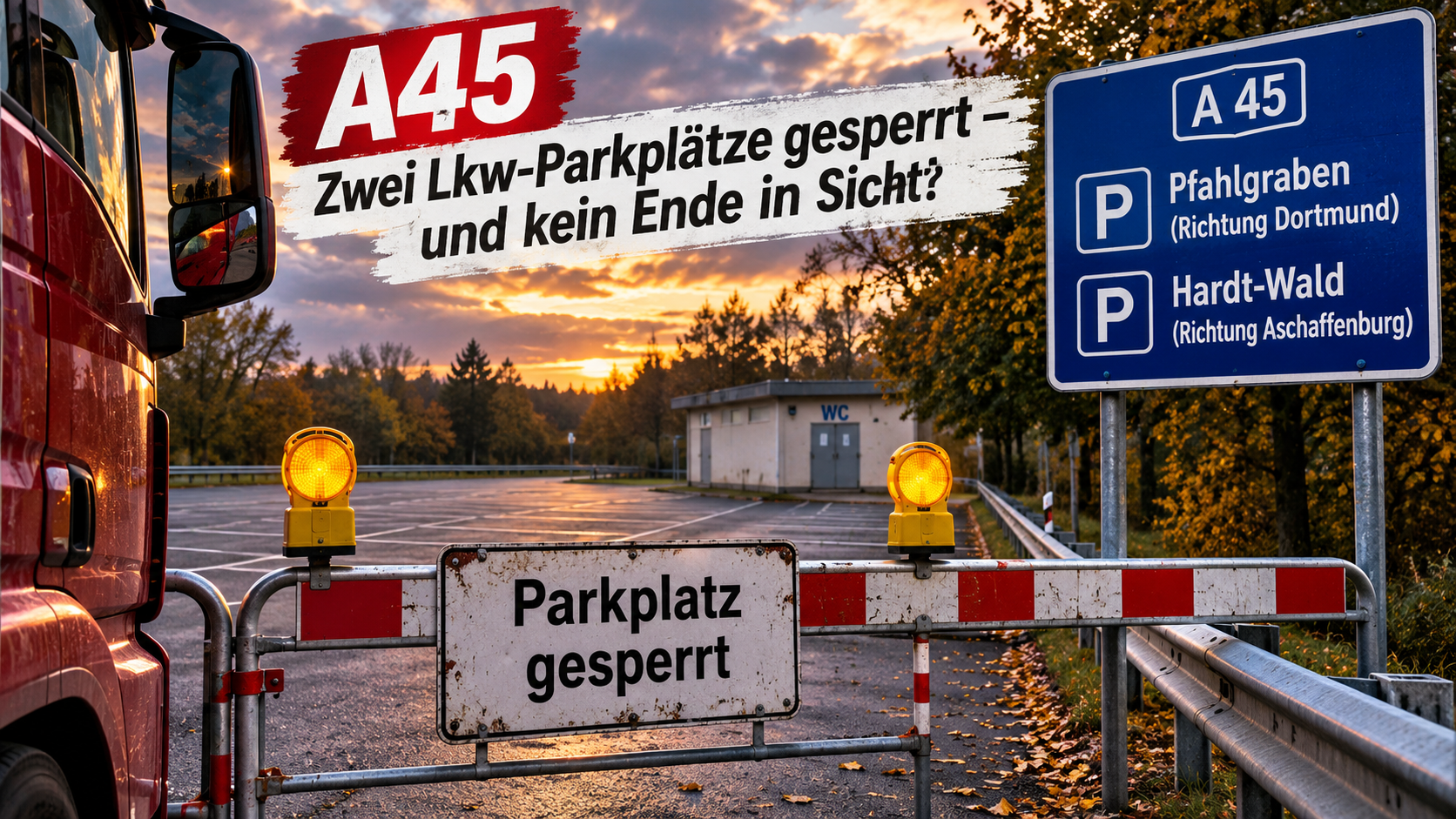
Since July 2025, the highway parking lots near the Gambacher Kreuz have been closed: Pfahlgraben and Hardt-Wald. Approximately 16 truck parking spaces are missing since then. On my inquiry, the Autobahn GmbH explained the reasons. At the same time, there are new developments regarding the planned six-lane expansion of A45.
Whoever I am who regularly travels on the A45, you may have noticed these two closed parking lots already for some time.
The parking lot Pfahlgraben in Fahrtrichtung Dortmund and the parking lot Hardt-Wald in Fahrtrichtung Aschaffenburg have been marked with barriers for a considerable period now.
What has always puzzled me: Nothing happens there practically. No major construction work, no visible rehabilitation measures. Occasionally, you can see employees of the Autobahn Maintenance Office engaged in green care. Otherwise, there is largely standstill.
Since I drive this route almost daily as a professional driver and am well aware of the shortage of truck parking spaces, I wanted to know what lies behind these closures.
So on November 3, 2026, I sent a press inquiry to the Autobahn GmbH.
On November 11, I received the answer.
Closed since July 6, 2025
As Alexander Fessler from Corporate Communications of the Autobahn GmbH, West Branch, informed me after consulting with the competent technical department, both parking lots were closed on July 6, 2025.
The reason is significant structural defects.
Especially the road and sidewalk surfaces are in a state that endangers traffic safety. Furthermore, toilet facilities cannot be offered at present.
The Autobahn GmbH also refers to possible hygienic health risks for parking lot users and entertainment personnel.
These are initially understandable reasons.
If traffic safety can no longer be guaranteed, a parking lot must be closed if necessary. No one would be helped if someone were to get hurt there.
However, this inevitably raises the next question: Why is not rehabilitation carried out?
A Rehabilitation Seems Unjustified at Present
The answer depends on the planned six-lane expansion of A45.
According to the Autobahn GmbH, the two parking lots must be relocated in their current form as part of this construction measure.
A rehabilitation at present would therefore be very costly and not a long-term solution.
I can also generally understand this reasoning.
Why should one invest so much money in rehabilitating just two parking lots when they will be renovated or relocated anyway within the framework of a larger highway project?
Only this calculation has a snag.
The parking lots are needed now. Not only after the completion of a highway expansion.
And precisely here lies the problem for me.
Approximately 16 Truck Parking Spaces Are Lost
In response to my question about the number of lost truck parking spaces, the Autobahn GmbH informed me that there are approximately 16 such spaces in total.
The actual number of usable parking spaces also depends on whether private vehicle areas are blocked there.
16 parking spaces may not seem particularly many at first glance.
However, whoever has already searched for a truck parking spot on an expressway in the evening knows that sometimes a single free space decides whether one can reasonably make their prescribed rest break.
The legal driving and rest times apply regardless of whether sufficient parking facilities are available.
A driver cannot simply continue driving until a suitable parking spot eventually appears. He must plan his journey so that he can comply with legal requirements.
If the parking lots are full or closed, this planning becomes correspondingly difficult.
And this is not a theoretical problem. It belongs to many professional drivers as part of their daily routine.
Six-Lane Expansion: What Is Actually Planned?
The affected section of A45 is planned to be expanded from four to six lanes of travel.
Specifically, it concerns the approximately 4.7-kilometer-long stretch north of the Talbrücke Langgöns up to the Gambacher Kreuz.
In addition to the Talbrücke Langgöns, this project will also replace it.
The bridge dates from an era when traffic volume was still significantly lower. Although it was comprehensively restored in 1996 or 2000, it is now approaching the end of its intended technical service life.
In addition to the Talbrücke Langgöns, the project includes other bridge structures, adaptations at the connection points, and measures for noise reduction.
The planning has been underway for many years.
Already in 2018 was the expansion announced. At that time, it was mentioned that a construction start in 2021 and an approximate construction period of five years were expected.
From this, nothing came to light.
The planfeststellungsverfahren (plan approval procedure) was initiated in September 2022. In September 2024, the Regierungspräsidium Gießen announced the conclusion of the hearing procedure. Subsequently, further documents and adaptations were required, including due to updated traffic forecasts and requirements under natural protection law.
New Development in November 2026
Now there is an important development.
As reported by Gießener Allgemeine on November 10, 2026, Hessens Verkehrsminister Kaweh Mansoori signed the plan approval decision for the replacement reconstruction of the Talbrücke Langgöns and the six-lane expansion up to the Gambacher Kreuz.
This is a significant step towards implementation.
Such a decision creates the legal basis for the construction project. Whether it is already irrevocable and when the actual construction work can begin, is not automatically determined at this point.
I could not find a new binding start date or completion date in my research.
The previously mentioned construction period of about five years dates from 2018 and therefore cannot be directly transferred to the current planning stage without further consideration.
In this context, it is interesting to note that according to current reports, the technical service life of the Langgöns Bridge already ends in 2029.
The time pressure is therefore quite present.
Sources for the expansion:
- Regierungspräsidium Gießen: Anhörungsverfahren abgeschlossen (12.09.2024)
- Hessisches Verwaltungsportal: Erläuterungen zur ersten Planänderung (PDF)
- Gießener Allgemeine: Talbrücke Langgöns bekommt Baurecht (10.11.2026)
What happens until the actual start of construction?
And thus we are back to the two blocked parking lots.
In response to my question about a possible reopening, the Autobahn GmbH referred to the expansion planning.
Whether and in what form the parking lots will become available again in the future should be included in the planning for the six-lane expansion between Langgöns and the Gambacher Kreuz.
A specific date was not given to me.
This means: The parking lots have been closed since July 2025; a renovation of the existing facilities is considered economically unsound, and there is currently no concrete perspective on reopening them.
Of course, one cannot simply remove the barriers and make the parking lots available again if there are significant safety deficiencies present there.
But must the only alternative be to keep the areas completely closed for possibly several years?
Could at least temporary measures be conceivable to make part of the parking spaces usable again? What costs would arise from this?
These questions cannot be conclusively answered without further knowledge of the physical state and the necessary measures.
However, they should certainly play a role in the planning.
The Autobahn GmbH names three alternatives
In response to my question about where truck drivers can spend their legally prescribed breaks and rest times instead, the Autobahn GmbH named the following alternatives:
- The already expanded parking lot Stauferburg on the A45.
- The parking lot Pfaffenfahrt.
- The Maxi Autohof Lützellinden.
This means that in principle, further parking options are available.
However, it remains open whether these facilities can fully meet the additional demand.
For the named parking lots will ultimately be used by other road users. A parking space that disappears due to a closure is not automatically replaced by another parking lot located several kilometers further away.
Above all, it would be interesting to know how high the actual utilization of these alternative options is during evening and night hours.
At this time, I do not have reliable figures available.
My conclusion: Long-term planning does not replace short-term solutions
I can certainly follow the Autobahn GmbH’s argumentation.
It would be economically questionable to invest large sums in two parking lots that may need to be relocated or fundamentally renovated in a few years.
Similarly, one cannot expect facilities with significant safety deficiencies to simply remain open.
But we are talking about infrastructure that is needed every day.
Lorry drivers transport goods, supply companies and must simultaneously comply with their legally prescribed driving and rest times.
For this they need suitable parking places.
If existing parking spaces have to be closed due to structural damage, it should therefore be clarified whether and when replacement can be created.
What disturbs me most about the whole story is the lack of a temporal perspective.
Since July 6, 2025, there are approximately 16 missing truck parking spots at this location. The planned Autobahn expansion has already made an important step forward; however, a reliable date for the restoration of the parking facilities remains unknown.
Planning six lanes in the long term is sensible. Providing sufficient parking spaces in the short term should not be forgotten.
I will follow the further development in the area of the Langgöns Bridge and the two parking lots.
My thanks go to the Autobahn GmbH, Niederlassung West, especially Alexander Fessler, for the detailed answer to my press inquiry from November 3, 2026.
The basis of this contribution is the written statement of the Autobahn GmbH from November 11, 2026, as well as the publicly available planning documents and press reports linked in the text.