
Digital Vehicle Registration Certificate in Freight Forwarding: Can the i-Kfz App Replace the Trailer Register?
Anyone working in a freight forwarding operation knows the problem. A tractor unit might be driven by the same driver over a long period. However, with trailers and semi-trailers, reality often looks quite different.
Today, Driver A pulls trailer 4711; tomorrow, Driver B takes over the same trailer. Afterwards, the trailer is back in the yard and put into use with another tractor unit. The vehicle registration certificate must still be present at the vehicle or with the driver.
It is exactly at this point that things become interesting. Since March 2026, companies can also use the digital vehicle registration certificate via the i-Kfz App. The Federal Ministry of Transport explicitly lists companies and fleet operators as a use case. Multiple vehicle registration certificates can be managed and handed over to different drivers.
Therefore, a freight forwarding operation faces a very practical question: Can the i-Kfz App be a solution for the many vehicle registration certificates of trailers?
A copy of the vehicle registration certificate is not enough
The background is quickly explained. In many operations, copies of the Registration Certificate Part I are kept in the vehicles with the trailers. This is practical, but legally, such a copy does not replace the required vehicle registration certificate.
According to § 13, paragraph 6 of the Vehicle Registration Ordinance (FZV), the Registration Certificate Part I must be carried by the person driving the vehicle. However, for several trailers belonging to the same holder, there is an explicitly provided alternative: Upon application, the licensing authority can issue a trailer register. If this register is presented during an inspection, it suffices in place of the individual registration certificates. However, obtaining one is usually quite expensive and takes time until the entire process is processed.
This specific trailer register is interesting for freight forwarders because several trailers or semi-trailers of a holder can be covered by a single common document.
However, issuing and managing such a register involves additional effort. Therefore, it now makes sense to look at the digital alternative.
The digital vehicle registration certificate also works for trucks and trailers
The digital vehicle registration certificate is not limited to classic passenger cars. According to current information from the Federal Ministry of Transport, it can be issued for all vehicle classes. Thus, the application is fundamentally also interesting for commercial vehicles, trailers, and semi-trailers.
The digital vehicle registration certificate is neither a self-created PDF file nor a photo of the paper document. It is provided via the i-Kfz App and can be displayed directly in the app during an inspection.
This is a crucial difference from a simple copy kept in the driver’s cab, especially since it costs €10 if an inspecting officer checks for one. €10 may not seem like much now, but initially, it is the driver who pays these €10, which can certainly generate dissatisfaction.
The digital vehicle registration certificate fulfills the obligation to carry the Registration Certificate Part I within Germany. During an inspection, the driver can display the vehicle registration certificate on their smartphone. The smartphone does not need to be handed over during this process. In addition, the police can request access to various data areas via the app to verify the authenticity of the digital document.
What has changed for companies since 2026
Until early 2026, the digital vehicle registration certificate was primarily designed for the classic situation: A private person owns a vehicle and loads its vehicle registration certificate into the app via the online identity function of their ID card.
This procedure is naturally not very practical for a freight forwarding operation. After all, the driver is not the holder of the trailer.
Therefore, since March 3, 2026, legal persons can also use the digital vehicle registration certificate. The Federal Ministry of Transport explicitly mentions multi-driver operations and the management of multiple vehicles in this context.
This makes the matter significantly more interesting for freight forwarders.
How a freight forwarding company can distribute vehicle registration certificates to drivers
The first step is taken at the company level. A freight forwarding company can use the i-Kfz App for its company vehicles. For legal persons, there is a special path via a QR code, which can be generated within the framework of an i-Kfz process. Employees with appropriate authorization can also log in via the company account and ELSTER technology to generate such a QR code. Alternatively, the QR code can also be obtained from the competent licensing authority.
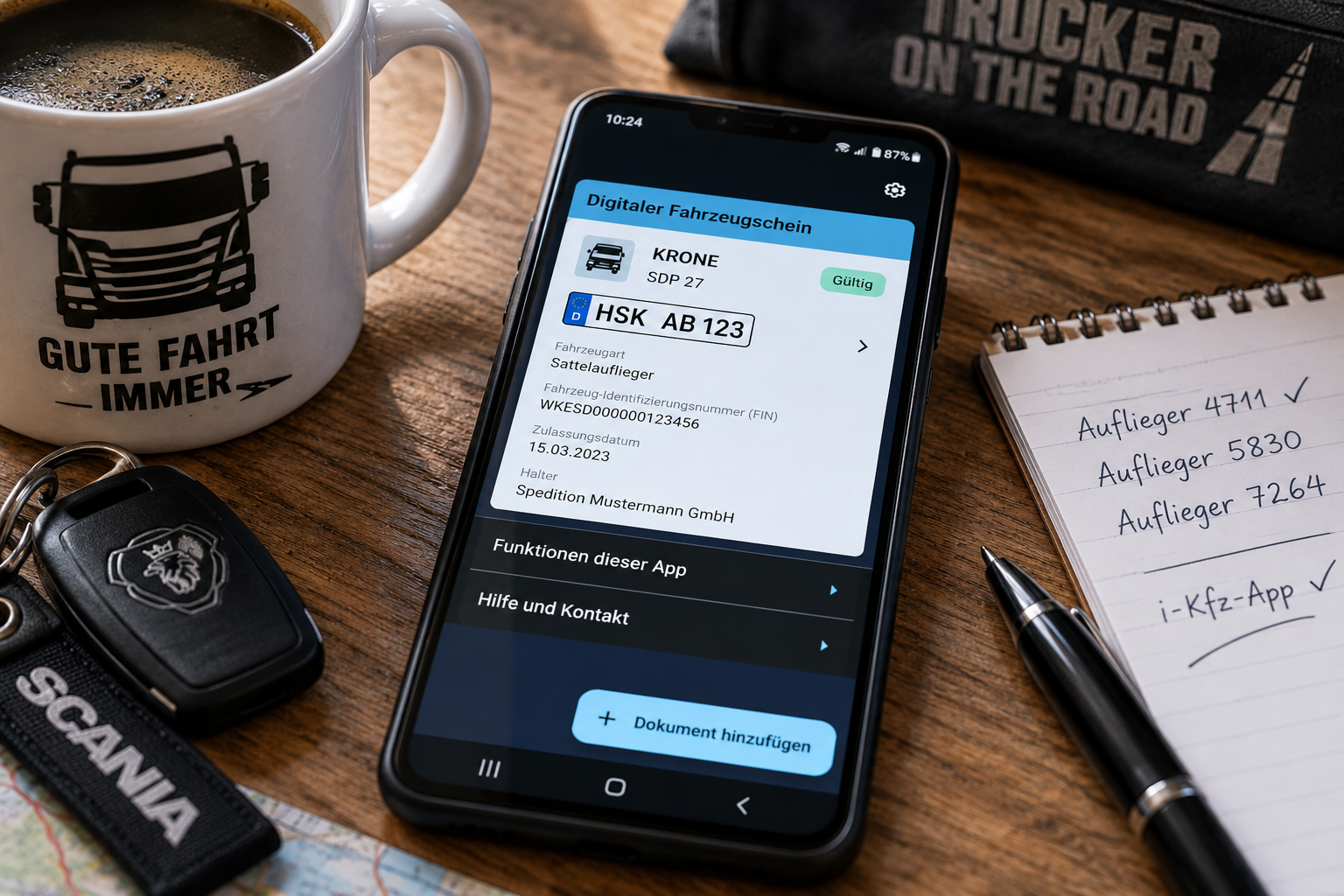
Subsequently, the i-Kfz App is installed on the respective smartphone. There, the further process is started via “Add document”. The app guides the user through the necessary steps.
This allows the company’s digital vehicle registration certificates to be stored on the corresponding devices. An important point for freight forwarders: According to the Federal Ministry of Transport, the number of vehicle registration certificates that can be stored in an i-Kfz App is unlimited.
This means, for example, that not only a single trailer needs to be stored on a company mobile phone. Several vehicles or trailers can be present in the same app.
The trailer changes drivers? Then the digital vehicle registration certificate can change with it
Exactly here lies probably the greatest practical advantage for a freight forwarding operation.
Suppose trailer 4711 is driven by Driver Müller today. The digital vehicle registration certificate is on his smartphone. The next day, Driver Schmidt takes over the same trailer.
The vehicle registration certificate (Fahrzeugschein) does not need to remain as a paper copy in the driver’s cab. The owner can share the digital vehicle registration certificate with another user via the i-Kfz app.
To do this, select the “Share Vehicle Registration Certificate” function for the corresponding certificate. The app will then generate either a QR code for handover on-site or a link for digital distribution. A time limit can also be set for the distribution. The QR codes and links generated within the app are valid for 24 hours.
This process can be repeated as often as desired. According to the Federal Ministry of Transport, there is no limit to the number of distributions.
For a fluctuating fleet, this could result in a fairly simple workflow: the trailer is assigned to the driver, and subsequently, the associated digital vehicle registration certificate is made available on their smartphone.
There is an important catch
However, the i-Kfz app is not quite as flexible as classic fleet management software.
A digital vehicle registration certificate cannot simply be passed from one driver to the next. Anyone who has received a vehicle registration certificate merely from another person cannot pass it on themselves. Distribution can only be done by the person who originally downloaded the digital vehicle registration certificate and for whom the vehicle is registered.
For a freight forwarding company, this means: The central department within the company must retain control over the vehicle registration certificates.
The driver can use the vehicle registration certificate assigned to them. If the trailer is subsequently reassigned to another driver, the transfer must again be done via the authorized department.
This is an important difference from a classic paper folder, which can simply be passed from one driver to the next.
An example from daily freight forwarding operations
Consider a company with 20 tractor units and 40 trailers.
Driver Müller receives trailer 4711 in the morning. The digital vehicle registration certificate for this trailer is already on his company smartphone. In the afternoon, the trailer is parked in the yard.
The next morning, Driver Schmidt takes over the same trailer. The dispatcher or the responsible person in the company re-distributes the digital vehicle registration certificate to Schmidt via the i-Kfz app.
Schmidt scans the QR code with his i-Kfz app and can then display the vehicle registration certificate on his device.
If Schmidt later takes over another trailer, its digital vehicle registration certificate can also be present in his app. The number of stored vehicle registration certificates is not limited.
Thus, a driver could quite easily have several trailers in their app without needing a paper document lying around in each cab for every single one.
What about the Trailer Register then?
Here, one should clearly distinguish between the two.
The trailer register and the digital vehicle registration certificate are not the same document and also not the same legal construct.
The trailer register is explicitly regulated in § 13, paragraph 2 of the Road Traffic Licensing Ordinance (FZV). It is issued upon application by the licensing authority for an owner with multiple trailers and contains the required vehicle data. According to § 13, paragraph 6, presentation of this register suffices instead of the individual registration certificates under the conditions mentioned there.
The digital vehicle registration certificate, however, pursues a different approach. Here, the respective vehicle registration certificate is provided digitally on a smartphone.
For a freight forwarding operation, therefore, not only the question arises as to what works technically. It is also crucial which procedure the company wishes to use organizationally and which vehicles are assigned to which drivers.
The statement by a licensing office that the i-Kfz app can be used for such a fleet should therefore not be understood as meaning that the app simply abolishes the legally prescribed trailer register. Rather, it offers an additional digital option to organize the carrying of the respective registration certificate Part I.
What happens with a new smartphone?
This should also be considered by a freight forwarding company.
The data of the i-Kfz app are not automatically transferred to the new smartphone when the device is changed. The digital vehicle registration certificate must be added again on the new device. If the document is successfully added there, the version on the old device is automatically deactivated. Already distributed digital vehicle registration certificates are also thereby withdrawn and must subsequently be redistributed again.
For a company with corporate smartphones, this means: A device exchange should not simply happen casually. The new device must then be set up correctly again.
During an inspection, the driver should not simply show a screenshot
There is also an important difference here between the digital vehicle registration certificate and a stored image.
During an inspection, the driver should access the digital vehicle registration certificate directly within the i-Kfz app. The Federal Ministry of Transport explicitly points out that the inspecting person does not need to take the smartphone into their hand. Instead, the driver can open various areas within the app and display the stored vehicle and owner data there. This allows verification that it is not merely a screenshot or a self-created image.
A screenshot of the vehicle registration certificate is therefore not an equivalent alternative.
Display also works offline
Of interest to professional drivers is also that the digital vehicle registration certificate can be displayed even without an internet connection. The app allows display of the existing document in offline mode.
New vehicle registration certificates cannot be downloaded or shared offline. Therefore, an existing data connection should be available for the actual handover between two drivers.
This is still practical for contingency cases. If a driver is already on the road and there is currently no mobile network coverage, they do not need to revert to the paper document as a result.
An Important Difference from International Travel
For logistics companies operating exclusively within Germany, this new option is particularly interesting. However, those driving trucks or trailers abroad must continue to carry the paper version.
The digital vehicle registration certificate is currently recognized only within Germany. Therefore, for international trips, the paper vehicle registration certificate remains required.
This restriction has little impact on a fleet operating purely within Germany.
This Could Simplify Things Significantly for Logistics Companies
The digital vehicle registration certificate is thus more than just a novelty for private drivers who no longer want to search in their glovebox.
There is a concrete use case, especially with changing trailers. A company can manage multiple digital vehicle registration certificates and make them available to the respective drivers. The driver no longer needs a self-made copy and does not necessarily have to keep a paper vehicle registration certificate for every trailer temporarily taken over in the cab.
However, this cannot work without organization. The logistics company must designate who manages the digital vehicle registration certificates and who passes them on to the drivers. Because a shared vehicle registration certificate cannot be forwarded from the recipient to the next driver.
For a manageable fleet, this can still be an interesting solution.
And perhaps that is exactly the point that is easily overlooked in normal passenger car operations: For a private car, one must digitize the vehicle registration certificate once and then have peace of mind. In a logistics company with tractors, trailers, and semi-trailers, however, there is a constantly changing assignment between vehicle and driver.
The fact that the i-Kfz app now supports this multi-driver operation and usage by companies also makes it interesting for classic logistics daily operations. The Federal Ministry of Transport explicitly names companies and fleet operators as the target group for this new feature.