

Why Political Debates Often Fall Short
Pensions, social spending, real wages, productivity, energy prices, industrial policy, wealth distribution, and economic growth are not isolated issues. They are interlocking gears of the same system.
The problem with many political debates is that each area and every indicator is examined in isolation.
The Finance Minister looks at government spending.
The Economy Minister looks at GDP.
The Labour Minister looks at employment figures.
The Pension Expert looks at contributors and pensioners.
The Climate Minister looks at CO₂.
But hardly anyone considers the interconnections.
Take an example:
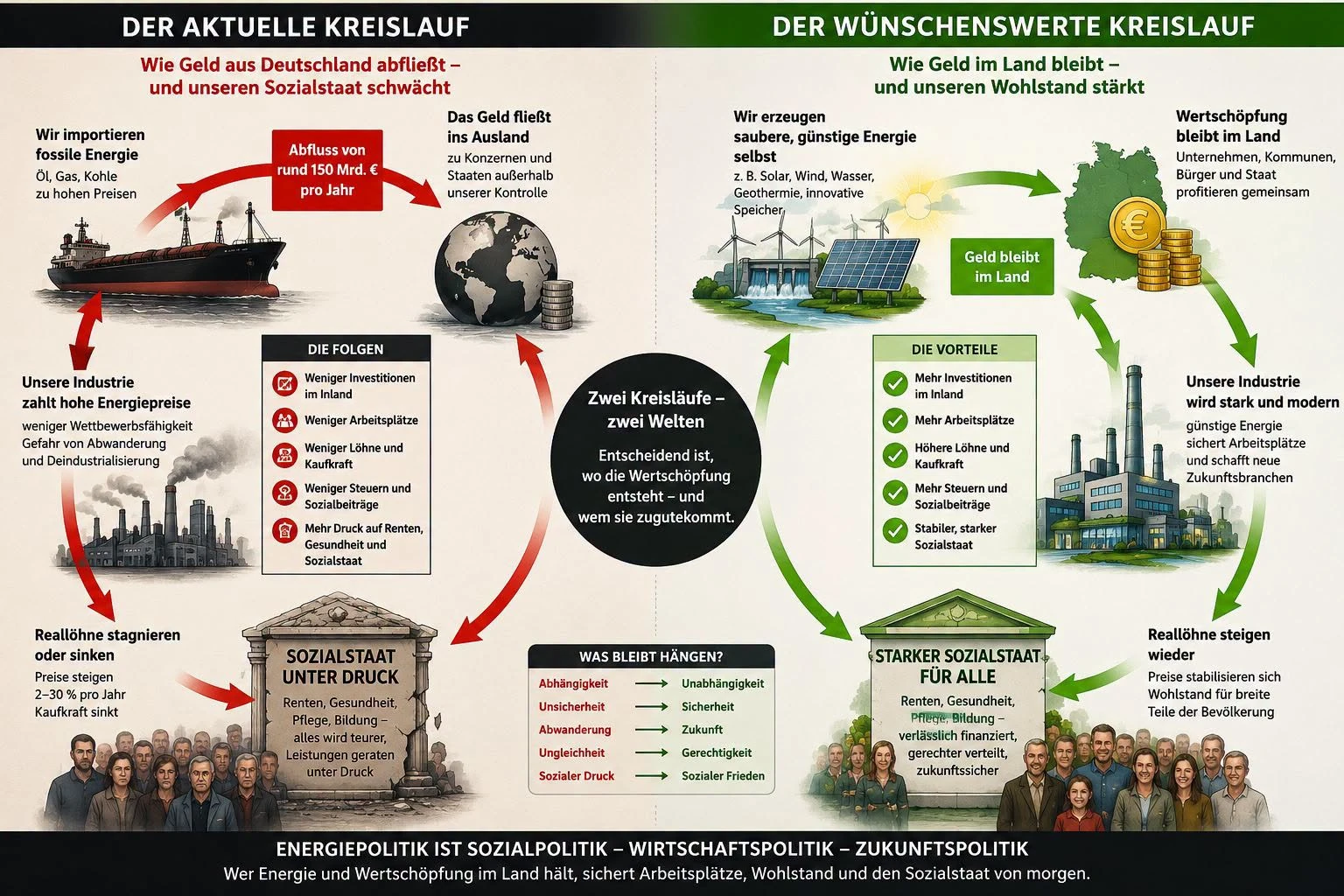
If Germany spends enormous sums every year on fossil energy imports, that is not just an energy problem.
It is simultaneously:
- an industrial problem,
- a balance of trade problem,
- a jobs problem,
- a wage problem,
- a pension problem,
- a welfare state problem,
- and a geopolitical problem.
Because every euro that permanently flows abroad for imported energy is missing multiple times from the domestic economic cycle.
It does not become:
- wages,
- pension contributions,
- corporate investments,
- tax revenues,
- or consumer spending in Germany.
The Pension Crisis Is Often Just a Symptom
That is why my thinking extends far beyond the pension debate.
If we succeed in keeping part of this value creation within the country, it generates not only revenue for the state.
It simultaneously creates:
- jobs,
- social insurance contributions,
- purchasing power,
- corporate profits,
- innovation capacity.
And suddenly, pressure on pension funds eases without having to change pensions or the retirement age itself.
I keep encountering the question of decoupled value creation.
The pension crisis does not arise in isolation.
It is often just a symptom of a deeper development:
- Productivity rises.
- Value creation increases.
- Wealth grows.
But the number of people directly participating in this value creation does not rise to the same extent.
And if, at the same time, real wages stagnate over long periods, then the entire social insurance system comes under pressure.
Because social insurances live off earned income.
- Not from stock market values.
- Not from share prices.
- Not from corporate value.
- Not from nominal GDP.
Why GDP Alone Tells Little
That is why focusing exclusively on GDP is simply wrong or mere window dressing.
GDP answers the question:
“How much was produced and sold?”
It does not answer:
“Who benefits from it?”
If GDP rises by 5%, profits rise by 10%, but real wages stagnate, then the economy grows, but not necessarily the wealth of the majority.
The Real Question: Who Benefits from Value Creation?
And it is precisely at this point that my reflections on pensions and energy policy converge.
Because ultimately, the crucial question is:
“How do we organize an economy in which productivity, technological progress, and energy availability benefit not only owners of capital but also people whose pensions, wages, and social security depend on them?”
This is not a pension issue.
It is a systemic issue.
Why Politics Often Treats Problems in Isolation
And that is exactly the real shortcoming of politics:
Not that it fails to see individual problems.
But that it almost always treats them individually, even though they are absolutely interconnected.
- The pension debate is conducted without industrial policy.
- Industrial policy without energy policy.
- Energy policy without social policy.
- Social policy without the distribution question.
And in the end, one wonders why none of the solutions work sustainably.
Meanwhile, the gears mesh completely. Whoever turns only one gear often does not understand why the whole machine still comes to a standstill.
