

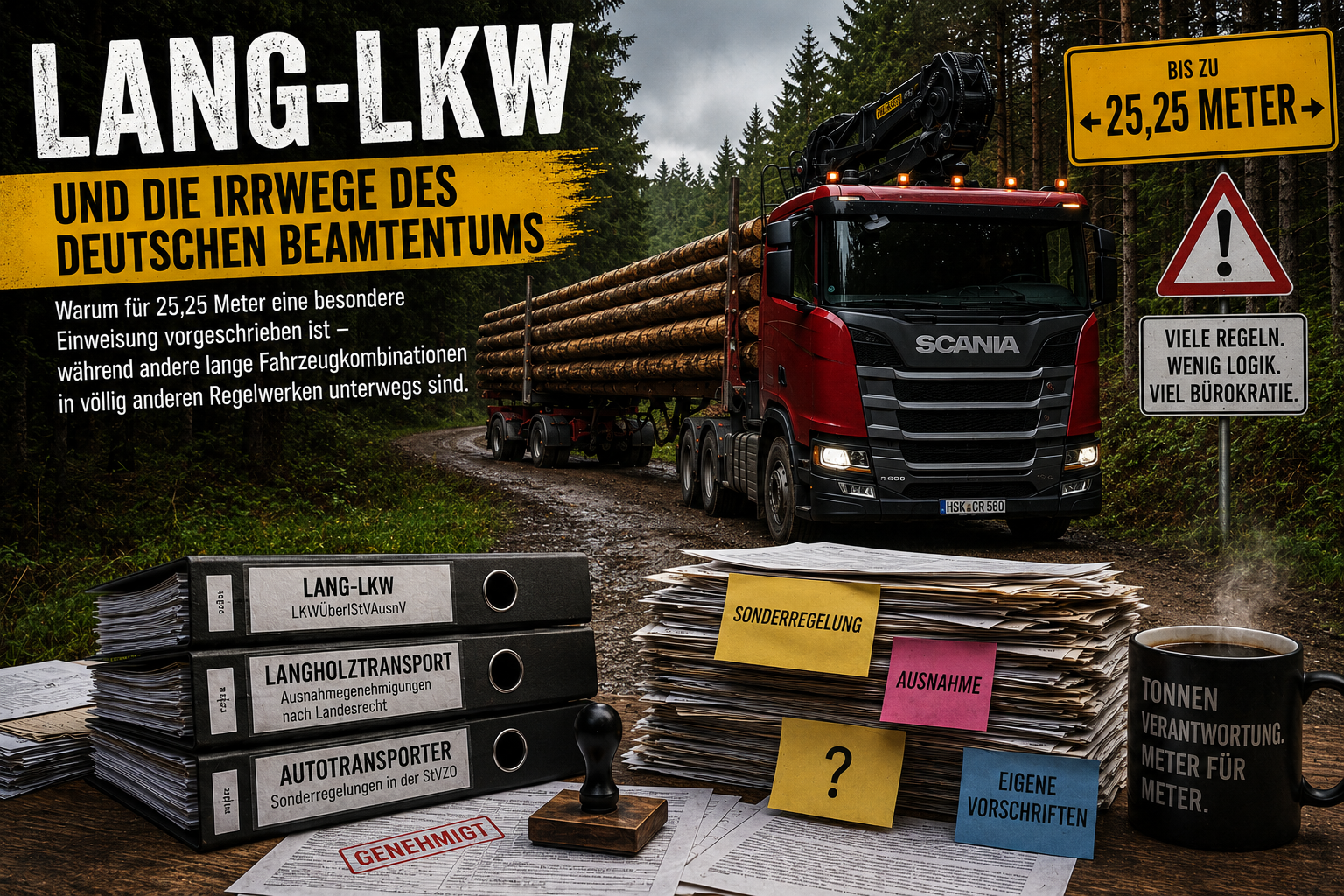
Long HGV and the Detours of German Civil Servantdom
Why a special briefing is required for 25.25 meters, while other long vehicle combinations travel under completely different regulations.
There are sometimes regulations in German road traffic law that make one wonder if the people who wrote them have ever actually sat in an HGV themselves.
Not because everything would be fundamentally wrong. On the contrary. Many provisions make perfect sense. Especially when it comes to large, heavy, and long vehicles, one can discuss which additional requirements should be placed on the vehicle and driver.
What is significantly harder to explain, however, are the sometimes completely different paths Germany takes to arrive at these regulations.
An example of this is the Long HGV. And due to a discussion on Facebook a few days ago, I went in search of the rules for the different vehicle combinations that do not meet the standard.
The Long HGV Gets Its Own Regulatory Framework
In simplified terms, a Long HGV is an especially long HGV or an especially long vehicle combination. Depending on the design and vehicle type, lengths of up to 25.25 meters are possible.
For this, there is its own regulatory framework: the LKWÜberlStVAusnV – the Ordinance on Exceptions to Road Traffic Law Provisions for Vehicles and Vehicle Combinations with Excessive Length.
And that is where it gets interesting.
Because the vehicle alone is not enough. Anyone wishing to drive certain Long HGVs must also meet special prerequisites. These include, among other things, corresponding professional experience and additional briefing in the specific vehicle combination.
Here, explicit reference is made to the special driving characteristics of such a train. For example, behavior in curves or when reversing.
Basically, one can hardly say anything against this.
A 25-meter-long train drives differently than a turntable with 18.75 meters or an ordinary semi-trailer truck with 16.50 / 17.30 meters. This starts with cornering, goes through swinging the rear out, and ends at the latest when shunting in tight spaces.
Anyone who has once tried to reverse a long train around a corner knows: A few meters more or less can make a significant difference.
So additional requirements for particularly long vehicles?
It can be done. It can even be sensible. As with us in timber transport. Our successors have a steerable front axle. This helps not only when reversing, but also so that we can better navigate corners with the partially 20-meter-long trunks in the forest.
But it is exactly at this point where my question begins: why does Germany apparently consider some long vehicles to require special explanation – while other long vehicle combinations travel in a completely different legal world.
What Exactly Is a Long HGV?
Before wondering about the different regulations, one must first clarify what the legislator actually understands by a “Long HGV”. Because “Long HGV” is not simply the designation for every particularly long HGV.
The Ordinance on Exceptions to Road Traffic Law Provisions for Vehicles and Vehicle Combinations with Excessive Length – short LKWÜberlStVAusnV – distinguishes five different vehicle types in total.
Long HGV Type 1 – The Extended Semi-Trailer Truck
In Type 1, there is a classic semi-trailer truck with an extended semi-trailer.
The permissible overall length is up to 17.88 meters. The semi-trailer may have a greater partial length than in a normal semi-trailer truck.
Exactly into this category would fall, for example, a semi-trailer truck that comes to an overall length of about 17.30 meters with an extended trailer.
And here it already gets interesting: Such a semi-trailer truck is legally a Long HGV Type 1, even though it can be shorter than a completely normal goods vehicle consisting of a motor vehicle and trailer. A conventional goods vehicle may be up to 18.75 meters long.
Type 1, however, occupies a special position. While the remaining Long HGV types are generally only allowed to travel on the approved positive network, Type 1 – with the exception of Berlin – can be used on the entire road network of the approving federal states.
The use of Long HGV Type 1 is currently also time-limited and, according to current regulations, planned until December 31, 2026.
Long HGV Type 2 – Semi-Trailer Truck with Central-Axle Trailer
In Type 2, a semi-motor vehicle is combined with an additional central-axle trailer.
The maximum overall length is 25.25 meters.
This is one of the classic Long HGV combinations where another trailer runs behind the actual semi-trailer truck.
Long HGV Type 3 – HGV with Underhung Axle and Semi-Trailer
Type 3 consists of a heavy goods vehicle with an underhung axle and a semi-trailer.
Here too, the maximum permissible overall length is 25.25 meters.
This vehicle combination belongs to those variants that are commonly grouped under the term “Gigaliner”.
Long HGV Type 4 – Semi-Trailer Truck with Additional Semi-Trailer
In Type 4, a semi-motor vehicle is combined with an additional semi-trailer.
This combination too may reach an overall length of up to 25.25 meters.
The decisive difference from a normal semi-trailer truck therefore lies not only in the length, but also in the fact that here an additional vehicle combination is carried behind the actual semi-motor vehicle.
Long HGV Type 5 – Goods Vehicle with Trailer
Type 5 is probably the variant most familiar to many drivers: a truck with a trailer.
However, this combination may be up to 24.00 meters long when classified as a long-haul truck.
In contrast, a standard articulated lorry may be no more than 18.75 meters long under general regulations.
Five Types, Five Different Combinations
In summary, the classification looks like this:

And it is precisely at this point that the question which bothers me about the entire regulation begins.
Because as soon as a vehicle combination falls under the definitions of the long-haul truck regulation, extensive additional regulations come into force. There are special requirements for both vehicles and drivers. For long-haul truck types 2 to 5, there is also continued operation on specific routes: they may only be used on motorways and federal roads designated for this purpose in the so-called Positive Network . Type 1 – the extended semi-trailer up to 17.88 meters – takes a special position and, in principle, may use the entire road network in the approved federal states.
At the same time, there are other vehicles on the road that are also significantly longer than a normal articulated lorry or can at least achieve similar dimensions without automatically falling under this regulatory framework.
And it is precisely here that long timber trucks and car carriers come into play.
Long Timber: The Vehicle Is Still Long
Take, for example, long timber transport.
Here too, we are not talking about a small delivery truck with a trailer. Anyone who has once driven behind such a train or operated one themselves knows that curves, roundabouts, narrow town routes, and construction sites do not suddenly become larger just because the legal basis is different.
Legally, however, such a long timber transport is not considered a long-haul truck within the meaning of the special long-haul truck regulation.
And thus begins the German regulatory landscape to sort itself into individual drawers.
The long-haul truck has its own nationwide special regulatory framework.
In contrast, long timber transport involves exceptional permits and approvals under other regulations. Depending on the federal state and the specific permit, there are their own conditions and requirements.
This is initially not a criticism. Different transports have different requirements. A timber transport behaves differently from a volume transport. The cargo is different, the weight distribution can be different, the vehicles differ technically, and even the type of securing is not comparable.
But the driver is still sitting behind the wheel of a very long vehicle.
And it is precisely there that it becomes interesting for me.
Because when one says about the long-haul truck that its length and special driving characteristics justify additional requirements for the driver, then inevitably the question arises as to why comparable challenges in other vehicle types are not considered according to the same principle.
Or put differently:
Why is it crucial in which legal category my truck falls, when the practical challenge ultimately consists of navigating a roundabout with a very long vehicle?
The roundabout, after all, does not care whether my vehicle falls under a special long-haul truck regulation or whether I am traveling with an exceptional permit.
It is simply too narrow. Or large enough.
There are no more options.
Car Carriers: Another Drawer
And then there are the car carriers.
Here too, there are special regulations. A car carrier is not automatically legally classified as a long-haul truck just because it looks damn long on the road.
Here too, specific regulations apply.
And here too, there is a driver in front who must deal with the length of his vehicle.
He must estimate how far his vehicle will swing out. He must know how the train behaves when turning. He must maneuver. He must drive in reverse.
Of course, one could now object that a car carrier is not automatically comparable to a 25.25-meter-long long-haul truck combination.
True.
A long timber train is also not automatically comparable to a long-haul truck.
But that is not what it is about anyway.
It is not about demanding the same regulations for all long vehicles.
It is about asking whether the German regulatory system still functions according to a unified logic.
The Driver Is the Same, But the Legal World Is Different
Because from a practical perspective, sometimes the impression arises that many regulations do not start from a fundamental question:
What special skills does a driver need to safely maneuver this vehicle?
Instead, it seems that first one looks at:
Which category does the vehicle fall into?
And then the regulations apply that were created for exactly that category at some point.
The result is a system of various historical drawers.
For the long-haul truck, there is its own regulation.
For long timber transports, other legal bases, permits, and sometimes state-specific regulations apply.
For vehicle carriers, there are again their own special regulations within road traffic law.
Each of these regulations has its own history. Each probably originated from a specific occasion at some point. And presumably, one can also find a justification for each individual provision.
The problem only arises when one considers the entire system.
Because then one suddenly finds oneself in the situation where a driver must meet special prerequisites and complete additional training for a certain vehicle combination, while another driver travels with an equally long vehicle under completely different conditions.
Not necessarily, because one vehicle would not inherently be more difficult or dangerous to drive than the other.
But rather because the vehicles have ended up in different legal categories.
A System of Historical Categories
And that, in my view, is the actual dead end.
Germany loves categories.
We categorize vehicles, transports, loads, permits, and exceptions. And as soon as something no longer fits into the original category, another exception is created.
Eventually, the entire system becomes a web of regulations where one can explain why almost every individual case is regulated exactly as it is—but can hardly explain why the overall system looks exactly the way it does.
Perhaps it would therefore be sensible to eventually move away from the question of how a vehicle was historically classified.
Perhaps we should focus more on what the driver actually needs to be able to do and master.
How long is the vehicle combination in reality?
How does it behave in curves?
What is the turning circle?
How difficult is reversing?
What are the visibility conditions?
What additional hazards arise from length, construction, or load?
And most importantly:
Does the driver need additional knowledge for this?
That would be at least a logic that could also be understood from practical experience.
Because in the end, no paragraph drives through a roundabout.
No regulation reverses onto a ramp.
And even an exception permit doesn’t help if you suddenly realize that the entrance is narrower than thought.
Perhaps the Task Should Count – Not the Category
I have been driving trucks for over 30 years now. Of course, I would not claim that every new driver should immediately be assigned to any arbitrary vehicle combination after passing their exam. Anyone who has once seen how some colleagues struggle with a normal tractor-trailer or articulated lorry knows that experience in handling large vehicles certainly plays a role.
Even for me, despite my professional experience, moving a truck through terrain I usually know from walking the dog was something completely new. Maneuvering a train about 25 meters long over narrow forest paths, some barely more than three meters wide, is not something one learns casually. Suddenly, entirely different standards apply compared to on the road. One practically learns driving all over again.
But this does not automatically mean that a truck suddenly becomes a special danger just because the trailer is a few meters longer or because another vehicle combination hangs behind the tractor unit.
In Germany, such a vehicle then receives the stamp “Long Truck.” Additional regulations apply, special requirements for drivers, sometimes route restrictions, and depending on the configuration, further requirements are added. One might almost get the impression that an extraordinary special vehicle is on the way, in front of which the rest of traffic must be particularly warned.
Yet reality on the road often looks much less spectacular.
In the Netherlands or Scandinavia, longer vehicle combinations are encountered in normal everyday traffic, sometimes without them even being particularly noticeable to the rest of traffic. You only notice them when you pay attention to whether you can actually see such vehicle combinations. The average car driver who sets out to overtake finally does not first ask whether the truck in front is 16.50, 18.75, or 25.25 meters long. They see a truck and want to pass it.
And that is precisely why I consider it questionable to automatically derive a special danger situation solely from a few additional meters of vehicle length.
Of course, the driving behavior of a longer combination changes. Turning radii, maneuvering, and overtaking operations pose different requirements than with a short tractor-trailer. But exactly here lies the crucial point for me: These requirements do not arise simply because “Long Truck” is written somewhere on a piece of paper or on a sign.
In the end, there is always a human behind the steering wheel.
And they must cope with the vehicle they are currently driving.
Whether “Long Truck,” “Long Timber Transport,” or “Vehicle Transporter” appears on its documents should be pretty much irrelevant for the next tight roundabout.
Perhaps the dead end lies not in the fact that there are special requirements for certain vehicle combinations. Of course, it can make sense to require experience or additional instruction for particularly demanding combinations.
Perhaps rather, the problem lies in the fact that we still judge driver requirements too much based on which legal category a vehicle belongs to, instead of judging them based on what requirements this vehicle actually places on the human behind the steering wheel.
Because an experienced driver does not need to be able to handle a vehicle combination simply because it is officially designated as a “Long Truck.” They must be able to do so because it is long, because it requires a certain turning radius, because it behaves differently when maneuvering, or because its vehicle combination poses special requirements.
And conversely, a vehicle does not suddenly become harmless or easier to control just because it accidentally falls into another legal category.
Because one thing does not change even with the most beautiful German administrative regulation:
A long truck remains a long truck.
And the road does not get wider just because something else is stated on the permit.
