

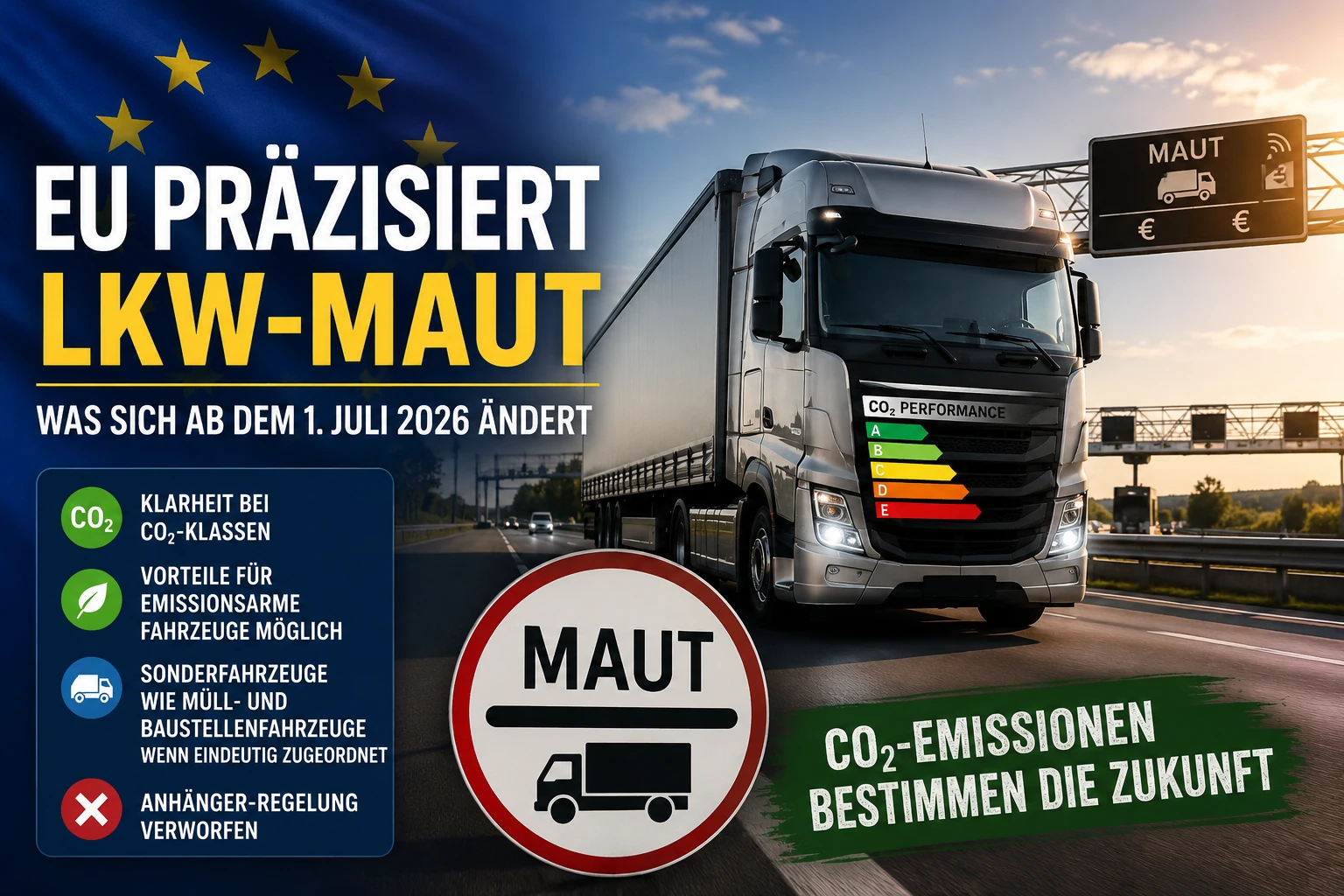
The European Union has agreed to changes to the so-called Eurovignette Directive. In late June 2026, the EU Council and the European Parliament reached a provisional agreement intended to clarify existing rules on road tolls and user charges for heavy-duty vehicles.
At first glance, the announcement appears unremarkable. No new toll fees were decided upon, nor is there an immediate additional burden imposed on drivers or companies.
Nevertheless, the decision clearly indicates the direction in which European transport policy is developing: CO₂ emissions from heavy-duty vehicles will play an increasingly significant role in the calculation of road tolls in the future.
Why the EU is adjusting the rules
The background to this change are the new CO₂ emission standards for heavy-duty vehicles, which come into force on 1 July 2026.
Since the Eurovignette Directive already stipulates that toll fees can depend on a vehicle’s environmental characteristics, various terms and classifications had to be adapted to the new regulations.
According to the EU Council, this adjustment is primarily intended to create greater legal certainty. Member States, toll operators, and transport companies will be able to more clearly identify which vehicles belong to which emission class in the future.
What is specifically being regulated
The agreement provides, among other things, for important terms to be defined more precisely.
These include:
- zero-emission vehicles,
- low-emission heavy-duty vehicles,
- vehicle groups,
- reference values for CO₂ emissions,
- emission reduction pathways.
This is intended to prevent individual Member States from interpreting the provisions differently.
For transport companies, this primarily means greater clarity regarding the classification of their vehicles and the resulting toll costs.
Special regulations for certain vehicle types
The EU is paying particular attention to so-called “Vocational Vehicles”.
Examples include:
- garbage trucks,
- concrete mixers,
- construction site vehicles,
- municipal special-purpose vehicles.
Until now, it was not always clearly regulated how these vehicles should be assigned to the various CO₂ emission classes.
The new regulations are intended to eliminate these uncertainties.
Lower fees for low-emission vehicles possible
Another point concerns the design of toll systems in individual Member States.
The EU will explicitly allow states in the future to provide lower infrastructure or user charges for low-emission vehicles.
Important note:
Member States may introduce such concessions – but they are not required to do so.
For transport companies, this means that the economic benefits of modern vehicle technology may develop differently depending on the country.
Proposed trailer regulation rejected
Notably, there is also what was not decided upon.
The European Commission had originally proposed making future tolls dependent on the type of trailer used.
The idea was to reward aerodynamically optimized or particularly energy-efficient trailers with lower toll fees.
However, this proposal was rejected by the Council and Parliament.
Reasons cited included:
- additional administrative burden,
- higher complexity of toll systems,
- control issues,
- difficulties in introducing electronic toll services.
Consequently, toll calculation will remain focused on the tractor unit and its emission class for the time being.
What does this mean for Germany?
The immediate impact on Germany is likely to be limited.
The Federal Republic has already introduced an increasingly CO₂-oriented truck toll in recent years, and many of the European provisions are already applied here.
The situation might look different in Member States that still need to adapt their toll systems to the new requirements.
The real message behind the decision
Even though the current agreement mainly contains technical and legal clarifications, it clearly shows the political course of the European Union.
The truck toll is no longer used exclusively for financing road infrastructure.
It is increasingly being utilized as an instrument to achieve climate goals in the transport sector. Vehicles with lower emissions are intended to become more economically attractive, while high-emission vehicles may incur higher costs in the long term.
For the transport industry, this means that the question of a vehicle’s CO₂ balance will no longer be relevant only for environmental reports or subsidy programs, but increasingly also for ongoing operating costs.
Conclusion
The agreement reached now does not fundamentally change the toll landscape. It primarily creates clarity regarding how existing rules should be applied in the future.
Nevertheless, the decision is another building block of a development that has been observable for years: the truck toll is increasingly becoming an instrument of climate and transport policy.
For companies, the question is no longer whether CO₂ emissions will have an impact on the costs of road freight transport, but rather how strong this impact will increase in the coming years.
Sources
- Council of the European Union: “Council and Parliament agree on clarified rules for road tolls and user charges for heavy-duty vehicles”, Press release dated 30.06.2026. Available at: https://www.consilium.europa.eu/en/press/press-releases/2026/06/30/council-and-parliament-agree-on-clarified-rules-for-road-tolls-and-user-charges-for-heavy-duty-vehicles/
- Council of the European Union: “Eurovignette: Council clarifies and simplifies EU rules on road tolls and user charges for heavy duty vehicles”, Press release dated 04.03.2026. Available at: https://www.consilium.europa.eu/en/press/press-releases/2026/03/04/eurovignette-council-clarifies-and-simplifies-eu-rules-on-road-tolls-and-user-charges-for-heavy-duty-vehicles/