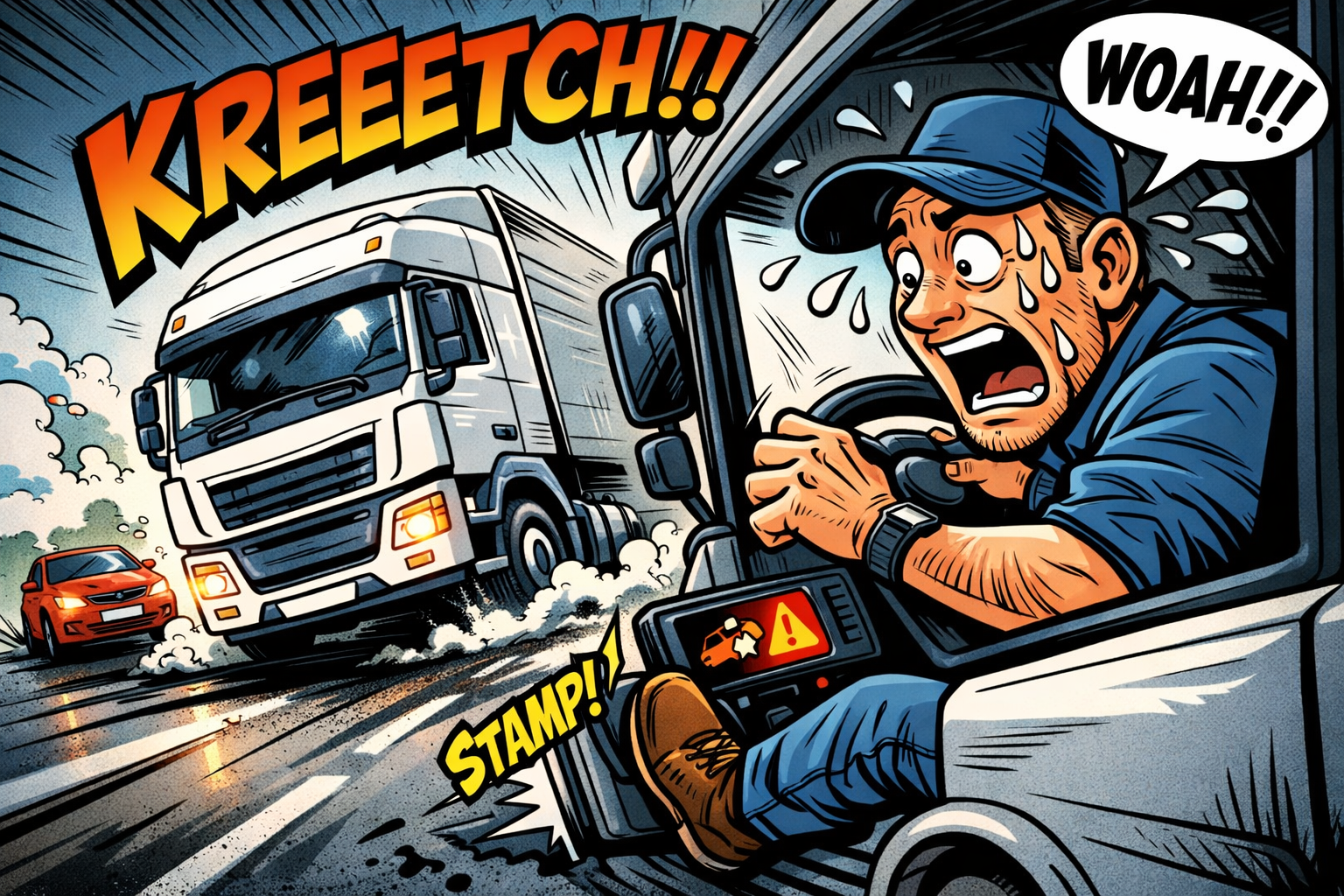
A truck is driving into a traffic jam.
Despite having an emergency brake assistant.
And exactly there comes the same question again: “Why didn’t the truck brake?”
The short answer: Because the system can’t do everything.
The long answer is coming now.
Since there have been more accidents on the motorway recently, it’s worth taking a closer look at the topic.
What does the emergency brake assistant actually do?
The emergency brake assistant (NBA) monitors the area in front of the vehicle and intervenes when it becomes critical.
Typical process:
- Obstacle is detected
- Warning for the driver
- automatic partial braking
- full braking in case of emergency
Everything happens in stages – not suddenly.
What technology is behind it?
For this to work, several systems work together:
- Radar (main sensor)
- Camera (object recognition)
- Control unit (evaluates the situation)
The system constantly calculates:
- Distance
- Speed
- Approach
Some want quantum computers in the server room.
We drive one.
And yet, practice shows: Computing power can’t replace understanding of the situation.
Legal requirements: What the emergency brake assistant must be able to do
The emergency brake assistant is not an extra, but is required by law.
It became mandatory:
- from 2013 for new vehicle types
- from 2015 for all new registrations of heavy trucks
The basis for this is, among other things, the UN/ECE regulation R131.
Important to note:
The systems did not have to prevent accidents back then.
Their task was to reduce the impact speed.
EU Regulation 2019/2144 – Strengthening the requirements
With Regulation (EU) 2019/2144, the requirements were significantly expanded.
Since:
- 2022 → mandatory for new vehicle types
- 2024 → mandatory for all new registrations
The systems were further developed – but not perfect.
On paper, everything works perfectly.
The road rarely has paper.
Then vs. now: What has really changed
When the first systems became mandatory, it wasn’t about preventing accidents.
It was about making them less severe.
The technology was simpler, the sensorics limited. Prefer a safe partial braking over a system that reacts uncontrollably.
Today it’s different.
Modern systems can recognize:
- moving vehicles
- stationary obstacles (although not always reliably)
- pedestrians
- partially cyclists
And they can brake to a stop in many cases.
That’s also changed expectations.
Many now assume that the truck will stop on its own in case of doubt.
That’s exactly the misconception.
The technology has improved.
The limits have remained.
Current state of the art: Example Mercedes-Benz
When you look at how this technology has developed, you can’t avoid Mercedes-Benz.
Systems like the Active Brake Assist were already available long before the legal requirement.
I myself drove an Actros MP2 in the early 2000s that had one of the first systems of this kind on board.
This shows: The technology was there earlier than the regulations.
Mercedes was one of the pioneers – other manufacturers only after the EU regulation came.
The technology was there before it was required. And yet the problem hasn’t disappeared.
More than what the law requires
Many modern systems can do much more than what is legally required.
They can recognize not only vehicles, but also:
- stationary obstacles (as already mentioned, not always reliably)
- pedestrians
- partially cyclists
And can initiate full braking in case of emergency, provided the conditions are optimal (weather, vehicle condition, etc.).
The legislation only caught up with this development later.
Interaction with other systems
The emergency brake assistant is an independent system. It operates independently of the adaptive cruise control (ACC).
The ACC regulates the distance to the vehicle ahead and drives in a comfort-oriented manner.
The emergency brake assistant only intervenes when a collision is imminent. These are two completely different systems – even though many put them in the same category.
Where it still “works together”
Both systems use similar sensors. That’s why it often seems to the driver like they work together.
In practice, this means:
- ACC brakes early and gently
- Emergency brake assistant intervenes late and strongly
And exactly this transition often comes as a surprise.
Can the emergency brake assistant be deactivated?
Short answer: No. At least not as many think.
In current vehicles, there is generally no option for the driver to deactivate the emergency brake assistant – not even temporarily.
This is also evident in practice: In my own vehicle, I can easily deactivate the adaptive cruise control, but not the emergency brake assistant.
And that’s exactly how it’s intended. The system should always be active.
What is still possible: The driver can intervene in a specific situation and override the system. However: Overriding does not mean deactivating it. Not even until the next restart of the truck.
Overriding can be done by:
- accelerating
- braking
- changing lanes
But there is no “turning off” anymore! Even if some see it differently. Which may also have to do with the vehicle…
Why it differs from vehicle to vehicle
Those who get involved with the topic quickly realize: There is no single answer.
The reason is simple: The technology has evolved over the years – and so have the regulations.
In older vehicles, it was sometimes still possible to deactivate the emergency brake assistant or at least turn it off for a longer time.
In newer vehicles, it’s different: Here, the system is generally active and cannot be turned off by the driver anymore.
In between, there is a transition phase, in which much was solved through software updates.
This leads to the fact that vehicles behave differently in everyday life – even though they look the same at first glance.
And exactly that causes many misunderstandings. Because the problem is not the technology – but that many believe it to be the same everywhere.
Where are the limitations?
The emergency brake assistant is not a universal solution.
Typical problems:
- stationary obstacles are sometimes detected too late or not reliably
- curves can be misinterpreted
- weather conditions affect the sensors
- false braking is possible
- there is always a system-related reaction time
The technology is impressive.
Reality doesn’t care.
Why didn’t the emergency brake assistant react?
After such accidents, the question quickly arises: Why didn’t the system intervene?
The honest answer: It’s not possible to say for sure from the outside.
Without:
- vehicle data
- error memory
- detailed analysis
everything remains speculation.
Possible reasons (no claim of completeness)
- The obstacle was detected too late
- The situation was misjudged
- The sensors were limited
- The driver intervened beforehand
- The system was outside its operating range
These points explain no specific accident.
They only show: The system has limitations.
Practice: Why it still crashes
Many rely too much on the technology. The system is a support – not a replacement.
If the driver:
- is distracted
- approaches too closely
- misjudges situations
- has health issues
then even the best system helps only limitedly.
The truck can brake. The question is only whether it does it in time. And especially in cases of health problems, it would be good if the truck could automatically drive to the shoulder. Volkswagen already has this in cars. Unfortunately, not yet in trucks.
Typical misconception
“The truck brakes on its own.”
No.
It can. But not always. And not in time in every situation.
Conclusion
The emergency brake assistant is useful. But it is a safety net – not an autopilot.
If the technology would solve everything, there would be no accidents anymore. Relying on it, you will eventually crash.
In the best case, only metaphorically.
Final thoughts
Assistive systems can do a lot. But you still have to think for yourself. Assistive systems take away work when you work with them. They make work harder when you act against them.
But: They do not take responsibility away from you!