

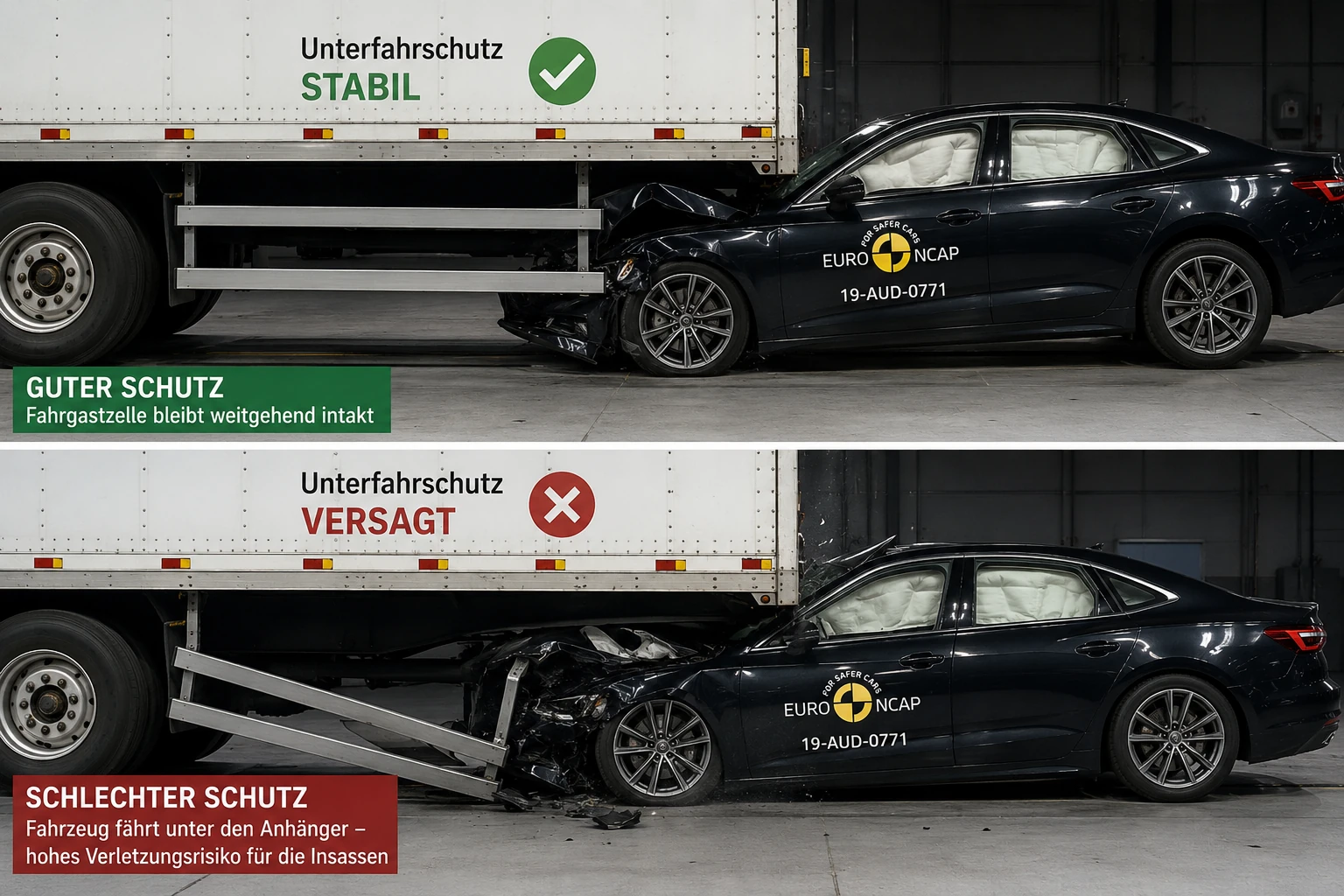
Who drives on German motorways daily sees them: the crosswise steel construction at the rear of trailers and semi-trailers. Most people hardly notice them. Yet they fulfill a life-saving function. The so-called underbody protection is supposed to prevent a car from sliding under the trailer in the event of a rear-end collision.
Exactly this component has now been examined in detail by Euro NCAP – with a result that raises questions.
What was tested?
Euro NCAP investigated how different underbody protection systems behave in the event of a rear-end collision. A car was driven deliberately into the rear of a trailer. It was not important whether the car was damaged – that is inevitable in such an accident – but whether the underbody protection prevented the vehicle from sliding under the trailer.
The images from the test show clear differences.
While a stable underbody protection holds the front of the car in an area where the crumple zones can exert their protective effect, a weaker system buckles. The vehicle slides further under the trailer, and the loads shift into areas that can be significantly more dangerous for the occupants.
Why is this so important?
Modern cars are equipped with highly developed safety systems. Airbags, seatbelt pretensioners, and complex crumple zones can absorb enormous forces.
This technology, however, only works if the impact energy is absorbed where the engineers intended it to be.
If a car slides under a trailer, part of the front structure is bypassed. The loads then act directly on the passenger compartment. The consequences can be significantly more severe than in a normal front-end collision.
The underbody protection is therefore not just a piece of steel at the rear of the trailer, but an important passive safety system.
Does the technology meet the regulations?
Exactly here lies the interesting point.
The tested vehicles generally meet the current registration requirements. Nevertheless, the tests show that there are significant differences in actual protective effect.
This does not automatically mean that the legal requirements are wrong. It shows, however, that there is apparently a gap between the legal minimum standard and what is technically possible.
Euro NCAP therefore calls for stricter requirements regarding the design and load-bearing capacity of underbody protection systems.
What the test does not say
Amid all the justified discussion, one important point should not be forgotten:
The test says nothing about the cause of the accident.
A rear-end collision usually arises from factors such as:
- insufficient safety distance,
- distraction,
- inappropriate speed,
- poor visibility conditions,
- fatigue or inattention.
Even the most stable underbody protection cannot prevent such an accident. It can only help reduce the consequences for the occupants of the vehicle that was hit from behind.
A topic that also affects the industry
For professional drivers, the discussion is certainly interesting. Often, discussions on road safety focus on driving times, speeds, or assistance systems. The Euro-NCAP test, however, shows that even seemingly insignificant components can have significant effects on road safety.
The underbody protection is not a minor detail. In an emergency, its stability decides whether the safety structure of a car can fulfill its function or not.
Conclusion
The results of Euro NCAP do not show that truck trailers are fundamentally unsafe. They rather show that the protective effect of underbody protection systems can vary – even when the legal requirements are met.
The real question is therefore not whether underbody protection is present, but how well it functions in an emergency.
Because, on the motorway, a few centimeters can decide whether modern vehicle safety can fulfill its function – or whether it never gets the chance to do so.
Here is the link to the Euro-NCAP test: https://www.euroncap.com/press-media/euro-ncap-reveals-fatal-flaws-in-trailer-underrun-safety-that-cost-400-lives-every-year/
