

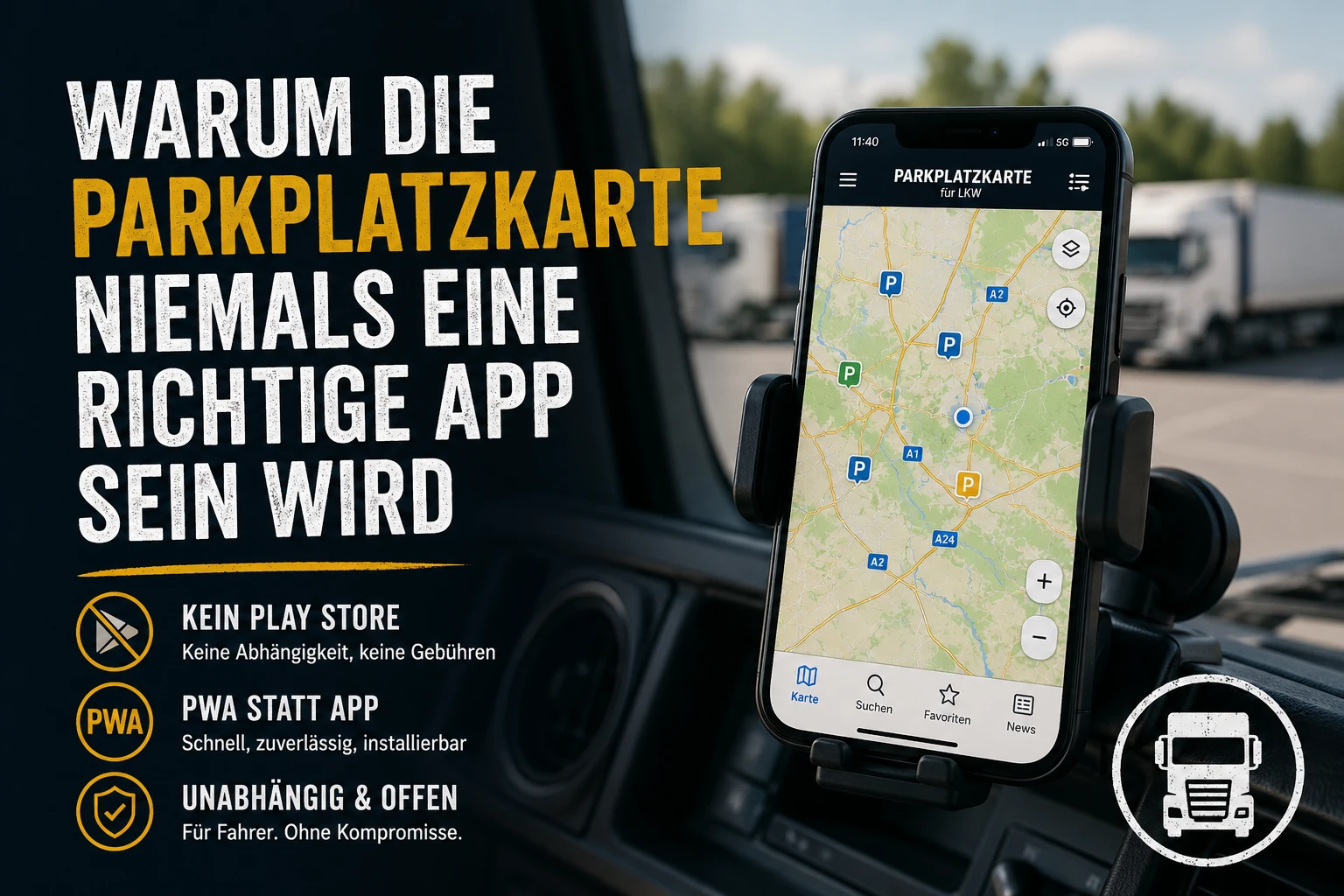
Why the Parking Map will never be a “real” app
The idea was there from the very beginning: a proper app for the parking map.
Installable via the Play Store, directly available on the smartphone, and as convenient as possible for professional drivers to use.
However, the more the project grew, the clearer it became to me:
I will probably never take this path.
And there are several reasons for that.
A classic app was originally planned
The idea seemed obvious at first.
A parking map for truck drivers, optimized for being on the go, directly available on the smartphone. Precisely because many drivers already handle almost everything via their mobile phone, an Android app initially seemed logical.
Especially with a “real app,” certain expectations automatically come into play: it feels more premium, can be installed directly from a store, and appears more professional to many people than a website at first glance.
But that is exactly where a closer look becomes worthwhile.
Because the crucial question is not:
Do I need an app?
But rather:
Do I really need an app store?
The Play Store is developing in a direction that increasingly hinders small projects
If you want to publish an app today, you have to comply with more and more requirements.
New guidelines, technical requirements, review processes, and developer account requirements have become almost part of everyday life.
And precisely against this, there is now growing resistance.
Currently, there is a campaign by smaller developers and independent projects that critically examines the new requirements around the Play Store. The accusation: ever more bureaucracy, ever higher hurdles – and ever less room for small, independent projects.
I can at least understand this criticism.
Because sooner or later, a rather simple question arises:
Am I investing my time in new features – or in platform rules?
Especially when developing a project on the side and not with an entire development team, this eventually becomes relevant.
And quite honestly:
I have little desire to invest money and time into a store whose rules can change at any moment. Perhaps a look at this campaign here also helps there.
Yes, I had alternatives available
Of course, there would be other possibilities.
For example, I could have taken the path via F-Droid – an alternative app store that is particularly popular in the open-source community. I myself use it exclusively on my Google-free Android smartphone.
Or I could have simply made an APK file directly available on my website.
Technically, both would be feasible.
But here too, I eventually came to the conclusion:
Why actually?
Because in the end, I would still have to maintain a classic app – including additional development effort, updates, tests, and potential issues between different Android versions.
And that is exactly where I reached the point where I thought:
Maybe I am just trying to solve a problem that doesn’t really exist.
Data protection also plays a role
Another factor that certainly played into my decision is data protection.
Anyone who knows my website knows:
I have been trying for some time to implement things as sparingly with data as possible. No unnecessary cookie banners, no excessive tracking orgy, and as little unnecessary baggage as possible.
Simply a platform that works.
Precisely because of this, the path via a large app store now feels somewhat contradictory to me.
Do not misunderstand me:
Of course, it is clear to me that Android is the standard for many drivers – and Google technically makes much of it possible in the first place.
Nevertheless, there remains a certain contradiction at the end:
On the one hand, I am trying to build an independent and data-sparing platform.
On the other hand, with a classic app, I would be stepping into this ecosystem even more strongly again.
And quite honestly:
Then I can almost save myself the data protection thought in the end.
Precisely because of that, a PWA fits for this project from my perspective simply better.
The map remains directly accessible, installable, and usable – but without the additional detour via a central store.
The truth is: A PWA often suffices today
Many still associate websites with something that feels somehow inferior in the browser compared to an app.
The problem with this:
This image feels like it comes from the early 2010s.
Modern Progressive Web Apps – short for PWA – can do much more today than many think.
The parking map can already be installed on the home screen like an app right now. It opens in full-screen mode, functions without distracting browser bars, and thus feels very close to a classic application.
And that is exactly the crucial point for me:
Users should get a good solution – not an app just for the sake of an app.
Because what does a native app bring me if the only real difference in the end is the Play Store logo?
For drivers, features count – not the packaging
In the end, a driver on the go cares mainly about one thing:
Does it work reliably?
Not whether something is technically called a website or an app.
If I can see at a glance:
- where free parking spaces are,
- what information is available,
- how the situation on site looks,
- or whether a stop is worthwhile at all,
then the application fulfills its purpose.
And that is exactly what I want to focus on.
I would rather invest time in meaningful features than into things that ultimately offer little added value.
A PWA even has real advantages
In fact, a Progressive Web App brings several advantages that are even more practical for this project.
No Store Dependency
There is no approval process, no waiting times, and no fear that some new guideline will suddenly cause problems.
As soon as a new feature is ready, it’s available immediately.
Without:
“Please download the next update from the App Store first.”
Platform Independent
Whether Android, iPhone, tablet, or desktop PC:
The map works everywhere.
Especially in the transport industry, where not everyone uses the same device, this is a real advantage.
Direct Updates
Improvements reach users immediately.
No manual updates, no outdated versions, and no version chaos.
More Independence
And yes, that is indeed important to me.
I want to keep the project as independent as possible.
Without unnecessary hurdles, without platform lock-in, and staying as close as possible to the core idea I pursue on my website anyway:
open, directly accessible, and without unnecessary bloat.
The Parking Map Should Still Feel Like an App
Just because the parking map doesn’t become a “real” app in the classical sense doesn’t mean it should feel like a typical website.
On the contrary.
The goal remains clear:
It should feel as much like a proper app as possible.
This includes, among other things:
- mobile operation that works on the go,
- fast loading times,
- an interface tailored for drivers,
- favorites,
- sensible offline functions,
- and further features in the long term that really help in daily life.
Not because it sounds technically interesting.
But because it must be practical while on the move.
Conclusion
The parking map will probably never become a “real” app in the classical sense.
And nowadays, I’m honestly quite convinced that this is actually good.
Yes, I could have taken the path via the Play Store.
Yes, F-Droid or an APK directly on the website would also have been options.
But in the end, I believe I’ll do better with a well-made PWA than with a classical app.
Not every idea needs an app store.
Sometimes a good solution that simply works is enough.