

Emergency Braking Assistants in Trucks: How an Innovation Became a Mandatory System
When heavy trucks approach the end of a traffic jam or slower-moving traffic, the consequences are often dramatic. Due to their high mass, commercial vehicles generate enormous forces that even modern safety systems cannot fully compensate for. For many years, manufacturers, legislators, and road safety organizations have therefore worked to reduce the number of severe rear-end collisions. The emergency braking assistant plays a key role in this effort, known internationally as Advanced Emergency Braking System (AEBS).
Today, this system is part of the standard equipment on modern trucks. However, the path to this point began long before the first legal requirements and is closely linked to one manufacturer that significantly drove its development forward.
The Beginnings: Mercedes-Benz as a Pioneer
The history of the emergency braking assistant does not begin with an EU regulation but with developments that started years earlier at Mercedes-Benz. As early as the beginning of the 2000s, radar-based distance control systems and adaptive cruise controls were introduced in the Actros. These systems monitored traffic ahead, automatically adjusted speed, and warned drivers of critical situations. For many professional truck drivers, this was their first encounter with technology that continuously analyzed road conditions in front of the vehicle.
I also remember driving a Mercedes-Benz Actros MP2 in long-haul transport as early as 2004. At that time, the vehicle already featured a radar-based distance control system that monitored traffic ahead and supported the driver. For many drivers, this technology was still something special back then; today, it is firmly part of everyday life for modern commercial vehicles. Looking back, it becomes clear that many assistance systems now taken for granted had their roots in this era.
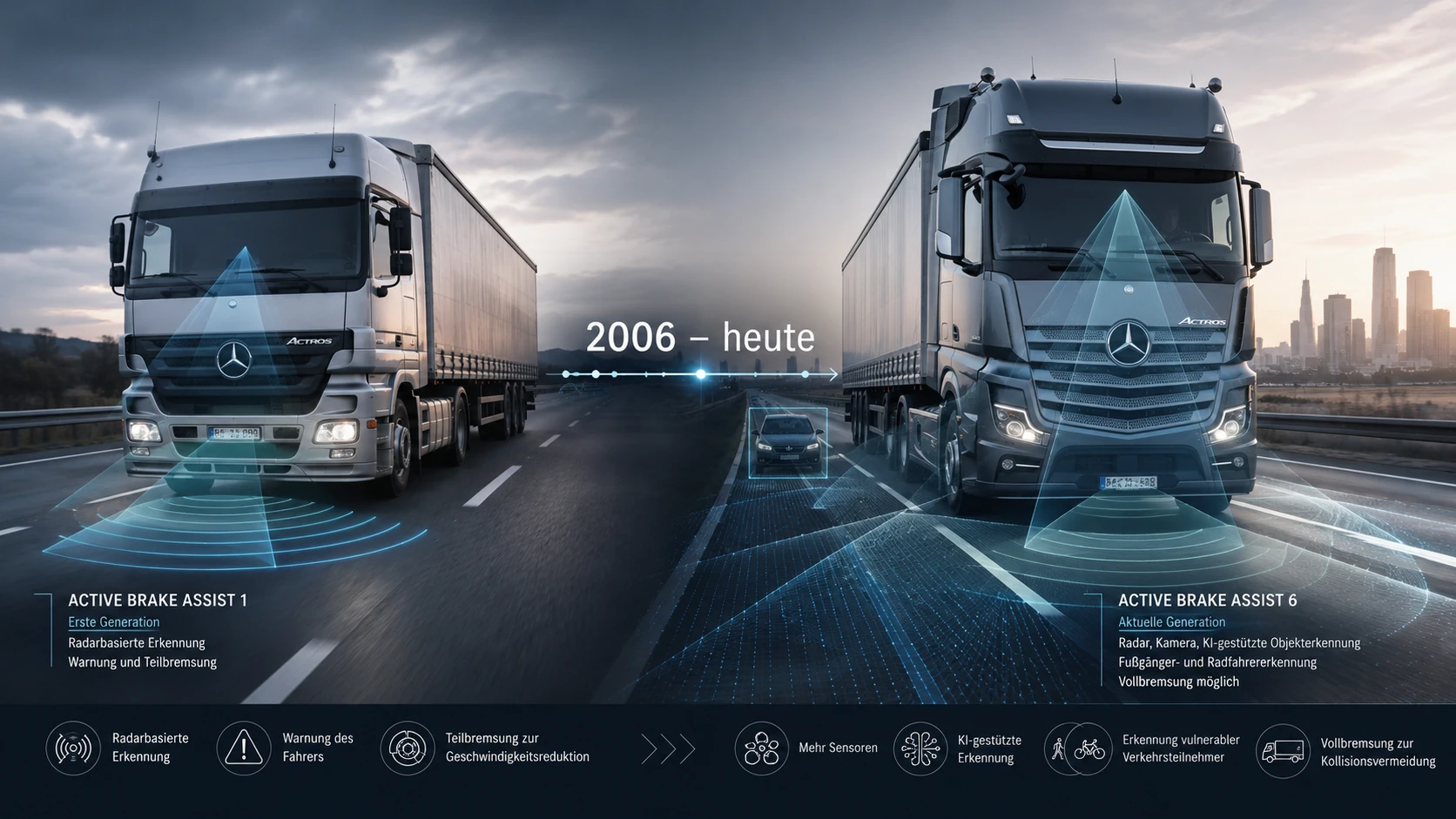
The experience gained with these early systems laid the foundation for a development that was to fundamentally change road safety in freight transport. Based on the existing radar and sensor technology, Mercedes-Benz introduced Active Brake Assist (ABA) in 2006. The system is considered the world’s first series-production emergency braking assistant for heavy trucks.
From today’s perspective, the capabilities of the first ABA may seem modest. The system monitored traffic ahead using radar sensors, detected impending rear-end collisions, and warned the driver. If no reaction occurred, the assistant would automatically initiate partial braking on its own. The goal was not to completely prevent an accident but to significantly reduce impact speed and thereby mitigate the consequences of a collision.
Nevertheless, the introduction of the system marked a milestone in truck technology. For the first time, a series-production truck was capable of actively intervening in traffic when the driver failed to react promptly to a recognized hazard. At that time, there were neither legal obligations nor binding European regulations. The development was driven by the desire to enhance safety on public roads and more effectively prevent severe rear-end collisions.
Looking back, it is often overlooked that the development did not begin with Active Brake Assist. Many drivers still remember the first Actros models equipped with radar-based distance control systems and adaptive cruise controls, which had already performed important preparatory work years earlier. Therefore, the step from a warning assistance system to an actively intervening emergency braking assistant was less a sudden revolution and more the consistent further development of a technology that had already been tested in the practical daily life of long-haul transport.
From Pioneer Project to European Requirement
The successes of the first systems did not go unnoticed. In parallel, European institutions increasingly focused on how to reduce the number of serious traffic accidents. Rear-end collisions involving trucks came particularly into focus.
With Regulation (EC) No 661/2009, the European Union decided for the first time on the mandatory introduction of various driver assistance systems for heavy commercial vehicles. This also included the emergency braking assistant. The specific technical requirements were subsequently refined in further regulatory documents.
The introduction was implemented gradually. Initially, newly type-approved vehicle models had to meet the requirements. A few years later, the obligation applied to all newly registered vehicles in the affected weight classes. Thus, a technical innovation by a single manufacturer became an EU-wide safety standard within just a few years.
The legislator pursued a pragmatic approach here. The initial regulations focused on the most frequent and severe types of accidents, particularly rear-end collisions with vehicles ahead. A complete prevention of collisions was not strictly required. Even a significant reduction in collision speed was considered a major safety gain.
The Limitations of the First Generation
However, as the systems became more widespread, their weaknesses also became apparent. The early generations worked almost exclusively with radar sensors. This technology was ahead of its time but reached its limits in certain situations.
A central problem was that the systems could not always classify obstacles unambiguously. To avoid dangerous false braking maneuvers, the algorithms were deliberately designed conservatively. As a result, some hazardous situations were only recognized relatively late.
At the same time, there were recurring situations where the system detected objects that did not actually pose a danger. Bridge structures, sign portals, or certain traffic facilities could generate radar reflections that were sometimes interpreted by the system as potential obstacles.
This issue was particularly intensively discussed in the context of the third generation of Mercedes-Benz’s Active Brake Assist, known as ABA 3. In practice, drivers reported occasional unexpected warnings or braking reactions associated with highly reflective road signs or metallic structures along the roadway.
However, this was not a problem occurring exclusively with Mercedes. Rather, it reflected the fundamental challenge faced by all manufacturers: an emergency braking assistant must react to potential hazards as early as possible while simultaneously avoiding unnecessary braking maneuvers. Striking the balance between sensitivity and false alarm safety remains one of the greatest challenges in developing such systems today.
Experiences from these years led to the fact that modern emergency braking assistants no longer rely solely on radar. Today, different sensor systems are combined. Cameras, radar, and intelligent evaluation algorithms enable significantly more precise detection of traffic events.
New Requirements for a More Complex Traffic Environment
While the first emergency braking assistants were developed almost exclusively for use on highways, requirements have changed significantly in recent years.
Modern commercial vehicles no longer operate only on long-distance roads but travel daily through city centers, residential areas, and complex traffic situations. There, other vehicles are no longer the sole focus; pedestrians and cyclists also play a central role.
Therefore, the European Union and the United Nations Economic Commission for Europe have continuously expanded the requirements for modern emergency braking systems. New vehicle generations must now perform significantly more than their predecessors. The systems should not only detect vehicles but also identify crossing or moving road users and be able to react accordingly.
This fundamentally changes the role of the emergency braking assistant. Evolving from a specialized rear-end collision protection system, it is increasingly becoming a comprehensive collision avoidance system that monitors the entire traffic environment.
Why an Emergency Braking Assistant Is Not a Free Pass
Following serious truck accidents, it is often heard that the driver had an emergency braking assistant. This statement creates the impression that modern commercial vehicles can handle critical situations autonomously. However, this is a widely held misconception.
An emergency braking assistant is an assistance system, not a replacement for an attentive human driver. Its task is to support the driver, not replace them. Even the most advanced systems operate within clear physical and technical limits.
A fully loaded semi-trailer with a permissible total weight of 40 tonnes carries enormous kinetic energy. If the sensors detect an obstacle too late, if the speed is too high, or if the available braking distance is insufficient, even an automatic braking intervention may no longer be able to prevent a collision. In many cases, the system significantly reduces impact speed and thereby saves lives. However, it cannot override the laws of nature.
Furthermore, assistance systems always depend on the quality of the data they collect. Weather conditions, visibility, or unusual traffic situations can impair their performance. Therefore, even in the age of highly developed assistance systems, the driver remains the most important safety component within the vehicle.
Public discussions following serious accidents often fall short. The crucial question is not whether an emergency braking assistant was present. Far more important is the question of why a situation arose at all that required such a system to intervene.
A Look into the Future
The development of the emergency braking assistant is far from complete. While the first systems were primarily designed to prevent rear-end collisions with vehicles ahead or mitigate their consequences, manufacturers now face significantly more complex challenges. The focus is no longer solely on traffic in front of the vehicle but increasingly on the comprehensive monitoring of the entire surrounding environment.
With current regulations from the European Union, requirements for emergency braking assistants are being gradually expanded. Future systems must not only detect vehicles but also reliably identify pedestrians, cyclists, and other vulnerable road users. Many modern systems already master this capability today. For example, Mercedes-Benz introduced the Active Brake Assist 4 at IAA Commercial Vehicles 2016, which could react to pedestrians for the first time. Current vehicle generations from other manufacturers, including Scania, now offer comparable functions. Therefore, the goal of further development is less about introducing these capabilities and more about their continuous improvement and higher reliability in complex traffic situations.
In parallel, manufacturers are working on increasingly stronger networking of vehicle systems. Modern assistance systems no longer rely exclusively on radar. Cameras, high-resolution sensors, and powerful analysis algorithms enable ever more precise analysis of traffic conditions. The development is increasingly moving towards 360-degree surround detection, where the vehicle can monitor its surroundings almost completely.
Communication between vehicles and infrastructure will also play a greater role in the future. Systems that warn about congestion points, construction sites, icy patches, or other hazardous locations before they become visible to the vehicle’s own sensors are conceivable. The emergency braking assistant would thus no longer react solely to detected obstacles but could take hazards into account in advance. Initial approaches to such networked systems are already being tested today.
Furthermore, the topic of automated driving in freight transport is gaining increasing importance. Fully autonomous trucks on European roads may still seem like science fiction for now, but many of the technologies required for this are already available. Emergency braking assistants, lane-keeping assistants, turn-assistants, and other driver assistance systems form the technical foundation for this development. They are the building blocks of a future in which vehicles take over more driving tasks and will increasingly support the driver.
Despite all technical advances, however, one insight remains: the safest emergency braking assistant is the one that never has to intervene. Attention, anticipatory driving, and sufficient safety distance will remain the most important prerequisites for safe driving in the future as well. Assistance systems can support, warn, and intervene in emergencies – but responsibility for the vehicle remains with the human behind the steering wheel.
Conclusion
The development of the emergency braking assistant impressively demonstrates how technical innovations can improve road safety. What began in 2006 as a pioneering achievement by Mercedes-Benz developed within a few years into a safety system mandated across Europe.
At the same time, the history of the system clarifies that technical solutions alone are not enough. The first generations struggled with sensor limitations and misinterpretations; modern systems must cope with ever more complex traffic situations. Despite all advances, the emergency braking assistant remains an aid and not a substitute for responsible driving.
Nevertheless, it is beyond doubt that the introduction of the emergency braking assistant counts among the most significant safety advancements in modern commercial vehicle manufacturing. Numerous severe rear-end collisions have been prevented or their consequences significantly mitigated. The development is far from complete. With each new vehicle generation, the systems become more powerful and intelligent. The goal remains unchanged: to avoid serious accidents and protect human lives.