

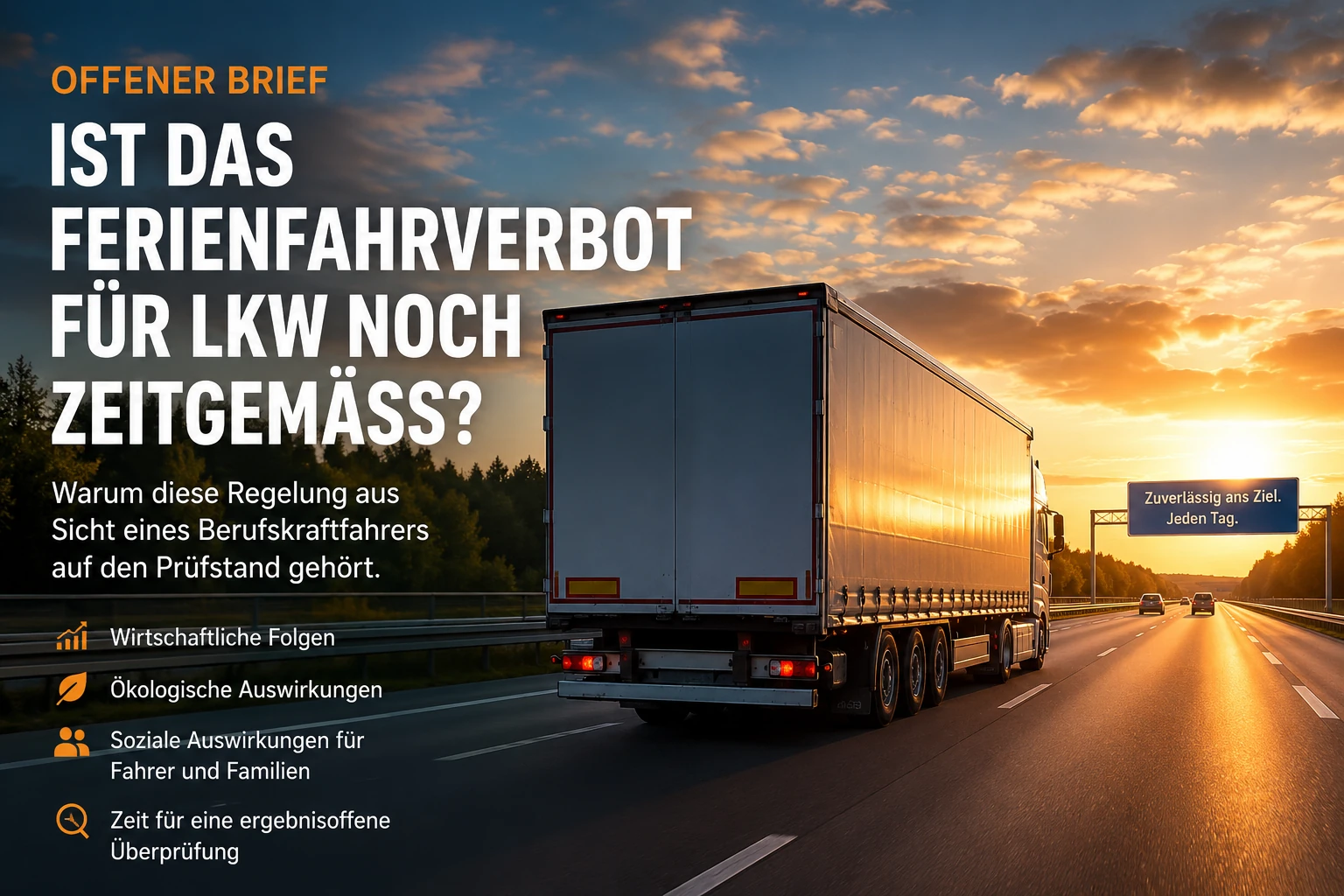
Open Letter: Is the holiday driving ban for trucks still relevant?
In recent days, much has been discussed about the possible abolition of truck driving bans on non-nationwide public holidays. In this context, another question has come to my mind that, in my view, also deserves discussion:
Is the holiday driving ban for trucks still relevant in its current form?
I am not asking this as a politician, scientist, or entrepreneur, but as a professional driver with around 30 years of experience. As a former works council chairman and operator of a specialist blog for professional drivers, I have been examining the impact of legal regulations on the daily work life of drivers for many years.
The holiday driving ban was introduced to relieve road traffic during summer holidays. This objective is fundamentally understandable. However, the world has changed considerably since this regulation was introduced.
Our motorways have been expanded, modern traffic control systems have emerged, and logistics has developed into a highly complex economic sector that relies on precise supply chains. At the same time, the question arises whether the holiday driving ban today actually still achieves the desired effect or whether it merely leads to a shift in traffic.
Goods do not simply disappear just because there is a driving ban on certain Saturdays. Transport operations are instead frequently advanced or made up later. This creates additional peaks in load before and after the prohibited periods. From my professional practice, I know situations where vehicles and drivers are under significant time pressure to reach their destination in time before the start of the driving ban.
In addition, there are economic and ecological aspects. Transport operations must sometimes be planned via longer alternative routes or organized at different times. This results in additional costs, higher fuel consumption, and avoidable CO₂ emissions.
The impact on traffic flows should also be critically examined. If certain road sections may not be used, this does not necessarily mean less traffic; often it is merely shifted to other roads. Whether a relief is actually achieved or whether other regions and town routes are instead more heavily burdened should be investigated based on current data.
However, what is particularly important to me is the human side of this discussion.
Many long-haul drivers try to spend their weekends with their families. However, the holiday driving ban often leads to drivers no longer being able to reach home in time due to the remaining driving and working hours. Instead of spending the weekend with family, they must spend it at service areas or truck stops.
Those who are not themselves active in freight transport often underestimate the burden that long absences can place on families and relationships. The profession of a driver already demands considerable personal sacrifices today. Additional hurdles that make return journeys more difficult or impossible should therefore be critically questioned at least.
I am explicitly not questioning free weekends or rest periods for drivers. Many colleagues appreciate these quiet times and consciously use them for recovery. The question is rather whether the existing holiday driving ban today is still the appropriate instrument to achieve its original objectives.
Therefore, I would like to see politics and administration subject this regulation to a modern and open-ended evaluation.
The following should be examined:
- Does the holiday driving ban today still fulfill its original purpose?
- What actual impact does it have on traffic flow?
- What economic consequences arise for companies?
- What ecological effects do traffic shifts and alternative routes have?
- What social consequences result for drivers and their families?
A regulation that has existed for decades should be regularly reviewed to determine whether it is still sensible and proportionate under current conditions.
I would be pleased if this discussion were conducted in a factual manner and took into account both the interests of road transport and the life reality of the people who ensure that supermarkets, industry, and the economy are reliably supplied every day.
Note:This open letter was sent on July 17, 2026, to the Federal Ministry for Transport as well as to Members of the Bundestag from the Hochsauerland district. Incoming responses will be documented and published if permissible.
