

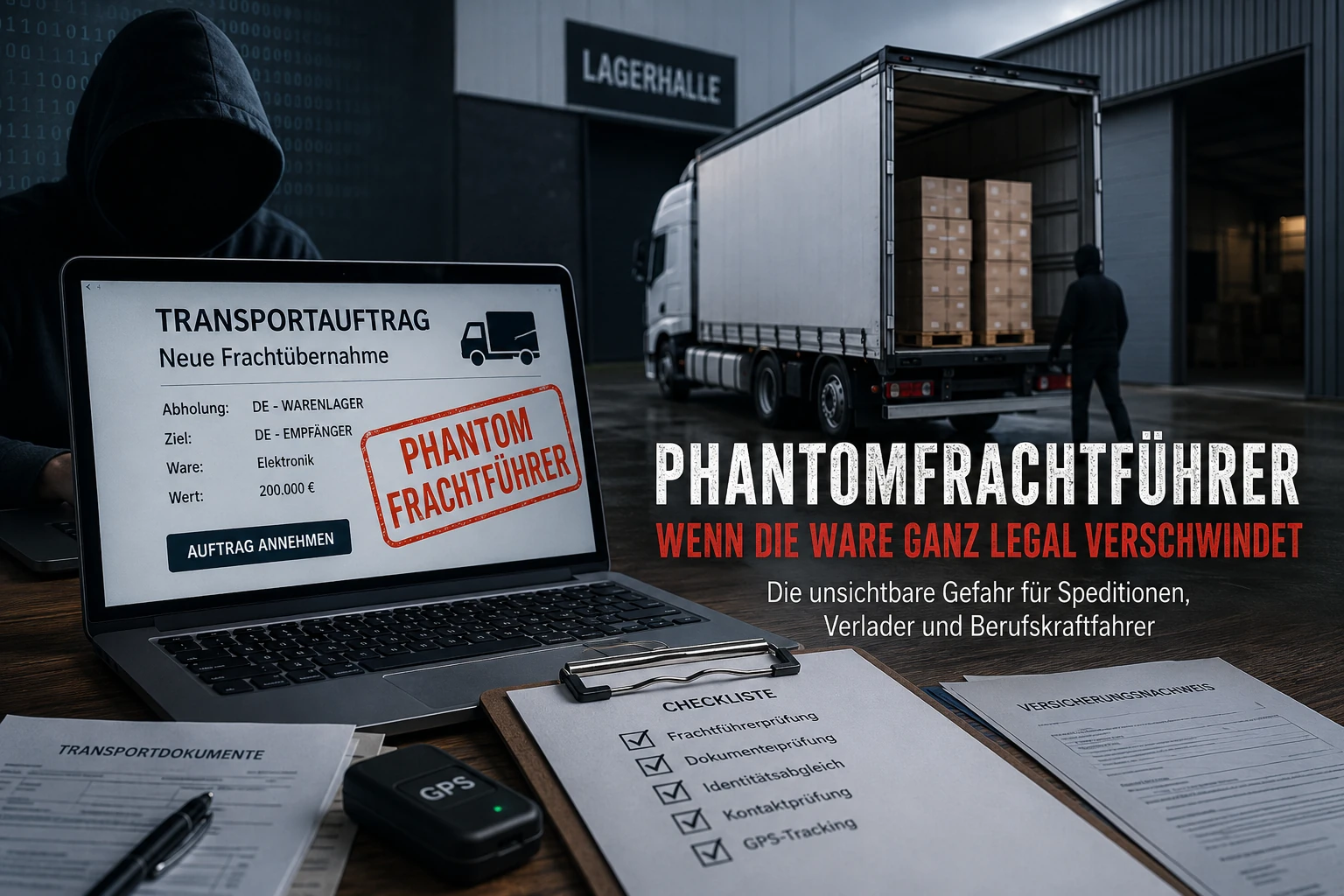
A truck arrives on time. The paperwork is complete. The driver checks in properly. The cargo is loaded, and the transport order seems to be proceeding as usual.
But the shipment never reaches the intended recipient.
What sounds like a classic cargo theft is actually a fraud scheme that has been occurring more frequently across Europe in recent years: so-called phantom freight forwarders.
The Current Case from Cologne
How professionally the perpetrators now operate is illustrated by a recent case from Cologne. After a forwarding agent had previously lost high-value goods, he proactively hid a GPS tracker in the cargo for another shipment.
When it became clear that the truck was not heading to the intended recipient but instead to a warehouse in Cologne, the entrepreneur immediately contacted the police. The officers were able to arrest several suspects and secure goods worth more than 200,000 euros.
The case clearly shows: Modern technology can help limit damage. Even more important, however, is recognizing the scam itself.
What Are Phantom Freight Forwarders?
Unlike in a classic theft, the cargo is not taken by force. The perpetrators receive it officially.
They pose as reputable transport companies. They use forged documents, copied company data, or even misuse the identity of actually existing forwarding agents. Through freight exchanges, email, or telephone, they contact shippers or forwarders and accept transport orders.
On the loading day, a vehicle appears, the cargo is properly accepted – and then disappears without a trace.
For the shipper, everything initially looks correct.
Why This Scam Is So Successful
The logistics industry today operates faster and more digitally than ever before.
Transport orders are assigned within minutes. New business partners are often verified solely through digital documents. At the same time, there is increasing time and cost pressure on dispatchers and forwarders.
Criminals exploit exactly this situation.
Often, a forged email address or a website that looks almost identical to the real one is enough to create trust. It becomes particularly dangerous when perpetrators misuse the identity of real companies.
Then, company name, address, and commercial register data may even match official information at first glance.
The Role of Phishing and Cybercrime
Many cases now begin not on the yard or at the ramp, but at the computer.
Forwarding agents regularly report phishing emails with which criminals attempt to gain access to company accounts or email inboxes. If a perpetrator gains access to such an account, they can read ongoing communications and even send messages under the name of a real company.
This creates particularly dangerous situations:
- Orders are accepted under someone else’s name.
- Documents are manipulated.
- Points of contact are swapped out.
- Driver and vehicle data are changed at short notice.
Everything appears authentic to those involved because the messages actually come from a known sender.
Cargo theft can then begin long before a vehicle even arrives at the loading site.
Why Email Alone Is Not Sufficient Verification
Many fraud cases start with a seemingly legitimate email. That is precisely why many forwarding agents do not rely solely on the information provided in a message when dealing with unknown business partners.
In practice, additional verifications are frequently carried out. These include callback requests via officially known phone numbers or confirmations through the used freight exchange.
Some companies compare contact details from the original request with company data stored in the platform. If email addresses, points of contact, or other information do not match, the process should be scrutinized more closely.
What Forwarding Agents Should Pay Attention To
Absolute security is not possible. Nevertheless, companies can significantly reduce the risk.
Important check points include:
- Carefully verify new freight forwarders.
- Research phone numbers exclusively through official sources.
- Scrutinize email addresses carefully.
- Obtain order confirmations preferably via the freight exchange or known communication channels.
- Question changes to vehicle, license plate, or driver.
- Verify insurance and license certificates directly with the issuer.
- Secure high-value cargo with GPS tracking.
Extra caution is required when multiple changes occur shortly before transport begins.
What Professional Drivers Can Do
Although the primary responsibility for order verification lies with dispatch and administration, drivers can contribute to early detection of irregularities.
Warning signs may include:
- Last-minute changes to unloading addresses,
- Unplanned reloading operations,
- Contradictory transport documents,
- Missing company markings,
- Unusual instructions during the trip.
Of course, a driver should not and cannot conduct criminal investigations. However, attention and common sense can help prevent damage.
The Threat Is Growing
Phantom freight forwarders are no longer just a problem for individual large corporations. Companies of all sizes are now affected.
The combination of digital order processing, identity theft, and cybercrime makes this form of fraud particularly dangerous. While vehicles or trailers were often stolen in the past, today a convincing digital identity is often sufficient to gain access to high-value goods.
For the logistics industry, this means: cargo securing no longer ends at the tarp or the truck door lock. It begins already with the selection of the transport partner.
Security is created through multiple control steps
Most successful fraud cases do not stem from a single error. Often, time pressure, incomplete checks, and a convincingly appearing fraudster come together.
That is why many companies rely on multiple control steps. An email address is verified, phone numbers are cross-checked, orders are additionally confirmed via the freight exchange, and GPS trackers are used for high-value cargo.
No single measure offers complete protection. However, the combination of several controls makes it significantly more difficult for criminals to pose as legitimate business partners.
Conclusion
The case from Cologne shows that criminals are acting increasingly professionally. At the same time, it clearly demonstrates that attention, careful checks, and modern technology can be effective means against this form of cargo theft.
Anyone assigning transport orders should keep in mind: Not every theft begins with a broken trailer. Sometimes it begins with an email.
from practiceHave you already had experiences with phantom freight carriers, forged transport orders, or suspicious inquiries?
Share your experiences in the comments or send me an email . The more information shared within the industry, the harder it will be for fraudsters to succeed.
