

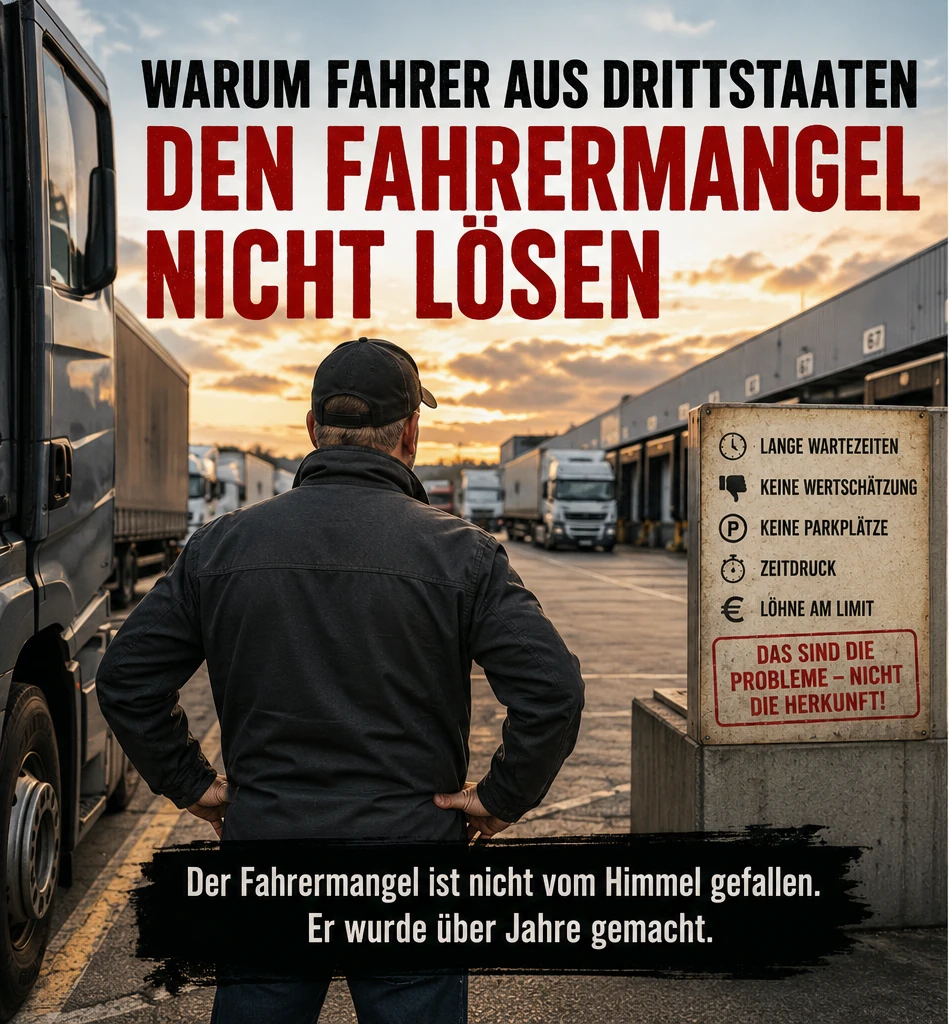
Why Drivers from Third Countries Won’t Solve the Driver Shortage
The current report by the Soester Anzeiger about a freight company that hires drivers from the Philippines actually shows only one thing: The pressure in the industry is now so great that companies have to find new ways. The real question, however, is not where the drivers come from – but why so many of them have left the profession.
That we have a driver shortage should now be noticed even by the last freight operator. The reasons are multifaceted and cannot be reduced to just one solvable problem.
And before anyone comes with the argument: “Then I’ll just pay more money, then they’ll come …” – you’re mistaken. Because salary is only one of many problems.
Job Postings: Many Promises, Little Substance
If you look at today’s job postings for drivers, they are all pretty much the same.
Even large freight companies, where the driver is hardly known by name, promise family-friendly conditions, “fairly paid” work, and some vaguely defined “additional benefits,” often mentioning a modern truck as a benefit. These are things that should be standard – and not benefits.
Then there are the stated net wages for LK 1, which sum up to XY.
But these do not solve the real problems. To name a few:
- Conditions at the ramps
- Lack of parking spaces
- Lack of appreciation by freight companies and customers
- Constant time pressure
- Waiting times without predictability
- Sanitary conditions on the road
- Wages where there’s still a lot of month left after the money runs out
As Long as Conditions Don’t Change, the Driver Shortage Won’t Either
Nothing will change as long as freight companies don’t finally do something for the drivers. And not just that – we drivers are also needed here. Instead of uniting with others, we tend to take advantage of each other – and in the end, there are still not enough drivers.
I myself have been driving for over 30 years, much of it in international freight transport, sometimes with wages where I didn’t know how to feed my family after the first or even second week. Raises only happened when you found a reasonably paid job, and even then, only if it was 10 € more a month.
Daily Life in Freight Transport: What Many Drivers Actually Experience
At the ramps, you’re often the last fool of the service as a driver, and you’re often forced to stack pallets into high shelves at some large retail chains, but only after removing the film, otherwise the computer won’t take the pallet. And if the pallet is somehow damaged for an unknown reason, you have to repack it.
Or if that’s not the case, there are also a few loading operations where you, as a driver, are supposed to sort the goods cleanly into the row. Quasi like, Cinderella, who had to sort peas.
Tasks that do not belong to my job, because I am not paid for them.
Pallet exchange is the same: You are supposed to deliver the goods on brand new pallets, but you have to take back the last bit of trash. In reality, it’s supposed to be: Pallets are exchanged 1:1, not only in quantity, but also in quality.
Driver shortage in politics: Much discussed, little changed
In the past, there were also a few round tables or several hearings in the German Bundestag’s transport committee. From May 2022 until the summer or autumn of 2023, discussions took place – among others under the leadership of the now deceased SPD politician Udo Schiefner – about the situation in the industry. Topics included, among others, the “working conditions of professional truck drivers and effective measures against driver shortages and driver scarcity.”
The problems were therefore long on the table. Politics, associations and companies were well aware of what was wrong in the industry. All the more disheartening is the question: What has actually improved for many drivers in their daily lives?
Nothing. As always. The employer association BGL (Bundesverband Güterkraftverkehr Logistik und Entsorgung e. V.) was also present, as well as some drivers who reported on the situation for us drivers out there.
The chairman Dr. Engelhardt has therefore become aware of the problems we drivers have, for example, at the ramps, as well as the DIHK (Deutsche Industrie- und Handelskammer). One could have reasonably expected the members of these associations to realize that something should change in their practices. But what does the BGL want? That the immigration of drivers from third countries is made easier, in order to tackle the driver shortage. No: “We need better driver management, also at the ramp,” or “We need more parking spaces.” Nothing. As long as it is possible to argue that we need drivers from third countries.
Yet, as one can see: In the year 2026, nothing has changed yet. Many drivers are glad to have left the job after XX years, because they have found something else where they are better off.
Why I see it as a driver
Well, I’m being honest: I myself have not been active in the freight industry for seven years now, but I have not given up driving altogether. I now drive something else: wood. The stuff from the forest, which just sits around, ensures that our CO₂ is captured and our air for breathing is produced.
I actually don’t have these problems. Nevertheless, I keep encountering them regularly, and I find it really sad that the gentlemen in the freight companies prefer to bring in drivers from third countries rather than ensure in Germany that drivers don’t have to be imported.
Because one thing is certain: Just as people were happy back then that the EKT was removed and that we could undercut prices, so it will certainly be the case that we won’t be able to get drivers from third countries forever. Because they will also carry the world with them, just as we treat drivers here in Germany.
Whether at the ramp or within the freight companies.
I know enough freight companies that still schedule their drivers until the last minute so that they can reach their customers but not the next parking spot anymore.
Drivers from third countries do not solve the causes of the problem
The current report from the Soest area about a freight company that recruits drivers from the Philippines may be an example of how companies are trying to deal with the driver shortage. However, the discussion behind it is clearly much larger.
Drivers from third countries can temporarily alleviate bottlenecks and fill open positions. They do not, however, solve the causes of the problem. Because as long as there is no fundamental change in appreciation, working conditions, ramp situations, time pressure, lack of parking spaces, or pay, we are just replacing people – not the reasons why so many have left the profession or never even considered it in the first place.
Or in other words: The driver shortage did not fall from the sky. It was made over the years.
Because let’s look at the situation from the perspective of the warehouse operators. They are annoyed when another driver arrives, who insists on holding their phone to their nose and says in their little German: “Wolle ladden.”
The fact that transport costs money is not compensated by hiring only cheap drivers from Eastern Europe or, in this case, drivers from the Philippines. Yes, they also cost money. But seriously: Who actually believes that these people will stay in Germany until retirement and be treated like the last fool here? The bush telegraph also works outside the EU. And to be honest: The Philippines are already far away. You can’t go much further than that.
What is currently being done with importing drivers from third countries is not the solution to the puzzle: It is just moving the problem. Yes, the drivers are initially happy to be allowed to drive here and earn more money than they might in Indonesia. But as said: The bush telegraph also works there. It will be carried on as it is here in Europe with the driver job.
