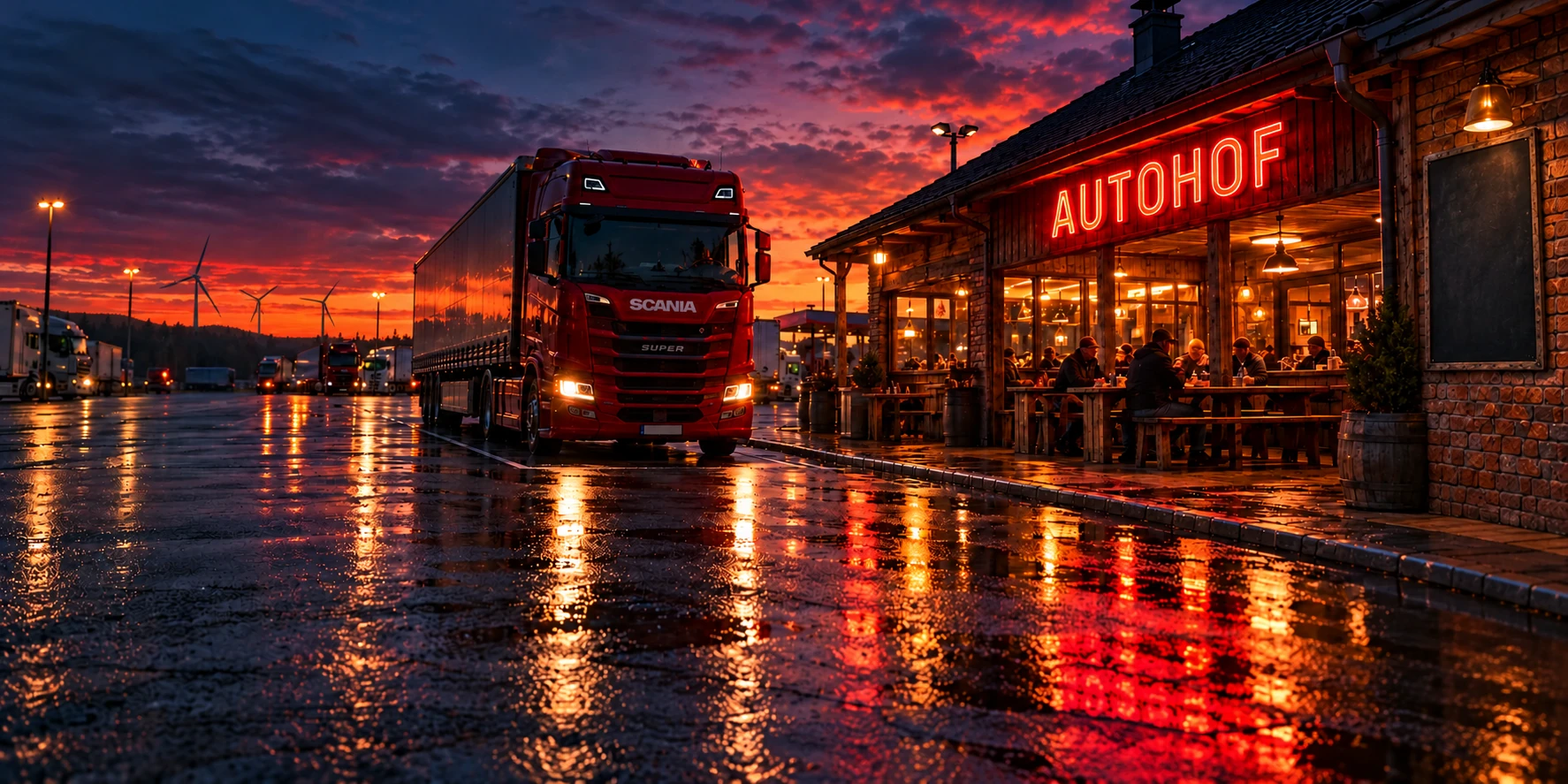

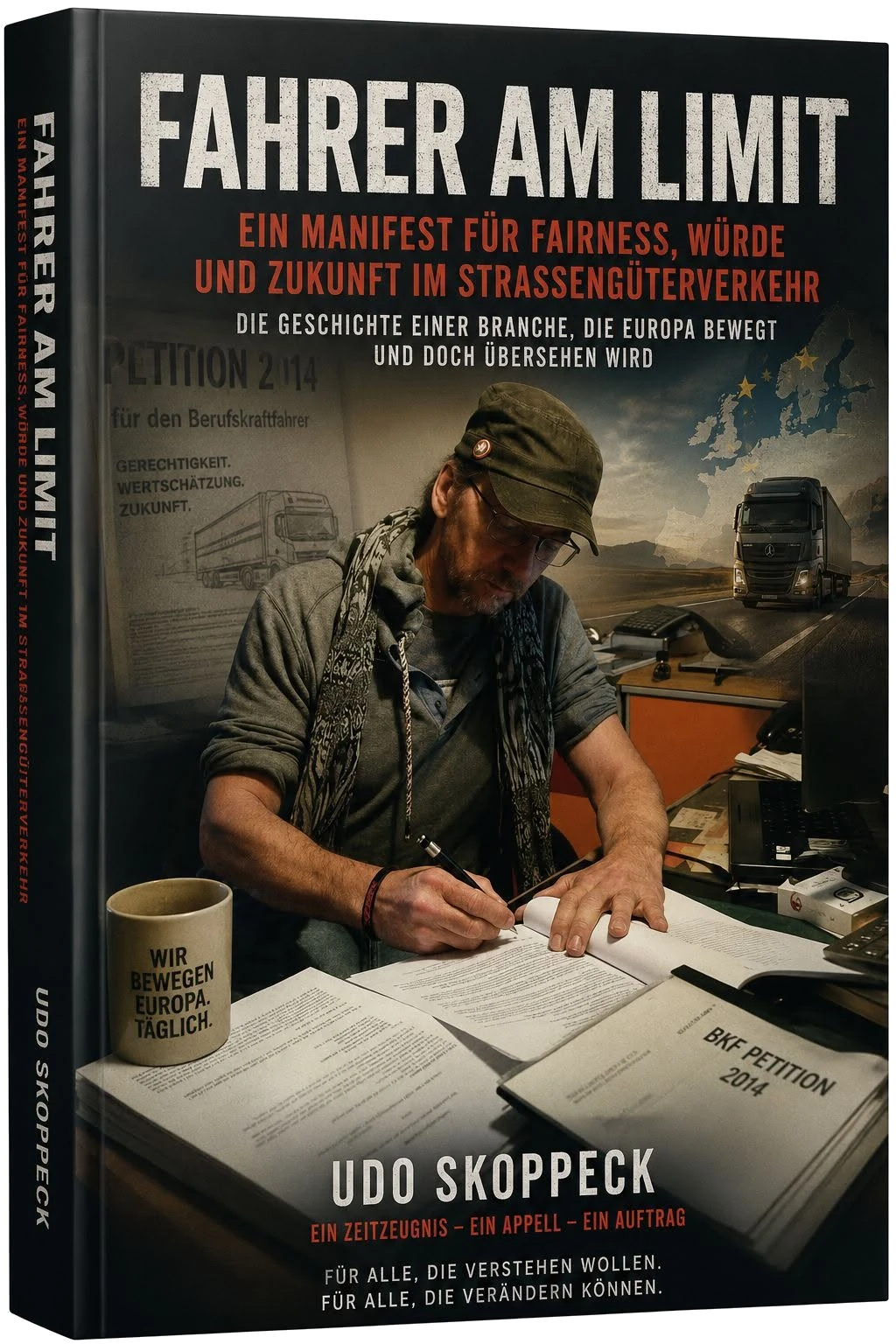
Chapter 1 - EUROPE STANDS STILL WITHOUT TRUCKS
The Importance of Road Freight Transport for Economy and Society
Whoever gets up in the morning starts their day with products that have been transported.
The bed we sleep in, the clothes in the wardrobe, the toothpaste in the bathroom, the coffee on the breakfast table, and the smartphone in our hand all share one thing: they were manufactured, stored, distributed, and transported.
Between the production of a product and its use often lie hundreds or even thousands of kilometers of transport routes. Modern societies therefore function not only through production and trade, but primarily through functioning supply chains.
Road freight transport forms the backbone of these supply chains.
While ships connect continents, aircraft transport particularly urgent goods, and railways move large quantities over long distances, the heavy goods vehicle takes on the task of actually delivering goods to companies, shops, hospitals, construction sites, and people.
Almost every product eventually comes into contact with a truck.
Road freight transport connects industry, agriculture, trade, healthcare, craftsmanship, and consumers into a common economic cycle. Without this connection, even highly advanced economies would hit their limits within a very short time.
This became particularly evident during times of crisis.
Whether natural disasters, border closures, economic crises, or the coronavirus pandemic – whenever supply chains are disrupted, it becomes visible how dependent modern societies are on a functioning transport system.
Food must be distributed daily.
Hospitals need medicines and medical equipment.
Production facilities wait for components.
Construction sites require materials.
Supermarkets must fill their shelves.
All of this does not happen by chance, but through the daily work of hundreds of thousands of people along the transport and logistics chain.
Despite this central importance, road freight transport is often viewed merely as a cost factor.
In many economic decisions, the question of what performance is delivered does not take center stage; rather, the focus is on how to purchase it as cheaply as possible.
It is precisely at this point that a fundamental misunderstanding begins.
Transport is not a side effect of economic activity.
Transport is the prerequisite for economic activity to take place at all.
Without functioning transport, production failures, supply shortages, and supply problems arise. The consequences affect not only the transport sector itself, but society as a whole.
Road freight transport is therefore far more than just an industry sector.
It is the link between almost all areas of social and economic life.
Perhaps its role can best be compared to the blood circulation of a body.
As long as the blood flows, hardly anyone perceives its importance.
Only when the circulation is disrupted do the consequences become visible.
The same applies to freight transport.
As long as goods are available, shelves remain filled, and production facilities run, transport appears self-evident.
However, this self-evidence relies on the daily work of millions of people across Europe.
Road freight transport is thus not only a mirror of economic developments.
It is often also their early warning system.
Changes in production, consumption, industrial policy, globalization, or social priorities often first appear on Europe’s roads.
Therefore, anyone who wants to understand how economy and society are changing should also understand what is happening on the roads of Europe.
Because there, the consequences of political and economic decisions often become visible earlier than in many statistics.
Road freight transport does not just move goods.
It connects economy, society, and people with one another.
And precisely for that reason, its future concerns us all.
CHAPTER 2 - WHEN THE PROFESSION YET OFFERED A PERSPECTIVE
The Transport Sector Before Liberalization, Globalization, and European Cost Pressure
To understand the current situation of European road freight transport, it is worthwhile to look back.
Many developments that are now taken for granted did not exist over decades or existed only to a much lesser extent. The transport sector was organized differently, market structures were more manageable, and economic framework conditions followed different rules.
Road freight transport in many regions of Europe consisted predominantly of medium-sized companies. Family businesses shaped the image of the sector. Often, several generations worked together within a company. Entrepreneurs knew their drivers personally, drivers knew their customers, and long-term business relationships were not an exception but the rule.
Competition existed, but it moved within a framework that enabled many companies to maintain economic existence. Prices were negotiated, but not defined exclusively by the lowest cost factor.
For many drivers, the profession was more than just a job. It offered the opportunity to support a family, build home ownership, and develop long-term prospects. The work was demanding, often involving long absences, yet many drivers still regarded their profession as respectable and identity-forming.
The heavy goods vehicle was not only a tool of work, but frequently an expression of responsibility, experience, and professional pride.
The transport industry was also more regionally rooted. National markets held greater significance than today; international transports played a role but did not yet dominate the sector.
A fundamental difference from the current situation lay in market regulation.
Until the 1990s, commercial long-distance freight transport was subject to tariff and legal frameworks that limited competition and ensured higher predictability.
The Reichskraftwagentarif (RKT), or National Freight Tariff, applied to long-distance freight transport. These tariff systems set freight rates for different distances, types of goods, and transport routes. The goal was to prevent ruinous price competition while ensuring that transports could be carried out at cost-covering levels.
Although deviations from standard tariffs were possible for regular customers, scheduled services, and larger transport volumes, such adjustments remained within clearly defined limits.
This created a market in which competition existed, yet transport services inherently possessed recognized economic value.
At the same time, access to the market was restricted. Concessions were required for various modes of transport and routes. These approvals represented not only administrative permission but often held considerable economic value.
Many entrepreneurs invested over years in these concessions. They were taken into account during company valuations and frequently served as an important component of retirement planning for entrepreneurial families.
With the gradual liberalization of European freight transport, this system underwent a fundamental transformation.
Tariff bindings were abolished, market access regulations relaxed, and competition increasingly opened up. What was politically intended to enable greater efficiency and lower transport costs meant for many companies simultaneously a dramatic loss of economic substance.
Concessions lost their value, tariff protection disappeared, and competition shifted increasingly toward price.
Many entrepreneurs and drivers look back on this period as the beginning of a historical transformation whose effects continue to shape the industry today.
Not everything was yet visible.
Yet the foundations for later developments had been laid.
Therefore, the story of today’s crisis does not begin with the driver shortage.
It begins with the fundamental restructuring of a market that had operated under different rules for decades.
CHAPTER 3 – LIBERALIZATION OF THE EUROPEAN TRANSPORT MARKET
From Regulated Market to Free Competition
The development of European road freight transport can only be understood if one keeps in mind how strongly the sector was regulated over decades.
Until the early 1990s, Germany had a system that limited competition while aiming to ensure economic stability.
In long-distance freight transport, the Reichskraftwagentarif (RKT) applied. It prescribed binding freight rates and aimed to prevent companies from driving each other out of the market through ever-lower prices.
In short-distance freight transport, the Güternahverkehrstarif (GNT) applied. Designed as a margin tariff, it allowed price movements within specified upper and lower limits.
The aim of these regulations was not to prevent competition altogether.
The aim was to prevent competition defined exclusively by price.
At the same time, access to the market was also regulated.
Concessions were required for various transport modes and international routes. The well-known pink, red, and blue concession certificates belonged to the industry’s daily life for decades.
They were far more than simple approvals.
They governed market access, limited capacities, and often held considerable economic value.
Many companies invested over years in these rights. They became part of company valuations, business transfers, and long-term investment decisions.
Contingent systems also existed in international transport.
These included, among others, CEMT approvals that enabled cross-border transports between member states of the European Conference of Ministers of Transport.
Access to the market was thus not unlimited but tied to specific prerequisites and quotas.
With the completion of the European single market, this system underwent a fundamental change.
The political objective was understandable.
Europe should grow economically together.
Borders should lose significance.
Goods should be able to move more freely.
More competition should lead to lower costs and higher efficiency.
For many economic sectors, this development indeed brought advantages.
In road freight transport, however, it meant a profound structural change.
On January 1, 1994, essential elements of the previous system were abolished.
Tariff bindings were eliminated.
Market access regulations increasingly lost importance.
Competition was opened up.
Transports could now largely be negotiated freely.
From the perspective of shippers, this was a great success.
Transport costs fell.
The range of service providers expanded.
Goods could be moved more cheaply.
Yet simultaneously, a development began whose long-term consequences few could estimate at the time.
With the disappearance of tariff protection and access restrictions, competition shifted increasingly toward price.
Transport became viewed more and more as an interchangeable service.
No longer was the quality of performance central.
No longer was the long-term stability of companies prioritized.
No longer was the sustainability of the market structure considered.
The decisive factor increasingly became the question of who could execute a contract at the lowest cost.
For many medium-sized enterprises, this meant a deep disruption.
Concessions lost their economic value.
Long-standing business relationships were frequently replaced by tenders.
Personal partnerships gave way to increasingly anonymous market mechanisms.
The transport sector thus entered a new phase.
A phase that initially brought more freedom but also generated cost pressure, which was set to intensify further in the decades to follow.
Liberalization was neither exclusively right nor exclusively wrong.
It created new opportunities and fostered European trade.
At the same time, however, a single market emerged in which companies increasingly competed with one another, even though economic and social framework conditions were by no means identical.
It is precisely at this point that the next chapter begins.
For with the enlargement of the European Union, open markets collided with enormous differences in wages, social contributions, and cost of living.
This created a cost disparity that continues to shape the transport sector to this day.
CHAPTER 4 - THE ENLARGEMENT OF THE EU
When Open Markets Met Different Realities
The liberalization of the European transport market had laid the foundations. With the enlargement of the European Union, a development began that was arguably set to change European road freight transport more sustainably than any other political decision of the past decades.
The enlargement of the European Union was initially a historic success story. After the end of the Cold War, the states of Central and Eastern Europe were to be integrated economically and politically into the European community. Peace, stability, and economic development were at the center of these efforts. In retrospect, this was a significant step for Europe.
For road freight transport, however, this created entirely new framework conditions.
With the accession of new member states, open markets collided with significant differences in wages, social contributions, company costs, and cost of living. Suddenly, companies competed within the same market, even though their economic prerequisites were hardly comparable.
A driver in Germany, France, or Belgium often incurred significantly higher costs for their employer than a driver in Poland, Romania, or Bulgaria. The difference did not lie in qualification, willingness to perform, or quality of work. Drivers moved the same goods, fulfilled the same legal requirements, and often worked under comparable conditions. The decisive difference lay in the economic environment.
It was precisely from this that a competitive advantage emerged, which became increasingly difficult for many companies in traditional Western European transport markets to offset.
One point is of central importance here: Drivers from the new member states were not the cause of this development. They merely utilized the opportunities opened up to them by the common European market. Many of them sought exactly what generations before them had also sought: work, income, and better prospects for their families.
The real change took place at the company level.
Freight forwarders and logistics companies quickly realized that significant competitive advantages could be achieved through different cost structures. Subsidiaries were founded, corporate headquarters relocated, vehicles registered in other countries, and personnel employed through new structures. Step by step, business models emerged whose economic success was largely based on the differing cost structures within Europe.
The transports themselves did not disappear. Goods still had to be produced, sold, and delivered. Demand for transport services also remained intact. What changed above all was the distribution of value creation within the supply chain.
For many medium-sized enterprises in Germany, France, Belgium, or the Netherlands, a period of increasing competitive pressure began. Companies that had worked successfully for decades suddenly found themselves facing competitors whose cost structures they could hardly match on their own. The result was an ever-stronger price pressure along the entire transport chain.
Clients benefited from falling transport costs. Trade and industry benefited from lower freight rates. Consumers also sometimes benefited from lower prices. However, the burdens of this development were increasingly shifted onto those sectors that actually performed the transport.
Thus, a mechanism emerged that continues to function to this day.
The political narrative was that Europe was growing together. In reality, the single market grew together much faster than the social and economic framework conditions of its member states. While goods, capital, and services could be moved more freely across borders, wage levels, social contributions, tax structures, and cost of living remained widely divergent.
The consequences were foreseeable.
Where companies compete with one another within a single market but encounter vastly different cost structures, there is no competition on equal footing. Instead, there emerges a competition of cost systems.
Those with lower costs gain an advantage. Those who finance higher social standards face pressure. Those who comply with collective agreements compete with companies that are not required to do so. Those who invest in training, safety, and personnel find themselves competing against rivals whose business model is based on lower costs.
It was precisely at this point that a problem emerged, which European politics has failed to resolve satisfactorily to this day.
Europe created a single market, but it did not create a common social framework.
This gave rise to a system in which success was not necessarily determined by the best companies, but rather by those able to operate under the most favorable cost conditions. Road freight transport became one of the first sectors where the consequences of this development became visible.
What initially appeared on Europe’s roads later spread to other industries. Whether in construction, agriculture, care services, or parts of industry—the same fundamental question arose everywhere:
How long can competition remain fair when the rules for market participants differ?
The enlargement of the EU was neither a mistake nor the cause of the crisis. However, it revealed a structural problem that had already been embedded in the single market.
The real crisis did not arise from open borders.
It arose where the lowest price became more important than the long-term consequences for companies, employees, and social stability.
This created the conditions for the next development: systematic competition based on wages and social costs, which continues to shape Europe’s transport sector today.
CHAPTER 5 - WHEN PRICE BECOMES THE MOST IMPORTANT CRITERION
How Competition Turned into Predatory Competition
The liberalization of the European transport market and the enlargement of the European Union opened up new opportunities. Companies could operate cross-border, access new markets, and benefit from a growing European economic area. This development was politically intended and regarded by many as a success.
However, with these new opportunities came a new dynamic.
While transport was previously seen as an independent and indispensable service, an increasingly different perspective emerged. For many clients, transport became primarily a cost factor within the supply chain. The question less frequently concerned which carrier delivered the best performance, but rather who could offer the same service at a lower price.
This change had far-reaching consequences.
Large industrial companies, trading corporations, and logistics providers downsized their procurement departments and professionalized their tendering procedures. Long-term business relationships lost importance. Instead of personal partnerships and established trust, price comparisons and tenders increasingly determined contract awards.
For clients, this was understandable. In a globalized economy, every company faces pressure to reduce costs and remain competitive. The transport sector, however, found itself in a particularly difficult situation.
Transport services incur real costs. Vehicles must be purchased and maintained. Fuel, tolls, insurance, and taxes must be paid. Drivers must be trained, employed, and compensated. Investments in safety, technology, and compliance with legal regulations are also required.
If transport prices are permanently reduced, these costs do not disappear. They are merely passed on within the value chain or shifted to other areas.
This is exactly what happened over many years.
Each new tender set a new price benchmark. Each cheaper supplier increased pressure on the remaining market participants. What began as normal competition gradually evolved into competition increasingly focused on price alone.
For many companies, this created a dilemma. Improvements in organization, utilization, and efficiency could only partially offset declining margins. Eventually, optimization possibilities were exhausted. Pressure inevitably shifted to other areas.
Labor costs came under pressure. Investments were postponed. Training services were reduced. The economic room for maneuver of many companies shrank.
Particularly noteworthy was a fundamental contradiction.
While transport prices came under pressure, demands on the sector simultaneously increased. Industry increasingly relied on just-in-time production. Trading companies demanded shorter delivery times. E-commerce raised expectations regarding availability and speed. Supply chains became more complex and at the same time more vulnerable to disruptions.
Transport companies were expected to deliver ever more flexibility, reliability, and performance. However, the willingness to adequately compensate for these services did not develop to the same extent.
The sector was asked to perform more while becoming cheaper at the same time.
This contradiction continues to shape European road freight transport today.
The consequences affected not only companies but also the people who daily traveled Europe’s roads. Drivers continued to take responsibility for high-quality goods, complex supply chains, and road safety. At the same time, the economic foundations of their profession increasingly came under pressure.
Many medium-sized enterprises also faced a difficult decision: either adapt to the new market conditions or risk losing orders and market share. Over the years, not a few companies disappeared from the market or were acquired by larger competitors.
The real winners of this development often did not sit behind the wheel of a truck nor in the dispatch offices of freight forwarders. The greatest advantages frequently emerged at the beginning of the supply chain, where transport services were purchased and declining freight rates led directly to cost savings.
Precisely for that reason, public discussion often falls short. It focuses on symptoms such as driver shortages, parking problems, or working hours. These issues are real. However, they do not explain why the situation arose in the first place.
The root cause lies deeper.
Over many years, a market developed in which price increasingly became more important than the conditions under which services were provided. The consequences of this development are visible today not only in road freight transport but in many other sectors of the economy.
Road freight transport was, however, one of the first industries in which this development became apparent.
Therefore, the real crisis did not begin with a shortage of drivers.
It began at the moment when the lowest price became the most important criterion.
This created the conditions for the next chapter of development: systematic competition over labour and social costs, which later became one of the defining issues of the European transport sector under the term “social dumping.”
CHAPTER 6 - SOCIAL DUMPING IS NOT AN ACCIDENT
Why the problems did not arise by chance
Anyone discussing the crisis in European road freight transport cannot avoid one term: social dumping.
Few other words are used more frequently. Fewer other words cause as many misunderstandings at the same time.
Often, the impression arises that social dumping is the result of a few black sheep. Individual entrepreneurs circumventing rules. Individual companies gaining advantages at the expense of others.
This explanation falls short.
When the same developments can be observed over decades in almost all parts of Europe, it is no longer a matter of individual exceptions. Then it must be permissible to ask whether the real causes lie deeper.
The answer is uncomfortable.
Social dumping did not arise by chance. It also did not arise because certain people or nations were particularly ruthless.
It arose because a system was created that precisely favoured this development.
“The crisis did not arise because suddenly there were too few drivers. The crisis arose because a market was created in which price became increasingly more important than the conditions under which services are provided.”
After transport services had been awarded more and more on the basis of price over the years, the search for further cost-saving opportunities began. Initially, processes were optimised, vehicles were better utilised, and new technologies were employed. But eventually, the possibilities were exhausted.
At this point, competition shifted to labour and social costs.
THE RISE OF SUBCONTRACTING CHAINS
With the increasing concentration of the logistics sector, structures within supply chains also changed.
Where direct business relationships between shippers and carriers used to prevail, increasingly longer chains of contractors and subcontractors emerged.
Between the manufacturer of a product and the driver who finally transports the goods, there are today often several companies.
Each additional level serves an economic purpose. At the same time, responsibility is passed on with each further level.
At the end, the driver often remains as the weakest link in a chain whose economic requirements have long been set elsewhere.
MAILBOX COMPANIES AND SITE ARBITRAGE
With the opportunities of the European single market, new corporate structures emerged.
Not every foreign branch is problematic. International companies need international locations. It becomes critical, however, where economic activities take place predominantly in one country while legal and social security organisation are deliberately shifted to another country.
This created significant competitive advantages for those companies that could utilise such constructions.
For many traditional medium-sized enterprises, it became increasingly difficult to keep up with these cost structures.
Transport continued to take place on the same roads. Customers often remained the same. What had changed above all were the framework conditions under which competition took place.
THE SEARCH FOR THE CHEAPEST COSTS
Over the years, a development continued that extended far beyond Europe.
Initially, cost differences within the European Union were exploited. Later, attention increasingly turned to third countries.
The origin of the drivers was never the real problem.
People seek work, security, and a future for their families. This applied to German drivers in the past just as it does today for drivers from Eastern Europe, Central Asia, or the Philippines.
Therefore, the crucial question is not where the drivers come from.
The crucial question is why companies are repeatedly forced or motivated to search for even cheaper labour.
The answer leads directly back to the beginning of this chapter.
To a market in which price has become the most important decision-making criterion.
THE SHIFTING OF RESPONSIBILITY
What is particularly noteworthy is that almost every party along the supply chain can invoke compliance with existing regulations.
The shipper refers to the logistics service provider.
The logistics service provider refers to the contractor.
The contractor refers to the subcontractor.
The subcontractor refers to the economic constraints of the market.
And yet, conditions arise that no one officially intended or wanted.
This is precisely where one of the core problems of modern logistics lies.
Responsibility has been distributed further and further over many years, while economic benefits remained concentrated at the upper levels of the value chain.
“Transportation did not disappear. Work did not disappear. Only value creation was shifted.”
Therefore, European road freight transport does not suffer from a lack of laws.
It frequently suffers from a lack of effective responsibility.
And that is precisely why the next chapter poses a crucial question:
If problems have been known for years, why were they not long ago solved?
CHAPTER 7 - RESPONSIBILITY EVAPORATES IN THE SUPPLY CHAIN
Why known problems can persist for decades
In recent years, as discussions increasingly focused on social dumping, driver shortages, lack of parking spaces, or poor working conditions, the public often got the impression that the causes were long understood. It is all the more surprising that despite numerous legislative changes, mobility packages, inspections, and political debates, little has changed regarding the fundamental problems.
The answer is as simple as it is uncomfortable.
Responsibility has become a commodity in modern logistics, passed from company to company.
Previously, there were often direct business relationships between shippers and transport companies. The client knew who was transporting their goods. The entrepreneur knew their customer, and both sides understood that long-term cooperation was based on trust, reliability, and mutual respect.
Today, reality often looks different.
Between manufacturers, traders, and the driver at the wheel, there are often several companies. International logistics providers coordinate European-wide supply chains; main contractors award transport tasks to subcontractors, who in turn pass them on to further companies. Not infrequently, multiple tendering stages follow until finally reaching the entity that actually performs the transport.
With each additional stage, however, not only does the price change.
Responsibility also changes.
The shipper refers to the logistics service provider. The logistics service provider refers to the main contractor. This one refers to the subcontractor. The subcontractor refers to the economic constraints of the market.
Each can credibly explain that they comply with applicable regulations.
And yet, conditions arise that no one officially intended or wanted.
This is precisely where one of the greatest problems of European transport lies.
“Responsibility today often ends where the own order is passed on.”
This development has profound consequences.
Anyone who purchases exclusively at the lowest price inevitably shares responsibility for the conditions under which such a price becomes possible at all.
A company cannot permanently take the stance that it is interested solely in the agreed price, not in the conditions under which the service is rendered.
For economic pressure does not disappear.
It migrates.
It moves along the supply chain – until it reaches the company with the least negotiating power. And finally, it lands on the people who actually perform the transport.
There, the true effect of a system becomes visible that shifts responsibility from top to bottom, while economic benefits often take the opposite path.
The closer one gets to the origin of an order, the greater planning security, economic stability, and profit margins tend to become.
The closer one gets to the actual transport, the smaller the room for maneuver becomes.
This mechanism is not a coincidence.
It is the result of a system in which efficiency was defined almost exclusively through price.
In doing so, another misconception arises that continues to shape many political debates today.
New control measures are repeatedly decided upon. More inspections can uncover irregularities and punish violations of law. They are important and necessary.
But controls alone do not change economic incentives.
As long as responsibility can be shifted further down the line, new constructions, new business models, and new ways to pass on existing cost pressure constantly emerge.
That is why the discussion often falls short.
The driver does not decide on the transport price.
The small subcontractor does not determine the purchasing strategy of international corporations.
The dispatcher does not set which margins are distributed along the supply chain.
The actual decisions are made where transport services are purchased.
It is precisely there that responsibility must also begin.
“Anyone who economically profits from a transport must also assume responsibility for the conditions under which this transport is carried out.”
This idea is by no means new.
Comparable principles already exist in other areas of our economy. Manufacturers are liable for their products. Builders bear responsibility for the safety of their construction sites. Companies must comply with environmental regulations and increasingly also observe human rights due diligence obligations along their supply chains.
Why should road freight transport specifically be exempted from this?
As long as clients can select solely based on the lowest price without simultaneously assuming responsibility for the social and economic consequences of their decisions, little will change in the fundamental mechanisms.
Therefore, it is not enough to merely control the last entrepreneur in the chain.
If one truly wants to solve the crisis of European road freight transport, one must intervene where the economic pressure originates.
Not at the end of the supply chain.
But at its beginning.
“Fair competitive conditions do not arise through ever-new regulations. They emerge where responsibility extends as far as economic benefit.”
With this thought, we leave the analysis of the causes and approach another central aspect of the crisis.
For when responsibility is constantly shifted further down, the next question inevitably arises:
Why does politics still predominantly speak of a driver shortage, even though the actual causes have long been known?
CHAPTER 8 - THE DRIVER SHORTAGE – CAUSE OR SYMPTOM?
Why Europe constantly seeks new drivers while the real problem persists
Few topics are discussed as frequently in road freight transport as the driver shortage.
Politics, business associations, and media regularly warn of tens of thousands of unfilled positions. New programs are continuously launched to attract people to the profession. At the same time, skilled workers are recruited from an increasing number of countries. Initially from the new member states of the European Union, later increasingly from third countries such as Ukraine, Serbia, Bosnia and Herzegovina, Moldova, Georgia, Uzbekistan, Kazakhstan, India, or the Philippines.
At first glance, the conclusion seems obvious.
Drivers are missing.
Therefore, new drivers must be found.
However, at this very point, the public debate falls short.
For a crucial question is rarely asked:
Why are drivers missing in the first place?
If the driver shortage were indeed the actual cause of the crisis, the situation would have improved noticeably long ago through the recruitment of ever-new labor forces.
Yet that has not happened.
For many years, new drivers have entered the European labor market. Simultaneously, many experienced professional truck drivers are leaving the industry or switching to other professions early on. Others reach retirement age without enough young people stepping up to fill their places.
A self-reinforcing cycle is created.
New drivers temporarily fill gaps.
However, the causes that led to the departure of many professional truck drivers remain unchanged.
Therefore, public discussion often focuses on the wrong level.
It was not a lack of people that made the profession unattractive.
Rather, over decades, economic and social framework conditions have changed so drastically that fewer and fewer people consciously choose this profession.
A profession that entails weeks-long absences from family.
A profession with high responsibility.
A profession demanding flexibility, resilience, and concentration.
And a profession whose economic appreciation in many places no longer keeps pace with its societal importance.
Therefore, those who search exclusively for new drivers are primarily addressing the symptoms.
The actual disease remains.
One could compare it to a leaking cask.
Instead of sealing the hole, water is constantly refilled.
As long as the cause is not eliminated, the cask will never remain full permanently.
Exactly this pattern has been observable in European road freight transport for many years.
New recruitment countries are continuously sought to offset the shortage.
However, as soon as living conditions improve there or more attractive labor markets emerge, the search begins anew.
The shortage migrates further.
The causes remain.
It is often overlooked that the driver shortage itself is already an important indicator.
People rarely make career decisions by chance.
They compare income, working conditions, work-life balance, development opportunities, and social recognition.
When fewer and fewer young people are willing to take up a profession whose services are indispensable, this is often not a sign of insufficient willingness to work.
It is a signal that the framework conditions no longer convince.
Therefore, the driver shortage is not the beginning of the crisis.
It is one of its most visible consequences.
Those who wish to eliminate it permanently must therefore intervene much earlier – at the economic mechanisms described in the previous chapters.
For as long as transport services are awarded predominantly based on the lowest price, there remains limited room for better working conditions.
And as long as nothing changes in this basic principle, Europe will presumably continue to search for new drivers in the future without ever truly overcoming the actual shortage.
Therefore, the driver shortage is not an independent crisis.
It is the visible reflection of a development that began many years ago.
Chapter 9 - The Gradual Destruction of the Middle Class
Why thousands of transport companies disappeared, not just a business model
The crisis of European road freight transport cannot be recognized solely through declining freight rates, growing cost pressure, or driver shortages.
It also manifests in a development that receives far less attention but whose consequences continue to reverberate to this day: the gradual decline of medium-sized transport enterprises.
For decades, road freight transport in many European countries was shaped by family-owned businesses. Often, several generations worked together within a single company. Decisions were not made in distant corporate headquarters, but where customers, drivers, and entrepreneurs knew each other personally.
These companies were more than mere economic units.
They formed an important part of regional economic structures. They created jobs, trained new talent, invested in their locations, and ensured that economic value creation remained within the regions.
With the liberalization of the market, European enlargement to the east, and intensifying price competition, precisely these companies came under increasing pressure.
Many tried to adapt.
They invested in modern vehicles, improved their processes, digitized their dispatching, and increased their efficiency. Yet eventually, even well-run businesses hit limits they could no longer overcome on their own.
For one cannot organize sustainably against permanently different cost structures.
Those who pay their drivers fairly, comply with legal requirements, invest in training, and operate with a long-term perspective can only compensate for falling freight rates to a limited extent.
Many entrepreneurs therefore faced difficult decisions.
They reduced their fleets.
They abandoned long-standing routes.
They sold their companies to larger competitors.
Or they had to declare insolvency.
Each individual company usually disappeared quietly.
Without headlines.
Without public debates.
Yet over many years, a profound structural transformation emerged from thousands of individual destinies.
In their place increasingly stepped larger corporate groups and internationally connected logistics service providers. Many of them work with high professionalism and make an important contribution to Europe’s supply.
Size alone is therefore neither good nor bad.
However, a development becomes problematic when economic diversity is lost.
Where numerous medium-sized enterprises once competed with one another, today fewer large market players increasingly determine the conditions.
With every acquisition and every business closure, a part of entrepreneurial independence disappears.
At the same time, valuable experiential knowledge is lost.
Many owner-managed companies had decades-long customer relationships, regional market knowledge, and high flexibility. Decisions could be made quickly because they were taken where daily work took place.
These structures cannot be arbitrarily replaced.
This becomes particularly evident during crises.
The more diverse an economic structure is, the more resilient it reacts to disruptions.
A healthy middle class distributes risks across many shoulders.
It creates alternatives.
It increases supply security.
If this diversity disappears, dependence on a few large actors grows.
Thus, not only does the transport sector change.
The economic balance of entire regions also changes.
The loss of the middle class is therefore far more than an economic development.
It is also a societal loss.
For with every family business that closes its doors, responsibility, regional connection, and often a corporate culture grown over generations disappear.
The real question is therefore not why so many companies have disappeared.
The more important question is:
What framework conditions must be created so that entrepreneurial success in the future depends more strongly on performance, quality, and reliability – and not primarily on who can produce at the lowest cost?
For a stable economy needs not only strong corporations.
It also needs a strong middle class.
Precisely in road freight transport, this diversity determines how resilient our supply will be in the future.
CHAPTER 10 - Who Really Pays the Price
The Hidden Costs of a System That Wanted to Make Transport Cheaper
For many years, road freight transport was viewed primarily through one lens: transport costs.
Freight rates were compared. Tenders were often decided based on the lowest offer. Procurement advantages were regarded as economic success. Falling transport costs were valued as a sign of functioning competition.
However, in doing so, a crucial question increasingly fell out of sight:
What does a cheap transport actually cost?
For costs do not disappear. They merely change their location.
What is saved at one point often reappears elsewhere – sometimes visibly, but frequently hidden.
Exactly this happened in European road freight transport.
The price pressure along supply chains did not lead to transports suddenly requiring less effort. Trucks still had to be purchased, maintained, and refueled. Drivers still had to take responsibility, meet deadlines, and deliver goods safely to their destination.
What fell was primarily the economic room for maneuver.
The consequences first appeared within the industry. Companies shifted investments. Workshops worked under ever-higher cost pressure. Training was reduced. Family businesses disappeared from the market.
But with that, costs did not end. They were merely passed on.
Professional drivers bear the health consequences of a workday often characterized by time pressure, irregular working hours, sleep deprivation, and long periods away from home. Back and joint problems, cardiovascular diseases, metabolic disorders, and psychological stress occur in this sector at rates above the national average. To these issues add physical inactivity, irregular nutrition, and a lack of suitable rest and recovery opportunities.
These burdens first affect the individual person. In the long term, however, they impact society as a whole.
Every illness-related absence incurs costs. Every early retirement means the loss of valuable professional experience. Every driver who leaves the profession out of frustration exacerbates the shortage of personnel and increases pressure on the remaining colleagues.
Families also bear their share of this cost.
Those who are away for days or weeks miss birthdays, family celebrations, and many moments of daily life. Partnerships are strained, and children often experience their parents only between two trips.
These effects do not appear in any business economic calculation. They are nonetheless real.
Companies also pay a high price.
Rising turnover rates complicate long-term personnel planning. New drivers must be sought, trained, and onboarded. Experience is lost. At the same time, the attractiveness of the profession for young people declines.
Finally, society as a whole pays too.
An unstable transport industry jeopardizes supply security. Bottlenecks in logistics affect industry, trade, healthcare, and consumers. What initially appears to be a problem of a single sector develops into an economic challenge for the entire economy.
The greatest misconception therefore lies in the assumption that cheaper transport is automatically less expensive.
In reality, many costs are merely shifted.
From purchasing departments to transport companies.
From companies to employees.
From employees to social security systems.
And finally to society as a whole.
From an economic perspective, there is no free price pressure. There are only different ways to distribute its consequences.
The crucial question therefore is not how transport can become even cheaper.
The crucial question is what price society is willing to pay if it permanently subjects one of its most important key industries to economic pressure.
Because in the end, a simple truth emerges:
Transport is not too expensive.
For too long, only its actual costs have been hidden elsewhere.
With this insight, the perspective on the people who nevertheless take responsibility every day also changes.
Because despite all the burdens, there are still thousands of professional drivers and entrepreneurs who practice their profession with conviction.
Why they stayed, even though so much speaks against them, is the story of the next chapter.
Chapter 11 - When Markets Lose Their Direction
Why Competition Needs Rules to Remain Fair in the Long Term
The previous chapters have shown how European road freight transport has changed over decades. Liberalization, European integration, and growing competition opened up new opportunities. At the same time, however, increasing pressure emerged on companies, employees, and entire market structures. At this point, a fundamental question arises:
Was competition itself the problem? The answer is: No.
Competition is one of the most important drivers of economic development. It fosters innovation, increases efficiency, and gives companies incentives to deliver better performance. European integration has also facilitated trade, overcome borders, and opened up new possibilities for many companies. The real problem begins where competition no longer operates on comparable conditions. Every sporting competition thrives on common rules. No one would describe a marathon as fair if some participants were allowed to start ten kilometers before the finish line. In football, a referee ensures that the same rules apply to everyone. In road traffic, traffic regulations prevent the stronger from simply imposing their will.
Markets also need such guardrails. They are intended to enable entrepreneurial freedom while simultaneously preventing competition from being distorted by unequal starting conditions.
It was precisely at this point that European road freight transport developed in a problematic direction. With liberalization, a single market was created. However, social security systems, tax structures, labor costs, and control possibilities remained largely organized nationally. As a result, companies competed in the same market but not under the same conditions. Many companies responded with creativity and entrepreneurial skill. New companies were founded, locations were relocated, and international corporate structures were built up. Much of this operated within the applicable law.
However, legality alone does not yet answer the question of whether a system is sustainable and balanced in the long term. When economic success increasingly depends on which country social contributions are paid or where a company is registered, the character of competition changes. Then quality, reliability, and efficiency are no longer the only factors competing against each other. Different legal, tax, and social systems compete instead. The result is a form of competition in which economic pressure is passed on ever further to those with the least room for action.
In the long term, this leads to a development that economists often describe as a “race to the bottom.”
Companies come under pressure to mimic their competitors’ cost structures.
States come under pressure to make their regulatory frameworks as attractive as possible.
Employees come under pressure to become increasingly flexible.
In doing so, competition gradually loses its original function.
It no longer serves primarily to produce the best performance.
Instead, it increasingly rewards those who can exploit the cheapest conditions.
That is precisely why this manifesto does not oppose competition itself.
It opposes a form of competition whose rules lead to an ever-greater separation of responsibility, value creation, and social risks.
A social market economy thrives on the balance between freedom and responsibility.
Entrepreneurial success and social responsibility are not opposites; they complement each other.
Where this balance is lost, developments emerge that initially affect individual sectors but, in the long term, impact the stability of entire economies.
Road freight transport is a particularly illustrative example.
It shows what happens when economic efficiency is promoted over many years at the expense of fair competitive conditions.
Therefore, the real task does not consist of reversing competition.
The task consists of further developing its rules so that performance, responsibility, and economic success are once again more closely linked.
Only a competition perceived as fair by all creates lasting acceptance.
And only on this foundation can people be inspired to pursue a profession that is indispensable for our society.
That is precisely why the next chapter focuses on those who have remained despite all changes.
On the people who keep road freight transport running day after day.
Chapter 12 – Why Many Stay Anyway
A Profession Driven by Conviction – Despite All Changes
Anyone who has read the previous chapters might conclude that the profession of a truck driver offers hardly any reasons to take it up or stay in it.
And yet, every day, hundreds of thousands of men and women sit behind the wheel of their heavy goods vehicles. They supply supermarkets, care for hospitals, deliver raw materials to industry, and ensure that production lines do not stop.
Why?
The answer cannot be found in any business calculation.
It lies within the people themselves.
For many truck drivers, this profession has always been and remains far more than a means of earning a living. It means responsibility. Freedom. Working independently. The certainty of making an indispensable contribution to society.
Anyone who has experienced how the first kilometres of a long journey feel at dawn knows this special feeling.
The road becomes the workplace.
The truck becomes, for many hours, a second home.
Every day brings new encounters, new challenges, and new decisions.
No computer, no artificial intelligence, and no dispatch plan can replace the experience that truck drivers acquire over many years.
They must master vehicles safely, secure loads, assess hazardous situations, cope with changing weather conditions, and often make decisions in seconds from which human lives may depend.
This responsibility is frequently underestimated outside the industry.
The profession demands far more than simply steering a vehicle.
It requires expertise, caution, resilience, and a high degree of personal responsibility.
Many drivers therefore still identify with their profession today.
Not because of high incomes or comfortable working conditions.
But because they know how important their work is.
They feel pride when, after a demanding tour, they safely reach their destination.
They help colleagues in breakdowns.
They support each other at rest stops.
They share experiences, pass on tips, and live a sense of solidarity that extends beyond company boundaries.
It is precisely in difficult times that this special culture of the profession becomes evident.
During the COVID-19 pandemic, society suddenly became aware of how indispensable functioning supply chains are. All of a sudden, those who were barely noticed before came into the spotlight.
The recognition was sincere.
But it lasted only briefly.
With the end of the crisis, everyday life returned.
The shelves remained stocked.
And with that, awareness of who ensures this every day disappeared once again in many places.
Nevertheless, they keep driving.
Not because they overlook the difficulties.
But because they take their profession seriously.
Because they accept responsibility.
Because they know that without their work, much would not function.
This attitude deserves respect.
Precisely for that reason, the current development is so worrying.
For when a society allows a profession with such high responsibility to become increasingly unattractive, it loses far more in the long term than just workers.
It loses experience.
It loses motivation.
It loses people willing to take on responsibility.
The truck driver is not an obsolete model.
He or she is an indispensable part of a modern society.
What needs to change are not the people.
What needs to change are the conditions under which they carry out their work.
For appreciation does not show itself in applause or well-sounding speeches.
Appreciation shows itself where responsibility, working conditions, and pay stand in an appropriate relationship to one another.
Only when this is achieved will the profession once again become a genuine prospect for future generations.
With this realization in mind, the next chapter turns its gaze to public debate.
After all, many proposals to solve the crisis start at the wrong points—because they confuse cause and effect.
Chapter 13 - The Major Fallacies of the Debate
Why well-intentioned explanations often miss the actual root causes
Anyone following the public discussion on road freight transport will repeatedly encounter the same explanations and seemingly simple solutions.
Talk is had about a shortage of drivers, about a lack of parking spaces, about insufficient inspections, or about individual companies that violate regulations.
All these topics are important.
Yet they only partially explain the crisis.
Frequently, symptoms are confused with causes.
As a result, political measures emerge that can alleviate individual problems without changing the underlying mechanisms.
The following sections will examine some of the most common fallacies in greater detail.
Fallacy 1: There simply aren’t enough drivers
The shortage of professional drivers is visible.
However, it is not the cause of the crisis; it is its consequence.
People do not decide against a profession by chance. They weigh responsibility, income, working conditions, work-life balance, and future prospects against one another.
As long as these framework conditions do not improve, every newly recruited driver will sooner or later become part of the same problem again.
Fallacy 2: More inspections will solve the crisis
Inspections are necessary.
They uncover violations and create more fairness for those companies that comply with the rules.
However, inspections do not change economic incentives.
As long as customers can purchase exclusively at the lowest price, new pressure along the supply chain will inevitably arise again.
Therefore, inspections address the consequences, not the cause.
Fallacy 3: Foreign drivers are to blame
This claim does not stand up to factual scrutiny.
People leave their home countries because they are seeking work, security, and better living conditions for their families.
Generations of workers in Europe have done the same thing.
Therefore, the problem is not the origin of the drivers.
The problem arises where different wage, social, and corporate structures are pitted against one another.
It is not the people who create competitive pressure; it is the framework conditions.
Fallacy 4: Cheaper transport benefits everyone
In the short term, low transport costs can relieve companies and consumers.
In the long term, however, costs often go unnoticed.
Health burdens, shortages of skilled workers, business closures, rising social expenditures, and reduced supply security do not disappear.
They merely reappear elsewhere.
What initially appears cheap can prove significantly more expensive in the long run.
Fallacy 5: The market will solve the problem on its own
Markets are efficient.
However, they require clear rules.
Without comparable framework conditions, no fair competition arises, but rather a competition among vastly different cost and social systems.
Permanently stable markets do not emerge through freedom alone.
They arise from the interplay of freedom and responsibility.
Fallacy 6: Road freight transport is only a problem for the transport sector
The opposite is true.
Every company, every supermarket, every hospital, and every private household depends on functioning supply chains.
Road freight transport is not a peripheral sector.
It is a foundational component of our entire economy.
Therefore, its problems affect not just drivers and entrepreneurs.
They affect us all.
Public debate is frequently dominated by individual catchphrases.
Driver shortage.
Parking space crisis.
Cabotage.
Wage costs.
Inspections.
Each of these topics describes an important part of reality.
None, however, explains the crisis on its own.
Only when all puzzle pieces are put together does the complete picture emerge.
It is precisely this overall picture that I aim to reconstruct.
For only those who understand the causes can develop solutions that go beyond short-term symptom treatment.
With this realization, the decisive question finally arises:
Who bears responsibility for the fact that this development was able to unfold over decades—and who can change it in the future?
The next chapter addresses this question.
CHAPTER 14 - RESPONSIBILITY CANNOT BE DELEGATED
The previous chapters have shown how European road freight transport has changed over decades. Liberalization, European integration, increasing competitive pressure, and increasingly complex supply chains have produced a development that is perceived as self-evident in many places. Precisely for this reason, a crucial question now arises:
Who actually bears responsibility for this development?
The temptation is great to search for a single culprit. At times, the gaze turns to politics, at other times to the European Union, to large logistics companies, or to international corporations. Others see the cause in consumers or in the free market itself.
But it is not that simple.
The silent crisis on Europe’s roads is not the result of a single wrong decision. It is the result of many decisions made over decades. Each, considered individually, often seemed understandable. Only their interaction created the dynamics we observe today.
Politics sets the rules within which the economy operates. It decides which laws apply, what controls are possible, and what responsibilities are demanded. With European integration, borders were opened and markets merged—a historic achievement that brought Europe economically and politically closer together. Yet a single market needs more than open borders. It also needs common guardrails so that competition does not become a contest between vastly different social and cost systems.
Companies also bear responsibility. Every shipper, every industrial enterprise, and every trading conglomerate decides daily according to which criteria transport services are purchased. Price is a legitimate factor in this process. However, it becomes problematic when price becomes the almost sole criterion. After all, every tender sends a signal to the market. Whoever exclusively seeks the cheapest provider inevitably also influences the conditions under which that service must be delivered.
Transport companies themselves also bear responsibility. Many of them invest in their drivers, provide training, and consistently comply with applicable laws. Others exploit every legally permissible opportunity to cut costs or outsource responsibility. Both realities exist. Therefore, it would be just as wrong to condemn an entire industry as it is to make individual “black sheep” the benchmark for everyone.
Control authorities, in turn, can only enforce what politics has decided. They are indispensable because rules can only build trust if their compliance is also verified. At the same time, it would be a mistake to believe that controls alone could solve the crisis. They can uncover irregularities and punish legal violations. However, they cannot eliminate the economic incentives that repeatedly give rise to such irregularities.
Finally, we as a society are also part of this system. We all expect fully stocked supermarket shelves, punctual deliveries, and prices that are as low as possible. That is understandable. At the same time, we rarely ask under what conditions these services are provided. In doing so, we too—often unconsciously—contribute to the signals the market receives.
At the end of the supply chain stand professional drivers. They take responsibility for millions of euros worth of goods on their vehicles, for the safety of all road users, and for reliable supply. Yet they do not decide on freight rates, tenders, or political frameworks. They work within a system whose rules are set by others.
Perhaps this is precisely where the most important insight of this manifesto lies:
Responsibility does not end where one’s own area of responsibility stops.
Those who have influence over political decisions bear responsibility for good laws. Those who purchase transport services bear responsibility for fair tenders. Those who run companies bear responsibility for their employees. Those who control bear responsibility for enforcing the rules. And we all bear responsibility for the form of economic activity we wish to support in the long term.
The crisis in European road freight transport is therefore not a story of good versus evil. It is the story of a system in which responsibility was passed down the supply chain over many years, until hardly anyone felt responsible for the overall outcome anymore.
But precisely there lies the opportunity.
For what has arisen through human decisions can also be changed through human decisions—not through mutual blame-shifting, but through the willingness to take responsibility again where influence exists.
With this insight, the analysis of the past comes to an end. In the next chapter, the focus shifts forward. Then it is no longer about who bears responsibility, but about what concrete changes are necessary so that road freight transport becomes an industry that is economically successful, socially fair, and socially recognized.
CHAPTER 15 - THE WAY OUT OF THE SILENT CRISIS
Why Europe does not need new promises, but the courage to consistently apply existing law
After fourteen chapters of analysis, a simple question arises:
What must happen tomorrow for the development to reverse?
The answer is surprisingly not: new laws.
Europe already today has numerous regulations, directives, and judgments intended to regulate road freight transport. The problem lies less in the absence of rules than in their patchy enforcement, their lack of coordination, and legal loopholes that can be exploited economically.
Therefore, the solution does not begin with ever more new regulations.
It begins by making responsibility visible again.
Transparency instead of Speculation
The most important reform step is therefore a European-wide uniform digital waybill.
Not as a replacement for paper.
But as the digital backbone of the entire supply chain.
Such a waybill documents not only the sender, recipient, and carrier.
It makes the entire transport process traceable.
- Who awarded the contract?
- Who passed it on?
- Which companies were actually involved?
- Who was responsible at what time?
- Which loading and unloading stops were visited?
- What dwell times occurred?
- Who issued which instructions?
Only when this information is available in a tamper-proof manner can authorities effectively control existing law.
At the same time, such a system protects the vast majority of companies that already act in compliance with the law today.
Transparency creates fairness. Not mistrust.
Finally fully applying existing law
Europe already has extensive regulations covering market access, cabotage operations, the establishment of transport undertakings, as well as driving and rest periods.
The European Court of Justice has also made it clear in numerous rulings that freedom of establishment cannot be a free pass for mailbox companies or abusive corporate structures.
Nevertheless, illegal structures are tolerated in many places for years.
Not because the law is missing.
But because its enforcement often fails due to lack of transparency, insufficient controls, or personnel shortages.
Therefore, the first political mandate is:
Fully apply existing law before constantly creating new law.
Responsibility must not end at the waybill
Today, responsibility often ends where a transport order is passed on to the next subcontractor.
It is precisely this practice that creates supply chains in which no one ultimately wants to take responsibility at the end.
Therefore, client liability must be developed further.
Not to punish companies en masse.
But so that the economically benefited party of a transport service also assumes responsibility for the conditions under which that service is provided.
Whoever decides on price, deadline, and terms shapes the market.
Therefore, responsibility must not remain solely with the last link in the chain.
Division of labour instead of overloading
The professional driver is a trained driver.
He is the safety officer for vehicle and cargo.
However, he is not a universal warehouse worker.
The separation between driving and loading activities, already practiced in some European countries, shows that transport can be organised differently.
Where loading and unloading are taken over by the operators, waiting times, physical strain, and accident risks decrease.
At the same time, the driver regains the time he was actually trained for:
Safely driving his vehicle.
Fair competition conditions instead of a race to the bottom in social systems
Europe does not need a competition about which country offers the lowest labour-related costs or the weakest controls.
Europe needs competition based on quality.
On reliability.
On innovation.
Therefore, economic advantages that rely solely on exploiting different social and corporate structures must be gradually eliminated.
Not by isolation.
But by comparable rules of the game.
Control must become intelligent
More controls alone will not solve the problems.
Better controls will.
Digital data, tachographs, company registers, and the digital waybill must be linked in such a way that irregularities can be automatically detected.
This allows authorities to target inspections where misuse is likely.
This relieves serious companies while simultaneously increasing control pressure on those who systematically gain competitive advantages through violations of the law.
The future does not begin with new promises
The crisis of European road freight transport is neither a natural disaster nor an inevitable result of globalisation.
It is the result of political and economic decisions.
Precisely for that reason, it can also be overcome through political and economic decisions.
Not tomorrow.
Not overnight.
But from the first day on which Europe finds the courage to put transparency over opacity, responsibility over shifting blame, and fair competition over social dumping.
For the most important raw material of a functioning economy is not diesel.
It is trust.
- Trust in rules.
- Trust in their enforcement.
- And trust that performance and responsibility belong together again.
CHAPTER 16 - A NEW SOCIAL CONTRACT
What must change. What we can create together. For a strong future on Europe’s roads.
After everything described in this manifesto, one might easily get the impression that European road freight transport is a system that has developed into a dead end over decades.
But that would be the wrong conclusion.
The challenges we face today are not the end of development. They are the moment when we must decide which path we want to take in the future.
The foundation for this is not a new funding programme, another regulation, nor an ever more extensive rulebook.
The foundation is a new understanding of responsibility.
Road freight transport is far more than just an industry. It connects regions, companies, and people. It secures jobs, supplies hospitals, keeps production facilities running, and ensures that our daily lives function. Its significance does not end at the factory gate of a company. It extends to every household in Europe.
Precisely for that reason, transport must no longer be viewed exclusively from the perspective of the lowest price.
A society that expects quality must enable quality.
A society that demands supply security must also strengthen the people and companies that ensure this supply every day.
A new social contract therefore begins with a simple insight:
Value creation does not only start in the supermarket shelf or on a customer’s invoice. It begins already with the first kilometre of a transport.
Whoever wants to secure this value creation permanently must assume responsibility along the entire supply chain.
Responsibility of Politics
Politics must have the courage to consistently enforce existing laws and tighten them where loopholes are being exploited.
Europe does not need to reinvent the single market, but rather develop it further so that economic freedom and social responsibility once again stand in balance.
Responsibility of Business
Shippers and consignees must recognize that every tender shapes the market. Whoever purchases exclusively at the lowest price also determines the conditions under which transport takes place.
Transport companies bear responsibility for their employees, their investments, and fair competition. Serious entrepreneurship must no longer be disadvantaged by those who systematically exploit loopholes.
Responsibility of Authorities
Regulatory authorities need modern digital tools, sufficient personnel, and political backing to effectively enforce existing laws.
Responsibility of Society
And we as consumers also bear responsibility. Every purchase is part of a supply chain. Each of us benefits daily from the work of countless people who ensure that goods arrive at the right place at the right time.
A new social contract therefore does not mean distributing burdens.
It means bringing responsibility back to where decisions are made.
If politics, business, and society walk this path together, more will emerge than just a better-functioning road freight transport sector.
Trust will be created.
- Trust in fair rules.
- Trust in equal competitive conditions.
- Trust in an economy where performance counts more than the cleverest circumvention of responsibility.
Europe possesses the knowledge, technology, and economic strength to shape this transformation.
What has been missing so far is not the possibility.
It was the shared will that was lacking.
This Manifesto
This manifesto does not claim to know every answer.
Rather, it sees itself as an invitation to ask the right questions and develop the courage to jointly implement the necessary answers.
The silent crisis on Europe’s roads is not fate.
It is the result of human decisions.
And precisely for that reason, it can also be overcome through human decisions.
Perhaps this is the true social contract of our time:
- That economic success and social responsibility are not opposites.
- That competition exerts its strength where equal rules apply to all.
- And that a society remains strong only as long as it respects those who make their daily lives possible.
In Conclusion
Road freight transport does not need heroes.
It needs fair framework conditions.
It needs transparency instead of opacity.
Responsibility instead of looking away.
Cooperation instead of pitting each other against one another.
If we succeed in this, Europe will not only be more economically successful.
It will also be more just.
For the future of Europe is decided not only in parliaments or boardrooms. It is decided every day – on the roads that connect all our lives.
CHAPTER 17 - Epilogue
Before I myself began to advocate for change in European road freight transport, I was simply one of hundreds of thousands of professional drivers on Europe’s roads for many years.
I witnessed how the industry changed – often gradually, sometimes barely noticeable. Much seemed like an inevitable development. But eventually came the moment when looking away was no longer an option for me.
This manifesto is the result of that decision.
It is not intended to provide final answers, but rather to help ask the right questions and ground the discussion about the future of European road freight transport in a factual basis.
For every change begins with the willingness to take responsibility.
For me, this decision was the beginning.
With it – this story begins and ends.