

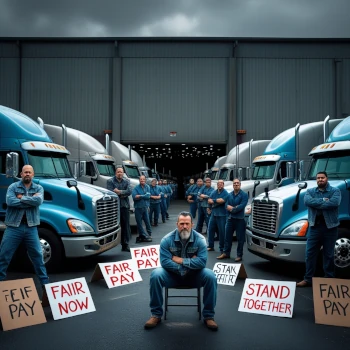
This article is about the right to strike in Germany. I would like to dispel the rumors circulating here in this country on this topic.
Can truck drivers strike?
I could keep it short again, but that wouldn’t provide an explanation for the short answer.
Let’s first look at the law and what it says about striking:
(3) The right to form associations for the protection and improvement of working and economic conditions is guaranteed to everyone and for all professions. Agreements that seek to restrict or hinder this right are void, and measures directed against them are unlawful. Measures under Articles 12a, 35(2) and (3), 87a(4), and 91 may not be directed against labor disputes conducted by associations within the meaning of the first sentence for the protection and improvement of working and economic conditions.
Source: Article 9(3) Basic Law
But what does that mean now?
Fundamental right to freedom of association in labor and economic matters All people – in every profession – have the fundamental right to join together in trade unions, professional associations, or similar organizations to represent their working conditions and economic interests.
Example: Workers may found a trade union to demand better wages or working hours.
In short:
- Everyone may organize professionally to achieve better working conditions.
- No one may be prevented from doing so – not even by contracts or employers.
- The state may not undermine this right through coercive means – even in exceptional situations.
All agreements or measures that seek to restrict or prevent this right are:
Void (i.e., invalid from the outset),
and even unlawful (i.e., prohibited).
Example: An employment contract stating “You may not join a trade union” is void and prohibited.
Should I continue? Gladly.
Which professional groups are not allowed to strike
The question of whether there are professional groups that are not allowed to strike, I actually don’t need to ask. However, they exist, and truck drivers do not belong to them.
Strike ban in Germany
In Germany, a general strike ban applies to civil servants. This ban is an independent, established principle of the civil service according to Article 33(5) of the Basic Law and has been confirmed multiple times by the Federal Constitutional Court. The strike ban serves to ensure the functionality of the state and affects all groups of civil servants – regardless of whether they perform sovereign tasks or not [1] [2] [3] .
The Federal Constitutional Court ruled in 2018 that the strike ban for female and male civil servants is constitutional. It also aligns with the European Convention on Human Rights. The European Court of Human Rights (ECtHR) also confirmed the strike ban for German civil servants in December 2023 and ruled that it is permissible [3] [4] [5] .
Civil servants do have the right to organize in trade unions, but they may not engage in collective labor disputes such as strikes to protect their interests [2] [3] . The strike ban is thus a central element of the special service and loyalty relationship between civil servants and the state [1] [3] .
Here again
| Professional Group | Right to Strike |
|---|---|
| Civil Servants (general) | No right to strike |
| Soldiers | No right to strike |
| Judges | No right to strike |
| Police Officers | No right to strike |
| Tenured Teachers | No right to strike |
| Non-Tenured Teachers | Right to strike |
| Church Employees | Restricted |
| Employees (general) | Right to strike |
What about truck drivers then
Truck drivers naturally fall under this right to strike. However, this right is often equated with the prohibition of blockades.
Statements such as Wer als LKW Fahrer streikt, verliert seinen Führerschein. Die Grundversorgung in Deutschland muss gewährleistet sein. are equally false.
Truck drivers have the same right to strike as any other employee.
And of course, there are rules in Germany regarding when and how one may strike. And yes, you lose your driver’s license in Germany if you violate the Road Traffic Regulations or other laws that justify revoking your driving permit. However, participation in a legal strike does not count towards this!
Legal prerequisites for a lawful strike in Germany
For a strike to be lawful in Germany, the following legal prerequisites must be met:
Union-called Strike:
The strike must be organized and supported by a competent trade union. Work stoppages not called by a trade union (“wildcat strikes”) are impermissible and prohibited [6] [7] [8] [11] .Collectively Bargainable Objective:
The objective of the strike must be directed at a collective agreement, i.e., working conditions that can be regulated collectively (e.g., wages, working hours, vacation). Political strikes targeting the legislature or government are not permitted in Germany [6] [7] [8] [11] [13] .No Peace Obligation:
During the term of a collective agreement (peace clause), no strike may be conducted. A strike is only permissible after the expiration or termination of the collective agreement [7] [8] [11] .Proportionality:
The strike must be proportional, meaning the means of striking may not be disproportionate to the intended goal. Strikes are a last resort (“ultima ratio”) after negotiations and, if applicable, conciliation procedures have failed [8] [13] .No violation of the legal order:
The strike must not violate existing laws or established conciliation agreements [7] [11] .
What is not listed here: To also be protected against potential lawsuits by the employer, one should already be a member of a trade union. As a non-member, it is not quite so good.
Why should one better be a member of a trade union when striking?
Strike pay as financial security:
During a strike, the employer does not pay wages. Trade union members receive strike pay from their union, which at least partially offsets the loss of earnings. Non-members receive no strike pay and must bear the loss of wages themselves.Legal protection and advice:
Unions offer their members free legal advice and legal protection, for example in labour law disputes related to the strike. Non-members have no claim to this.Strong negotiating position:
A high level of trade union membership increases enforcement power in collective bargaining and strikes. The more employees are organized, the greater the pressure on the employer side.Protection against labour law disadvantages:
Those participating in a lawful strike organized by the union are protected from labour law consequences such as warnings or dismissal. This protection also applies to non-members, but in case of disputes, members benefit from union legal protection [19] .Additional benefits:
Members also benefit from better collective agreements, free training courses, support in disputes with the employer, and further services.
Conclusion:
Membership in a trade union offers financial, legal, and collective advantages in the event of a strike that are denied to non-members.
In conclusion
I am quite aware that I cannot refute false statements with this contribution. I am also aware that I cannot convince people with this text to become members of the trade union.
For, in the minds of many, there still exists the belief in an equally false statement Die machen ja nichts für uns firmly held.
That this is not true can be repeated often enough, yet it will not get out of their heads.
References
- staatklar.org: Why are civil servants not allowed to strike?
- dbb.de: Strike rights and civil servants
- bundesverfassungsgericht.de: Ban on strikes for civil servants is constitutional
- haufe.de: Civil servant teachers are not allowed to strike
- gew.de: The most important questions and answers on civil servant strike law
- hensche.de: Strike and strike law
- haufe.de: Strike – Rules for a lawful labour dispute
- dgb.de: Strike – What rights do you have as an employee?
- rechtsanwalt-menaker.de: The strike – Rights and obligations for employees
- bundestag.de: Limits of strike rights (PDF)
- arbeitsrechte.de: Strike law – What is allowed?
- arbeitsrecht.de: Strike law in Germany
- bundestag.de: Limits of strike rights (PDF)
- gew-leer.de: Must one be a trade union member to strike? `
