

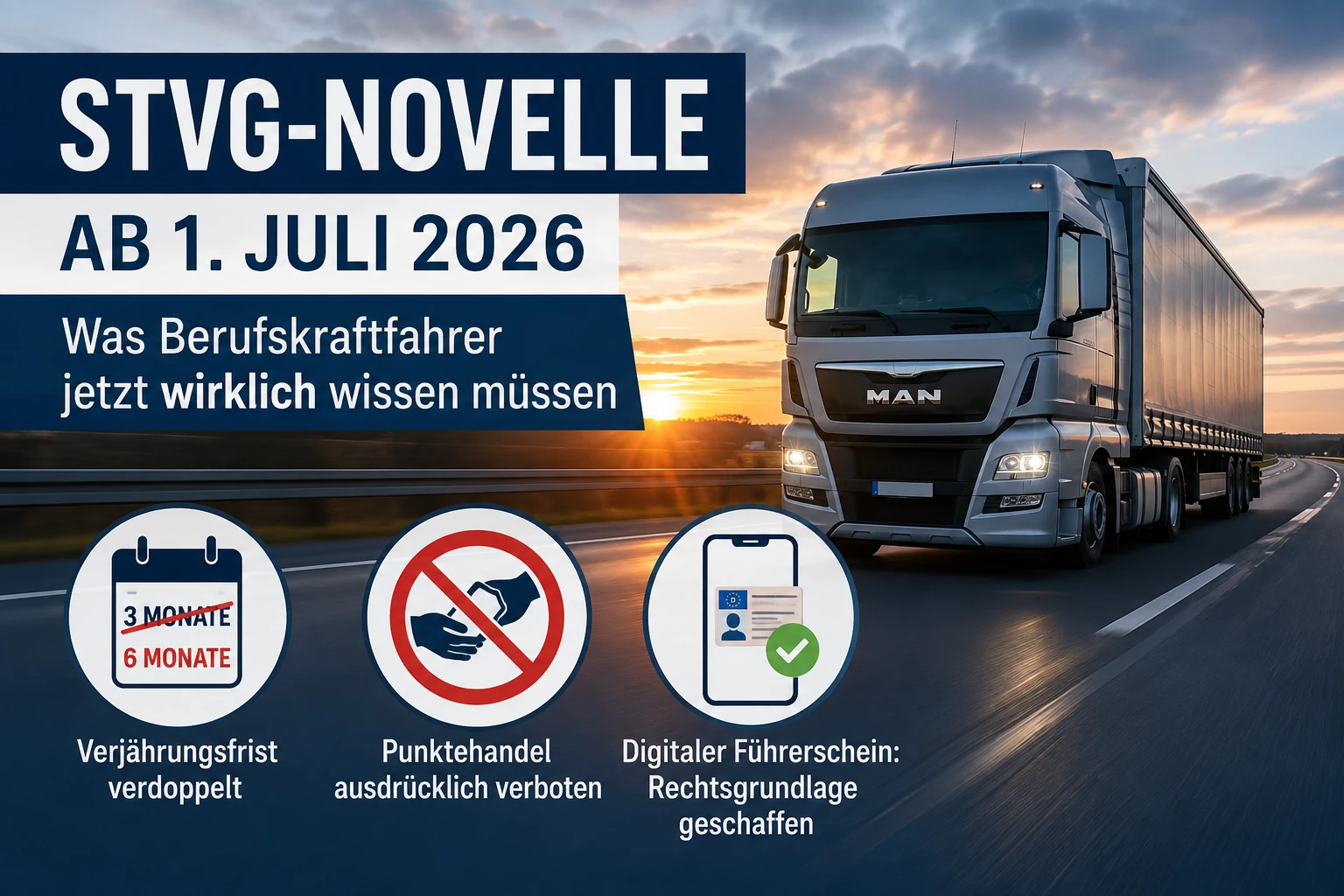
StVG-Novelle ab July 2026: What Professional Drivers Need to Know Now
As of July 1, 2026, a change to the Road Traffic Act (StVG) will come into effect. Those who follow the headlines of the industry might think that this means everything will suddenly change for professional drivers. Talks of stricter rules, new penalties, and digital driver’s licenses are in the news.
But as often is the case, a closer look behind the headlines is worthwhile. Because not every change will affect the daily life behind the wheel equally – some are more about legal fine-tuning, while others could indeed be relevant for drivers and transport companies.
I have looked at the changes and placed them in context, explaining what they actually mean for professional drivers.
Fines: Traffic violations can now be pursued for longer
The most important change for professional traffic concerns the statute of limitations for traffic offenses.
Until now, a period of three months applied to many traffic violations, provided no fine notice was issued within that time. From July 1, 2026, this period will be extended to six months.
At first glance, this seems unremarkable, but it can have real effects in the daily lives of truck drivers.
In long-distance transport, there are often weeks or even months between a violation and the administrative processing. Added to this are driver changes, international operations, or complex company structures. Authorities will now have significantly more time to conclude procedures.
This applies to the following:
- Speeding violations
- Following distance violations
- Using a mobile phone while driving
- Running a red light
- Stopping and parking violations
- general traffic offenses
For professional drivers, this means one thing above all: The hope of “statute of limitations” will become much less likely in the future.
Those traveling abroad or working with changing vehicles should also consider that companies must maintain clean driver documentation. Because if a procedure comes up months later, it must still be possible to trace who actually drove the vehicle.
Point trading is now explicitly prohibited
Another point of the reform is the ban on so-called point trading.
This refers to cases where a person claims to have driven a vehicle for money or as a favor, to keep points in Flensburg or to avoid a driving ban for the actual driver.
Although authorities could already act against such practices, legally some cases remained in a gray area. This gray area is now closed.
In the future, severe sanctions can be expected. Anyone who deliberately provides false information or organizes such models must expect heavy fines.
For most professional drivers, this is likely to remain a marginal note. In regular professional work, so-called point trading plays hardly any role.
Anders sieht es in larger fleets or internationally active companies. There, where vehicles frequently change or violations must be assigned to multiple people, the topic of compliance is likely to gain in importance in the future.
Digital Driver’s License: More Legal Basis than Practice Change
Currently, there are particularly large headlines around the digital driver’s license.
In fact, the legislative change creates a legal basis for this. However, this does not mean that professional truck drivers will suddenly only need to show their smartphone starting in July.
On the contrary: the classic paper driver’s license remains the standard for now.
The new regulation mainly creates the conditions for future digital solutions. When these will be available nationwide, how they will be controlled, and whether they will be recognized in international freight transport, is still unclear.
Especially in cross-border traffic, the physical driver’s license is likely to remain an important role for a long time.
For professional truck drivers, this means: No panic – the paper driver’s license will not disappear overnight.
What does the reform mean for truck drivers now?
In short, the StVG amendment is far less spectacular than some headlines suggest.
The most important practical change, in my view, is the extended statute of limitations for traffic violations. Here, drivers and companies will actually notice the effects.
The ban on point trading mainly concerns abuse cases and larger fleet structures. The digital driver’s license, on the other hand, is more of a future topic than an immediate change in daily driving life.
In short:
For professional truck drivers, less will change starting in July 2026 than many headlines suggest – but some details should still be kept in mind.
Sources
German Bundestag – Changes in the Road Traffic Act (StVG) https://www.bundestag.de
ADAC – Changes for drivers in 2026 https://www.adac.de
ADAC – Statute of limitations for fines and traffic offenses https://www.adac.de
trans.info – Report on the StVG amendment 2026 https://trans.info/deutschland-verscharft-regeln-ab-juli-fur-lkw-fahrer-483822/