

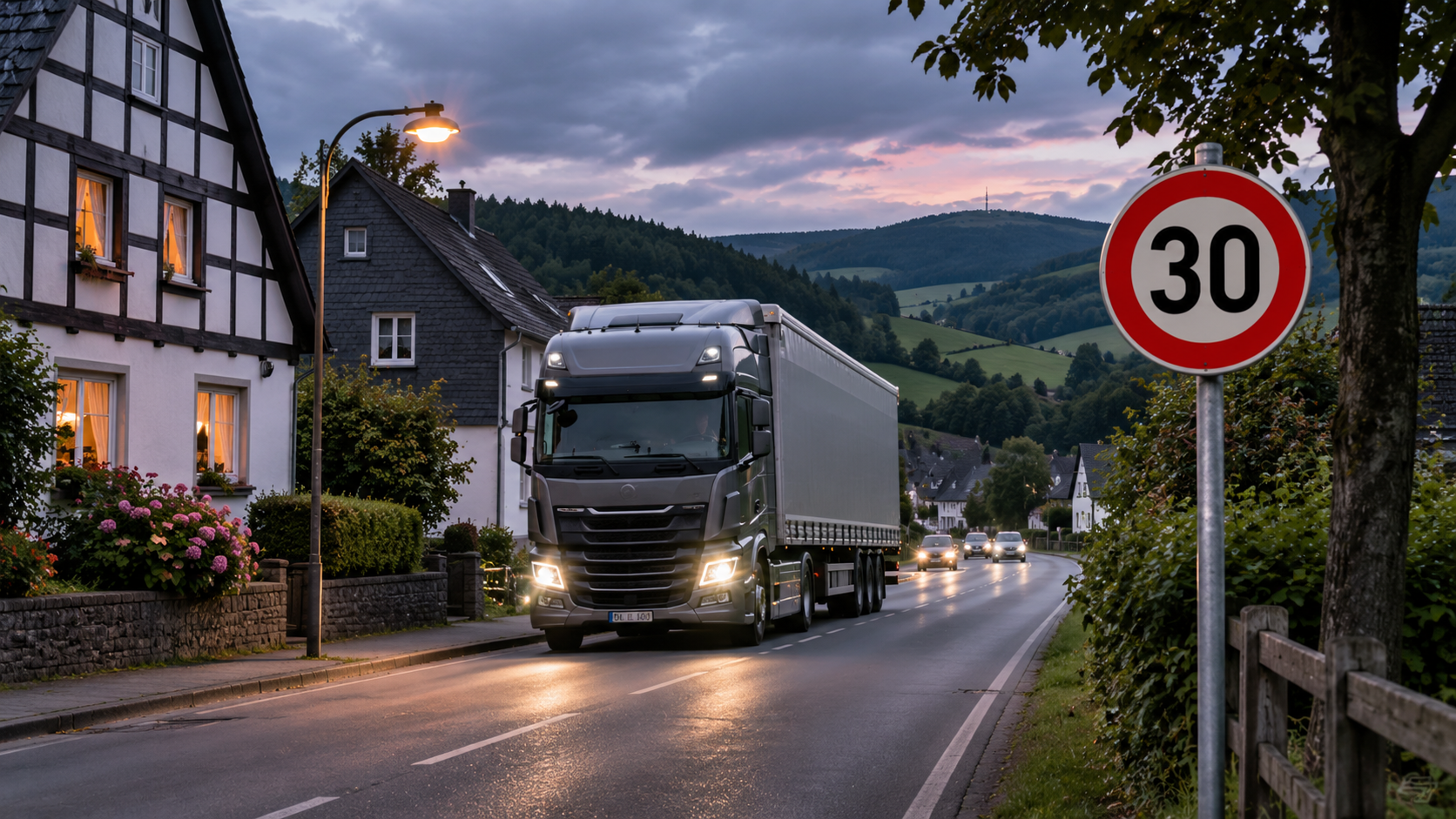
In March 2025 I already addressed the new 30 km/h speed limits in Hochsauerlandkreis. A year and a half later, the situation shows: while some municipalities are introducing further speed restrictions, they are being lifted again elsewhere. At the same time, the Sauerland Mobility Association is calling for a nighttime driving ban for through-traffic trucks. Time for a review.
Tempo 30: Lots of activity in Sauerland
When I published my first article on Tempo 30 and noise protection in March 2025, Antfeld, Niedersfeld, and Züschen were the main focus.
Since then, more locations have been added. Especially along the B7, B480, and B236, residents have campaigned for speed limits. Other major roads in Sauerland are also involved.
The arguments are understandable. Anyone living directly next to a heavily trafficked federal highway does not want to have to endure engine noise, tire noise, and vibrations around the clock.
However, the question remains whether erecting a Tempo 30 sign is actually sufficient to significantly reduce these burdens.
The developments of 2026 show at least that the answers are not the same everywhere.
Where Tempo 30 has been introduced
Several corresponding regulations can now be identified in Hochsauerlandkreis.
Olsberg-Antfeld: Since early 2025, a speed limit of 30 km/h applies on the local section of the B7. The measure was introduced based on the local noise protection plan.
Winterberg-Niedersfeld and Züschen: Both towns have speed restrictions on their main roads. In Züschen, a full-day Tempo 30 regulation was additionally ordered in January 2026 in the area of a pedestrian crossing and important bus stops.
Winterberg-Siedlinghausen: Also since January 2026, there is a corresponding order in the area between the church and the Sparkasse bank. Here, the safety of pedestrians and schoolchildren is particularly in focus.
Olsberg-Assinghausen and Wiemeringhausen as well as Hallenberg: According to the Sauerland Mobility Association, Tempo 30 regulations were also introduced there. However, the exact route sections and periods of validity are not fully visible from the evaluated publications.
Meschede-Olpe: On June 10, 2026, the city of Meschede announced Tempo 30 for Freienohler and Berger Straße. This was preceded by noise calculations and consultations with the police and Straßen.NRW. In the 2021 traffic count, 9,132 vehicles were recorded daily there, including 12.4 percent heavy goods vehicles. Whether the announced signage has been fully implemented can no longer be conclusively confirmed based on the published notice.
Particularly interesting is the justification given by the city of Meschede: a speed restriction exclusively for trucks would not sufficiently reduce noise in their view. Different speed limits for cars and trucks could also encourage dangerous overtaking maneuvers.
This shows how complex such decisions actually are.
Sundern steers back
The political debate becomes particularly clear in Sundern.
Full-day Tempo 30 restrictions were introduced on several main roads there in November 2025, based on the city’s noise action plan.
The reactions were by no means exclusively positive.
In an online survey in May 2026, 2,568 people participated. Many participants criticized extended travel times, worse traffic flow, and restrictions for commuters.
According to WDR reports, 87 percent of respondents reported extended travel times.
However, one must look closely at this.
The survey was not representative. Only about 13 percent of participants lived directly next to the affected roads. Furthermore, multiple participation could not be reliably excluded.
Interesting is also the difference between subjective perception and calculated travel time: while a citizen reported up to 15 minutes of additional travel time, the city administration calculated only 53 seconds on the relevant route. For the journey over all reduced route sections, they estimated around 3.2 minutes additionally.
These are calculations, not actually measured travel times under all traffic conditions.
On October 15, 2026, the Sundern city council finally drew conclusions.
In future, Tempo 30 shall apply only at night in several areas:
- Hachen, Hachener Straße and L519: 22 to 6 o’clock.
- Sundern, Hauptstraße and Silmecke: 22 to 6 o’clock.
- Stemel: 22 to 8 o’clock, on a shortened route section.
- Seidfeld: for now still full-day Tempo 30, especially due to the poor road surface condition.
When the new regulations would be fully implemented through corresponding signage was still open at the time of the announcement of the resolution.
Remarkable is also the previous criticism from Straßen.NRW. The authority had expressed doubts about the legal certainty of the original speed restrictions because the noise calculations used did not correspond to the procedure it considered relevant.
Thus, Sundern shows that a noise action plan alone does not justify every traffic law order.
Tempo 30 was also lifted again in Hagen
Another example can be found in the Sundern district of Hagen.
On the L687, the speed limit of 30 km/h was lifted again in spring 2026.
It had originally been introduced in connection with the closure of the Rahmedetalbrücke on the A45. The diversion routes had additionally burdened the local section.
After the bridge’s reopening in December 2025, investigations revealed a reduction in overall traffic of approximately 15 percent. Heavy goods vehicle traffic decreased by even around 30 percent.
Furthermore, the road surface was renewed in autumn 2025.
For the town of Sundern, this meant that the original reasons for the speed reduction had been eliminated.
This example is particularly instructive: a genuinely relieved traffic route and a renewed road surface can lead to the conclusion that a previously ordered speed limit is no longer necessary.
However, it cannot be quantified from this how large the specific contribution of the road resurfacing was to noise reduction.
Hellefeld: No blanket 30 km/h speed limit
In September 2026, politics in Sundern also decided against a continuous 30 km/h speed restriction in Hellefeld.
A traffic survey recorded 6,206 vehicle passages. The average speed was 34.5 km/h, with a median of 36 km/h. 85 percent of the recorded vehicles drove at most 42 km/h.
The responsible committee decided against the blanket speed restriction and instead opted for targeted improvements to traffic safety.
These include measures on school routes and a review of signage for heavy goods vehicles.
However, neither noise nor exhaust values were measured during this traffic survey. Therefore, no conclusive statement about the actual noise exposure can be derived from the speed data alone.
What does 30 km/h actually achieve against traffic noise?
According to the Federal Environment Agency, reducing speed from 50 to 30 km/h can reduce road traffic noise by approximately two to three decibels.
This is far from insignificant. Traffic noise is a serious health issue, particularly in the case of prolonged nighttime exposure.
However, the actual effect depends on several factors.
Decisive are not only the driving speed, but also the condition of the road surface, the volume of traffic, the proportion of heavy goods vehicles, and the operating conditions of the vehicles.
For a passenger car, the reduction in speed can be clearly perceived.
For a heavy truck, the situation can look different in part.
In particular, in the Sauerland region, there are numerous town passages with significant gradients and downhill stretches.
Driving uphill with a loaded semi-trailer or articulated lorry may require selecting a lower gear at 30 km/h. The engine speed can thereby increase.
Going downhill, vehicles must be controlled to brake. Depending on the vehicle, gradient, and speed, engine brakes or retarders are used. Their noises can also play a role.
This does not mean that 30 km/h is fundamentally noisier for trucks than 50 km/h. Such a blanket statement would be just as wrong as the claim that 30 km/h reduces noise equally in every situation.
One must examine the respective route.
On a flat, well-developed road, different results can arise compared to a steep town passage with a damaged road surface.
Precisely for this reason, I consider blanket speed restrictions without consideration of local conditions to be problematic.
The condition of roads is frequently underestimated
As early as my first article, I criticized the condition of the town passage in Züschen.
Potholes, damaged road edges, sunken manhole covers, and numerous repair sites not only cause unpleasant driving noises.
Especially for heavy vehicles, road surface irregularities can cause additional vibrations and noise peaks.
That there is a need for action here is now even admitted by the Sauerland Mobility Association (MoVe). At a meeting with District Administrator Thomas Grosche on May 11, 2026, the renovation-required town passage in Züschen was explicitly discussed.
The urgently needed renovation was repeatedly postponed, lamented the association in its subsequently published report.
Here I see a point where residents and professional drivers share the same interests.
A sensible road surface improves driving comfort and can reduce noise. It benefits residents as well as people who travel on these roads daily.
The Sauerland Mobility Association and its demands
The Sauerland Mobility Association, short MoVe, advocates for traffic-calming measures along the B7, B480, and B236.
The association demands, among other things:
- 30 km/h speed limits in towns.
- Two stationary speed cameras per town.
- Renovation of intra-town road surfaces.
- A night driving ban for through traffic by heavy goods vehicles.
- The continuation of the B7n and a stronger diversion of heavy goods traffic onto motorways.
I consider some demands to be quite understandable.
In particular, regarding road renovation and sensible bypasses, there is fundamentally a shared interest.
It becomes more difficult with the demanded night driving ban for heavy goods traffic.
Night driving ban for trucks: Where should the traffic go?
According to the association’s ideas, through traffic by heavy goods vehicles between 22:00 and 6:00 should be kept out of the affected towns.
Trips starting or ending in the affected towns should remain permitted.
This exception is important. However, it does not solve all problems.
For the decisive question remains: Where are those trucks supposed to drive that are no longer allowed to use the federal highways at night?
A federal highway is not intended exclusively for the supply of the municipalities through which it runs; it also fulfills a supra-regional connecting function.
Of course, it can be sensible to shift traffic onto motorways if suitable alternatives exist.
However, it must be examined whether these routes are actually available and what additional burdens they entail.
A driving ban ultimately does not eliminate freight traffic.
The goods still need to be transported.
If a previously used connection is blocked, longer journeys may result. The burden might shift to other municipalities.
Whether this would be the case in the specific instance can only be answered through a reliable investigation of traffic flows.
Similarly, it has not yet been publicly verifiable how the association assessed the impact on travel times, vehicle kilometers, and other affected municipalities.
The planned exception for destination and origin traffic is particularly in need of explanation.
How far should the area extend within which starting or ending at a location permits through traffic? Is a loading or unloading point in Winterberg sufficient? What about an operation in a neighboring town? What evidence should be required during an inspection?
And why should a night-time drive through the same municipality be considered less burdensome if the vehicle belongs to a local business?
For residents, the noise pollution is initially the same.
An exception for the regional economy may be politically understandable. However, from the perspective of noise protection, it must also be justified.
543 Signatures are a political signal, but not a traffic study
On May 11, 2026, the association handed over 543 signatures to District Administrator Thomas Grosche, according to their own statement.
This shows that people along the affected roads are concerned with the traffic situation and desire changes.
However, collecting signatures does neither replace a representative survey nor a professional traffic study.
It says nothing in particular about how many of the signatories support all demands in detail or what effects a night driving ban would actually have.
In July 2026, the association also reported that the demand for a night driving ban had been concretized during the conversation with the District Administrator. Destination and origin traffic should be exempted.
I could not find a publicly documented final decision by the Hochsauerland district on such a night driving ban so far.
Our inquiry from October 23
On October 23, 2026, I contacted both the Mobility Association Sauerland and the Hochsauerland district.
The background was primarily the demands for a night driving ban and the associated questions regarding practical implementation.
It was not about questioning the legitimate desire for less noise.
Rather, I wanted to know on what data basis the demands are based, which alternative routes are planned, and what consequences for cross-regional freight traffic could be expected.
As of November 4, 2026, I have received no response from either side.
The processing time with the Hochsauerland district is still relatively short so far. Therefore, a final assessment would be premature.
If responses are received, I will consider them in a further contribution.
Nighttime noise protection: And what about garbage collection?
Another point often overlooked in the discussion about nighttime traffic noise is garbage collection.
In Sauerland as well, it regularly happens that garbage collection vehicles are on the road before 6 am and empty waste containers. This creates a significant noise environment. To operate the hydraulic tipping mechanism, the engine speed of many vehicles is increased. In addition come the rattling and banging of the bins, the sound of falling waste, and the subsequent compaction in the vehicle.
How loud the emptying turns out also depends on what is currently being disposed of. While bio-waste or paper often fall relatively quietly into the collection container, residual waste can cause significant noise peaks, for example with glass bottles, canned goods, and other hard objects.
However, in a residential street, there is not just a single garbage bin. The vehicle stops every few meters, several containers are lifted one after another, emptied, and set down again. With each subsequent stop, the process repeats.
What might take only a few seconds for a single bin can accumulate over the entire street into a minute-long noise exposure. Especially before 6 am, when ambient noises are still relatively low, these recurring noise peaks stand out particularly.
This raises a legitimate question: Why is a night driving ban for heavy goods vehicle through traffic between 22 and 6 o’clock being discussed, while other noisy activities take place partially already before 6 o’clock?
What does the legislator say?
Here it is worthwhile to look at the applicable regulations.
According to § 9 Paragraph 1 of the North Rhine-Westphalia State Emission Protection Act (LImschG NRW), activities that are suitable for disturbing nighttime rest are generally prohibited between 22 and 6 o’clock.
The 32nd Federal Emission Control Ordinance (32. BImSchV) becomes even more specific.
Its § 7 Paragraph 1 Number 1 prohibits the operation of the devices and machines listed in the annex on weekdays between 20 and 7 o’clock in certain residential areas. Garbage collection vehicles are explicitly included under Number 47 of the annex.
This means: In the residential areas covered by the ordinance, garbage collection is generally only permissible from 7 o’clock onwards.
However, there are exceptions. According to § 7 Paragraph 2 of the 32. BImSchV, the competent authority can approve earlier operation in individual cases. This can be considered, for example, due to special operational circumstances or a public interest. Whether the legal prerequisites for this actually exist must be examined by the authority.
The North Rhine-Westphalia Emission Protection Act also provides for exceptions to the night quiet period under certain conditions.
Therefore, emptying trash bins before 6 a.m. is not automatically unlawful. What matters are the location of the site, the applicable regulations, and possible administrative exception permits.
We also interviewed the Hochsauerlandkreis on this matter
In our inquiry dated October 23, 2026, to the Hochsauerlandkreis, we already addressed early morning garbage collection.
We are particularly interested in which legal basis allows waste collection vehicles to empty waste containers in affected residential areas as early as before 6 a.m., and whether corresponding exception permits exist for this purpose.
As of November 4, 2026, we have not yet received a response.
Of course, garbage collection must function; waste does not simply disappear on its own. And no one seriously demands that waste disposal be stopped.
However, the same applies in a figurative sense to freight transport: supermarkets must be supplied, production facilities provided with goods, and merchandise transported.
Nevertheless, it should be permissible to question whether early morning waste collection is truly necessary in noise-sensitive residential areas or whether routes can be organized differently.
Anyone demanding night noise protection should consider all relevant noise sources and not focus exclusively on through-traffic heavy vehicles.
Because the resident woken up at 5:30 a.m. by a loud trash bin emptying would hardly be comforted by the fact that regional truck traffic in their town may be subject to a night driving ban.
Legal Basis
- § 7 of the 32nd BImSchV – Operation in Residential Areas
- Appendix of the 32nd BImSchV – Waste Collection Vehicles under Number 47
- § 9 North Rhine-Westphalia Emission Protection Act – Protection of Night Quiet
Noise protection must not end at the town sign
Neither a blanket speed limit of 30 km/h nor a blanket truck driving ban can solve all traffic problems in the Sauerland region.
Anyone who wants to reduce traffic noise in the long term must address the actual causes.
These include, in particular, traffic flows, the capacity of existing roads, and their structural condition.
The reconstruction of the Rahmedetal Bridge has shown how a functioning highway connection can affect surrounding federal highways.
Just as clearly, the discussions in Sundern demonstrate that speed restrictions must be carefully justified, reviewed, and adjusted when circumstances change.
Traffic safety must not be compromised. Lower speeds can be sensible and necessary, especially at schools, bus stops, and pedestrian crossings.
It is not about driving through towns as quickly as possible.
It is about finding measures that actually bring about improvement.
As a professional driver, I know that trucks cause noise. But I also know that vehicles, routes, and traffic conditions differ significantly.
Therefore, I consider it the wrong path to generally label heavy goods transport as the problem without simultaneously presenting realistic solutions for its operation.
A 30 km/h sign can be erected quickly. Repairing a damaged road, directing traffic flows sensibly, and creating functioning infrastructure is considerably more complex.
That is where genuine noise protection begins for me.
Sources and Further Information
- ChristiansBlog.eu: Noise Protection – 30 Zones in Towns, March 22, 2025
- Federal Environment Agency: Road Traffic Noise
- City of Sundern: Participation in the Noise Action Plan 2026
- WDR: Poll on Speed Limit 30 in Sundern, June 10, 2026
- Radio Sauerland: Sundern Limits Speed Limit 30, October 16, 2026
- City of Meschede: Speed Limit 30 in Olpe, June 10, 2026
- Radio Sauerland: Hellefeld Waives Continuous Speed Limit 30, September 11, 2026
- Mobility Association Sauerland: Our Demands
- Mobility Association Sauerland: Report on Meeting with the District Administrator, July 12, 2026
