

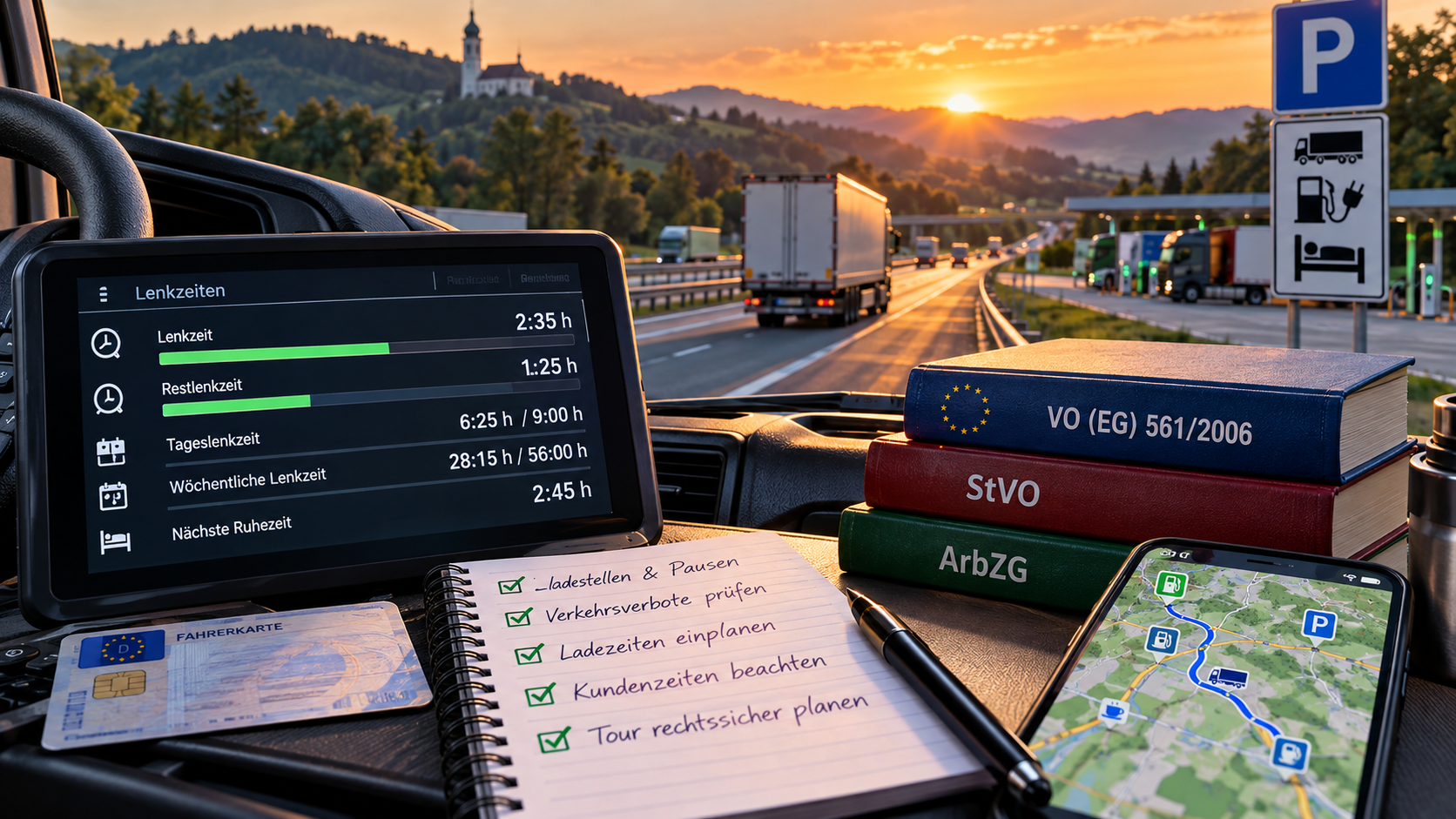
What to do when a tour after planning seems unlikely to fit within the legal time limits? The answer must not be to drive faster, to skip breaks, or to manipulate the speedometer. Then the planning must be reviewed.
In an earlier article from 2017, I drew premature conclusions about a specific company based on observations on the Autobahn and from the services offered by a workshop. These were not reliable. A single traffic situation does not prove manipulation—and a workshop that checks or calibrates speedometers in accordance with § 57b StVZO is, taken alone, no ground for suspicion. Such inspections are provided for by law and can only be carried out by authorized persons.
The fundamental question remains important: What can drivers do when a schedule seems to require only one rule violation?
First, calculate, then continue driving
For vehicles and journeys within the scope of Regulation (EC) No 561/2006, fixed limits apply. The maximum driving time per day is generally nine hours. This may be extended to ten hours twice a week. A maximum of 56 hours per week is allowed, and within two consecutive weeks, a maximum of 90 hours in total. After no more than four and a half hours of driving time, a break of at least forty-five minutes is required.
These rules are not target values that must be “pushed” during a tight tour. In addition to traffic jams, waiting times, roadworks, weather conditions, parking searches, and actual work processes can alter the planned time requirement. A scheduled stop in the navigation device does not override the legal limits.
Responsibility lies not only with the driver
The driver must observe the applicable driving and rest time rules and record their activities correctly. At the same time, Article 10 of Regulation also obliges the transport operator: it must organize work so that drivers can comply with the regulations, instruct them properly, and regularly verify compliance.
Compensation models must not lead to a situation where safety is endangered or violations are encouraged. The Driver’s Law prohibits certain payments based on distance or cargo volume if they could impair traffic safety. Thus, not every performance-based payment is automatically prohibited; what matters is the design and effect.
A tight time requirement does not make a rule violation unavoidable or permissible. It is an occasion to reorganize the tour and report the actual situation.
Manipulation is not a solution
Falsifying, concealing, or deleting speedometer data is prohibited. Likewise, manipulating the speedometer, the driver’s card, or charts in such a way that records can be falsified, suppressed, or destroyed is prohibited. Companies must train drivers on correct use of the device, monitor its usage, and cannot set up direct or indirect incentives for misused use.
A legal inspection or calibration in accordance with § 57b StVZO is clearly distinguished from this. It involves checking installation, condition, measurement accuracy, and working method of the device. This is routine vehicle engineering and not evidence that a business manipulates tachographs.
Accusations of manipulation should therefore not be derived from speculation, nationality, vehicle make, or a supposedly high speed. If there are concrete indications, these should be reported to a competent authority—not in public accusations against a specific company without reliable evidence.
What drivers can do concretely under time pressure
- Check remaining driving time. This includes hours already driven during the day and week, as well as driving time from the previous week.
- Report deviations early. If it becomes clear that a delivery date cannot be met with the regulations, the disposition should be informed promptly.
- Request a new plan. This may include a later time window, another unloading point, a driver change, or a safe break.
- Record instructions and actual processes. Messages, waiting times, and changes to the tour can later help reconstruct the situation.
- Use the speedometer correctly. Activities must not be recorded incorrectly or retroactively changed in a way that conceals violations.
- Stop safely before crossing a limit. Further driving should only continue after a legally sound and safe plan has been made.
- If there is no other option and the disposition shows no insight: say NO and insist. No driver is obligated to violate legal driving and rest time rules just so a tour can be carried out as planned. Refusing to carry out a legally unlawful instruction is not considered negligent. A termination solely for this legitimate refusal would, in principle, be legally attackable. What is important is to document the situation and inform the disposition promptly why the tour cannot be carried out as planned.
A factual message to the disposition could, for example, read: “With the remaining driving time and current delays, I can no longer reach the delivery point conformly with the regulations. I will park at a suitable safe location. Please reorganize the tour.” It is important to accurately report actual times and circumstances.
If pressure recurs or a specific instruction to violate rules is given, trade unions, labor unions, or an employment legal advisory office can help in subsequent steps. In case of immediate danger on the road, safety takes precedence.
A tight tour is not proof
A late truck or a tight schedule alone are not enough to prove a violation of the law or manipulation. On the other hand, no one should simply make up for an obviously unachievable plan at the expense of their own safety and that of other road users.
To drive professionally means also to call out limits in time, record them correctly, and demand a safe solution. If the tour were only possible through rule violations, the planning would have to be changed.
Legal status: 8 October 2026. Which specific regulations apply depends, among other things, on the vehicle and the particular journey. This article provides general orientation and does not replace individual legal advice.
Still Relevant Today
Even today there are freight forwarders whose dispatch apparently did not understand that it cannot work in the long run if tours are constantly “struck with the hot needle.” This may have worked for weeks, months, or perhaps even years. But eventually comes the point where the calculation no longer adds up.
And even if something goes wrong, the tour planning is not necessarily questioned. Instead, things continue as before. The responsibility then quickly falls on the driver, even if he had hardly any chance to avoid the situation.
How problematic such situations can be is shown by an example from a freight forwarder in this region.
Several drivers of this company have independently reported that tour planning in long-distance transport should generally proceed in such a way that regular planning is made up to the time limits. It is not about individual tours where the dispatch may have been mistaken at some point, but rather about an apparently systematic approach.
According to the reports of these drivers, it comes about that after a shift of up to 15 hours they can only finally begin to search for a suitable truck parking spot for their daily rest period.
And precisely this is the decisive point. If the entire tour planning is designed to make full use of available times without sufficient reserves for traffic jams, waiting periods or searching for parking spots, then it is no longer about occasional planning problems.
Then the question arises whether compliance with legal driving and rest times in such a type of tour planning is actually realistic.
One must imagine this once more. Someone has already had a long working day behind him, is therefore exhausted and has to watch where his truck can be parked at all. That such things do not contribute to traffic safety should be clear to everyone.
What makes me especially thoughtful is another circumstance: In this freight forwarder, a driver has already caused two accidents by hitting oncoming vehicles, in each case he was driven onto the front of a vehicle. Fortunately, he remained uninjured according to the information I have available, but was nevertheless fired from the company due to the accidents. As can be seen here, it is not the dispatch that is the problem, but the driver who apparently does not stand up to the pressure permanently.
Whether the work load or the tour planning actually played a role in these accidents cannot be assessed. For this one would need to know the respective accident circumstances. Simply asserting such a connection would be unserious.
What I can assess are the conditions that several drivers from this company have described to me. And if these reports are true, then there is a fundamental problem with tour planning there.
For a 15-hour working day is not a requirement that one must make full use of as much as possible. And certainly not should a tour be planned in such a way that the driver can only search for a parking spot after the end of his available time.
Whoever calculates tours so tightly that no reasonable time reserves are left, at least accepts that his drivers regularly fall under considerable pressure.
And precisely for this reason it is not enough to show the driver solely after an incident. One must also look at under what conditions he had to carry out his work and what demands were made upon him.
