

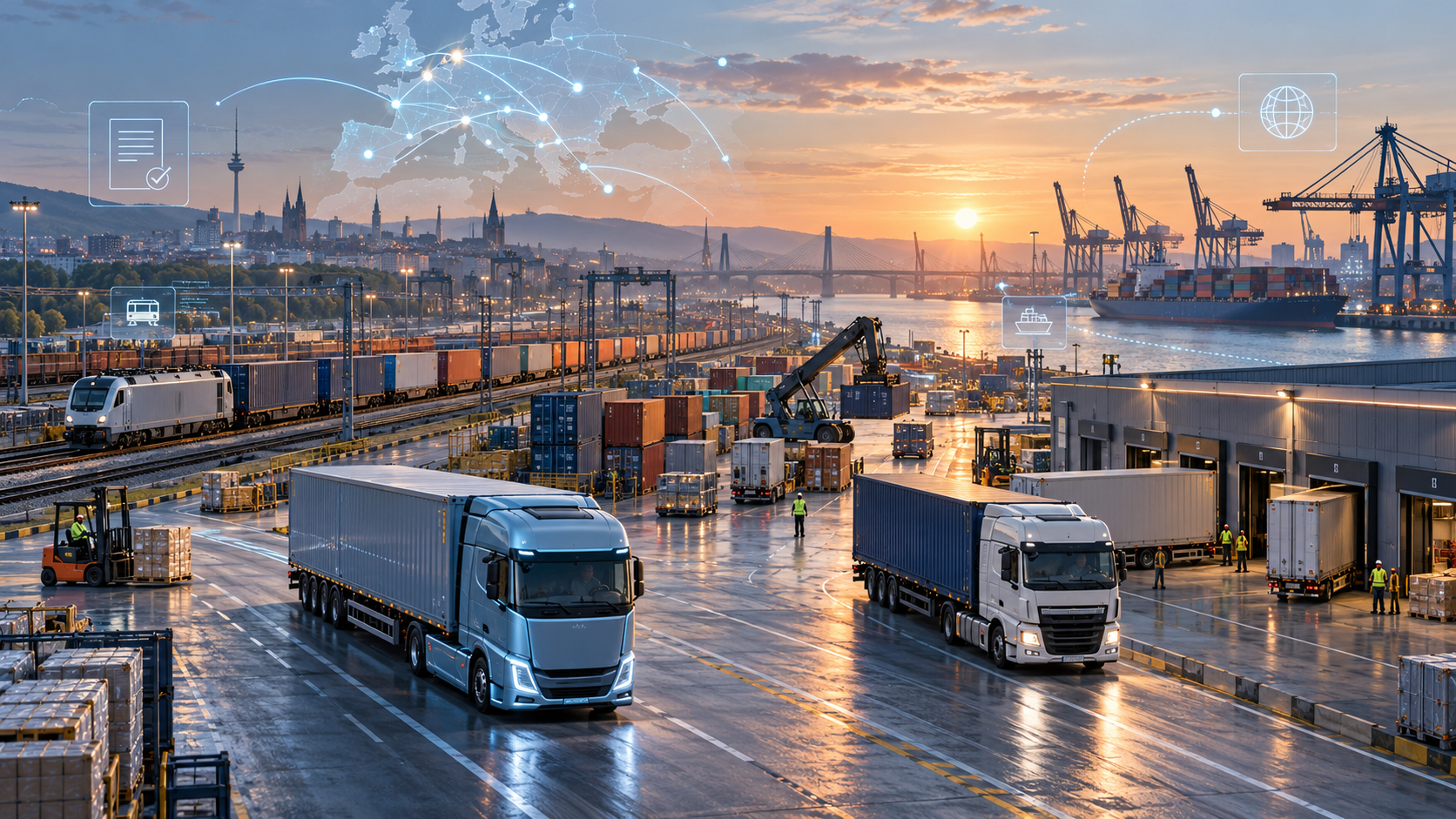
Hellmann acquires a consolidated cargo business, DHL invests hundreds of millions of euros in Eastern Europe, Rhenus develops new trade routes between Asia and Europe, and Spain digitizes its transport documents. At the same time, logistics corporations are investing in electric trucks. What initially appears to be a series of independent corporate announcements reveals, upon closer inspection, how European freight transport is changing. But what are the consequences for forwarding agents, transport operators, and above all, professional drivers?
Anyone observing European freight transport currently encounters a number of press releases that seem unrelated at first glance. In Germany, a major logistics company acquires another location; investment programs are announced in Eastern Europe; a container terminal is to be established on the Caspian Sea; and in Spain, transport documents are being digitized.
In addition, new ferry connections and investments in electric trucks are emerging. Companies speak of more efficient transport networks, more resilient supply chains, and better connectivity of international trade flows.
These are initially economic decisions made by individual companies. Taken together, however, they reveal where parts of European logistics are heading: freight orders are being organized within larger networks, international routes are being expanded, and information is increasingly processed electronically. The technology used to transport goods is also changing.
For professional drivers, however, another question is likely at least as interesting. What actually comes out of these changes into the driver’s cab?
Hellmann and Honold: Why consolidated cargo business is changing
On October 7, 2026, Hellmann Worldwide Logistics and the Honold Logistics and Real Estate Group announced that Hellmann will acquire the shares in Honold International GmbH & Co. KG effective January 1, 2027. The affected consolidated cargo business at the Neu-Ulm site is to become part of Hellmann’s nationwide road transport network.
Both companies are family-run and already connected within the piece-goods network NG.network. For Hellmann, the acquisition strengthens its presence in southern Germany. Honold, on the other hand, intends to focus more on other business areas, including contract logistics, logistics real estate, defense logistics, and Night Star Express.
Remarkable is the reasoning behind this decision. Honold sees no sufficient economic basis for the independent long-term development and expansion of the affected consolidated cargo business. With the sale, existing activities are being integrated into a larger transport network.
Such an acquisition is initially neither unusual nor necessarily problematic. Larger networks can better consolidate shipment volumes, utilize existing transshipment facilities, and reduce empty runs. This is particularly relevant in piece-goods transport, where many small shipments must be transported daily between various locations; the size of a network plays a significant role here.
At the same time, this development raises questions. What economic opportunities remain for medium-sized forwarding agents who wish to maintain their own networks? And what position do smaller transport operators take that actually perform the transports for such networks?
Because there can be multiple contractual relationships between a logistics corporation organizing a transport and the driver finally delivering the goods, an expanding transport network does not automatically mean that the performing carrier becomes economically stronger.
Whether and to what extent changes result for subcontractors or drivers from the specific acquisition in Neu-Ulm cannot be derived from the press release.
DHL bets on Eastern Europe – and thereby changes the logistics map
Just one day after the Hellmann announcement, DHL announced on October 8, 2026, a comprehensive investment program for Central and Eastern Europe. The group plans to invest more than 400 million euros there by 2030.
Poland, the Czech Republic, Hungary, and Romania hold particular importance for DHL. Planned measures include additional warehousing and transport capacities, the expansion of international connections, and investments in digital systems for managing supply chains.
This is not simply about expanding some warehouses. DHL is also responding to changes in European industry. Companies are reviewing their existing production sites, procurement routes, and sales markets. Spatial proximity between production and European customers is gaining importance in certain areas.
Poland occupies a special position in this development. DHL points out that Polish trade grew significantly faster between 2016 and 2025 than global and entire European trade. The group also expects above-average growth for the coming years.
This is certainly of interest to German forwarding agents. New production and logistics sites in Eastern Europe can create additional transport orders. At the same time, the geographical distribution of trade flows is changing. Shipments that were previously processed via certain German transshipment points may take different routes in the future. Whether and where this happens depends on the specific supply chains.
Crucially, it also matters who performs these transports. The European single market allows transport companies from various member states to offer cross-border carriage. In competition, besides the operational capability of the enterprises, different cost structures also play a role.
For precisely this reason, it would be too simplistic to portray DHL’s investments either as a threat to German freight forwarders or as an unrestricted windfall for European freight transport.
Investments initially create infrastructure and additional opportunities. How the resulting orders are distributed among companies and employees is a separate question.
Rhenus develops new trade routes between Europe and Asia
While DHL expands its European networks, Rhenus looks even further east.
On September 30, 2026, the company reported on the further development of a planned trimodal container terminal in Aktau on the Caspian Sea. In addition to Rhenus, the port of Aktau and the Kazakh railway company Kazakhstan Temir Zholy are involved in the project.
The project is part of the Trans-Caspian International Transport Corridor. This connects trade routes between Asia and Europe via Central Asia, the Caspian Sea, and the South Caucasus. It offers an additional connection that can bypass Russian territory.
The political and economic significance is clear. International companies have been trying for years to reduce their dependence on individual transport routes. This concerns both geopolitical risks as well as delivery times, capacities, and the reliability of existing connections.
A trimodal terminal is intended to connect different modes of transport and facilitate container transshipment. This can contribute to improving international supply chains. However, the project is still in development; therefore, it cannot yet be described as a fully functional new logistics hub.
Such projects are nevertheless relevant for European road freight transport. Containers arriving in Europe via new sea and rail connections must ultimately be transported to their recipients. In this process, the truck often remains an important component of the transport chain.
The question is therefore not whether rail and shipping will fundamentally displace trucks. More interesting is how the modes of transport will be connected in the future and what tasks road freight transport will assume within these connections.
DFDS expands connections to North Africa
That international transport routes are changing is also shown by the Danish shipping company DFDS.
On October 8, 2026, the company announced an expansion of its capacities on the connection between Algeciras in Spain and Tanger Med in Morocco. For this purpose, DFDS is taking over the combined cargo and passenger ferry Volcán de Tamasite. The ship is scheduled to operate in addition to the ferries already in service from mid-November.
A few days earlier, DFDS had announced that it would also strengthen the connection between Damietta in Egypt and Trieste in Italy. From October 15, a second cargo ship will be put into service there. This increases the number of weekly departures in both directions to two each.
Foodstuffs, textiles, and industrial products are transported on these routes, among others.
Additional departures can bring significant advantages, especially for time-critical goods. For freight forwarders, it becomes easier to plan transport chains and compensate for delays.
At the same time, these developments demonstrate that European freight transport is no longer organized solely within the European Union. North Africa is gaining importance as a trading partner and production site.
This also raises questions regarding working conditions and legal frameworks for international transport. Which companies carry out pre- and post-haulage? Which social regulations apply to the drivers involved? And how is compliance monitored in transport chains that cross multiple countries?
The new ferry capacities do not answer these questions, but they make clear why they could come even more into focus in the future.
Spain takes digital transport documents seriously
While companies organize new flows of goods, the documentation of the actual transport is also changing.
Spain has mandated the digitization of certain administrative transport control documents with its Law 9/2025 on Sustainable Mobility and a technical regulation dated June 5, 2026. The obligation has been in effect since early October 2026.
This primarily affects domestic commercial freight transport. Cabotage operations by foreign companies on Spanish territory also fall under this scope.
However, it is important to distinguish this from the international consignment note. The Spanish regulation does not generally mandate all international transports to Spain to use an electronic CMR consignment note. International transports continue to be governed by the respective applicable international regulations.
For the affected transports, the electronic administrative control document, referred to in Spain as DeCA, must meet certain requirements. The data are processed digitally and must be available in an electronic document before the start of the transport.
The technical regulation provides for a digitally generated PDF with a QR code for this purpose. Authorized control authorities must be able to download the document via a unique web address during the transport. A merely scanned paper document does not meet the requirements.
In doing so, not only the format of the transport document changes, but also the manner in which its availability and verification are organized.
For professional drivers, this can bring significant relief in daily operations. Documents no longer need to be passed between various parties in paper form. Changes can be processed electronically, and inspections can be conducted more quickly under suitable technical conditions.
However, this only works if the systems used operate reliably and responsibilities are clearly defined.
What happens, for example, if a driver takes on a transport but the electronic document has not yet been created correctly? Who is responsible when information needs to be changed retrospectively? And how can it be ensured that the driver actually has access to the required information during an inspection?
These are not fundamental arguments against digitalization. They are practical questions that primarily affect those who work with these documents on a daily basis.
From July 2027, the European eFTI regulation will come into force
Spain is not alone in its development. At the European level, the electronic exchange of transport information is also being advanced.
Regulation (EU) 2020/1056 on electronic freight transport information, short eFTI, establishes a common framework for the electronic provision of certain legally required transport information.
From 9 July 2027, competent authorities in Member States must accept corresponding electronic information when it is provided according to the requirements of the regulation via certified eFTI platforms.
However, this does not mean that all waybills on paper must disappear from this point onwards. The regulation primarily creates an obligation for authorities to recognize properly provided electronic information. Companies are not generally obliged to document every transport exclusively digitally.
Furthermore, eFTI and the electronic CMR consignment note are not the same thing. The eFTI regulation concerns the electronic provision of certain regulatory transport information. The eCMR, on the other hand, refers to the international contract of carriage within the scope of the CMR Convention.
Both developments can complement each other in practice but have different legal bases and functions.
Especially for transport companies that regularly operate cross-border, greater harmonization of digital procedures could bring advantages. So far, businesses must sometimes take into account different national requirements for international transports.
For such systems to work in practice, it is not enough to create new legal possibilities. The programs used must be able to communicate with each other, and the affected companies must actually be able to use them.
Electric trucks additionally change transport planning
In addition to organizing international transport networks and digitalization, vehicle technology is also changing.
On 5 October 2026, the French logistics group GEODIS announced a binding order for 110 electric 44-tonne trucks. The vehicles from Renault Trucks and Volvo Trucks are to be delivered by May 2027 and put into operation in French road freight transport.
GEODIS intends to build up electric transport corridors on which charging opportunities will be available at intervals of approximately 250 to 500 kilometres. The existing network of around 60 charging points is to grow to more than 200 by 2030.
Already on 1 October, the Dutch logistics company PostNL announced the commissioning of six additional electric Mercedes-Benz eActros. This will initially increase the company’s heavy electric fleet to seven vehicles.
Particularly interesting are the planned annual mileage figures. According to PostNL, each of the new electric trucks is expected to cover around 150,000 kilometres per year. The vehicles will be used on longer routes within the Netherlands and to Belgium. PostNL cites a range of approximately 500 kilometres with a loaded trailer and plans two trips per day.
These figures refer to the planned annual mileage, not an already achieved experience value.
The two announcements show that major logistics companies are increasingly considering heavy electric trucks as a regular part of their transport planning.
Especially here it becomes clear how closely vehicle technology and organization are linked.
A diesel truck can usually be refuelled within a few minutes. A heavy electric truck, on the other hand, requires charging infrastructure that matches the respective vehicle operation. Charging performance, available parking spaces, driving routes, and stand times must be taken into account accordingly.
For drivers, there is also the question of how charging processes can be coordinated with driving time breaks, rest periods, and operational routines. It must be distinguished between a pure charging process and possible additional activities by the driver. Not every stand time automatically constitutes a rest break.
Electrification therefore does not merely mean replacing a diesel engine with an electric motor. It may require different planning of the entire transport process.
What does all this mean for smaller transport operators?
At this point, the various developments converge.
Major logistics groups have the financial and organizational means to build international networks, introduce digital systems, and invest substantial sums in new vehicle technology.
Smaller freight forwarders and independent transport operators face different challenges. They must often manage their investments with significantly lower financial reserves while simultaneously meeting the requirements of their clients.
This applies, for example, to electronic transport documents. If a client requires a specific digital system in the future, the performing carrier must be organizationally and technically capable of using it.
The economic starting point can also vary greatly for electric trucks. A logistics corporation that regularly serves the same routes and can build its own charging infrastructure has different options than a small haulier who accepts short-term, changing transport orders.
Whether this will lead to a long-term increased dependence of smaller companies on large transport networks cannot be answered solely based on current press releases. The question is, however, justified.
Because digitizing a transport order, investing in a new vehicle, or connecting to an international network does not incur the same costs for every party involved. Nor do all parties necessarily benefit equally from potential efficiency gains.
And where are the professional drivers?
It is striking that current corporate announcements focus mainly on investments, infrastructure, and transport capacity. This is initially also expected in press releases about economic decisions.
The people who carry out these transports rarely take center stage.
However, neither new international trade corridors nor modern transport networks function without those who drive the vehicles, handle shipments, and deliver goods to the recipient.
Digital transport documents can facilitate daily work. However, they can also create additional requirements if drivers have to work with multiple different applications or if technical problems occur during an inspection.
New logistics centers can improve existing workflows. However, this does not automatically mean that sufficient parking spaces, sanitary facilities, or suitable resting areas for drivers are available.
And even a modern electric truck does not, in itself, change long waiting times at ramps or the handling of drivers at loading and unloading points.
This is exactly where a crucial difference lies between technical progress and an actual improvement in working conditions.
European social regulations apply regardless of whether a driver is traveling with a diesel truck or an electric vehicle. Likewise, the involved transport companies and other actors remain obligated within their respective areas of responsibility to comply with the relevant regulations. Article 10 of Regulation (EC) No 561/2006 explicitly also considers the responsibility of further parties in the transport chain.
Therefore, a more efficient organization must not lead to economic pressure simply being passed down within the transport chain and ultimately landing on the driver.
Europe’s logistics is changing – but progress must also reach the cab
Reports from Hellmann, DHL, Rhenus, DFDS, GEODIS, and PostNL show different developments in an industry that is changing technically and organizationally.
Transport networks are becoming denser, Central and Eastern Europe is gaining importance as a logistics location, international trade corridors are being expanded, and heavy electric trucks are given a larger place in operational planning.
At the same time, Spain and the European Union are creating the legal prerequisites for increasingly exchanging transport information electronically.
These individual developments do not yet result in a unified master plan from the major logistics corporations. The involved companies pursue different business models and economic interests.
It is evident, however, that the organization of freight transport is becoming more complex and better networked. Investments in infrastructure, vehicles, and data processing are gaining importance.
Precisely for this reason, the discussion about the future of logistics should not stop at investment sums and technical possibilities.
Because the economic success of a transport chain depends not only on modern transfer facilities, digital freight papers, and optimally planned vehicles. It also depends on the conditions under which the people who actually carry out these transports work.
The crucial question is therefore not only how Europe’s logistics will become more efficient in the future. But also whether those who keep it running day after day benefit from these changes.
Sources and further information
- Hellmann Worldwide Logistics – Acquisition of Honold Consolidation Activities, October 7, 2026
- DHL Group – Investments of more than 400 million euros in Central and Eastern Europe, October 8, 2026
- Rhenus Group – Expansion of the Trans-Caspian Corridor, September 30, 2026
- DFDS – Expansion of the Gibraltar Connection, October 8, 2026
- DFDS – Additional freight ship connection between Egypt and Italy, September 30, 2026
- Spanish Official State Gazette – Technical regulations for electronic transport control documents, June 5, 2026
- European Commission – Implementation of the eFTI Regulation
- GEODIS – Order for 110 electric heavy-duty trucks, October 5, 2026
- PostNL – Six new electric trucks, October 1, 2026
- EUR-Lex – Regulation (EC) No. 561/2006, in particular Article 10
