There are things in road traffic that continue to fascinate me again and again even after around 30 years as a professional driver. In particular, this includes the creativity with which some professional colleagues interpret the Road Traffic Regulations.
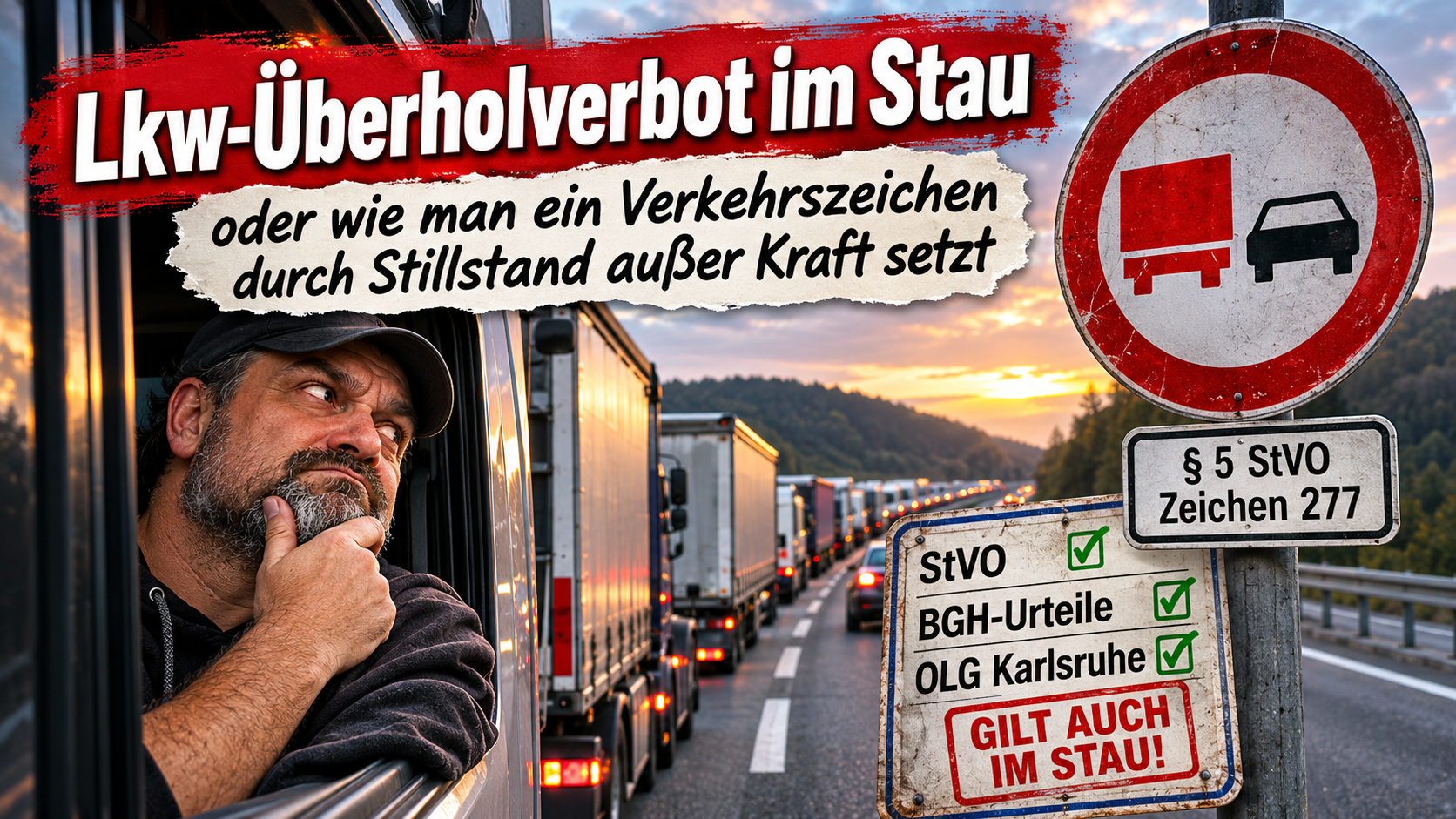
One of these interpretations regularly comes across me on social media: The prohibition on overtaking trucks would no longer apply in a traffic jam. After all, one cannot overtake a stationary vehicle, but merely drive past it.
It sounds logical at first. At least then, if one spares oneself the trouble of looking into the Road Traffic Regulations or even the relevant case law.
I also find the following statement particularly amusing in this context:
Overtaking ban in a traffic jam is nonsense.
Well, whether one considers an overtaking ban sensible or not is up to each individual. However, it becomes interesting when the legal invalidity of a traffic sign is derived from a personal assessment of it.
For according to this logic, we could save a significant part of the Road Traffic Regulations in the future.
A round piece of metal with two vehicles
The sign in question is traffic sign 277. A round sign with a red border, on which a red truck and a black car are depicted.
The official designation reads: Overtaking ban for motor vehicles over 3.5 t.
The matter is regulated in Annex 2 to § 41 para. 1 StVO, running number 54. Affected are motor vehicles with a permissible gross mass over 3.5 tonnes, including their trailers as well as tractors. Passenger cars and motor omnibuses are generally excluded.
The sign prohibits overtaking multi-lane motor vehicles and of motorcycles with sidecars.
What I could not find despite an intensive search is the addition:
This traffic sign loses its validity as soon as the vehicles to be overtaken have come to a standstill.
Perhaps this paragraph was forgotten during the last revision of the Road Traffic Regulations. Perhaps it is also in a special edition of the StVO, which is distributed exclusively via Facebook and various truck regulars’ gatherings.
In the publicly available version, it is not there anyway.
Instead, there is a quite clear regulation in § 5 Abs. 3 Nr. 2 StVO overtaking is not permissible if it is prohibited by an ordered traffic sign 276 or 277.
When does overtaking actually become passing by?
Here we come to the actual problem. Because in common usage, the distinction is quite understandable.
A vehicle is moving – I overtake it.
A vehicle is stopped – I drive past it.
However, the Road Traffic Regulations are not solely interested in whether the wheels of a vehicle are currently turning. Rather, it depends on why this vehicle is stopped and whether it continues to participate in the flow of traffic.
A vehicle waiting at a red traffic light continues to participate in the flow of traffic. Likewise, a vehicle that has come to a standstill due to traffic congestion.
A vehicle, however, that has actually been parked and thus temporarily withdrawn from the flow of traffic is not overtaken. One drives past this vehicle.
This is a significant difference.
If only the standstill of a vehicle were decisive, the legal assessment of an overtaking maneuver would have to change on a second-by-second basis in every stop-and-go traffic situation.
The truck next to me is rolling: I am overtaking.
The truck is stopped: I am driving past it.
The truck starts rolling again: I am overtaking.
That would certainly be an interesting occupation for our courts. Fortunately, they have already solved this problem much more in line with practice decades ago.
Eight hours of standing still – and yet still overtaking
Particularly interesting in this context is a decision by the Higher Regional Court of Karlsruhe from 20 May 2003, case number 2 Ss 216/01.
The underlying facts are likely familiar to many internationally active professional drivers.
On May 16, 2001, a lorry driver was traveling on the A5 towards Switzerland. Due to the Swiss night driving ban, the parking spaces in front of the border crossing were occupied. A backlog of trucks had formed on the right and middle lanes of the motorway.
The already ordered truck overtaking ban was indicated again by switched-on sign bridges.
The driver nevertheless used the left lane, drove past the waiting trucks and then pulled into the third lane.
On 11 October 2001, the local court imposed a fine of 200 DM (equivalent to 102.26 euros) for intentional overtaking in violation of the prohibition.
The driver was not satisfied with this. His legal complaint was still being handled by the Higher Regional Court of Karlsruhe in May 2003. Germany had meanwhile even changed its currency. The legal significance of the overtaking ban, however, had not changed.
His argumentation was indeed creative: The other trucks would have to wait up to eight hours due to the night driving ban. The drivers would use this time as rest time. Consequently, the vehicles could no longer be regarded as participants in the flowing traffic.
He therefore did not overtake, but merely drove past stationary or parked vehicles.
One must admit that his argumentation was significantly more extensive than a short Facebook comment.
However, it did not help him.
The Higher Regional Court of Karlsruhe rejected his appeal. The fine remained in place, and he had to bear the costs of the legal remedy as well.
The trucks were waiting due to traffic conditions and should have resumed their journey as soon as further travel was permitted again. The duration of this interruption changed nothing about that.
So if even eight hours of standing still are not enough to turn an overtaking maneuver into mere passing, it will be difficult to apply this argumentation successfully in the case of an ordinary ten-minute motorway traffic jam.
Three minutes standing – now we all park?
Another interesting regulation can be found in § 12 para. 2 StVO.
It says there:
Whoever leaves their vehicle or holds it for longer than three minutes is parking.
If one wants to be particularly creative, one might come up with the idea that after three minutes of standing still, all vehicles in a traffic jam automatically become parked vehicles.
In that case, a fully utilized motorway would be Germany’s longest parking lot after at most three minutes.
One could even consider whether a parking ticket is needed.
However, this interpretation also has a small flaw: the rules on stopping and parking refer to an intentional interruption of the journey. Waiting due to traffic conditions is not considered stopping within the meaning of these regulations.
The Higher Regional Court of Karlsruhe addressed this explicitly in its ruling as well.
Whoever has to stop because of a red light, a traffic jam, or a traffic-regulating instruction is waiting. They are not parking merely because a certain period of time has passed.
Here too, it is not the duration of the standstill that is decisive, but its cause.
But I haven’t changed lanes!
This argument is regularly encountered.
If one does not cut out and then re-enters, one could not have overtaken anyone.
Unfortunately, I must also disappoint hopes here.
The Federal Court of Justice already dealt with this question in 1974. In the decision with file number 4 StR 3/74, published in BGHSt 25, 293, it explains the concept of overtaking.
An overtaking operation does not necessarily require the driver to leave his lane and then re-enter it.
Whoever moves past another road user from behind to the front on an adjacent lane can also overtake.
The notion that an overtaking maneuver must necessarily consist of signaling, changing lanes, passing, and re-entering the lane may stem from driving school instruction. However, it is not suitable as a conclusive legal definition.
An overtaking prohibition is simply not a lane-change prohibition.
If that were the case, one could bypass every overtaking prohibition by changing to the left lane some hundred meters before the traffic sign and simply continuing to drive there.
The legislature did not make it that simple for us after all.
Overtaking also takes place at a red traffic light
On February 13, 1975, the Federal Court of Justice dealt with the issue again. Case number 4 StR 508/74, published in BGHSt 26, 73.
This time it was about the general overtaking ban after sign 276 and a line of vehicles waiting at a red traffic light.
The Federal Court of Justice found that passing such a line of vehicles within an overtaking ban zone can also constitute a prohibited overtaking maneuver.
The vehicles were stationary. Nevertheless, they were overtaken.
One could naturally object that a red traffic light is not a motorway traffic jam. That is true. However, what is decisive for the legal distinction between overtaking and passing is that the vehicles are waiting due to traffic conditions in both cases.
The Higher Regional Court of Karlsruhe relied, among other things, on this case law of the Federal Court of Justice in its later decision regarding the truck traffic jam.
We are therefore not talking about a new or particularly exotic legal view.
The fundamental case law on this matter has existed for more than half a century.
And what about § 7 StVO?
Whoever engages more intensively with the Road Traffic Regulations will possibly bring § 7 StVO into play.
Indeed, this paragraph contains special regulations for multi-lane carriageways and the formation of vehicle queues.
In case of corresponding traffic density, the rule of driving on the right may be deviated from. Under the provisions of § 7 para. 2, one may drive faster on the right than on the left. Para. 2a allows cautious overtaking of a stationary or slowly moving vehicle queue under certain conditions.
This is necessary because otherwise, in dense traffic on multi-lane roads, hardly any meaningful traffic flow would be possible.
However, one must distinguish two different things here: the general provisions on the use of lanes and a concrete overtaking ban ordered by traffic signs.
§ 7 StVO contains no general exception to sign 277.
In particular, no right can be derived from this to deliberately change lanes to the left to pass a queue of waiting trucks.
In special traffic situations, the specific case must of course be considered. Not every movement within parallel queues of rolling vehicles can be equated with the facts of the Karlsruhe court ruling without further consideration.
However, there is no general lifting of the truck overtaking ban upon the formation of a traffic jam.
Why an overtaking ban can be particularly sensible in a traffic jam
Regardless of the legal situation, we should ask ourselves once why an overtaking ban for trucks is ordered in certain traffic jam situations.
The example at the Swiss border is excellent for this purpose.
While the trucks were not allowed to proceed due to the night driving ban, other vehicles could still pass the border crossing.
If all the waiting trucks had been distributed across all three lanes, it would have eventually been over for these vehicles as well.
The Higher Regional Court of Karlsruhe explicitly addressed this purpose of the overtaking ban.
A similar phenomenon can regularly be observed on German autobahns as well.
Roadworks, a reduction in the number of lanes, or an accident lead to a traffic jam. A driver discovers that it seems to be moving faster on the adjacent lane. Others follow his example. A few hundred meters further, all vehicles have to merge back into their respective lanes again.
Often, no one gains anything from this.
In the worst case, additional lanes are blocked, necessary lane changes are made more difficult, and the flow of traffic is further impaired.
Of course, this does not mean that every truck overtaking ban on every German autobahn was sensibly ordered. I also know from my professional daily life enough stretches where I wonder what considerations the competent road traffic authority was based on.
But my personal assessment does not replace a road traffic order.
Who actually decides whether a traffic sign is sensible?
You may criticize a traffic sign. You may question its necessity. Under certain circumstances, you can even take legal action against the corresponding traffic regulation.
What you may not simply do, however, is unilaterally ignore a valid traffic sign because you personally consider it superfluous.
The Higher Regional Court of Karlsruhe also addressed this in its decision.
The affected driver additionally argued that the competent traffic authority should have reacted differently to the situation. For example, instead of an overtaking ban, it could have closed certain lanes for heavy goods vehicles.
This argument also proved unsuccessful.
The question of whether another traffic regulation might have been more appropriate did not change the obligation to observe the existing overtaking ban.
And that is also good.
Otherwise, in the future, upon every encounter with a traffic sign, one would first have to take into account the respective driver’s personal legal opinion.
One considers a speed limit of 80 to be superfluous because their vehicle is also safe at 90 km/h. The next person considers a prohibition on passing through to be nonsensical because their navigation device recommends a different route. And the third person declares the prohibition on passing for trucks to be lifted because no one is driving right now.
We could say goodbye to a uniform road traffic regulation.
When does a prohibition on passing for trucks actually end?
Regulations have been provided for this purpose as well.
Sign 281 marks the end of the prohibition on passing for motor vehicles over 3.5 tonnes. Sign 282 lifts all speed limits and prohibitions on passing applicable to a specific stretch of road.
In addition, a prohibition on passing can be limited, for example, by an expressly specified length of stretch or, under certain conditions, by the visible end of a danger associated with the prohibition. The concrete duration of validity of a variable traffic sign display must also be taken into account.
The formation of a traffic jam is not found, however, as a general ground for lifting in the road traffic regulation.
I have certainly not yet seen a sign 281 that automatically rises from the road gutter as soon as the first truck comes to a standstill.
Professional drivers and professional expertise
What increasingly occupies me in such discussions is less the individual incorrect statement than rather the matter-of-factness with which it is partially disseminated.
No one can memorize all provisions of the Road Traffic Regulations, all European regulations, and the associated case law.
I also have to read things up regularly. And occasionally I find that my previous assumption was wrong or that a provision has since been changed.
That belongs to the job.
However, I expect a professional driver to be at least willing to engage with the provisions relevant to his profession.
Especially when one publicly explains to other drivers which behaviour is allegedly permissible.
For the person who relies on such a comment and subsequently pays a fine will presumably have little to say to the police that someone on Facebook assured him that a prohibition on overtaking in traffic jams is nonsense.
Facebook comments are, to my knowledge, not yet a recognized source of law.
Conclusion
One can discuss whether a truck overtaking ban at a specific location is sensible. One can also discuss whether it should be time-limited or whether traffic-dependent signage would be the better solution.
These are legitimate discussions.
The claim that a truck overtaking ban loses its validity solely due to the formation of a traffic jam cannot be derived from either the Road Traffic Regulations or the case law available on this matter.
A vehicle stopped due to traffic conditions is not automatically removed from the flow of traffic. Anyone driving past such vehicles from behind to the front can overtake them even if their wheels are not turning.
The Higher Regional Court of Karlsruhe even decided a case in this regard where the affected trucks had to wait up to eight hours for their journey to continue.
200 DM and the costs of a legal remedy were the price for this insight at the time.
Today you can acquire the same insight for free.
You just have to be willing to read a few pages.