

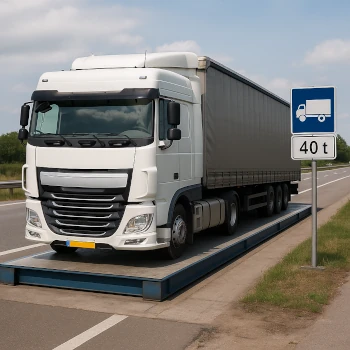
Invisible Control Traps on German Autobahns: Truck Weight Control 2026
Starting in the year 2026, innovative, invisible control systems for truck weight checks will be put into operation on German autobahns. These powder-coated “invisible traps” are installed flush with the asphalt as fully automatic weighing bars and measure the weight of trucks while they are driving, without requiring them to stop. The goal is to identify overloaded vehicles early, increase road safety, and protect the heavily stressed autobahn infrastructure.
Background and Motivation
Trucks traveling overloaded pose a significant safety risk: they have longer braking distances, are harder to steer, excessively stress tires and axles, and endanger particularly dilapidated bridges through faster material fatigue. In 2024, the Federal Office for Logistics and Mobility (BALM) inspected over 146,000 trucks, of which more than 16,000 were significantly overloaded – often by several tons 1 2.
Technology of Invisible Control Systems
The core of the new control technology consists of so-called “Weigh-in-Motion” (WIM) systems. These consist of piezoelectric sensor bars integrated into the roadway that generate electrical impulses when crossed, with their strength proportional to the vehicle weight. Thus, the weight of trucks can be recorded in real time without stopping or delays in traffic flow.
If an exceedance of the permissible total weight is detected, an LED display board appears a few hundred meters further ahead, showing the license plate of the overloaded vehicle and instructing the driver to stop at the next rest area 1 3.
Process of Controlled Weight Measurement
At the indicated rest area, specially designated special lanes are available. Here there are calibrated control scales consisting of a static and a dynamic scale. The second, more precise weight check verifies the preliminary measurement results.
If the overload is confirmed, fines ranging from 30 to 452 euros may be imposed. In case of an exceedance of more than five percent, unloading the excess cargo on site is mandatory before further travel is permitted. For this purpose, additional parking areas are created at the rest areas to solve the problem on site 3 4 5.
Pilot Project and Outlook
The first of these modern weight control stations is currently being built in North Rhine-Westphalia on the A4 autobahn between Aachen and Cologne near the Rur-Scholle-Süd rest area. There, around 500 vehicles are to be checked daily starting in spring 2026.
By 2028, an expansion to a total of 16 such control stations across the entire federal territory is planned. The locations are strategically chosen to optimally cover main axes of freight transport, for example near large container ports and logistics hubs 4 5.
Benefits for Traffic and Environment
Automatic weight checks enable early detection of overloaded trucks and thus reduce the risk of accidents. In addition, they help relieve road infrastructure and extend its lifespan. Environmental protection also benefits, as overloaded vehicles consume more fuel and thereby cause higher emissions 4 5.
Conclusion
With the concealed control systems for truck weight control on German autobahns, a significant step towards improving traffic safety, infrastructure, and the environment is being made. Vehicles are monitored in real time, and violations are effectively sanctioned. For truck drivers, this means a new era of surveillance that is precise and efficient at the same time.
Sources
CHIP: Unsichtbare Fallen auf deutschen Autobahnen: 2026 starten die Messungen (2025-09-23) ↩︎ ↩︎
Auto Motor und Sport: 16 secret fine traps on German autobahns (2025-06-05) ↩︎ ↩︎
Autobahn GmbH & BALM: Pilot project for truck weight control on the A4 (2025-05-06) ↩︎ ↩︎ ↩︎
Deutschlandfunk: First digital weight control for trucks on the A4 (2025-07-13) ↩︎ ↩︎ ↩︎
