

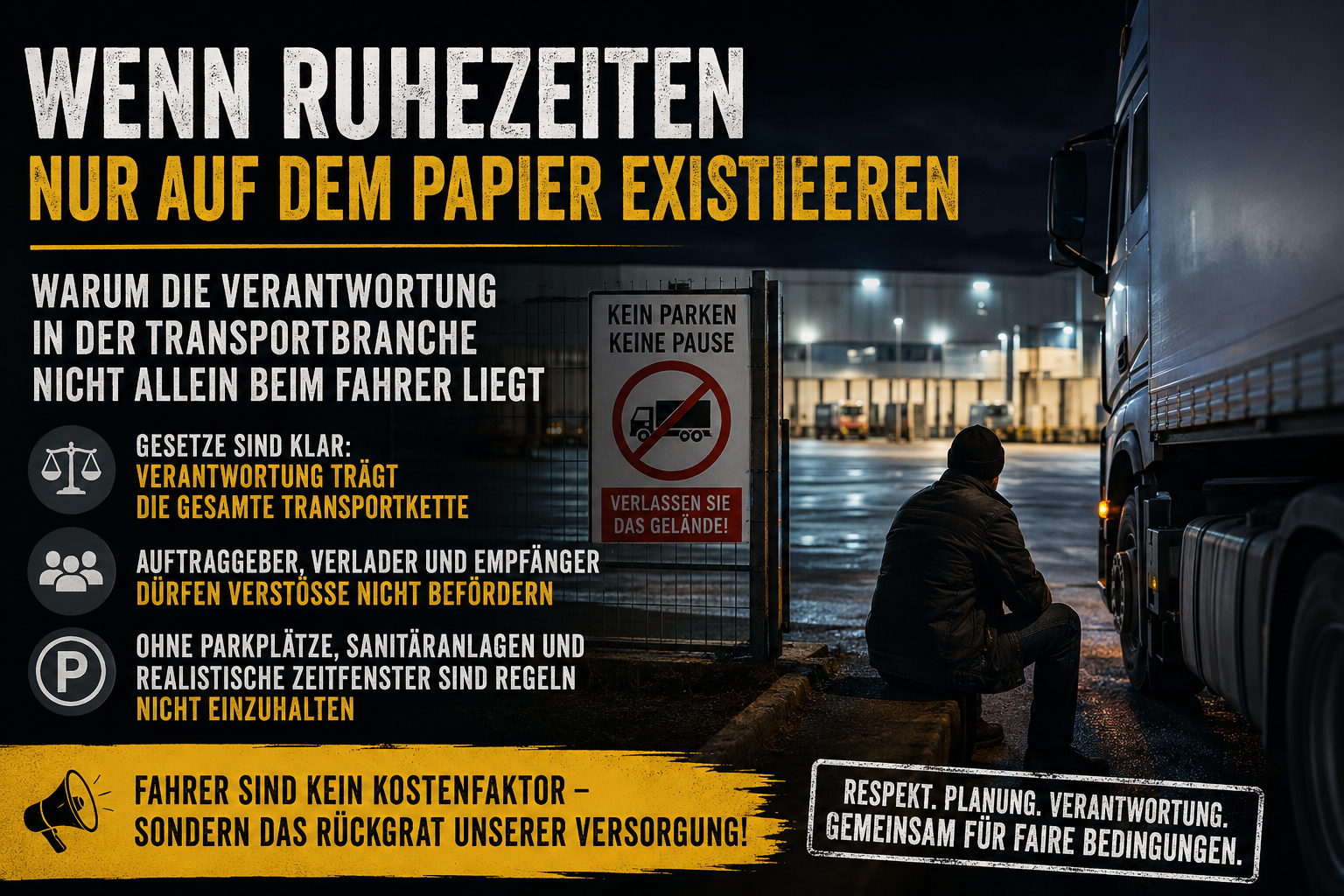
Again and again, one reads reports about truck drivers who are sent to company premises at night, even though they need to unload there the next morning. Often, there is a lack of parking spaces, sanitary facilities, or even possibilities to properly observe the legally mandated rest periods.
The public discussion usually follows almost the same pattern: The driver is supposed to comply with the regulations. Period.
Yet legally and practically, it is not that simple.
Because the responsibility for complying with driving and rest periods does not solely lie with the driver himself.
The EU Regulation (EG) No. 561/2006 explicitly obliges other participants in the transport chain to design work processes and schedules in such a way that the legal regulations can actually be followed.
In Article 10 of the Regulation, the following are named among others:
- Transport companies
- Freight forwarders
- Shippers
- Tour operators
- Main contractors
- Subcontractors
- Driver recruitment agencies
It states among other things:
„Companies, shippers, freight forwarders, tour operators, main contractors, subcontractors and driver recruitment agencies ensure that agreed transportation schedules do not violate this Regulation.“
— Article 10, paragraph 4, Regulation (EG) No. 561/2006
The responsibility therefore does not automatically end at the gate or at the driver’s cab. Although the driver remains obliged to comply with the regulations, companies and employers may not create conditions that actually encourage or provoke violations of driving and rest periods.
Of course, companies can cite safety, liability or insurance reasons as to why overnight stays on company premises are not allowed. As private premises, logistics sites can generally set their own rules.
The question, however, is whether this fully discharges the responsibility.
Because at the same time, the Regulation also obliges other participants in the transport chain to organize processes in such a way that drivers can realistically observe their legal rest periods.
This has been a structural problem in the industry for years: Truck parking spaces are heavily overloaded in many places. Anyone driving at night knows that free parking spaces are often hard to find.
When drivers arrive at a fixed unloading time in the early morning, but are not allowed to park on the premises and no practical alternatives are available, a contradiction arises between theory and practice.
The statement „find another parking spot“ sounds simple on paper — in reality, it often means additional stress, time pressure and the risk of not finding any legal parking spot at all.
The problem is therefore not only with the driver, but also with the conditions of the entire logistics chain.
This sounds clear at first. However, the daily reality for many drivers is different. Because the real problem is: the responsibility is passed down to the bottom.
A typical example:
A driver arrives in the evening at a logistics center. The unloading time is the next morning at 7 a.m. It would be logical to spend the night there, observe the rest period and unload on time in the morning.
Instead, it is often said: „You are not allowed to park here. Go away and find a spot elsewhere.“
The problem here is: Legal truck parking spaces are heavily overloaded in many places. Anyone driving at night knows that free parking spaces are often a matter of luck.
The result:
- additional stress
- unnecessary trips during rest periods
- time pressure
- and partly situations in which drivers are actually forced to improvise
Officially, the driver still bears the responsibility. In practice, however, the conditions are often created by decisions made by other participants.
The driver shortage does not come out of nowhere
Politics and business have been talking about the „driver shortage“ for years. At the same time, the working conditions for many drivers are becoming increasingly unattractive.
These include:
- unpaid waiting times
- lack of sanitary facilities
- lack of appreciation
- constant time pressure
- parking shortages and partly conditions that have little to do with normal working life
The politics know these points. I have reported here that under the leadership of the now deceased Udo Schiefner, a round table „Transport & Logistics“ took place, where four meetings were held on the driver shortage. There, drivers were heard who precisely described the problems that have been burdening many in the industry for years.
I cannot be at my customer at 7 a.m. in the morning if I have to look for a parking spot at 10 p.m. in the evening, because I am not allowed to stop at the customer, even though the spot is available.
Added to this is a point that many outsiders are not aware of: In the central warehouses of discounters, drivers sometimes unload their goods themselves, sort pallets or fulfill additional requirements on-site — even though they are actually drivers and not warehouse workers.
Do not misunderstand: I have no problem with the unloading of goods. However, I do have a problem with these additional tasks. For me as a driver, the end must be immediately behind the ramp:
- No removing of film
- No storing in high shelves
- No sorting by product content
Of course, there are also companies that treat drivers reasonably. However, the problem is structural and affects large parts of the industry.
Legal responsibility does not end at the gate
Of course, a company may set rules for its private premises. Nobody can generally demand that one can stay overnight everywhere.
Nevertheless, the question remains: How realistic is the compliance with all regulations, when at the same time the necessary infrastructure is missing?
Exactly at this point begins the responsibility of the entire transport chain.
Anyone who sets fixed time windows, plans night deliveries, or causes long waiting times cannot fully absolve themselves from responsibility if drivers are thereby put under pressure.
Because laws on paper help little when reality stands in the way of their compliance. The industry needs no Sunday speeches, but better conditions.
As long as drivers are primarily seen as a cost factor, little will change regarding the problem.
One cannot simultaneously:
- demand ever faster deliveries,
- maximize every process,
- save on infrastructure,
- send drivers to the site at night,
- and then be surprised by a lack of young drivers.
Road freight transport is one of the most important components of modern supply chains. Without drivers, warehouses remain empty, supermarkets remain unsupplied, and production comes to a standstill.
Perhaps this would be exactly the right moment to finally show the people behind the wheel a bit more respect.
