

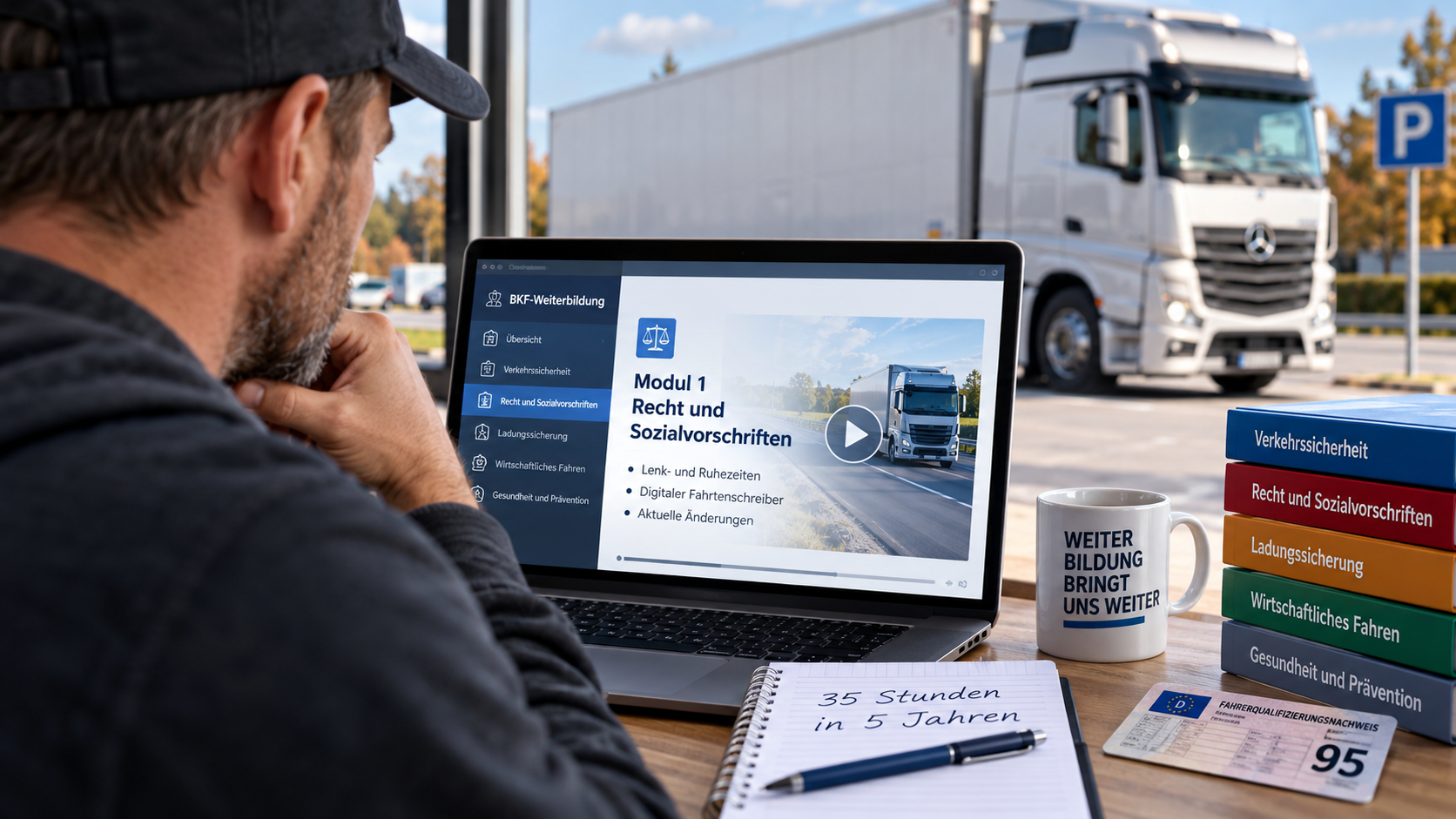
35 hours of further training every five years are part of the daily routine for professional drivers. In the future, up to twelve of these hours could be completed digitally. The legal basis for this has been in place since February 2026. However, an important step remains between the political decision and practical implementation. At the same time, drivers are being asked how they would like to learn in the future.
Anyone who commercially drives a truck or bus and falls under the Professional Driver Qualification Act knows the procedure: Within five years, a total of 35 hours of further training must be completed. Many drivers attend five one-day courses at an accredited training institution for this purpose.
This will not change initially regarding the scope. What is new is the possibility to design parts of the further training digitally in the future. Instead of having to sit in the training room personally for every topic, drivers could work on certain content online or participate in digital lessons.
What at first sounds like a simple modernization raises questions, however. Which contents are suitable for digital learning? How will participation be controlled? And do drivers actually benefit from more flexibility?
The legal basis has already been decided
On December 18, 2025, the German Bundestag passed amendments to the Professional Driver Qualification Act. The Bundesrat agreed on January 30, 2026. The corresponding amendment act was published in the Federal Law Gazette on February 5, 2026, and came into force on February 6.
An important component concerns digital further training. The Professional Driver Qualification Register will be able to record information about digital instruction in the future. In doing so, the legislator distinguishes between synchronous and asynchronous forms of instruction.
Synchronous means that participants attend the lesson together at a fixed time, for example via video conference with an instructor.
Asynchronous means that learning content can be worked on independently of time. Digital learning modules with videos, explanations, and tasks are conceivable.
Important: The passed amendments do not yet mean that professional drivers can already credit any online courses to their prescribed further training hours.
The specific requirements for implementation, recognition, and control must be regulated accordingly.
Sources:
Where does the limit of twelve hours come from?
The possibility of digital further training goes back to European regulations.
Directive (EU) 2022/2561 stipulates in Annex I, Section 4 that at most twelve of the total 35 further training hours may be conducted as e-learning.
However, the European provisions contain not only this time limit but also require that the quality of instruction be maintained. Training institutions must select suitable instructional content. In addition, reliable identification of participants and appropriate control measures are provided for.
The European legislator thus makes it clear that digital learning must not simply mean playing a training film and subsequently confirming participation.
Further training should convey knowledge that is actually needed for professional work.
Source: Directive (EU) 2022/2561 – EUR-Lex
What actually applies at the end of October 2026?
The current Professional Driver Qualification Ordinance was last amended by an ordinance dated August 12, 2026, which was published on August 17.
In § 4 BKrFQV, it remains at 35 instructional units in instructional units of at least seven instructional units each. The provision does not yet contain a general approval for twelve hours of e-learning in its current version.
The SVG also points out in its publication dated October 19, 2026, that the concrete start of the new online offerings is still open.
For drivers, this means: Anyone currently planning their further training should not rely solely on advertising statements about digital modules. What matters is whether a training course is recognized according to current regulations and properly recorded in the Professional Driver Qualification Register.
Sources:
Further training should be more than an attendance check
The mandatory further training pursues several goals. These include, in particular, road safety, health protection, economical driving, and the updating of professional knowledge.
The BKrFQV explicitly requires that the prescribed areas of knowledge be deepened and refreshed.
Nevertheless, participation in further training is not equivalent to a renewed theoretical or practical driver test. What matters fundamentally is proper participation in recognized training courses.
This leads to a fundamental question: How can it be determined whether the conveyed knowledge actually takes root in professional daily life?
Digitalization alone does not answer this question.
Poor face-to-face instruction will not become better simply because the same slides appear on a screen in the future. Conversely, a carefully developed digital learning offering can certainly offer advantages.
Which contents are suitable for online instruction?
Not all topics of professional driver further training require the same form of instruction.
Changes to legal regulations can be explained, for example, via digital learning programs. These include new regulations on driving and rest periods, changes in social law, or requirements for the use of the digital tachograph.
Basic principles of new vehicle technologies can also be taught partially online. A learning module could, for example, explain the functioning of regenerative braking, assistance systems, or high-voltage systems in electrically powered commercial vehicles.
The situation is different with practical exercises.
Anyone who needs to secure a load correctly must not only know which forces can occur; they should also be proficient in handling securing devices, anchorage points, and specific loading situations.
Similar requirements apply to certain safety exercises and driving training.
Therefore, a sensible approach would be a combination: teach theory digitally where it is professionally appropriate, and continue to link practical topics with actual exercises.
Taking Professional Differences More Seriously
Another point is the different nature of drivers’ work.
A professional driver in scheduled bus service has different daily requirements than someone who performs international transport with a tractor-trailer.
Tasks also differ significantly within freight transport.
In timber transport, securing irregular loads, behavior on forest roads, and safe handling of loading cranes play a role. Drivers in temperature-controlled transport must instead deal with the cold chain and technical requirements for transport equipment.
The European directive already requires that further training should address the specific needs of the driver and the types of transport they perform.
The regulations thus provide an approach for more occupation-specific training. Whether this is actually utilized in teaching depends largely on the training offerings and their implementation.
The Quality of Training Institutions Also Belongs to the Discussion
When it comes to digitalization, the advantages for participants are often in the foreground. However, the requirements for trainers should not be overlooked.
According to § 7 BKrFQV, trainers must regularly refresh their knowledge. At least 24 instructional units are prescribed within a training course that must be completed at least once every four years.
Digital teaching formats create additional requirements.
A lecturer teaching a group in a training room does not automatically need the same skills as someone who designs an interactive online course.
Digital further training must be understandable, professionally up-to-date, and structured in a verifiable manner. This also includes ensuring that learners can ask questions and receive support in case of technical problems.
Otherwise, there is a risk that only the teaching format changes without improving the quality of further training.
Source: § 7 BKrFQV – Training for Trainers
What Does Digitalization Mean for Drivers and Freight Forwarders?
Digital further training could bring organizational advantages.
Drivers might no longer need to travel to a distant training facility for suitable theoretical courses. For freight forwarders, new opportunities could arise to plan training better.
However, new questions also need to be clarified.
It must be ensured that participation takes place during suitable times and is handled in accordance with labor law. Mandatory professional further training must not become a private leisure activity solely because it can technically be done from home.
Data protection is equally important. If digital learning systems control the identity of participants and document learning activities, it must be clear which data are collected, who has access to them, and how long they are stored.
Therefore, the new teaching format should not only be practical for training institutions and employers but also consider the legitimate interests of drivers.
SVG Academy Asks Drivers About Their Wishes
In line with the ongoing reform, the SVG Academy published a survey on October 19, 2026.
The survey is being conducted by Anna Zimmermann, Product Manager E-Learning at the SVG Academy, as part of her master’s thesis.
It examines the wishes and expectations of professional drivers regarding future further training.
This includes, among other things, the question of whether drivers prefer to participate in online instruction with a lecturer, learn independently on a computer, or continue to prefer classic face-to-face instruction.
Participation is voluntary and anonymous. According to SVG, answering takes about 10 to 15 minutes. The survey is available in eleven languages.
The survey is still running until November 30, 2026.
Anyone who wants to support the development of further training with their experience from professional daily life can participate.
Take the survey via the SVG website
Contextualization: What Matters Is Not the Screen, but the Content
The following section is an editorial assessment.
The introduction of digital learning opportunities can be a sensible development of professional driver further training. Especially with theoretical content, modern learning programs could make teaching more flexible.
However, it should not be implied that twelve possible online hours would already constitute a comprehensive reform.
The central challenge remains the quality of further training.
Professional drivers work with vehicles whose technology is changing. New drive systems, digital tachographs, and additional assistance systems bring new requirements with them. At the same time, classic topics such as load securing, accident prevention, and health protection remain important.
A modern continuing education program should regularly address these developments and give greater consideration to the knowledge actually required for each specific task.
Additionally, practical skills could be taught more frequently through concrete tasks rather than solely repeating theoretical content.
Continuing education should not be organized as an additional burden. It is part of professional qualification and accordingly requires time, suitable framework conditions, and qualified trainers.
Conclusion: The Reform Offers an Opportunity
The legal basis for digital teaching formats has been established. The European framework allows up to twelve hours of e-learning. However, how this possibility will be practically and legally implemented in Germany has not yet been fully clarified.
For professional drivers, this means that initially less changes than some announcements might suggest.
The real opportunity lies in modernizing continuing education overall: with appropriate learning formats, up-to-date content, and greater consideration of professional practice.
Whether this actually leads to improvement will only become apparent upon concrete implementation.
Until then, professional drivers can at least do one thing: contribute their experiences and expectations to the discussion.
The current survey by the SVG Academy offers an opportunity for this.
Sources and Further Information
- Professional Driver Qualification Act (BKrFQG)
- Professional Driver Qualification Ordinance (BKrFQV)
- EU Directive 2022/2561
- German Bundestag: E-Learning Regulations Adopted
- Federal Ministry of Transport: Amendment to BKrFQV 2026
- SVG Academy: Survey on Future Continuing Education
Research and legal status: October 31, 2026.